sn83035487 1852-05-22 ed-1: segmentation, region by region
LoC issue · American Stories revision 77e27fa6
Same LoC scan for 4 of 4 pages.
4 American Stories boxes lie inside another of its boxes (p. 2: #1 inside #9; p. 2: #24 inside #10; p. 3: #12 inside #20; p. 3: #46 inside #1). Nothing in AS's data marks or explains it: its layout detection boxed the same print twice (a column and an item in it, say) and both were OCR'd and published as articles. We compare every AS article as published; where both copies fall inside one of our components, the shorter is set aside and counted once as text AS has twice, not as another article.
Scorecard
Each comparison starts from a snewpapers component. "=" means both systems drew the same article. Where they differ, a language model, shown only the text, was asked which is right, twice, with the two claims stated in each order.
Where the two segmentations agree or differ
| times | snewpapers right | AS right | neither | unsure | page furniture, not counted | |
|---|---|---|---|---|---|---|
| Same article on both sides (=) | 34 | – | – | – | – | – |
| One snewpapers component, several AS articles (1 : N) | 10 | 10 | 0 | 0 | 0 | – |
| Several snewpapers components, one AS article (N : 1) | 1 | 1 | 0 | 0 | 0 | – |
| One snewpapers component, one AS article running on into other text | 0 | 0 | 0 | – | 0 | 0 |
| AS text attached outside a snewpapers component | 7 | 1 | 0 | – | 0 | 6 |
| A line of a snewpapers component in another AS article | 2 | 1 | 0 | – | 0 | 1 |
Where only one side has text
| times | |
|---|---|
| snewpapers component, AS has no text, no AS box there (an AS error) | 1 |
| snewpapers component, AS has no text, AS marked it illegible (an AS error) | 0 |
| snewpapers component, AS has text for under 90% of it, the rest in no AS box (an AS error) | 0 |
| snewpapers component, AS has text for under 90% of it, the rest marked illegible (an AS error) | 0 |
| AS text in no snewpapers component: ads, terms or page furniture (left out on purpose) | 15 |
| … of which ads (AS says it leaves ads out) | 12 |
| AS text in no snewpapers component: other content snewpapers does not serve | 2 |
| AS text in no snewpapers component: too short to ask | 1 |
| AS boxes in no snewpapers component with no text at all (AS read nothing) | 1 |
| AS text in no snewpapers component: no verdict | 0 |
What the decisions judged
| judged wrong | judged right | |
|---|---|---|
| American Stories articles | 26 | 0 |
| snewpapers components | 0 | 22 |
American Stories errors found
| errors | decisions | |
|---|---|---|
| items of ours AS merged into one article | 13 | 1 |
| fragment articles AS split our components into | 26 | 10 |
| lines of ours AS put in another article | 1 | 1 |
| AS articles running on into other items | 0 | 0 |
| AS articles missing part of a component (under 90%) | 0 | – |
| our components AS has no text for | 1 | – |
| pages of our components AS lacks the text for | 0 | – |
| text AS has twice | 2 | – |
| ads AS kept (it says it leaves ads out) | 12 | – |
| AS boxes it marked illegible that snewpapers read | 0 | – |
Text quality: words found in an English word list
| real words | words | share | |
|---|---|---|---|
| snewpapers | 17,110 | 17,146 | 99.8% |
| American Stories | 16,165 | 17,084 | 94.6% |
| American Stories boxed area it marked illegible and did not read | – | – | 0.5% |
How this was scored
Every comparison is anchored on a snewpapers component and the American Stories boxes inside it. Where those boxes belong to several AS articles (or several of our components lie inside one AS article), the model was shown the passage as the numbered pieces and asked whether it is one component, several or mixed, twice, with the two beliefs stated, unattributed, in each order. A verdict that changed with the order is unstable and counts for neither side. AS text inside none of our components was asked whether it is advertisements, terms or page furniture, which snewpapers leaves out on purpose. Where AS attaches text outside one of our components (text of an AS article our component otherwise has), the model was shown our component's text and the attached text and asked whether the text belongs to the component, twice, the two beliefs stated in each order: "separate" means snewpapers is right, "belongs" American Stories. Where two AS articles inside one of our components hold the same text (the shorter sharing at least 50% of its 4-word phrases with the longer), the longer is kept and the text counted as duplicated by American Stories; so is attached text another AS article also holds. Where American Stories has a line or two of our component (at most 12 words and 5% of its area) in another AS article while one article holds the rest, the line is no split: the model was shown the rest of the AS text and the line and asked whether the line belongs to the component, both ways; "belongs" means snewpapers is right and judges only the article holding the line wrong (lines in another AS article). One AS article counts as a match only when the two cover each other, both ways: AS text covers at least 90% of our component, and our component at least 90% of that AS article's text. Coverage is measured line by line down each column (how much of its height the other side's boxes span, so a centred headline narrower than its column still counts). Under 90% the first way, the component is partly captured by AS (the rest in no AS box, or marked illegible): not asked, an AS error by the geometry, its AS article judged wrong (AS articles missing part of ours). Under 90% the second way, the AS article runs on beyond our component into other text: that text is asked about as text attached outside, and "separate" judges the AS article wrong (AS articles running on into other items). Decisions are the unit counted above; the last table counts what they judged: an as_split decided "one" is one decision and every AS article inside our component judged wrong, an N ours : 1 AS decided "several" one decision and each of our N components judged right (an article or component judged both ways by different decisions counts in both rows). AS errors count what the decisions for snewpapers found American Stories got wrong, next to those decisions: an N ours : 1 AS is N errors, the N items of ours AS failed to separate (items AS merged), a 1 ours : N AS N errors, the N AS fragment articles. A component inside an N ours : 1 AS (its AS text a slice of the merged article) is counted in the components table by that decision's outcome. A component running over pages is one comparison across them (American Stories never links an article across pages): its AS articles on all its pages, labelled by page, are the pieces asked about, once; it counts once among our components, and a decision for snewpapers judges every one of those AS articles wrong, each a fragment article.
| groups | 78 |
|---|---|
| 1:1 match | 34 |
| 1 ours : N AS | 10 |
| N ours : 1 AS | 1 |
| in N ours : 1 AS | 12 |
| continued | 1 |
| ours only | 1 |
| AS only | 17 |
| AS only, tiny | 1 |
| AS only, no text | 1 |
| 1:1, AS partial | 0 |
| 1:1, AS article wider | 0 |
| snewpapers covered by AS (area) | 95.6% |
| AS covered by ours (area) | 88.4% |
| median text ratio over matches | 97.0 |
| AS duplicated text | 2 |
| AS text attached outside ours | 7 |
How to read this
Each group is the same crop of the scan twice: snewpapers' boxes on the left, American Stories' on the right. The group's own boxes are outlined in red. Groups are in page position order (column by column), not reading order. A component can appear twice: in its own case and in an N ours : 1 AS group. Text of a component's own AS articles printed outside the component is left out of the comparison and shown beneath the group as "American Stories also attaches: «…» (outside this component)".
| 1:1 match | the AS text inside our component (boxes, or the slices of boxes it overlaps) all belongs to one AS article (or to several that duplicate one another: American Stories duplicated the text) |
|---|---|
| 1 ours : N AS | the AS text inside our component belongs to several AS articles: one component or several? |
| N ours : 1 AS | two or more of our components lie inside one AS article (80% or more of each, or 50% or more with a slice of the article): one component or several? |
| in N ours : 1 AS | all the AS text inside our component is a slice of an AS article that holds other components of ours too: no agreement (the slice is cut along our boundaries, not AS's); decided by that N ours : 1 AS |
| continued | a later page of a component of ours running over pages: compared, asked and decided once, across its pages, in the group on its first page |
| ours only | no AS box overlaps our component enough to give it a slice: not captured by American Stories |
| AS only | AS text inside none of our components (one AS article's): left out on purpose, or missed? |
| AS only, tiny | AS text inside none of our components, under 20 characters: not asked |
| AS only, no text | an AS article inside none of our components with no text at all (AS boxed it but read nothing, most often marking it illegible): nothing to ask, counted for neither side |
| 1:1, AS partial | the AS text inside our component all belongs to one AS article, but AS has text for under 90% of our component, measured line by line (the rest is in no AS box, or AS marked it illegible): partly captured by American Stories, not asked; its AS article counts as an AS error |
| 1:1, AS article wider | one AS article holds our component, but runs on beyond it into other text (our component covers under 90% of the article's text, measured line by line): the text it runs into is asked about, and decides it |
snewpapers:newsopinionnoticescommercepeopleliterarylistingsother
American Stories:articleheadlineauthor
only in snewpapersonly in American Stories(words compared lowercase, without punctuation)
Page 1
AS onlycorrectly not servedAS #7 p1-1
- subscription terms or colophon: This text gives the newspaper's title/masthead along with subscription terms ('Terms: $... per annum') and instructions for correspondence, i.e. subscription terms/colophon material rather than a discrete advertisement or article.
American Stories
THE ANTI.SLAVERY BUGLE,Published every Saturday, at salem, Col. Co., {
P"5IsFed every saturday, at Salem, Cot. Co., o,
TRRNs.-$ 80 per annum If paid in advance.
Sl,75 per annum If paid within the first six months of the subscribers year.
$500 per annum, if payment be delayed beyond six months.
WWe occasionally send numbers to those who are not subscribers, but who arc believed to be interested in the dissemination of anti-sa- very truth, with the hope that they will either subscribe themselves. or use their influence to extendits circulation among their friends.
decentralization intended for insertion. to be addressed to MARtus Il. RoBNsoN, Editor, AL others to ENLY RoBrNsoN, Publishing Ag't.
1 ours : N ASsnewpapers rightstory ↔ AS #8, AS #1 p1-2 AS attaches text outside it
- stated first: several components (American Stories): snewpapers right (said one): Piece [2] is the continuation of the sermon begun in [1], running on mid-sentence from 'all can' to 'here see at a glance,' so the whole passage is a single article.
- stated first: one component (snewpapers): snewpapers right (said one): The two pieces are a continuous sermon report; [1] ends mid-sentence and [2] picks up the same sentence, so they form a single article.
American Stories also attaches: «T HE B U G L E i.» (outside this component; AS article #8) page furniture, not counted
- stated first: the component does not include it (snewpapers): page furniture, not counted (said furniture): This is the newspaper's masthead/title, page furniture that should not decide which segmentation system is correct.
- stated first: the component includes it (American Stories): page furniture, not counted (said furniture): This is a small masthead/fragment line ('The Bugle'), i.e., page furniture, not part of the article.
snewpapers
From the N. Y. Tribune.The Duty of Society to Criminals and Discharged Convicts.
Rev. Mr. Storms, of Brooklyn, delivered a very eloquent sermon upon the above subject, on Sunday, at the Church of the Messiah, Broadway, before a numerous congregation. The Rev. gentleman took for his text the last clause of the 36th verse, 25th chapter of Matthew—"I was in prison and ye came unto me." He commenced by taking a general view of the duty of Christians to those who have deviated from the paths of rectitude and virtue. There are two great principles of the Christian character,—the first to feed the mind with the doctrines of Christ; the second to give food and clothing and comfort where they are needed. This is true Christian charity. It is to save: the same sublime virtue which is expressed by Christ in his mission. By the careful labor of Christian men, Asylums have been established, Retreats and Institutions have been formed, which have exerted the most beneficial influences upon mankind. Christianity can point to what Infidelity or Paganism cannot show.—Asylums are her trophies—her field is the world, which is emblazoned on her banners.
The first class of criminals, said the speaker, are those who have been entrapped by older villains. There are such persons in all our prisons. The second class is larger in number: those who have been trained in vice from their youth, and who have had no education but in sin. Those are generally trained in cities or in the outskirts of large towns. The child is thus made familiar with sin, and its only thought is to hide it. It is therefore not wonderful that they pursue a sinful course, and become the inmates of prisons. There is not one of those but who might walk the earth as a useful member of society, had he received proper training. In such souls there is always occasion for courage and hope. The worst and smallest class are those who have had examples of parental piety, but who are, notwithstanding, depraved. Of such men, doubtless, there is small hope; although some even of them have been saved against hope; and they may be reclaimed.—They are like us, with human hearts, susceptible of being impressed with sentiments of Christianity.
It is clear that criminals cannot be relieved from punishment, when that punishment is just; but when the conviction is illegal, it becomes society to exert its influence in this behalf; and where the law under which they have been convicted is unjust, it is obligatory on Christianity to urge its repeal; but a just law conserves and advances the interests of society. It is intended to educate the criminal, and the carefullest vigilance should be exercised in the appointment of those having charge of those unfortunates. The speaker alluded to sympathy for the criminal in consequence of the pain he was sentenced to undergo for real crime, as pernicious and exerting a bad influence; and in substantiation, adverted to the Apostle Paul, who says: "If I have been an offender and deserve death, I refuse not to die." Our efforts should be to save criminals, morally. The deposit of power, continued the speaker, is always dangerous in the hands it is placed in; and in this connection he urged the necessity of appointing men as jailors whose example and influence would tend to reform those over whom he exercises the authority of master. This functionary stands before the prisoner as a sort of representative of the society he has left behind. If cruel, he engenders a spirit of revenge, and still keeps him a criminal in feeling. If imbued with Christianity, the influence he exerts will be for the benefit of the criminal. It is, therefore, the duty of society to see that proper men, regardless of political considerations, are selected for these stations. By adopting this course, the first step in the way of reformation will be gained.
The second point dwelt on by the speaker was proximity to crime. A criminal, he continued, put in conjunction with an old offender, will tend to augment his appetite for crime. He becomes saturated with evil which it is hard or even impossible to eradicate. Solitary confinement for long terms, with a view of reformation, he thought impracticable, although he deprecated the custom of convicts mingling together. The best mode would be to confine them solitarily, say for one day in a week, thus giving them time to think and contemplate. For short terms he recommended solitary confinement. Instruction in all useful branches of industry he also recommended, and solitary confinement for short terms would make books attractive, where elsewhere they would have been spurned,—all can here see at a glance the opportunity for Christian instruction.
The criminal is suffering, and he knows it—degraded, and is aware of it, but let the gospel be explained to him in plain terms and by proper men and he will profit by it. There is no better place to reform, under proper instructions.—The bonds which connect the criminal with society are not broken by being imprisoned. He is never lost who shows evidence of reformation, and exertion must be made to win him over.
On his egress from the prison walls Christians should meet him, and extend to him a helping hand, and aid him to find employment, and he will be inclined to pursue an exemplary course thereafter. There are Christian duties, and the duties of society are identical. He recommended that chaplains be appointed to all prisons, and of any sect which the criminal might choose. In conclusion, the Rev. gentleman urged upon all Christians the duty of contributing toward sustaining the Society for the Reformation of Discharged Convicts, of which the late Isaac T. Hopper had been the leading spirit. Its existence in this City has been a center of hope; especially has it accomplished a great and wise work in forming a Home for those who have served the term of confinement. The speaker then entered briefly into the statistics of the Association, which has since its organization relieved nearly one thousand persons, the present state of whom, as far as ascertained, is as follows:
Doing well, 225 | Doubtful, 126 Hopeful, 470 | Returned to prison, 19 Unknown, 137
American Stories
From the y. Y. Tribune. The Duty Of Society 10 Criminals and Discharged COnvlCtS.Rev. Mr.. STORMS, OF brooklyn, delivered
very eloquent Sermon upon the above subject
on Sunday. at the Church of the Messiah
Broadway, before a numerous congregation
The Rev. gentlemen took for his text the las
clause of the seth verse, 2jth chapter of Math
thcw-"I was in prison and ye camo unto me.
lie commenced by taking general view Of tho
duty of Christian, to those who have dcviatcd
from the paths of rcctitudc and virtue. There
arc two great principles of the Christian char
aoter,--thc first to feed the mind with the doc
trincs Of Christ the second 70 give food and clothing and comfort whore they are needed. This is true Christian charity. 1t is to save The same sublime virtue which is expressed by
Christ in his Nilsson BY the careful labor Of
Christian men, Asyums have been established,
Retreats and Institutions, have been formed
which have cXcrtcd tho most beneficial influ. cnces upon mankind Christianity can point to
what Iniidciiiy or Pagani,m cannot show ASylums are her trophics-hcr field is the world, which is embiagoncd on her banners 49, The first class OF criminals said the speaker
arc those who have been cntrappcd by older villains. There are such persons in all our prisons. The second class is larger in number !: those who have been trained in vice from their YOUTH and who have had no education but in sin. Those arc generally trained in cities or in the outskirts of large towns. The child is thus made familiar with sin, and its only thought is to hide it. 1t is therefore not wonderful that they pursue sinful course, and become the inmates of prisons. There is not one of those but who might walk the earth as useful men, Der of society, had he received proper training. In such souls there is always occasion for cour- age and hope. The worst and smallest class are those who have had examples of parental pioty, but who arc notwithstanding, dcp.avcl OF such men doubtless there is small hope
although some even Of them, have been saved against hope and they may be reclaimed They are like us, with human hearts, suscopti- bic of being impressed with sentiments of Chris tianity. 1t is clear that criminals cannot be re- licvcd from punishment, when that punishment is just but when tho conviction is illegal, it be- comes society to exert its influence in this be- half; and where the law under which they have been convicted is unjust, it is obligatory or Christianity to urge its repeal but a just law conscrvcs and advances the interests Of So
cicty. 1t is intended to educate the criminal, and the carefullest vigilance should be oxcr- csed in the appointment of Il osc having charge of those unfortunates. The speaker alluded to sympathy for the criminal in consequence of the pain he was sentenced to undergo for real crime, as pernicious and exerting bad influence; and in substantiation, adverted to the Apostle Paul, who says " If l have been offender and de- serve death, refuse not to die" Our efforts should be to save criminals, morally. The de- posit of power, continued the speaker, is always dangerous in the hands it is placed in, and in, this connection he urged the necessity of appoin. ting men as jailors whose example and inAu- ence would tend to reform those over VIII ON he exercises the authority of master. This func- tionary stands before the prisoner as a sort of representative of the society he has left be- hind. If cruel,he engenders asprit of revenge, and still keeps him q criminal in feeling. If imbued with Christianity, the influence no ex- erts will be for the benefit of the criminal. It is, therefore, the duty Of society to see that proper men, regardless of political considera- tions, are selected for these stations. By adopt ing this course, the first step in the way of re- formation will be gained The second point dwelt on by the speaker was proximity to crime A criminal he continued, put in conjunction | with an old offender, viii tend to augment his | appetite for crime, He becomes saturated with | evil which II is hard or even impossible to erad- ieate. Solitary confinement for long terms, | with view of reformation, he thought imprac- ticable, although he deprecated the custom of eonyicts minsling together. The best mode would be to confne them solitarily, say for one day in week, thus giving them time to think and contemplate. For short terms he recon- mendcd solitary confinement. Instruction in all useful branches of industry he also recon- mended, and solitary confinement for short terms would make books attractive, where else where they would have been spurned, all can
here see at glance the opportunity for Chris tian instruction.
The criminal is suffering, and he knows it. degraded, and is aware of it, but let the gospel be | explained to him in plain terms and by proper men and he will profit 10y it. There is no better place to reform under proper Instructions | The bonds which connect the criminal with So cicty are not broken by being imprisoned. lie is never lost who shows evidence Of reformation, and cxertion must be made to win him over On his cgrcss from the prison walls Christians should meet him, and extend to him helping hand, and aid him to find employment, and he will be Inclined TO pursue an exemplary course thereafter. There arc Christian duties, and the duties of society are identical. lie recommend cd that cAapans be appointed to all prisons, and Of any sect which tic criminal might choose. In conclusion, the Rev. gentleman urged upon all Chris;ons the duty of contribu- ting toward sustaining the Society for the Re- formation of Discharged Convicts, Of which the late Isaac Hopper had been the leading spirit. Its existence in this City has been a center of hope especially, has it accomplished great and wise work in forming q Home for those who have served the term of confinement. The speaker then entered briefly into the statistics OF the Association, which has since its organiz- ton relieved nearly one thousand persons, the present state of whom, as far as ascertaincd, is as follows:
Doing well, 225 Doubtful, 1876
Hopeful, 40 Returned to prison, 10
Unknown, I37
- the pieces asked about (American Stories):
- [1] AS #8: begins: "From the y. Y. Tribune. The Duty Of Society 10 Criminals and Discharged COnvlCtS. Rev." … ends: "terms would make books attractive, where else where they would have been spurned, all can"
- [2] AS #1: begins: "here see at glance the opportunity for Chris tian instruction. The criminal is suffering, and" … ends: "as follows: Doing well, 225 Doubtful, 1876 Hopeful, 40 Returned to prison, 10 Unknown, I37"
1:1 matchmatchfiller ↔ AS #4 p1-3
snewpapers
The Chances of Life.Among the interesting facts developed by the recent census are some in relation to the laws that govern life and death. They are based upon returns from the State of Maryland, and a comparison with previous ones. The calculation it is unnecessary to explain but the result is a table from which we gather the following illustration:—Nat. Intelligencer.
10,268 infants are born on the same day and enter upon life simultaneously. Of these 1,243 never reach the anniversary of their births; 9,025 commence the second year; but the proportion of deaths still continues so great that at the end of the third only 8,183, or about four-fifths of the original number, survive.—But during the fourth year the system seems to acquire more strength, and the number of deaths rapidly decreases. It goes on decreasing until twenty-one, the commencement of maturity and the period of highest health. 7,134 enter upon the activities and responsibilities of life—more than two-thirds of the original number. Thirty-five comes, the meridian of manhood, 6,302 have reached it. Twenty years more, and the ranks are thinned. Only 4,727, or less than half of those who entered life fifty-five years ago, are left. And now death comes more frequently. Every year the ratio of mortality steadily increases, and at seventy there are not a thousand survivors. A scattered few live on to the close of the century, and at the age of one hundred and six the drama is ended; the last man is dead.—Albany Journal.
American Stories
The Chances OF Life.Among the interesting facts developed by the recent census arc some in relation to tho laws that govern lie aud death. They arc based up on returns from the State of Maryland, and a comparison with previous ones. Tho calcula- ton it is unnecessary to explain but the result
is table from which We gather the following illustration MAJ. htcHiycaeer.
l0,2G3 infants arc born on tho same day and enter upon life simultaneously. OF these |, ,2I3 never reach the anniversary of their births /; OOPS commence the second year but tho pro- portion of deaths still continues so great tha at tho end OF the third only S,lS3, or about four hiths of the original number, survive But during the fourth year the system seems to acquire moro strength, and the number of deaths rapidly decreases 1t goes on decreasing until twenty-onc, tho commencement of metu- rity and the period Of highest health. 7,l34 enter upon the activities and responsibilities of lie-morc than two-thirds of the original num- Der. Thirty fvc comes, the meridian of man hood, G,302 have reached il. Twenty years moro, and the ranks are .hinncd. Only 4,727, or less than half of those who entered life fifty five years ago, are left. And now death comes more frequently. Every year the ratio of mortality steadily increases, and at seventy there are not a thousand survivors. A scatter ell few live on to the close of the century, and at the age Of one hundred and six the drama is endcd the last man is dead Albany Journal
1 ours : N ASsnewpapers righteditorial ↔ AS #2, AS #3 p1-4
- stated first: one component (snewpapers): snewpapers right (said one): The second piece is the direct continuation of the sentence and story in the first piece ("those who knew her best could not believe her guilty"), forming a single article on capital punishment.
- stated first: several components (American Stories): snewpapers right (said one): Piece [2] is simply the continuation of the same capital punishment article that breaks across columns; the sentence flows directly from [1] to [2], so it is a single printed item.
snewpapers
Capital Punishment in Michigan.Much noise has been made in regard to a presentment made by the Grand Jury of one of the counties in Michigan, in regard to the ill effects attending the repeal of the law of Capital Punishment. This presentment is published in form, every year; but all the facts in regard to it are kept back.—It has just been published by the New York Journal of Commerce, and copied into several papers. The 'Star in the West' meets the matter with the following facts.—Essex Freeman.
1st. The presentment is now some two or three years old. (Have the fearful facts therein stated excited no alarm in the Grand Jury to this day?)
2d. Upon the strength of this presentment the Legislature was petitioned to repeal the law abolishing Capital Punishment.
3d. The Legislature appointed a committee to investigate the subject; and the committee, in the discharge of its duty, elicited the following facts, and reported the same to the Legislature: five murders had been committed in an unusually short time in Wayne County. (Detroit is in this county.) Of these five, two were foreigners who knew nothing of the English language and of course were ignorant of our laws. The other three confessed that they supposed the death penalty still in existence; and one of them actually inquired of the officer who arrested him, if he should be hanged on that day—the day of his arrest. The Legislature, on the receipt of this report, voted that it is inexpedient to legislate upon the subject; a wise decision I think.
In connection with this matter the following statement made by Mr. Broomall, in a speech in the Pennsylvania legislature, is of great interest. The event occurred in Delaware county, and we quote from the Harrisburgh Telegraph;
A young girl of fair character was unfortunate in giving birth to an illegitimate child. Sometime afterwards she made an excuse one afternoon to visit a neighbor, she took the child with her, but returned alone.—Search was made for it and it was found buried in the woods, in the neighborhood.—On these circumstances she was tried and convicted of murder, and sentenced to be hanged; but such had been her previous character, and so apparently discordant to her disposition was the perpetration of such a fearful crime, that those who knew her best could not believe her guilty. But she did not and would not make any explanation or denial of her guilt, until the evening before the execution was to take place; when believing that her fate was sealed she confessed to her brother alone in her cell, that the father of the child had induced her to meet him in the woods under a promise of immediate marriage, when he murdered the child and buried it in her presence, in the place where it was found. She preferred losing her own life innocently, to prosecuting the father of the child, and before a reprieve could be procured from the Governor she was executed. Circumstances afterwards transpired, such as the finding of the letter inviting her to the meeting, and others, which rendered it certain that this is true, and that she had been unjustly condemned. So this brave and generous girl was sacrificed to an unyielding law.
American Stories
Capital Punishment In Michigan.Much noise has been made in regard To preSrntmcnt made 10y the Grand Jury OF one OF the counties in Michigan, IN regard TO the III effects attending the repeal OF the law OF Capital Punishment. This present meni Is published ia form, every year, but all tile facts IN regard to il are kept back.- il has just been published by the New York Journal OF Commerce, aud copied into sew eral papers. The Star in the West meets the matter with the following iac,s.-EsSer Freeman.
LIST. The presentmcnt is now some two or three years old. (lIave the fearful facts therein stated continued no alarm the Grand Jury TO this day p
I'd. Upon the strength of this present ment the Legislature WIS pcttioned to re- peal the law nholishing Capital Punishment.
ID. The Legislature appointed a commit tee TO investigate the subject; which the con- mlitee IN the discharge OF its duty, ELECTED the following facts, and reported the same TO the Legislature; five murders had been committed in an unusually short time i'm Wayne County. Detroit is in this county.) Of these five, two were foreigners who knew nothing of the English language and OF course were ignorant of our laws. The ohVi HHcc Coulesseu tHht lney supposed the death penalty still in existence; aud one of them actually inquired OF the officer who arrested him, il he should be hanged on that day-the day of his arrest. The Legislature, on the receipt Of this report, voted that il is inexpedient TO legislate upon the subject 3 a wise decision think.
In connection with this matter the follow ing statement made by Mr.. Broomall, in a speech in the Pennsylvania legislature, is of great interest. The event occurred ia Della ware county, and we quote from The Harris burgh Telegraph;
A young girl of fair character was unfor- tunate in giving birth to an illegitimaie child. Sometime afterwards she made an excuse one afternoon TO visit neighbOr, she took the child with her, hut returned alone.- Search was made for it aud it was found buried in the woods, in the neighborhood.- On these circumstances she was tried and convicted of murder, and sentenced 10 be lung but such had been her previous char acter, and so apparently discordant 10 her disposition was the preparation Of such a fearful crime, that those who knew her best
could not believe her guilty. But she did not aud would not make any explanation or denial of her guilt, until the evening before the execution wus to take place; wien he. lieving that her fate was sealed she confessed to her brother alone in her cell, that the faith er of the child had induced her to meet him in the woods under promise of iin- mediate marriage, when he murdered the child aud buried it in her presence, in the place where it was found. She preferred losing her own life innocently, to prosecut- ing the father of the child, aud before re- prievc could he procured from the Governor she was executed. Circumstances after wards lrnnspired, such as tie finding OF the letter inviting her TO the meeting, aud others, which rendered it certain that this is true, and that she had been uujuslly condemned so this brave aud generous girl was sacriiic- ed TO On unyieldng law.
- the pieces asked about (American Stories):
- [1] AS #2: begins: "Capital Punishment In Michigan. Much noise has been made in regard To preSrntmcnt made 10y" … ends: "disposition was the preparation Of such a fearful crime, that those who knew her best"
- [2] AS #3: begins: "could not believe her guilty. But she did not aud would not make any explanation" … ends: "uujuslly condemned so this brave aud generous girl was sacriiic- ed TO On unyieldng law."
1 ours : N ASsnewpapers righteditorial ↔ AS #6 (p. 1), AS #12 (p. 1), AS #9 (p. 1), AS #11 (p. 1), AS #13 (p. 2), AS #6 (p. 2) p1-5 AS attaches text outside it continued in p2-1
- stated first: several components (American Stories): snewpapers right (said one): The numbered pieces are continuous text of a single speech by Wendell Phillips, broken only by page and column boundaries (including a run-on mid-sentence from page 1 to page 2); no piece is a distinct printed item, so they form one component.
- stated first: one component (snewpapers): snewpapers right (said one): This is a single continuous newspaper article—Wendell Phillips's speech as printed with its extract headings—running across pages 1 and 2; the numbered pieces are successive column/page segments of the same text, with sentences continuing directly from one to the next.
American Stories also attaches: «WHOLE NO. 34S.» (outside this component; AS article #11) page furniture, not counted
- stated first: the component includes it (American Stories): page furniture, not counted (said furniture): This is a small page-number/issue-number line, a piece of page furniture rather than part of the speech article.
- stated first: the component does not include it (snewpapers): page furniture, not counted (said furniture): “WHOLE NO. 34S.” is a publication/issue number line, a piece of newspaper furniture rather than part of the speech's content.
snewpapers
From the Liberator.Extracts from a Speech of Wendell Phillips, Esq.
At the Melodeon, on the first Anniversary of the rendition of Thomas Sims, April 12, 1852.
When the Pulpit preached slave-hunting, and the Law bound the victim, and Society said 'Amen! this will make money'—we were 'fanatics'—'enthusiasts'—'seditious'—'disorganizers'—'scorners of the pulpit'—'traitors.' Genius of the Past! drop not from thy tablets one of these honorable names.—We claim them all, as our surest title deeds to the memory and gratitude of mankind.—We indeed thought Man more than Constitutions: Humanity and Justice of more worth than law. Seal up the record! If Boston is proud of her part, let her rest assured we are not ashamed of ours!
All this has been said so often, that it is useless to dwell on it now. The best use that we can now make of this occasion, it seems to me, is to look about us, take our bearings, and tell the fugitives over whom yet hangs this terrible statute, what course, in our opinion, they should pursue.
And, in the first place, it is neither frank nor honest to keep up the delusive idea that a fugitive slave can be protected in Massachusetts. I hope I am mistaken; I shall be glad to be proved incorrect; but I do not believe there is any such Anti-Slavery sentiment there as is able to protect a fugitive on whom the Government has once laid its hand. We were told this afternoon, from this platform, that there were one hundred and fifty men in one town, ready to come with their muskets to Boston—all they waited for was an invitation. I heard, three weeks before the Sims case, that there were a hundred in one town in Plymouth county, pledged to shoulder their muskets in such a cause. We saw nothing of them. I heard, three weeks after the Sims rendition, that there were two hundred more in the city of Worcester ready to have come, had they been invited. We saw nothing of them.—On such an occasion, from the nature of the case, there cannot be much previous concert; the people must take their own cause into their own hands. Intense earnestness of purpose, pervading large classes, must instinctively perceive the crisis, and gather all spontaneously for the first act which is to organize revolution. When the Court was in pursuit of John Hampden, we are not told that the two thousand men who rode up to London the next morning, to stand between their representative and a king's frown, waited for an invitation. They assembled of their own voluntary and individual purpose, and found themselves in London.—Whenever there is a like determination throughout Massachusetts, it will need no invitation. When, in 1775, the British turned their eyes toward Lexington, the same invitation went out from the Vigilance Committee of Mechanics in Boston, as in our case of April, 1851. Two lanterns on the North Church steeple telegraphed the fact to the country: Revere and Prescott, as they rode from house to house in the gray light of that April morning, could tell little what others would do—they flung into each house the startling announcement, 'The red-coats are coming!' and rode on. None that day issued orders—none obeyed aught but his own soul. Though Massachusetts rocked from Barnstable to Berkshire, when the wires flashed over the land the announcement that a slave lay chained in the Boston Court-House, there was no answer from the Anti-Slavery feeling of the State. It is sad, therefore, but it seems to me honest, to say to the fugitive in Boston, or on his way, that if the Government once seize him, he cannot be protected here. I think we are bound, in common kindness and honesty, to tell them there are but two ways that promise any refuge from the horrors of a return to bondage; one is to fly—to place themselves under the protection of that Government which with all her faults, has won the proud distinction that slaves cannot breathe her air—the fast-anchored isle of empire, where tyrants and slaves may alike find refuge from vengeance and oppression. And this is THE COURSE I WOULD ADVISE EVERY MAN TO ADOPT. THIS, UNLESS THERE ARE, IN HIS PARTICULAR CASE, IMPERATIVE REASONS TO THE CONTRARY, IS HIS DUTY. If this course be impossible, then the other way is to arm himself, and by resistance secure in the free State a trial for homicide—trusting that no jury will be able so far to crush the instincts of humanity as not to hold him justified.
But some one may ask, why countenance, even by a mention of it, this public resistance—you whose whole enterprise repudiates force? Because this is a very different question from the great issue, the Abolition of Slavery. On that point, I am willing to wait. I can be patient, no matter how often that is defeated by treacherous statesmen.—The cause of three millions of slaves, the destruction of a great national institution, must proceed slowly; and like every other change in public sentiment, we must wait patiently for it, and the best policy there, is, beyond all question, the policy of submission, for that gains, in time, on public sympathy. But this is a different case. Who can ask the trembling, anxious fugitive to stop and submit patiently to the overwhelming chances of going back, that his fate may, in some different manner, and far off hour, influence for good the destiny of his fellow-millions? Such virtue must be self-moved. Who could stand and ask it of another?—True, Thomas Sims returned is a great public event, calculated to make Abolitionists; but the game sickens me, when the counters are living men. We have no right to use up fugitives for the manufacture of Anti-Slavery sentiment. There are those who hang one man to benefit another, and create a wholesome dread of crime. I shrink from using human life as raw material for the production of any state of public opinion, however valuable. I do not think we have a right to use up fugitive slaves in this pitiless way, in order to extend or deepen an Anti-Slavery sentiment. At least, I have no right to use them so, without their full consent. It seems to me, therefore, we are bound to tell those who have taken refuge under the laws of Massachusetts, what they must expect here. The time was when we honestly believed they might expect protection. That time, in my opinion, has passed by. I do not certainly know when they may choose again to take another man from Boston. But I do know, that just so soon as any other miscreant Webster (hisses and cheers) shall think it necessary to lay another fugitive slave on the altar of his Presidential chances, just so soon will another be taken from the streets of Boston. I note the hisses. Do not understand me, that Mr. Webster himself will ever find it worth while to ask again this act of vassal service from his retainers. Oh, no! wait a few months, and his fate will be that of Buckingham: 'wicked but in will, of means bereft, He left not faction, but of that was left.' But even though he die or be shelved, the race of traitors will not be extinct; and it is a sickening dread for these two or three hundred men and women to live with this law, worse than the sword of Damocles, hanging over their heads.
I believe the Abolitionists of the country owe it to their brethren to tell them what policy should rule their conduct in the present crisis. To be sure, we may ask them to stay, and when they are taken, to submit, and let the fact appeal to the sympathies of the country, which will result in kindling public indignation; and if they choose, from deep religious convictions, to make themselves thus the food of Anti-Slavery growth, God bless them for the heroic self-sacrifice, which dictates such a course. But I cannot ask of a poor, friendless, broken-hearted fellow creature such a momentous sacrifice. I do say, in private, to every one that comes to me, 'But one course is left for you. There is no safety for you here; there is no law for you here. The hearts of the judges are stone; the hearts of the people are stone. It is in vain that you appeal to the Abolitionists.—They may be ready, may be able, ten years hence. But the brace of Adamses,' to which our friend (Theodore Parker) alluded this morning, if they had mistaken 1765 for 1775, would have ended at the scaffold instead of the Declaration of Independence and the treaty of 1783. We must bide our time, and we must read, with anointed eyes, the signs of our time. If public opinion is wrong, we want to know it; know it, that we may remodel it. We will ourselves trample this accursed Fugitive Slave Law under foot (great cheering). We are a minority, at present; we cannot do this to any great practical effect; and we are bound to suggest to these unfortunates who look to us for advice, some feasible plan. This, in my view, should be our counsel: 'Depart, if you can—if you have time and means.—As no one has a right to ask that you stay, and, if arrested, submit, in order that your case may convert men to Anti-Slavery principles; so you have no right, capriciously, to stay and resist, merely that your resistance may rouse attention, and awaken Anti-Slavery sympathy. It is a grave thing to break into the bloody house of life. The mere expectation of good consequences will not justify you in taking a man's life. You have a perfect right to live where you choose. No one can rightfully force you away. There may be important and sufficient reasons, in many cases, why you should stay and vindicate your right, at all hazards. But in common cases, where no such reasons exist, it is better that you surrender your extreme right to live where you choose, than assert it in blood, and thus risk injuring the movement which seeks to aid your fellows. Put yourselves under the protection of the British flag; appeal to the humanity of the world. Do not linger here.'
Does any friend of the cause exclaim, 'You take away the great means of Anti-Slavery agitation. The sight of a slave carried back to bondage is the most eloquent appeal the Anti-Slavery cause can make to the sympathies of the public.' I know it is bought by the sacrifice of one man, thrust back to the house of American bondage. Still, circumstances may prevent flight—imperative reasons may exist why he should remain here; he may be seized before he succeeds in escaping. I say to him, then, There is a course left, if you have the courage to face it. There is one appeal left, that has not yet been tried; it may avail you; I cannot insure you even that. It has now reached that pass when even the chance of a Boston gibbet may be no protection from a Georgia plantation; but if I were in your place, I would try (tremendous cheering)! The sympathies of the people will gather round you, if put on trial for such an act. The mortal hatred which would set the hounds of the law, thirsty for our blood, on keener scent, if we stood charged with legal offences, would not reach you. I do not know that the State Prison would be any refuge from the jail at Savannah or Charleston; but there may be something in an appeal to a Massachusetts jury empanelled to try a man's inalienable right to liberty, the pursuit of happiness, and to protect himself: and I hope—I dare not hope much, but I do hope—that there is still humanity enough to bring you in 'guilty.' There is another point. I really believe if a jury of Boston merchants should steel themselves to a verdict of guilty, that a governor sitting in the seat of Samuel Adams or Henry Vane would never dare to sign the warrant, until he had secured a passage on board a Cunard steamer. I think, therefore, that it is possible an appeal to the criminal jurisdiction of the State might save a man. Perhaps it might be just that final blow which would stun this drunken nation into sobriety, and make it heed, at last, the claims of the slave.
Mark me! I do not advise any one to take the life of his fellow—to brave the vengeance of the law, and run the somewhat, after all, unequal risk of the hard technical heart of a Massachusetts jury. Such an act must be, after all, one's own impulse. To burst away from all civil relations, to throw one's self back on this primal right of self protection, at all hazards, must be the growth of one's own thought and purpose. I can only tell the sufferer the possibilities that lie before him—tell him what I would do in his case—tell him that what I would do for myself, I would countenance another in doing, and aid him to the extent of my power. No, I confess I am not a non-resistant.—The reason why I advise the slave to be guided by a policy of peace is because he has no chance. If he had one—if he had as good a chance as those who went up to Lexington seventy-seven years ago, I should call him the basest recreant that ever deserted wife and child, if he did not vindicate his liberty by his own right hand (cheers).—And I am not by any means certain that Northern men would not be startled—would not be wholesomely startled—by one or two such cases as a scoundrel Busteed shot over his perjured affidavit. If a Morton or a Curtis could be shot on a Commissioner's bench, by the hand of him they sought to sacrifice, I have no doubt that it would have a wholesome effect (great applause).—Is there a man here who would either himself go to Georgia, or let any one, near and dear to him, go there, if he could have arms in his hands, without sending somebody before him to a lighter and cooler place than a Georgia plantation?
I am not dealing with the cause of three millions of slaves. I am not dealing with the question of a great sin and wrong existing among us. I believe I understand the philosophy of reform. I understand the policy of waiting. I know that, in reforming great national abuses, we cannot expect to be in haste; that the most efficient protection for the three millions of slaves is to eradicate the prejudice of the twenty millions of whites who stand above them. I have learnt all that. But Mr. Chairman, the question to which I speak is a very different one. It is this. I, William Crafts, an independent, isolated individual in myself, am no more called to secure the safety of three million of slaves than you are. I, William Crafts, have succeeded in getting to Boston. I have reached what is called free territory. It happens that there are strong and sufficient reasons why I cannot leave those shores, or cannot yet leave them. I have got possession of arms. I have inquired of the most intelligent men, and they tell me that the laws afford me no protection. I have asked of the highest authorities on government, my duty in this emergency, and they tell me one and all, from Grotius down to Lord Brougham, that when government ceases to protect the citizen ceases to owe allegiance. Very well. My case stands by itself. It is for me to decide to-night whether I will go back to Georgia to-morrow. It is no special comfort to assure me that half a century hence, somebody will go down to Faneuil Hall, some Robert C. Winthrop, perhaps, converted for the occasion—and pronounce an oration on the jubilee of American freedom. It is no answer to tell me, that, in order to this, it is considered by some people to be a great thing that the fugitive should go willingly and quietly back to Slavery.—There comes up to me a man who says he is an officer, and has a parchment warrant in his pocket. Somebody has given him authority to seize me. I am not to be bullied by institutions; I am not to be frightened by parchments. Forms and theories are nothing to me. Majorities are nothing. You have outlawed me from your law. You have exiled me from your protection. I am a descendant of Esau—every man's hand against me, my hand against every man. I have no time or means of escape, no defence, except I make it. If I make it, I secure the hour of liberty and escape. I decide to make it. I shoot the miscreant, and thus gain time to pass from the spot where I was to have been arrested, to freedom under the flag of England or on the deck of a vessel.' Let him who fully knows his own heart and strength, and feels, as he looks down into his child's cradle, that he could stand by and see that little nestling one borne away, and submit—let him cast the first stone. But all you, whose blood is wont to stir over Naseby and Bunker Hill, will hold your peace, unless you are ready to cry—Sic semper Tyrannis! So may it ever be with slavehunters!
Mr. Chairman, it seems to me that the man who is not conscientiously a non-resistant, is not only entitled, he is bound, to use every means that he has or can get, to resist arrest in the last resort. What is the slave, when he is once surrendered? He goes back to degradation worse than death. If he has children they are to perpetuate that degradation. He has no right to sacrifice himself or them to that extent. These are considerations which it is just as well to state, and to bring before the community. I know my friend Mr. Garrison differs from me on this question. You will listen to him. I shall not quarrel if you agree with his judgment, and leave me alone. I am talking to-night to the men who say they were ready to take up their muskets in defence of Thomas Sims, or Shadrach, or somebody else. It is very well for fiction—for a Harriet Beecher Stowe to paint a submissive slave, and draw a picture that thrills your hearts. You are very sensitive over Uncle Tom's Cabin.' Your nerves are very sensitive; see that your consciences are as sensitive as your nerves. If your hearts answered instead of your nerves, you would rise up every one of you Abolitionists, ready to sacrifice every thing, rather than a man should go back to Slavery. Let me see that effect, and then I will reckon the value of the tears that have answered to the wand of this magician; but till then, they are but the tears of a nervous reader under high excitement. Would those tears could crystallize into sentiment, crystallize into principle—into Christian principle, out of which the staple of Anti-Slavery patience and perseverance and self sacrifice is to be wrought!
Guard yourselves, friends, against the delusive idea, that the tears and sad eyes you see about you are harbingers of a better hour for Massachusetts than this day twelve months saw darken over her fame. It may be so; but there is no certainty that it will. We are to speak to practical Massachusetts. I do not shrink from going before the farmers, the mechanics, and the working-men—the thinking men of Massachusetts, and urging upon them the consideration that the State, by solemn act, has proclaimed to every one that her soil is not holy enough to protect the fugitive, and that, so far as she is concerned, the only thing left, the only possibility, the only chance remaining for the fugitive, lies in his own courage and good right arm.
The city of John Hancock has proved that her soil is not holy enough to protect the fugitive; Faneuil Hall where 'still the eloquent air breathes—burns with Otis and Adams, is not holy enough to shelter the fugitive; Bunker Hill, red with the blood of the noblest man that ever fell in the cause of civil liberty, is not too sacred for fettered feet; the Churches, planted, as we have been told to-day, in tears, in prayers, and in blood, have no altar horns for the fugitive; the Courts, even that which first naturalized Lord Mansfield's decision, drawing a nice distinction between slaves brought and slaves escaping—judges loving humanity so well, even in the humblest suitor, that, like their noble predecessors in the great case of De Vere, they 'caught hold of a twig or a twine thread to uphold it'; that, too, has shut its doors on the fugitive—yes, against that very child Mep, should she again be seized, in whose behalf they settled this proud rule.
I would say all this to the men about me, and add—There is one gleam of hope. It is just possible that the floor of the State's Prison may have a magic charm in it. That may save the fugitive, if he can once entitle himself to a place there. When, then, the occasion shall demand, let us try it (great cheering)! It is a sad thought, that the possibility of a gibbet, the chance of imprisonment for life, is the only chance that can make it safe for a fugitive to remain in Massachusetts.
You will say this is bloody doctrine—anarchical doctrine; it will prejudice people against the cause. I know it will! Heaven pardon those who make it necessary for hunted men to turn, when they are at bay, and fly at the necks of their pursuers! It is not our fault! I shrink from no question, however desperate, that has in the kernel the possibility of safety for a human being hunted by twenty millions of slave-catchers in this Christian Republic of ours (cheers). I am willing to confess my faith. It is this: that the Christianity of this country is worth nothing, except it is or can be made capable of dealing with the question of Slavery. I am willing to confess another article of my faith: that the Constitution and Government of this country is worth nothing, except it is or can be made capable of grappling with the great question of Slavery. I agree with Burke—'I HAVE NO IDEA OF A LIBERTY UNCONNECTED WITH HONESTY AND JUSTICE. NOR DO I BELIEVE THAT ANY GOOD CONSTITUTIONS OF GOVERNMENT OR OF FREEDOM CAN FIND IT NECESSARY FOR THEIR SECURITY TO DOOM ANY PART OF THE PEOPLE TO A PERMANENT SLAVERY. SUCH A CONSTITUTION OF FREEDOM, IF SUCH CAN BE, IS IN EFFECT, NO MORE THAN ANOTHER NAME FOR THE TYRANNY OF THE STRONGEST FACTION: and factions in Republics have been and are full as capable as monarchs of the most cruel oppression and injustice.' That is the language of Edmund Burke to the electors of Bristol; I agree with it (applause)! The greatest praise Government can win is, that its citizens know their rights, and dare to maintain them. I know no use for good laws, except to teach men to trample bad laws under their feet.
On these principles, I am willing to stand before the community in which I was born and brought up—where I expect to live and die—where, if I shall ever win any reputation, I expect to earn and keep it. As a sane man, a Christian man, and a lover of my country, I am willing to be judged by posterity, if it shall ever remember either this meeting or the counsels which were given in its course. I am willing to stand upon this advice to the fugitive slave—baffled in every effort to escape, or bound here by sufficient ties, exiled from the protection of the law, shut out from the churches—to protect himself, and make one last appeal to the humane instincts of his fellow-men.
Friends, it is time something should be said on these points. Twenty-six cases—twenty-six slave cases, under this last statute, have taken place in the single State of Pennsylvania. I do not believe one man in a hundred who hears me, supposed there were half a dozen cases there. So silently, so much a matter of course, so much without any public excitement, have those slaves been surrendered! Should the record be made up for the other States, it would probably be in proportion. Recollect, beside, the cases of kidnapping, not by any means unfrequent, which are so much facilitated by the existence of laws like this. For slayen
to stay among us and be surrendered may excite commiseration; but remember, and this is a very important consideration, familiarity with such scenes begets indifference; the tone of public sentiment is lowered; soon cases pass as matters of course, and the community, burnt over with previous excitement, is doubly steeled against all active sympathy with the sufferers. What was usurpation yesterday is precedent to-morrow.
When we asked the Supreme Court of Mass. to interfere in Sims' behalf, on the ground that the law of 1850 was unconstitutional, they declined, because the law was much the same as that of 1793, and that was constitutional, because so well and truly tried. Surely, tyranny should have no such second acquiescence to plead. Yet that feeling, so alert, so indignant at the outset, already droops and grows cold. Government stands ever a united, powerful and organized body, always in session, its temptations creeping over the dulled senses, the wearied zeal, or the hour of want. The sympathies of a people for the down-trodden and the weak are scattered, evanescent, now excited, now asleep. The assembly which is red-hot to-day, has vanished to-morrow. The indignation that lowers around a Court-House in chains is scattered in a month. The guerrilla troops of reform are now here, and now crumbled away. On the other hand, permanently planted, with a boundless patronage, which sways every thing, stands Government, with hands ever open, and eyes that never close, biding cunningly its time; always concentrated; and, of course, too often able to work its will, for a time, against any amount of popular indignation and sympathy.
Do not misunderstand me. I know the Anti-Slavery Cause will triumph. The mightiest intellects—the Websters and the Calhouns of the Whig and Democratic parties—they have no more effect upon the great mass of the public mind, in the long run, than the fly's weight had on the chariot wheel where he lighted. But that is a long battle. I am speaking now of death or life, to be dealt out in a moment. I am dealing with a family about to be separated, standing, as many of you have been called again and again to do, by the hearth, or at the table, where that family circle were never to assemble again; broken and scattered to the four winds; the wife in agony, her husband torn from her side, her children gathering around, vainly asking, 'Where are we to go, mother? Open those doors? How many of them might you open in these Northern States within the last two years! How many of these utterly indescribable scenes might you have witnessed within that brief period! This law has executed itself. Twenty-six have been sent back from Pennsylvania; only one from Boston; only a dozen, perhaps, from New York. Yes: but in the mean time, the dread that they might be seized has broken up hundreds of happy families. It has been executed; and when I remember that Northern traitor who made its enactment possible, I sometimes think that the vainest man who ever lived never dreamed in the hour of his fondest self-conceit, that he had done the human race as much good as Daniel Webster has wrought it sorrow and despair (great applause). I do not think you fully appreciate the state of dread in which the colored population have lived for months.
Mark, too, the infamous characteristics of these cases! It is not their frequency, after all, that should cause the most apprehension, but the objectionable incidents and very dangerous precedents they establish. It is not that the Slave Law is law. That is not half the enormity of the fact. It is, that not only is the Slave statute held to be law, but that there is really no law beside it in the free States—to execute it, all other laws are set aside and disregarded. The commonest and best settled principles have been trodden under foot. Almost all these persons have been arrested by a lie. Sims was—Long was—Preston was. In the case at Buffalo, the man was arrested by a bloodthirsty attack—knocked down in the streets. The atrocious haste—the brutal haste of Judge Kane, in the case of Hannah Kellam. Language fails in describing, indignation stands dumb before the cold and brutal wickedness. Many of these cases have been a perversion, not only of all justice, but of all law. Take a single and slight instance. The merciful and safe rule has always been, that an officer, arresting any one wrongfully, shall not be permitted to avail himself of his illegal act, for the service of a true warrant while he has the man in custody. This would be not only a sanction, but an encouragement of illegal detention. But, in several of these cases, the man has been seized on some false pretence, and then the authorities allowed those having him in custody to waive the prosecution of the pretended claim, and serve upon him the real warrant. The same disgraceful proceeding was allowed in the Latimer case in this city, his master arresting him as a thief and afterwards dismissing that process, and claiming him as a slave. This dangerous precedent has been followed in many of these late cases. The spirit of the rule, and in some cases its letter, would have set the prisoner free, and held void all the proceedings.
Amid this entire overthrow of legal safeguards—this utter recklessness of all the checks which the experience of ages has invented for the control of the powerful and the protection of the weak, it is idle to dream of any colored persons being safe. They stand alone, exposed to the whole pelting of this pitiless storm. I wish there existed here any feeling on this subject adequate to the crisis. Is there such? Do you point me to the past triumphs of the Anti-Slavery sentiment of Massachusetts? The list is so short we know it by heart. Yes, there has been enough of feeling and effort to send Charles Sumner to the Senate. Let us still believe that the event will justify us in trusting him, spite of his silence there for four long months, silence when so many ears have been waiting for the promised words. There is an Anti-Slavery sentiment here of a certain kind. Test it, and let us see what it is worth. There is Anti-Slavery sentiment enough to crowd our Legislature with Free Soilers. True. Let us wait for some fruit, correspondent to their pledges, before we rejoice too loudly. Heaven grants us the sight of some before we be forced to borrow from our fathers a name for these Legislative committees of Free Soilers. In 1765, there were certain Parliamentary Committees, to whom were referred the petitions of the Colonists, and many good plans of relief, and that was the last heard of either petition or plan. Our fathers called them 'Committees of Oblivion,' I hope we may never need that title again; and wherever we find the untarnished name of Seward, we need have no apprehension.
Yes, there is Anti-Slavery sentiment sufficient to put many persons on their good behavior—sufficient to bring Orville Dewey to his knees, and make him attempt to lie himself out of a late delicate embarrassment (great applause). That, to be sure, is the only way for a true-hearted American to apologize! Some men blame us for the personality of our attacks—for the bad taste of actually naming a sinner on such a platform as this. Never doubt its benefits again.— Did not the Rev. Dr. 'go to and fro in the earth, and walk up and down in it,' offering to return his own mother into Slavery for our dear Union; and was he not rewarded by our National Government by a Chaplaincy in the Navy—as most men thought to secure him a trip to the Mediterranean to repose his weary virtue? Where could public rumor more appropriately send him than to that very spot on the Naples coast, where his great and only exemplar, Nero, devoted his mother to a kinder fate than this Christian imitator designed for 'a venerable relative'! Could he have passed his life at Bauli, the genius of the place would have protected her so deserving son, and all had been well. But here a certain 'rub-a-dub agitation' had done so much mischief, that even the Unitarian denomination could not uphold its eminent leader till he had explained that he did not mean his 'venerable relative,' he only meant his son! How clear the lesson to that son not to treat others as they treat him—since then he might be led to do what even his father deems inhuman, namely, return his 'venerable relative' into Slavery to save a Union! Does Dr. Dewey indeed think it 'extravagant and ridiculous to consent' to return one's mother to Slavery?— On what principle, then, it has been well asked, does he demand that every colored son submit patiently to have it done? Does his Bible read that God did not make of one blood all nations?
Yes, we have Anti-Slavery feeling and character enough to humble a Dewey; we want more—we want enough to save a Sims—to give a safe shelter to Ellen Crafts.—'Hide the outcast; bewray not him who wandereth,' is the simplest lesson of common humanity. The Commonwealth, which, planted by exiles, proclaimed by statute in 1841, her welcome to 'any stranger who might fly to her from the tyranny or oppression of her persecutors'—the State which now seeks 'Peace in Liberty,' should not content herself with this; her rebuke of the tyrant, her voice of welcome to the oppressed, should be uttered so loud as to be heard throughout the South. It should not be necessary to hide the outcast. It ought not to be counted merit now that one does not lift hand against him. Oh, no! fidelity to ancient fame, to present honour, to duty, to God, demands that the fugitive from the oppressions of other lands should be able to go up and down our highway, in peace—tell his true name—meet his old oppressor face to face, and feel that a whole Commonwealth stands between him and all chance of harm. 'God save the Commonwealth of Massachusetts!' How coldly, often, does the old prayer fall from careless lips! How sure to reach the ear of Him who heareth the sighing of the prisoner, when it shall rise, in ecstasy of gratitude, from the slave hut of the Carolinas, or from the bursting heart of the fugitive, who, after deadly peril, rests at last beneath the shadow of her protection!
American Stories
From the Libcrator. Extracts from a Speech Of Wendell Phillips, BSq.
N he .Nelodeon, on The first .1nnirersary Of hs
rendition Of Thomas Sims, .fpr,l ~, 1852.
N He .Nelodeon, on The first .Annirrsa,y Of HE
rendition Of Thomas Sims, .fpril ~, 1852.
When the Pulpit preached slavo-hunting,
aud the Law bound the victim, aud Society
said amen! this will make money'--we were 'ianaics'-'enihusn
rguuizers'-'scorncrs of the pulpit
traitors Genius of the Past drop not from | thy tablets one of these honorable names
We claim them all, ns our surest title deeds
to the memory aud gratitude Of mnnkind.-
We indeed thought Man more than Consti-
tulions; Humanity aud Justice of more
worth than law. Seal up the record II
Boston is proud of her part, let her rest as
surcd we are not ashamed of ours
All this has been said so often, that il is
useless TO dwell on il now. The hest IIse
that we can now make of this OCCASION, il
seems to me, is to look about us, take our
boarngs,and tell the fngitives over whom yet
hangs this terrible statute, what course, in
Our opinion, they should pursue.
Aud, III the first place, it is neither frank
nor honest TO keep up the delusive idea that
fugitive slave can he projected in Massa-
chuseiis. | hope ! am mistaken; shall be
glad TO be proved incorrect; hut | do not
believe there is any such Anli-SlHvcry srnii-
nent here ms is able TO protect Il fugitive on
whom the Government hus once laid its
hand. We were told this afternoon, from
this PLATFORM, that there were one hun
drcd and filty men in one Town, ready TO
come with their nllskcts to Boston-aIl they
waited for was nn invitation. | heard. three
weeks before the Sims case, that there were n hundred in one town in Plymouth county, pledged to shoulder their mnskets in such cause We saw nothing of them. heard, three weeks after the Sims rendition, that there were two hundred more in the city | ol Worcester ready to have come, had they | been invited. We saw nothing OF lhem.- On such an occuson, from the nature of The case, there cannot he much previous con- cert; the people must take their own cause into their own hands. Intense carnestneSs of purpose, prevailing large classes, must perceive the crisis, aud gather all spontaneously for tue first net which is to organize revolution. When the Court was in pursuit of John IInmpIen, we are not told thnt the two thousand men who rode up TO London the next morning, to stand between their representative aud n kings irOwn, waited for an invitation. They assembled of their own voluntary and individual pur- pose, and found themselves in London.- Whenever there is like determination throughout Massachusetts, it will need no invitation. When, in l775, the British turn ed tl,cir eyes toward Lexington, the same went ont from the Vigilance Com mittec of Mechanics in Boston, MS in Our rase of April, 1851. Two anters on the North Church steeple telegraphed the fact to the country: Revere and Prescott, as they rode from house TO house in the gray light of that April morning, could tell little what others would do-they flung into each house the startling announcement, The red.coats are comingn aud rode on. None that day issued orders-none obeyed aught but his own soul. Though Massachusetts, { rocked from Barustabe to Berkshire, when the wires flashed over the land the announce | ment that slave lay chained in the Boston { Courthouse, there was no answer from the Ami Slavery feeling Of tie state. II is sad, but il seems to me honest, 10 say to the fugitive in }ostoI,or on his way that il the Government once seize him, he cannot he protected here. .hink we are bound, s in common kindness aud honesty TO tell them there are but two ways that promise any refuge from the horrors of a return TO { bondage; one is TO fly-to place themselves 1 under The protection of that Government s which with all her faults has won the proud I IlsuuClloH tnut slaves cannon DTedtile HtT hH I the fnst-ancIlored isle of empire, where yrants and slaves may alike find refuge from ! vengeance aud oppression. AND THIS IS rHE COURSE | WOULD ADVISE EVERY MAN TO I ADOPT. TINS, UNLESS THERE ARE, IN HIS S 'ARTiCULAR CASE, IMPERATIVE REASONS TO I rHE CONTRARY, rs HIS DUTY. II this course % impossible, then the other way is to arm G llnself aud by resistance secure in the free I state trial for Notwithstanding that no ury will be able SO far to crush the instincts Z II humanity as not to hold him justified.
But some ono may ask, why countenance, { wen 10y n Inention of il, this public resist i nce--yon whose whole enterprise repudi- c les force? Because this is a very different ' question from the grea: issue, the Abolition q u Slavery. On that point, am willing to I vait. can be patient, no matter how often { hat IL defeated by treaeherous statesman.- The cause of three millions of slaves, the I destruction of great national institution, I must proceed slowly; aud like every other I hange in public sentiment, we must wnit 'atiently for it, and the best policy there, is,
stop aud submit patiently to the oyerwhelm
ing chances of going back, that his fate mny
III some different manner, aud far off hour
Influence for good the destiny of his fellow.
millions? Such virtue must he self.moved
Who could stand and usk il of another P
True, Tholnns Sims returned is n great pub
lie event, calculated to make AboIitionists
but the game sickens me, when the counters are living men. We have no right to use iiI | idgliivcs for tie manufacture of Auti-Slnve. ! ry sentiment. There nre those who hang
one man to benefit another, and create Il wholesome dread of crime. ! shrink irou
using human life MS raw material for the | production of any state of public opinion,
however valuable. do not think we have ! n right to Use up fugitive slaves in this pitt
less way, in order to extend or deepen an
Anli-Slnvery sentiment. AT least, have no | right TO Use them so, without their full con sent. IL seems TO me, therefore, we are bound 10 tell those who have taken refuge
under the laws of Massachusetts, what they
must expect here. The time was when we honestly believe they might expect protec- non. That time, ia my opinion, has passed hy, | do not certainly know when they inny choose again to take another man from
Boston. But do know, that just so sOon
as any other miscrcant Webster misses aud
cheers shall thing it necessary TO lay another
fugitive slave Oh the altar of his Presidential
chances, just so soon will another lie taken
from the streets of Boston. ! note the misses.
DO rot understand me, that Mr.. Webster
himself will ever find il worth while to ask
again this act of vassal service from his
rctainers. Oh, no wait a few months,
aud his fate will be that Of Buckingham:
wicked but in will, OF means bcrcft,
lie left not faction, but Of that was Left
But even though he die or be shcyed, the
race of traitors will not he extinct; aud it is n sickcning dread for these two or three
hundred men and women to live with this
law, worse than the sword of Damocles, hanging over their heads. believe tho Aboliiionsts of the country owe it to their brethren to tell them what policy should rule their conduct in the present crisis. To be sure, we may ask them To stay, and when they are taken, TO submit, and let the fact appeal to the sympathies of the county, which will result ia kindling public indig ua- ton and il they choose, from deep religious convictions, to make themselves thus the iood of Anii.Slavery growth, God bless them torsthe heroic seli-sacriiice, which diciFtes such course. But conuot ask of n poor, friendless, broken-hearted fellow creature such nInncntOus sacrifice. ! do say, in private TO every one that comes to me, But one course is left for you. There is no safety for you here there is no law for you here. The hearts OF the Judges are stone the hearts of the people arc stone. Ii is in vain that you appeal to the AbolltioniS;s.- They may be ready, may be able, ten years hence But the brace of AdanIses,' TO which our friend (Theodorc Parker alluded This morning, IT they had mistaken l1GJ for lI15, would have ended at the scatiUid in stead of the Declaration of Independence md the treaty Of 1888. We must bide our lme, and we MUST read, with annointed yes, the signs of our time. II public opin- uu Is wrong, we want To know il; know il, hat we may remodel it. We will ourselves rampo this accurscd Fugitive Slave Law lnder foot (greut cheering) We are mi loriiy, NJ present; we cannot do this 10 any | great practical effect; nd we Hre bound to | suggest to these unlOrtunntcs who look To us | or advice, some feasible plan. This, in my | Jew, should he our counsel: Depart, | { you cau-if you have time aud meana.- Is no one has right to ask that you stay, / md, il arrested, submit, in order Tint your / asc may convert men to Aini-Sluvcry prin- | iples; so you have no right, capriciously, ! o stay aud resist, merely that your resistance | nay rouse attenlion,aud awaken Anti-Sluvery / 1t is q grave thing to break into | he bloody house of life. The mere eXpcc- ! alton of good consequences will not justify | ou in taking n mans life. You have n | crlect right TO live where you choose. No | ne can right fully force you away. There 7, nay be important aud sufficient rensOns, in | lany cases, why you should stay aud vindi- | ate your right, at all hazards. But in com Iou cases, where no such reasons exist, il is eller that you surrender your extreme right D live where you choose, than assert il in lood, and thus RISK injuring the movement 'lch seeks TO aid your fellows. Put your elves under the protection of the British ag; appeal to The humanity of the world. 10 not liuger here.'=f0 Does any friend { the cause eXclaim, You take away the reat means of Anti-Slavery agitation. The Ight of a slave carried back TO bondage is ne most eloquent appeal the Anti-Slavery ause can make TO the sympathies of the pub c.'I know il is bought by the sacrifice OF one nan, thrust back TO the house of American ondnge. Still, circumstances may prevent reasons niuy exist why he hould remain here; lac may be seized be- IRE he succeeds in escaping. say TO him, Ien, There is Il course left, if you have The ourage to face il. There is one appeal left, nat has not yet been tried; it may avail you; cannot insure you even that 1t has now cached that pass when even the chance OF a 'oslon gibhet may be no protection from a ieorgia plantation but il were } your pluce, | would try tremendous The symDathips of the ueople iii gather round you, ii put on trial for such n act Tho mortal hatred which would set le hounds Of the law, thirsty for our blood, u keener scent, il we sCnd charged with gal offences, would not reach you. | do OF know lllat the State Prison would be any singe from the Jail at Savannah OF Charles- IN; hut there may be something in an ap- cal TO a Massachusetts
jury en,panelled TO y mans INALIENABLE right to liberty, the
| blHS lou w Eulltl. lUcie is atlOtnef
point. ! really believe if jury of Boston
merchants should steel themselves to vor-
diet of guilty. that governor sitting in the
seat of Samuel Adams or Henry Vnne would
never dare to sign the warrant until he had
secured passage OH board Cunnrd steam
er. think k,hereloro,il that il is possible an up ! peal to the criminal jurisdiction OF the Stnte
might save man. Perhaps it might be just
that final blow which would stun this drunk
en- nation into sohrieiy, aud make il heed, at
last, the claims of the slave.
Mark me! do not diyise any one TO take / the lie OF his ltlow-to brave the ven ! geauce of the law, aud run the somewhat,
after all, unequal risk OF the hard technical ! heart of a Massachusetts, jury. Such an act
must he, after all, ones owu impulse. To
burst away from all civil relations, 10 throw
ones self back on this primal right of self. ! protection, al all hazlrds must be tie growth
OF ones own thought and purpose. eau only tell the sufferer the possibilities that lie
before hln-tell him what | would do in his
case-lell him that what would do for my sell, would countenauce another in do. ing, and aid him TO the extent OF my power. No. confess um not n uon-resistunt.- The reason why advise the slave to he guided 10y II policy Of peace is because he b"o wv NhhhN's ~ It uuu OHt-ll iutl
ms good II chance as those who went up To
Lexington seventy-scven years ago, should call him the bnsest rccreant that ever desert
ed wife and child il he did not viudirute
his liberty 10y his own right hand (chcers).-
And am not by any means certain that
Northern men would not he stnrlcd-wouId
not he whoesomely startled-hy one or two
such eases as n scouudrcl Bustcrd shot over
liis pCilurcd affidavit. Ii n Morton or
Curtis could he shot on n Commissioners
bench, 10y the hand of him they sought to
sacrifice, | have no doubt that il would
have u wholesome effect (greHt appnuse).-
L. there a man here who would either him
self go to Georgia, or let any one, near aud
dear to him, 20 there, il hc could have arms
in his hands, without sending somebody he
tore him To lighter aud cooler place than
Georgia plantation?
| am not dealing with the cause of tlree
millions Of slaves. | anI not dealing with
the question OF great sin and wrong exist
ing among us. believe | understand the philosophy of reform. | understand the
policy of waiting. know that, in reorm- ! ing great national abuses, we cannot expect ! TO hc in haste; that the most efficient pro-
lection for the three millions of slaves is to
erradcato the prejudice of the twenty mill
lulS VI WHITES NilO sIduu UUuNt Ucltl. 1
have learnt all that. But Mr.. Chairman, the question to which speak is very different one. II is this. /, William Crafts, an indie pendent. isolated individual in myself am no more called to secure the safety of three million of slaves than you are. ], William Gratis, have succeeded in getting TO Boston. have reached what is called free territory. | II happens tIIatth arc strong aud sufficient | reasons why | cannot leave those shores, or | cannot YET leave them. lnve got posses sion of arms. ! have inquired of llc most
Intelligent men, aud they tell me that the laws afford me no protection. ] hive asked of the highest authorities ON government, my duty IN this emergency, and they tell me one aud all, from Groiius down TO Lord BrOughnm, that when government ceases To protect the citizen ceases TO owe nllcgiaece. Very well. My case stands by itself IL is for me to decide tonight whether will 90 back to Georgia Tomorrow. IL is no special comfort 10 assure mo that half century hence, somebody will go down to Funcuil Hall, sOmc Robert &. Winthrop, perhaps, for the occasiou-und pronounce an Grafton on the jubilee of American free dom. Ii is no answer to tell me, thul, in or der 10 this, il is considered by some people to he a great thing that the fugitive should go willingly aud quietly hack TO Slavery There comes up to the II man who says lie is an officer aud has parchment warran, in his pocket. Somebody has given him au- thOrlly TO seize me. ! aln MOTTO he hullied by institutions am not to bG frightened 10y parchments. Forms aud theories are noIII- lug to me. Majorities are nothing. You have outawed me from your law. You have eXiled me from your protection. | um 1nsgaItflnl ff Loo against ne, my hand against every nan.
have no time or means OF escape, no defence, except make il. Ii make it, secure the Innr of liberty and escape. | decide TO make II. | shoot the miscreant, and thus gain time 10 pass from the spot where / wns o have been arrested, TO freedom under tue tag of England or on the deck OF vessel. Let him who fully knows his own heart aud strength, and feels, as lac looks down into his ,hilds cradle, that he could sund 10y and see that little nesting one borne away, aud him cast the first stone. But all , 'Ou, whose blood is wont 20 stir over Naseby , md Bunker Hill, will hold your peace, un- ess you are ready TO cry-Sic sempu Iyrdp- / as So may il ever be with slavehunIers I
Mr.. Chairman, it seems to me that the { nan who is not cOnscieniiously a non-re- : istnnt, is not only entitled he is bound, 10 { lse every means that he has or can get, To ! esist arrest in the last resort What is the { lave, when he is once surrendered? lie loes back to degradation worse than death. @ { he has children they are To perpeluate l. hat degradation. lie has no right to sacri- i ice himself or them TO that extent. These 5 ne considerations which it is just as well TO i tate, aud to bring before the community 1 know my friend Mr. Garrison differs from ! ne on this question. You will listen TO q ,im. shall not quarrel if you agree with | lis judgment, and leave me alone. | am alking tonight TO the men who say they we're ready TO take up their muskels in de- ence of Thomas Sims, or Shadrach, or else 1t is very well for fiction
| 'Uhcle TOMS Cabin. -FOUR nerves are
very sensitive; see that your consciences
are as sensitive ns your nerves. If your
hearts answered instead of your nerves, YOU
would rise mp every one Of you Abolitionists,
ready to sacrifice every thing, rather than
men should go back TO Slavery. Let me
see that effect, aud then | will reckon the
value of the tenrs that have answered 60 the
waud of this magician; but till then, they
are but the tears of nervous reader under | high excitement. Would those tears could | chrystalizc into sentiment, chrystalize into | principe-into Christian principle, out OF
which the staple of Anti-Slavery patience
and perseverance mud self sacrifice is to be
wrought! Guard yourselves, friends, against
the delusivo idea, thnt the tears and sad eyes you see about YOU are liorbngers of bet
ter hour Tor Massachusetts than this day
twelve months saw darken over her fame.
1t nny he so; but there is no certainty that
it will. We are to speak TO practical Mnssn- | chusrtts. do not shrink from going before
the farmers, the mechanics, and the work. iug-men-the thinking men of Mussachu- sets and urging upon them the considera- | ton that the State, by solemn net, has pro-
claimed to every one that her soil is not holy
enough TO protect the fugitive, and that, so
far as she is concerned, the only thing left,
the only possibility, the only chance remain- ing for the fugitive, lies ia his own courage
and good right arm. The city Of John
Hancock llns proved that her soil is not holy enough Ia protect the fugitive; Faneui Hall
where stiil the eloquent mir brenthes--burns'
with Oils aud Adams, is not holy enough to
shelter the fugitive; Bunker Hill, red with
the blood of the noblesl man that ever fell
in the cause of civil liberty, is not too sacred
for trtirred feet; the Churches. planted, as
we have been told to-day, in tears IN prayers,
and in blood, have no altar horns for the fii-
gitIve; the Courts, even that which first
nuturlized Lord Mnusfieds decision, draw
ing a nice distinction between slaves brought and slaves escaping loving huinani- ~ so well, even in the hunblest suitOr, that, like their noble predecessors in the great case of De We're, they 'caughI hold OF twig ora twine thread To uphold it.; that, too, has shut It's doors on the iugiive-ycs, against that very Child MED, should she again be seized,
ia whose hcmlf they settled this proud rule.
would say all iliis TO the men about me,
and ndd--l'hcre is one gleam of hope. Ii
is just possible that the floor of the States
Prison mny hnve unpic chnrm in IL. That
nnay save the fugitive, ii he can once entitle
himself 10 place there. When, then, the
occasion shall demand, let ms try il (grcut
cheeriug)! II is sad thought, TINT the pos
sibiliy Of gibhei, the chance of imprisou-
meht for lite, is the only chance that can
mnko it safe for fugitive to remain in Mas saclusclts.
You will say this is bloody doctrine-an- arcllical doctrine; il will prejudice people against the cause. know il will Heaven pardon those who make il necessary for hunt ed men TO turn, when they are at bay, und fly at the nccks Of their pursucrs II is not orr fault ] shrink from no question, how lpspprufn hat L,e in tha Gne tl,a possibility of safety for human being hunt ed by twenty millions of slave-cntchcrs in this Christian Republic OF ours (cheersl am willing Ia confess my faith. Ii is this that The Christianity of this country is worth nothing, except il is or can he male capable Df dealing with the question OF Slavery. I nm willing to confess another article of my nh that the Constitution aud Government nf this country is worth noihing, except it is 'r can be made capable of graphing with lc great question Of Slavery. ngree with HAVE NO IDEA OF A LIBER- lY UNCONNECrED WITH HONESTY AND JUSTICE. NOR DO | BELIEVE THAT ANY GOOD CONSTITUTIONS CAN FIND IT NECESSAl FOR THEIR SECURITY TO DOOM ANY PART OF TIE PEOPLE TO A PERMANENT SLAVERY. SUCH A CONSTITUTION OF FREEDOM, IT. SUCH CAN BE. Is IN EFFECT, NO MORE THAN ANOTHER NAME FOR THE TYRANNY OF THE ; STRONGEST FACTION aud factions in Republics have been and ure full as capable hs mOuarcls Of the most cruel oppression and Injustice That is the language of Ed mund Brke 10 the electors OF Bristol; agree witt il (applause) The greatest praise Government can win is, that its citizens know their rights, and dare 10 ranan them. know no use for good laws, except TO teach men 10 irample bud laws IudcT their feet.
On these principles, am willing to stand before the community in which ! was horn nd brought uf--where expect to live aud W lie-wlere, ii | shall ever win any reputa- ion, expect TO earn aud keep il. As q sane 1 nan, II Christian man, und lover Of my 'ouniry, am willing 10 be Judged by pos Gritty, ii IL shall ever remember either this meeting or the cOunsels which were given u its course. am willing 10 stand upon his advice TO the fugitive slave-batlled in very effort To escape, or bound here by uflicient ties, eXed from the protection of he law, shut OUT from the churches--to RoTEcT HIMSELF, aud make one last appeal D the humane instincts of his fellow men. friends, II is time something should he said u these points TwenIy-six cases--iwen- i.siK slave cases, under this last statute, ave taken place in the single Statsof Penn ylvanla. do not believe one fnan in nndred who hears me, supposed there were ulf II dozen eases there. So silently, SO much matter of course, so much without ny public excitement, have those slaves 'een surrendered. Shonld the record be made up for the other States, il would prob Ihly DO in proportion. Reeollec,. beside, he cases of kidnapping, not by any i,heans which are SO much facilitated by he existence Of laws like this. For slayea
the tone of public sentiment is lowered, soon cases pass as matters of course and the community, burnt over with previous excite ment, is doubly steeled against all active sympathy with the sufferers. What wua nsurpation yesterday is precedent tomorrow. When we asked the Supreme Court of Mass. TO interfere in Sims behalf on the ground that the law of 1850 was unconsti- tutonal, they declined, because the law was much the same as that of l793, and that was constitutional, because so HELD and SUBMITTED TO. Surely, tyranny should lave no such second acquiesneuce to plcnd. Yet that feeling. so alert, so indignant at the outset, already droops aud grows cold Government stands ever united, powerful and organized body, always in session, its temptations creeping over the dulel senses, tile wenried zeal, or the hour of want The hympa'hies of people for the down-trod- hen and the weak are scattered, evanescent, now excited, now asleep. The assembly which IS red-hot to-day, has vanished TO. morrow. The indignation that lowers around Court-llousc in chains is scattered an month. The guerrilla troops of reform are now here, aud now crumbled away On the other hand, permanently planted, WIN boundless patronage, which swnys every thing, stands Government, with hands ever open, and eyes that never close, biding cunDingly its time; always concentrated |; aud, OF course, too often able to work its wsii, for time, against any amount of pop. nlnr indignation aud sympathy.
do not misunderstood me. know the Antl'Slavery Cnuse will triumph. The migh'iest intellects-the Websters and the Caihouns Of the Wing and Democratic pnr- ties-they have no more effect upon the great mass Of the public mind in the long rWn, than the ily's weight had on the chariot wheel where he lighted. But that is long battle. Inn speaking now of death or life, to be dealt out in moment. am dealing with family about to be separated, standing, MS many Of you have been called again und again TO do, by the hearth, or at the table, where that family circO were never 10 as semble again; broken aud scattered 10 the four winds; the wife in agony, her husband torn from her side, her children gathering around, vainly asking, 'Wherc arc we to go, | moihcrP Open those doors? How many | of them might you open in these Northern | States within the last two years How mu- ny of these utterly udcscrihablo scenes / might you hive Witnessed within that brief period! This law has eXecuied ilscE- Tweny-six have boeu sent back from Penn | SylVania; only one from Boston; only n dozen. perhaps, from New York. Yes: but IN the mean time, the dread that they might he seized has broken up hundreds of happy families. II has been executed; and when remember thar Northern traitor who mn,le its enactment possible sometimes think ihut tho vainest mau who ever lived never dreamed in the hour Of llis iOndest self-con. ceit, that he bad done the human race ns much good as Daniel Webster hus wrought 1t sorrow and despair (great applausol do not think you fully appreciate the state of dread in which the cUlorcd population have lived for months.
Mark, too, the Infamous characteristics of these cases Ii is not their frequency, after all, that should cause tie most apprehension, hut the oheclonnl incidents and very dan gcrous preccdenis they establish. Il is not that the Slave Law is law. That is not half the enornity of The fact II is, that not only is the Slave statute held to hs law, but that | there is really 10 law beside it in the free | Stuies-to execute il, all other laws are set aside and disregardcd. The comnones: | nnd best settled principles have been trod- | den under foot. Almost all these persons | lave been arrested 10y lie. Sims wus- Long was-Preston was. In the case at Buffalo, the man was arrested 10y blood thirsty nttack-knocked down in the streets.
Judge Kane, in the case of Hannah Kcllam. Language fnils in describing, Indignation stands dumb before the cold aud brutal wick edness. Many Of these cases have heen n perversOn, not only of all Justice, hut of all law. Take single and slight instance The merciiuI and safe rule has always been, that un officer, arresting any one wrongliilly, shall not be permitted 10 avail himself of his illegal net, for the service Of true warrant while lie has the man in custody. This would be not only sanction, but an encOur- agement of i!legnl detention. But, in scvc- raj of these cases, the man has been seized on some false pretcnce, and then the author tiles allowed those having him ia custody to wniye tho prosecution of the pretended claim, and serve upon him the real warrant. Tho same disgraceiu proceeding WINS allow ed in the LlIimor case IN this city, his mas Ter arresting him as thief und afterwards dismlsslng that process, and claiming him as a slave. This dangerous precedent has been followed in many Of these late cases. The spirit of the rule, and in some cases its let ter, would hive set the prisoner free, and held void oll the proceedings.
Amid this entire overthrow of legal safe guards-this utter recklessness OF all the checks which the experience of nges has invented for the control Of the powerful and she protection Of the weak, il is idle to dream of any colored PERSONS being safe. They stnnd alone, exposed to the whole peltng of this pitless storm. ! wish there existed here amy feeiing on this subject adequate to the crisis. Is there such? DO you point the to the past triumpls of The Anli-Slavery senli- Inent of Massachusetts? The list is 20 short we know il by heart. Yes, there has been enough of l0eling and effort to send Charles Simmer to the Senate. Let us still believe that the event viii justify us in trust ing him, spite of his silenre there for four long months, silence when so Unny ears have been willing for tho promised words. There is an An,i-Savery sentiment here of u certain kind. TEST il, and let MS see what
wo may never need that title agaiu; and wherever we find the untoruished name of SEwALL, VIC need have no apprehension.
NeS, there is Anti-Savery sentiment sufIi- cient to put many persons on their good be- havlor-suificient to bring Orville Dewey to ms Knees, aud make him attempt to lie him self out of a late delicate embarrassment tgrcat opplausel That, to bo sure, is the only way for a true-bearted American 10 apologize! Some men blame us for the per- sonaliiy of Our attncks-ior the bad tnste OF actually naming sinner on such platform as this. Never doubt It's benefits again.- Did not the Rev. Dr. go to and go IN the earth, aud walk up and down in it, Offering to return his own mother into Slavery for our dear Unionj aud was he not rewarded Dy our National Government 10y Chaplain cy III tho Navy-as most men thought TO Sc. cure him trip 10 the Mediterranean TO re.
pose his weary virtue? Where could pub
lie rumor more appropriately send him than
to TINT very spot on the Naples coast, where
his great and only exempar, Nero, devoted
his mother TO kinder fate than this Chris
tan imitaior designed for "a venerable rela.
tive! Could he have passed his life at Bauli
the genius of the place would have protected
her 50 deserving sou, and all had been well
But here a certain 'rub.a.dub agitation had done so much mischief that even the Uni
tnrian denomination could not uphold its eminent leader till nc had explained that hC did not mean his venerable relative,' he only meant his son How clear the lesson tO
that son not to treat others as they treat him since then he might be led to do what
even his father deems inhiman, namely, re.
turn his venerable relative into Slavery to
save Union! Does DIR. Dewey indeed
think il 'eXtrnvngnnt and ridiculous to con.
sent to return ones mother to Slavery p
On what principle, then, 1t has been well
asked, does he demand that every colored son submit patiently TO have it done? Docs
his Bible read thnt God did not make of one
blood all nations?
Yes, we have Anli-Slavery feeling and character enough to humble Dewey; we want more--we waat enough to save a Sims 10 give n sHio shelter TO Ellen Crafts.- Hide the oulcast; bcwray not him who wan dcreih,' is the simplest lesson of common humanity. The Commonwealth, which, planted by exiles, proclaimed by statute in IS4l, her welcome to 'any stranger who might fly TO her from the tyranny or oppres- sion of her persccutors'--the State which now seeks PEACE IN LIBERTY should not content herself with this; her rcbuke OF the tyrant, her voice of welcome to the Oppress- cd, should be uttered so loud az TO be heard tho South. Il should not be ne cessary to hide the ou,cast. Ii ought not to be counted merit now that one does not liit hnnd against him. Oh, no. fidelity 10 ancient fnnc, To present honour, to duly, to God, demands ,hat tho fugitive from tile op- pressions OF other lnuds should be able to go mp and down our highway, in peace-tel his true nhine--ncet his old oppressor face to face, aud ic.l that whole Commonwealth stands between him ard all chance of harm.
God savo tho Commonwealth of Mnssa- How coldly, often, does the old prayer fall from careless lips How sure to reach the ear of Him who heareih the sigh ing Of the prisoner, when it shall rise, in ecstacy Of gratitude, from the slave hut of the CurOiiDas, or from the bursting heart of iho fugitive, who, after deadly peril, rests at last beneath the shudow Of her protection
- the pieces asked about (American Stories):
- [1] AS #6 (p. 1): begins: "From the Libcrator. Extracts from a Speech Of Wendell Phil lips, BSq. N he .Nelodeon," … ends: "in public sentiment, we must wnit 'atiently for it, and the best policy there, is,"
- [2] AS #12 (p. 1): begins: "stop aud submit patiently to the oyerwhelm ing chances of going back, that his fate" … ends: "ap- cal TO a Massachusetts jury en,panelled TO y mans INALIENABLE right to liberty, the"
- [3] AS #9 (p. 1): begins: "| blHS lou w Eulltl. lUcie is atlOtnef point. ! really believe if jury of" … ends: "de- ence of Thomas Sims, or Shadrach, or else 1t is very well for fiction"
- [4] AS #11 (p. 1): begins: "| 'Uhcle TOMS Cabin. -FOUR nerves are very sensitive; see that your consciences are as" … ends: "i,heans which are SO much facilitated by he existence Of laws like this. For slayea"
- [5] AS #13 (p. 2): begins: "the tone of public sentiment is lowered, soon cases pass as matters of course and" … ends: "an An,i-Savery sentiment here of u certain kind. TEST il, and let MS see what"
- [6] AS #6 (p. 2): begins: "wo may never need that title agaiu; and wherever we find the untoruished name of" … ends: "iho fugitive, who, after deadly peril, rests at last beneath the shudow Of her protection"
AS only, no textno text, not askedAS #1 p1-6
snewpapers
nothingAmerican Stories
nothingAS onlymissed by snewpapersAS #23 p1-7
- other content: The text is a short, garbled OCR fragment with no indication of advertising, subscription terms, or page furniture; it appears to be a stray printed fragment rather than any of those categories.
snewpapers
nothingAmerican Stories
ganl,n b. 'dou 10 aaH.0ml uaHhsPage 2
continuedsnewpapers righteditorial ↔ AS #13, AS #6 p2-1 continues p1-5: compared, asked and decided there
1 ours : N ASsnewpapers righteditorial ↔ AS #2, AS #10 p2-2 American Stories duplicated this text (articles #10 and #24) AS attaches text outside it
- stated first: several components (American Stories): snewpapers right (said one): The passage is a single article/essay from the True Democrat, with [2] continuing mid-sentence from [1]'s end; the apparent split is just a mid-sentence break, not a separate item.
- stated first: one component (snewpapers): snewpapers right (said one): The pieces form a continuous article: [1] ends mid-sentence ('in answer to the question asked') and [2] picks up with the continuation ('by himself...'), so it is a single printed item.
American Stories also attaches: «Fran tho n V 'Pr;Lnr,» (outside this component; AS article #10) page furniture, not counted
- stated first: the component does not include it (snewpapers): page furniture, not counted (said furniture): This is a garbled OCR fragment of a source credit line (like 'From the ...') that serves as a small tagline, not substantive content deciding the item's boundaries.
- stated first: the component includes it (American Stories): page furniture, not counted (said furniture): The fragment 'Fran tho n V 'Pr;Lnr,' is garbled OCR of a headline or tagline-like line, not substantive content of the article.
snewpapers
From the True Democrat.A Question.
The question, why the most liberal of Southern men, in the past, are now the most illiberal, is worthy the serious attention of the North.
We are so much in a hurry, and the present so absorbs our thoughts, that many of us may not know the fact. Perhaps some may dispute it. Yet all those familiar with the fact cannot fail to remember the 'extreme' toleration of Clingman, when he voted for the right of petition, and up to 1848, the readiness of Humphrey Marshall to lead in the cause of emancipation in Kentucky during that period, if the people would only demand it, and the comparative boldness of Toombs and Stephens of Georgia, in 1845, both in private and public, when discussing the issue of that and this day. The record tells all this. We take from that, the following extract from a speech made by Stephens, (by all odds the ablest of the 'extremists,') at Athens, Ga., in 1845, advocating the annexation of Texas:—
"This acquisition will give additional power to the Southwestern section in the National Councils, and for this purpose I want it. Not that I am desirous to see an extension of the era of Slavery, as some gentlemen have said its effect would be. I am no defender of Slavery in the abstract. Liberty always had charms for me, and I would rejoice to see all of Adam's family, in every land and clime, in the enjoyment of those rights which are set forth in the Declaration of Independence as natural and inalienable, if a stern necessity, bearing the mark and impress of the Creator Himself, did not, in some cases, interpose and prevent. Such is the case with the States where Slavery now exists. But I have no wish to see it extended to other countries; and if the annexation of Texas was for the sole purpose of extending Slavery where it does not now and would not otherwise exist, I would oppose it."
As he felt and spoke the other Southern liberals—not here or there—not in private talk or in the caucus room—but in Congress, on the 'stump,' and everywhere, when the occasion would justify it. The fact, as we state it, then, cannot be considered a moot point.* Now comes up the question, why have they veered completely round! Why are they changed from liberal Southern, to illiberal and extreme pro-slavery men?
The intelligent reader will hardly doubt the fact, taken for granted in these queries. To make sure work of it, however, let us be specific. These men already named—including Gentry, and all of that class, take now the harshest and narrowest pro-slavery ground. They say, the North must pledge itself to the business of slave-catching! On this 'idea,' they would organize parties, and marshal their forces. Here they rest, and declare they will offer no candidate, and support no candidate, for any office, National or State, will not occupy this position. Speaking for this class, Mr. Stephens, in his ultra speech, made in the House of Representatives at Washington, on the 27th of April, and in answer to the question asked by himself, 'What is the prominent question of the day?' says:—
"The great, leading, controlling, prominent question which is likely to enter into the contest, is, the right, the constitutional right, of one section of this country to reclaim their slaves."
All other grave matters—River and Harbor Improvements—the industry of the country—the disposal of the public lands—whether this Union shall help Despotism or cheer on the champions of Liberty, and what not of national value in morals or money, are to be set aside, till Congress shall settle the issue, whether slave-catching is the proper business of the North? This is the platform of the former liberals of the South, and that it is so, on the record, no one can safely dispute.
Having thus stated the facts, we come to the question asked. Why is this so?
One class suppose, that the liberality of these Southern men, had hurt their prospects politically, in the South, and that, therefore, they have changed. Not so. For on this question, they know, by instinct, where they are, and what they are to gain or suffer by any action for or against slavery. Thus in 1845, Mr. Stephen's speech met with great applause in Georgia, and the body of the people of that State were to second and support his views. He knew that before he made it.
Besides, even now, many of the real perpetualists doubt these liberals, as Senator William Smith of South Carolina, for long years doubted Mr. Calhoun, in regard to his fidelity to the interests of Slavery. Their argument is this. There are many ways of killing a system. If it be badly worked or badly defended, the result is the same; it must fall; and when ground is taken by its advocates which neither the constitution will bear, nor the People of the North tolerate, nor reason or common sense justify, the effect will be, of course, not only to weaken but to destroy it. So that the idea, that these liberals have changed because they feared a home influence, in itself, has, really, no foundation in fact.
No, the cause of this change of opinion and position of Southern liberals, arises, in our belief, wholly from the fact, that the North has failed to do its duty. We say failed. That is not the right word. For the heaviest blows dealt against them have been dealt by the Free States. And these blows have been given, not once or twice, but steadily since 1845. Since that year, the Free States have grown fainter and fainter in their opposition to slavery; they have strengthened it at Washington; and we have damning proof of these averments, in this fact, that the richest offices in the gift of the Federal Executive, have been given to betrayers of Freedom, like Duer, from the North, and the hugest defenders of Slavery, like Sharkey, from the South. We do not speak too strongly when we say that these leaders, on both sides, have been lavishly rewarded. Now these Southern Liberals, being politicians, and, though well disposed, not ready to become martyrs, seeing the 'cowards' of the North rewarded, and the 'Ultras' of the South upheld, by all the strength of the National Government, and by both parties in the North have said and do say, virtually—'we can do nothing now; the North will not let us; if they should let us alone, we might get along; but, not content with that, they strengthen "the few" of the Slave States, and purposely weaken us; we will balk both: and go with the ultras for slavery, and for the South.' And they have done it; unwisely, in a coward spirit, and for a bad end; yet from a cause which sways large classes in every society!
Let the North, then, look to itself. The ruptures caused by these changed liberals are of its creation. It reaps only of the seed it has sown.
*Hon. Humphrey Marshall, a few years since, endeavored to organize an Emancipation party, independent in its action of both of the old parties. Finding that his scheme would not take and determined to be a leader in some movement that will keep him prominently before the people, he now takes a tack in an entirely opposite direction, and is endeavoring to organize a Southern Union party. It needs no prophet to predict the result.—Louisville (Ky.) Courier.
American Stories
From tho True Democrat.A Question.
The question, why the most liberal of Southern men, IN tie past, are now the most iiiiheral, is worthy the serious ailcntion of the North.
We nre so much in n hurry, and the pres cnt so absorbs our thoughts, that many of us
may not know the fact. Perhaps some may dispute it. Yet all those familiar with the fact cannot iail TO remember the "exireme" liberation OF Clingman, when he voted for the right of petition, aud up to 1913, the | readiness Of Humphrey Marshall to lead in the causc of emancipation in Kentucky during that period, il the people would only deuaih il, and the comparative bOldncss Of IoOnIbs uEd Stephens of Georgia, in 1915, ! both IN private and public, when discussing TIC Issue Of that aud this day. The record tells uli this. We take from that, the follow ing extract from speech made by Stephens, (hy all odds the abest of the "extremists," ~ at Athens, Ga, in 1915, advocating the an- neXaiion Of Texas;--
"Iiis acquisition will give additional pow er 10 tho Southwestern section in the Nation al Councils, and for this purpose want it, Not that l am dcsirOus 10 see an eriension of he dtra Of S!arsry, us some gentlemen have said ils effect would be. am no defender of .SUeiy il he abstract. Liberty aiiunjs had charms for NE, aud would rejoice 10 see all OF Albums family, in every land aud cline, in the enjoyment of those rights which are set forth III The Declaration OF independence rs natural and nalienable, if stern necessity, hearing the mark and impress of the Creator HIMSELF did moi, in some cases, interpose md prevent. Such is the case with the States where Slavery now exists. But hare no iCSh 10 see IL eriended 10 other countries and J The annexation Of T'erds tpas for the sole purpose Of extending Slavery ioLere il does not no,O and wouid mol oihert0iSe erisi, ieouitl oppose H."
As he felt and spoke the other Southern / libcral5-nnl here or there-not in private talk or in the caucus room-but in Congress, on tho "sIunp", and everywhere, when the occasion would justify IT, The fact, as we state it, then, cannot he considered u moot points Now CONES up the question, why / have they yecred completely round! Why are they changed from liberal Southern, 10 iiibera and extreme pro-slGyery men? | The intelligent reader will hardly doubt Ito fact taken for granted in these queries. To mike sure work of il, however, lei us he specific. These men already named -incu- ding Gentry, and all Of that class, take now the harshest aud narowe.t pro-savery ground. They say, the North must pledge itself to the business of slave-catching! On this "idea", they would organize parties, and
marshall their forces. Here they rest, aud declare they will offer no candidate, and support no candidate, for any office. Ma lional or State, will not occupy this position. Speaking for this class, Mr. Stephens. in his ultra speech, made in the House of Repre- sentative. at Washington, on the 9Th of April, aud in answer 70 the question asked
by himself "What is the prominent ques- ton of the day'" says:-
"The great, leading, controlling, promin- ent qustion which is likely to enter into the contest, is the right, the constitutional right, Of one section Of this country to reclaim their slaves"
All other grave matters-River and lIarbor lmprovements--the industry of the country 1.-The disposal of the public lands-whcthcr this Union shall help Despotisn or cheer on the champions of Liberty, and what not of national value in morals or money, IRE TO be set aside, till Congress shall settle the issue, whether slave-catching is the proper busi- ness of the North? This is the platform OF the former liberals of the South, aud that it is 30, on the record, no one can safely dispute.
Having thus stated the facts, we come to the question asked. Why is this so
One class suppose, that the liberality of these Southern men, had hurt their prospects politically, in the South, nnd that, therefore, they have changed. Not so. For on this question, they know, by instinct, where they are, and what they are to gain or suffer by any action for or against slavery. Thus in 1Sl5, Mr.. Stephens speech met with great
pie Of that State were TO second aud sup port his views. lie knew that before lie mnde it.
Besides, even now, many of the real per- petuaists doubt these liberals, as Senator William Smith of South Carolina, for long years doubted Mr.. Calhoun, in regard TO his fidelity to the interests of Slavery. Their argument is this. There are many ways of killing system. If il bc badly worked or badly defended, the result is the snme it must fall and when ground is taken by its advocates which neither the constitution will bear, nor the People Of the North tolerate, nor reason or common sense justify, the effect will be, OF course, not only to weaken hut to destroy it. So that the idea, that these liberals have changed becauSe they feared a home influence, in ITSELF has, really, 10 foundation in fact.
No, the cause of this change of opinion aud position OF Southern liberals, arises, ia our belief wholly from the fact, that The Worth has .Eiiied 10 90 is duiy We say filled. That is not the right word For the heaviest blows dealt against them have been dealt by the Free States. Aud these blows have been given, not once or twice, but siendily since 1915. Since that year, the Free states have grown fainter aud fainter in llieir opposition 10 slavery; they have strengthened il at Washington; and VIC hnvc dnmhlBg proof of these ayertnenis, IN this fact, that the richest offices in the gift of tho Federal Executive, have been given to he trayors OF Freedom, like Daer, from the North, and hugest defenders of Slavery, like Shnrkey, from tho South. We do not speak too strongly when we sly that these leaders, OF both sides, have been lavishly re- warded. Now these Southern Liberals, be- ing politicians, aud, though well disposed, not ready to become martyrs, seeing the "cow- ards" of the North rewarded, and the "Uliras" of the South upheld, by all tho strength of the National Government, and by both pur- ties in the North have said and do sny, vriu- ally-"we can do nothing now the North will not let us; it they should let us alone, We might get along; but, not content with thn', t'iey strengthen "lho few" of the Elave S,atcs, aud purposeiy weaken us; we will balk both aud 90 with the ultrns for slavery, and for the South" And they hive done il; unwisely, in coward spirit, aud for bed end; yet from cause which sways large classes in every society
Let the North, thcn, look to itself The ruplurcs caused by these changed liberals are of its creation. lireaps onIy Of the seed il has sown.
.IIon. Humphrey Marshall, q few years since, endoavorod to organize an Emancipation party, independent in its action of both OF the old par tics Finding that his scheme would not take and determined to be leader in some move mont that will keep him prominently before the people, he now takes tack in an entirely oppo- site direction, and is endeGvorug 10 organize Southern Union party. 1t needs no prophet to predict the rcsult-ioyisriHo (ky.) Courier
- the pieces asked about (American Stories):
- [1] AS #2: begins: "From tho True Democrat. A Question. The question, why the most liberal of Southern men," … ends: "sentative. at Washington, on the 9Th of April, aud in answer 70 the question asked"
- [2] AS #10: begins: "by himself "What is the prominent ques- ton of the day'" says:- "The great, leading," … ends: "10 organize Southern Union party. 1t needs no prophet to predict the rcsult-ioyisriHo (ky.) Courier"
1 ours : N ASsnewpapers rightobituary ↔ AS #4, AS #9 p2-3 AS puts a line of it in another article
- stated first: one component (snewpapers): snewpapers right (said one): Both pieces belong to a single continuous obituary article; piece [2] continues the same narrative (the window rescue sentence carries over, and the article runs to its signed conclusion by L. Maria Child).
- stated first: several components (American Stories): snewpapers right (said one): The second piece is simply the continuation of the obituary of Isaac T. Hopper that begins in the first piece; the break mid-sentence ('he re-appeared' / 'in the room, through another second story window') shows they are a single article.
American Stories puts part of this component in another article: «i. MARIA CHILD.» (inside this component; AS article #1) snewpapers right
- stated first: the component does not include it (American Stories): snewpapers right (said belongs): The line 'i. MARIA CHILD.' is the byline/signature at the end of the obituary article, so it is part of the same printed item.
- stated first: the component includes it (snewpapers): snewpapers right (said belongs): The line 'L. MARIA CHILD.' is the author's byline/signature that concludes the obituary/article, so it is part of the same printed item.
snewpapers
From the N. Y. Tribune.Death of Isaac T. Hopper.
On Friday last, in the 81st year of his age, Isaac T. Hopper closed his earthly pilgrimage, which had been one long mission of energetic benevolence. When he was a lad, eleven or twelve years old, he happened to see an old coloured man sitting on the fence, watching him with a very dejected countenance. He went up to him, and inquired why he seemed so sad. "Ah," said the old man, "I was thinking of the time when I was a boy, like you, before the white men came and carried me off into Slavery, see how my hands were torn by clinging to bushes, brambles, and rocks, as they dragged me along!" He held out his hard hands, which still showed the scars left by deep wounds in that desperate struggle. As he walked thoughtfully away, he made an inward vow that, from that time, through his whole life, he would be the friend of Africans; and faithfully he kept this juvenile resolution.
He was one of the very earliest friends of the slaves, and, to his latest hour, he warmly sympathized with their wrongs. He was a prominent member of the first Abolition Society in Pennsylvania, and labored zealously with Benjamin Rush, Dr. Rogers, and other distinguished philanthropists of the time. No man at that period, not even eminent judges and advocates, was better acquainted with all the intricacies of law questions connected with Slavery. His accurate legal knowledge, his natural acuteness, his ready tact in avoiding dangerous corners, and slipping through unseen loopholes, often gave him the victory in cases that seemed hopeless to other minds. On many of these occasions, physical courage was needed as much as moral firmness; but Friend Hopper possessed both these qualities in a remarkable degree. When a loaded pistol was pointed at his breast, he looked the slave-hunter steadily in the eyes, and said calmly, "Foolish man, put up that murderous weapon! Dost thou expect to terrify me from my duty?" Once he was thrown out of a second story window, by two or three enraged men, who were binding a slave with cords; but he re-appeared in the room, through another second story window, a few minutes after, and rescued their victim by simple boldness and presence of mind.
After his removal to Philadelphia, fewer cases of this kind were brought under his observation. Systematic arrangements to aid 'fugitives from injustice' had become more common; and even among those who talked loudest against Abolitionists, there was an increasing tendency to ask no questions when they saw a coloured man in a hurry to step Northward. But though Friend Hopper's zeal and energy were less needed in slave cases in his later years, he was always ready and active when called upon. Not many months before his decease, he left his bed at midnight to place a poor fugitive in safety; and had the step involved imprisonment during the remainder of his natural life, the brave old man would not have hesitated for a moment.
In all the mobs where freedom of speech on the subject of Slavery has been assailed in N. York, he always met the rioters with calm, steady courage; and when he walked about in the midst of them, no one ventured to insult the dignified old man, whose bearing told plainly enough that he never knew the sensation of fear. His last appearance on any such occasion was on the platform of the Society Library, in 1850, when democrats so far forgot their own principles as to make a noisy and brutal onset on men who met to declare to the world that Slavery is oppression, and ought not to be tolerated by honest freemen.
Friend Hopper was deeply grieved by the inhuman custom of excluding coloured people from cars and omnibusses. Once, when a woman of modest deportment, and neatly dressed, was turned out into the rain, for no other fault than having a brown complexion, he indignantly jumped out of the cars and walked home in the rain himself, though well nigh eighty years old, and weary with the labors of the day. Sometimes coloured men were ordered to stand on the platform outside of the cars; and whenever he heard such orders given, he walked out and stood with them. His earnest representations to the managers did, at one time, effect a temporary change; but things soon relapsed into their former state. If New York contained ten men like Friend Hopper, this unchristian custom would soon be abolished forever.
A vase, with a bird standing beside it, was given to one of his children by a ransomed slave, forty years ago, and was always preserved in the family. During his last illness, he asked to have it placed on the mantel-piece before him, and seemed to find pleasure in being thus reminded of one of the many victims he had rescued from oppression.
It was the subject of Slavery that produced separation between him and the Society of Friends, to whom he was closely bound by early religious associations and many years of fellowship. They would not consent to make any exertion in favor of the slave themselves, and at the same time they required members, whose consciences were more alive on the subject, not to co-operate with individuals of other sects. They were satisfied with referring to testimonies against Slavery recorded by early fathers of the sect; but Friend Hopper's sincere and earnest nature required that professed principles should be manifested in action. Under such circumstances, what could he do? If he followed the footsteps of Jesus, there was no other way but to 'leave the dead to bury their dead.'
His enlarged sympathies had always embraced the criminal and the imprisoned, as well as the oppressed; but the last eight years of his life were peculiarly devoted to the Prison Association. In this department of benevolence, he manifested the same zealous kindness and untiring diligence that had been so long exerted for the coloured people. The last time he rode out during his illness, he called at the Anti-Slavery Office, and the Office of the Prison Association. The objects for which they labor formed the earliest and latest links in his long life of benevolence and usefulness, and to them he bade his last farewell.
L. MARIA CHILD.
American Stories
From tho n. Y. Trihunc.Death Of Isaac 7, Hopper.
On Friday last, in the Slst year Of his age, ISAAC I. EopPER closed his earthly pilgrimage, which had been one long mission of energetic bencvolence. When he was q lad, eleven or twelve years old, he happened to sec an old coloured man sitting on tho fence, watching him with very detected countcnPncc. He went up to him, and inquired why he seemed so sad. "Ah," said the old man, "I was thinking Of the time when | was a boy, like you, before the white men came and carried me of into Slavery, sec how my hands were torn by clinsipg TO bushes, bramblcs, and rocks, as they dragged me along" He held out his hard hands, which still showed the scars left by deep wounds in that desperate struggle As he walked thoughtfully away, he made an inward vow that, from that time, through his whole life, he would be the friend of Africans /; and faithfully ne kept this juvenile resolution
lie was one of the very earliest friends of tho slaves, and, to his latest hour. he warmly sym. pathized with their wrongs. lie was a promi- nent member OF tho first Abolition Society in Pennsylvania, and laborcd zealously with Ben jamin Rush, DR.. Rogers, and other distinguish ed philanthropists of the time. No man at that period, not even eminent judges and advo- Gates, was better acquainted with all the intri- cacies of law questions connected with Slavery. His accurate legal knowledge, his natural aeuteness, his ready tact in avoiding dangerous corners, and clipping through unseen loop holes, Otter gave him the victory in cases that seemed hopeless to other minds. On many of these occasions, physical courage was needed as much as moral tirmness; but Friend Hopper possessed both these qualities in a remarkable degree. When loaded pistol was pointed at his breast, he looked the slaye-hunt steadily in the eyes, and said calmly, Foolish man, put up that murderous weapon Dost thou expect to tcrrify me from my dutyi" Once he was thrown out of second story window, by two or three enrage1 men, who were binding slave with cords but he ro-appeared
. IllO Il IL VI lIGs
in the room, through another second story win dow, few minutes after, and rescued their victim by simple boldness and presence of mind.
After his removal to Philadelphia, fewer cases Of this kind were brought under his OBJ servation. Systematic arrangements to aid "fu- pitiyes from injustice" had become more COM mon ard even among those who talked loud est against Abolitionists there was an increas- ing tendency to ask no questions when they saw a colourod man in hurry to step North ward. But though Friend IIoppers zeal and energy were less needed in slave cases in his later years, he was always ready and active when called upon. Not many months before his deccase, he left his bed at midnight to place poor fugitive in safety and had the step in volvtd imprisonment during the remainder of his natural life, tho brave old man would not have hesita,od for a moment.
In all the mobs where freedom Of speech on the subject of Slavery has been assailcd in n. York, he always met the rioters with calm, steady courage; and when he walked about in the midst Of them, no ono vcntuTcd to insult the dignifed old man, whose bearing told plain ly enough that he never knew the sensation of fear. Ills last appearance on any such occa- sion was on the platform of the Society Libra ry in 1850, when democrats so far forgot their own principles as to mako noisy and brutal onset on men who met to declare to the world that Slavery is oppression, and ought not to be tolerated by honest freemon.
Friend Hopper was deeply grievcd by the inhuman custom Of excluding coloured people from cars and omnbusscs. Once, when q woman of modest department, and neatly dressed, was turned out into the rain, for no other fault than having brown complexion, he Indignantly jumped out of tho cars and walked home in the rain himself, though well nigh eighty years old, and weary with the labors of Of the day. Sometimes colourcd men were ordered to stand on the platform outside of the cars and whenever he heard such orders given, he walked out and stood with them. His car nest reprcsontions to the managers did at enc time, effect temporary change; but things soon rolapscd into thoir former state. If New York contained ten men like Friend Hopper, this unchristian custom would soon be abolish cd forever.
a vase, with bird standing beside it, was given to one of his children by a ransomed slave, forty years ago, and was always prescrv- cd in tho family. During his last illness, he asked to have it placed on the mantcl-pieco be- fore him, and seemed to find pleasure in being thus reminded of one of the many victims he had rescued forom oppression.
it was the subject Of Slavery that produced separation between him and the Society OF Friends, to whom he was closely bound by carly religious associations and many years OF fellowship. They would not consent to make any exertion in favor of the slave themselves, and at the same time they required members, whose conscicnces were moro alive on the sub ject, not to cooperate with individuals OF other sccts. They were satisfied with referring to testimonies against Slavery recorded by carly fathers of the sect but Friend Hoppor's sincere and earnest nature required that pro- fcsscd principles should be manifested in action. Under such circumstances, what could he do : If he followed the footsteps OF Jesus, there was no other way but to "lcave the dead to bury their dead"
His enlarged sympathes had always embrace cd tho criminal and the imprisoned, as well as the oppressed but the last eight years of his life were peculiarly devoted to the Prison As soeiation, In this department of bcncvoonce, he manifested the same zsalous kindness and untiring diligence that had been so long exert cd for the colourcd people. The last time he role out during his illness, no called at tho An IT, Slavery Office, and the Office of tho Prison Association. The objects for which they labor formed the earliest and latest links in his long life of bcncvolencc and usefulness, and to them he hadc his last farewell.
i. MARIA CHILD.
- the pieces asked about (American Stories):
- [1] AS #4: begins: "From tho n. Y. Trihunc. Death Of Isaac 7, Hopper. On Friday last, in the" … ends: "by two or three enrage1 men, who were binding slave with cords but he ro-appeared"
- [2] AS #9: begins: ". IllO Il IL VI lIGs in the room, through another second story win dow," … ends: "of bcncvolencc and usefulness, and to them he hadc his last farewell. i. MARIA CHILD."
1 ours : N ASsnewpapers rightletter_to_editor ↔ AS #1, AS #11 p2-4
- stated first: several components (American Stories): snewpapers right (said one): The passage is a single continuous newspaper correspondence/letter from Boston (signed D.Y.), with the second part simply continuing the same article after a column break; the repeated heading and mid-sentence split do not indicate separate components.
- stated first: one component (snewpapers): snewpapers right (said one): Both pieces are continuous columns of the same letter from Boston (the second picks up mid-sentence where the first ends), so they form a single article.
snewpapers
Kossuth in Boston—Daniel Webster.Extracts from the Boston Correspondence of the Anti-Slavery Standard.
Boston, May 10th, 1852.
Well, we have had our turn at M. Kossuth, and, on the whole, have done about as well by him as most of the places he visited. To be sure, we did not go quite as Hungarian mad as you did in New York; but then, on the other hand, we didn't turn any of our pets into the street as you did, after you was convalescent.
* * * My only opportunity of hearing him speak was on the occasion of the Legislative Banquet given to him in Faneuil Hall. Not that I went to the Banquet, not feeling disposed to give M. Kossuth a dinner, honoris causa, by way of honor, not thinking he had deserved any at the hands of an Abolitionist, though I was very willing to give him a dollar for a dinner, forma pauperis, if he should ever be in actual want of one, as is not unlikely. So I bought a ticket for the gallery, and had the pleasure of sitting seven hours (but in good company) seeing other people eat, and hearing them talk. M. Kossuth did not lay himself out for an eloquent speech, though it was one of the longest he has given in this country, being fully two hours long. It was mainly historical and did not contain many facts with which one who has kept moderately posted up about current history would not be acquainted. But his management of his voice is very fine and his air and manner grace itself. I could easily understand how it is that he exercises such extraordinary personal influence, and that so few persons can withstand the magic of his presence. The scene was effective, though not so fine as our own Banquet to Mr. Thompson. Assembly Hall, where that was held, is better calculated to display such an audience than Faneuil Hall, and, besides, we had at least a third more in number, and one half of them being women, the spectacle was finer. And, indeed, the enthusiasm was as much more genuine and hearty on that occasion, as it was a more real one.
It is funny what different luck different people have in this world. True it is, as Goldsmith's Contented Sailor says, that 'one man is born with a silver spoon in his mouth, and another with a wooden ladle.' Now why should not Louis Kossuth be hung in effigy on Springfield Common as George Thompson was? Why should not the windows of his hotel have been broken, and night made hideous by a mob the Republican had excited. But he was received with processions, Dr. Osgood's church (the same worthy Doctor who came near having his head broken by a stone meant for Mr. Thompson) was opened for him to speak in, Hungarian Bonds sold readily in the market, and he went away comforted strengthened. So in Boston, why did not the city government give him the same reception thus awarded to Sims? He was no more a fugitive than Sims, and from nothing like so bad a Slavery. Why was not Marshal Tukey instructed to prevent a riot in the streets, and why did not that over-zealous official, in order to prevent a riot, arrest M. Kossuth and chain him up in the Court House? And why did not Commissioner Curtis send him back to Austria as a fugitive? There was just as much law for the one case as the other, and more common sense. The hospitality of the State was due to the one as much as to the other. The 'Sims Brigade,' indeed, was under arms on both occasions: but on the last, in honour of the fugitive, as on the first to the dishonour of their city and themselves. M. Kossuth should have been advised as to what shabby dogs they were. I don't think he has stood quite straight since he came to this country (as I have said heretofore, and may again, but not now,) but I don't think he deserved such an insult as to be escorted by the Sims Brigade. They are too mean.
The poor Whigs! They are always out of luck! Have you heard what a blessed piece of luck they narrowly escaped? Mr. Webster, you must know, has come on to arrange about the District Elections to the Whig Nominating Convention. He arrived, and as his organs assure us, by a purely spontaneous movement, a multitude ranging, according to the vividness of the reporter's imaginations, from four hundred to two thousand, met him at the Station with deafening cheers. By the same spontaneous process (a marvel never approached since Cinderella's god-mother died), a barouche and six was conjured up to convey him to his lodgings, where, entirely unprepared as he was, he made an impromptu speech. But all this, though spontaneous, was but the order of Nature (Why Nature) and is not what I am coming to. After this unexpected, but therefore the more gratifying, Reception, the Farmer of Marshfield proceeded to his Tusculum to see how the Spring work went on. Now came the ill-luck of the Whigs: on his way from the nearest Station to his house, he was thrown from his carriage; but, such being the Whig Fate, he did not break his neck! No! The ancient prophecy was fulfilled, and the Serpent only bruised his head! Possibly, however, as he fell on his face, he may have agreeably varied his diet by eating some Northern dirt. Had the news only arrived that he was out of their way! The onion market might have risen, newspapers would have been edged with black, a portentous funeral would have blackened the streets, Mr. Choate would have lied over him like a bulletin or an epitaph, or what is the same thing, a Eulogy; but what a relief it would have been! Compelled by Mr. Webster's personal influence and insolence, they are compelled to stand by him for the Presidency. They know as well as you and I, that either you or I have as good a chance as he. By standing by him, they forfeit all claim to the spoils in the remote contingency of Scott's election. Poor fellows! No pap for them. They are shelved. They are your only martyrs of this Age. Fox's Book has nothing that can hold a candle to them.—D. Y.
American Stories
KOSsuih In BOsiOn-Daniel Webster.Extracts from the Boston Correspondence of the Anti Slavery Standard.
Extracts from the Boston Correspondence of the Anti.Slavcry Standard.
BosroN, May 10th, 1852.
Well, we have had our turn at NJ Kossuth, and, and on the whole, have done about as we'll by him as most of the places he visited. To be sure, wc did not go quite as Hungarian mad as you did in New York but then,o on the other hand, VIC didn't turn any of our pets into the street as you did, after you was convalcscent.
My only opportunity of hearing him speak was on the occasion of the Legislative Banquet given TO him in Faneuil Holl. Not that went to the Banquet, not feeling disposed TO give NJ. Kossuth dinnor, hOnoris cansa, by way of honor, not thinking he had deserved any at the hands of an Aboli- tionists, though was very willing to give him dollar for dinner, .torma pauperis, if he should ever be in actual want of one, as is not unlikely. So bought ticket for the gallery, and had the pleasure Of sitting seven hours (bLt in good company seeing other people cat, and hearing them talk. NJ. Kossuth did not lay himself out for an eloquent speech, though it was one of the longest he has given in this country, being fully two hours long. 1t was mainly historical and did not contain many facts with which one who has kept moderately post cd up about current history would not be acquainted. But his management of his voice is very fine and his air and manner grace itself. 1 could easily understand how it is that he ex- ercises such extraordinary personal influence, and that SO few persons can Withstand the mag ic of his presence. The scene was effective, though not so fine as our own Banquet to Mr.. Thompson. Assembly Hall, where that was
held, is better calculated to display such an au- al least third moro in number, and one half Of them being women, the spectacle was finer. And, indeed, the enthusiasm was as much more genuine and hearty on that occasion, as it was amore real one.
II is funny what different luck different peo- plc have in this world. True ii is,as Goldsmith's Contented Sailor says, that "ono man is born with silver spoon in his mouth, and another with wooden ladle." Now why should not Louis Kossuth be hung in eliigy on Springfield Common as George Thompson wasi Why should not the windows of his hotel have been Republican had excited. But he was received with professions, DIR. Osgood's church (tho same worthy Doctor who came near having his head broken by stone meant for Mr.. Thomp- son) was opened for him to speak in, Hunga- rion Bonds sold rea lily in the market, and he went away comforted strengthened. SO in Boston, why did not the city government give him the same reception thus awarded to Sims lie was no more a fugitive than Sims, and from nothing like so bad Slavery. Why was not Marshal TuSey instructed to prevent a riot in tho streets, and why did not that over jealous official, in order to prevent riot, arrest DI. Kossuth and chain him up in the Court House, And why did not Commissioner Curtis send him back to Austria as fugitivci There was just as much law for the ono case as the other, | h.a,,;s.ltf,. If the State was due to the one as much as TO tho other. The "Sims Brigade" indeed, was under arms on both occasions; but on the last, in honour Of the fugitive, rs on the first to the dis honour of their city and themselves. NJ. Kos suth should have been advised as to what shah. by dogs they were. Idon't think he has stood quite straight since he came to this country Gas have said heretofore, and may again, but not now,) hut don't think he deserved such an in- suit as to be escorted by the sims Brigade. They are too mean.
Tho poor Wings They are always out of luck Have you heard what a blessed piece of luck they narrowly escaped; Mr.. Webster, you must know, has come on 10 arrange about tho District Elections TO the Wing Nominating Convention. lie arrived, and as his organs Us sure us, by a purely spontaneous movement, a multitude ranging, according to the yiyidnoss of the reporters imasinotions, from four hun dred to two thousand, met him at the Station with dcaienirg cheers. By the same sponta- ncous process Ga marvel never approached since Cindcrella's god-uoihcr died), barouche and six was conjured up to convey him to his lods- ings, where, entirely unprcparcd as he was, he made an impromptu speech. But all this, though spontaneous, was but the order Of Ma turo( Why Naturc)andi Ia not what am coming to. After this unexpected, but therefore the more gratifying, Reception, the Farmer of Maishield proceeded to his Tusculum TO see how the Spring work went on. Now came the ill-luck Of the Wings: on his way from the nearest Station to his house, he was thrown from his carriage but, such being tho Whig Fate, he did not break his neck No! The ancient prophecy was fulfilled, and the Serpent only bruised his head Possibly, however, as lie fell on his face, he may have ngrecably varied his dict by eating somo Northern dirt. Had the news only arrived that he was out of their way! The onion market might have risen, newspapers would have been edged with black, portentous funeral would have blackcncd the streets, Mr.. Choatc would have lied over him like bulletin or an cpitaph,or what is the same thing, n Ealcgy; but what relief it would have been Compelled by Mr.. Wcbster's per- sonal influence and insolcncc, they are compell- cd TO stand by lin for the Presidency. They know as well as You and 7, that either you or I have as good a chance as he. BY standing by him, they forfeit all claim to the sports IN the remote contingency of Scott's election Poor fellows! No pap for them. They are 'hslrod. They are your only martyrs of this Age. Fox's Book has nothing that can hold candle to | them.-D. Y.
- the pieces asked about (American Stories):
- [1] AS #1: begins: "KOSsuih In BOsiOn-Daniel Webster. Extracts from the Boston Correspondence of the Anti Slavery Standard. Extracts" … ends: "not so fine as our own Banquet to Mr.. Thompson. Assembly Hall, where that was"
- [2] AS #11: begins: "held, is better calculated to display such an au- al least third moro in number," … ends: "of this Age. Fox's Book has nothing that can hold candle to | them.-D. Y."
1:1 matchmatchdomestic_news ↔ AS #5 p2-5
snewpapers
American Woman WhippingA free colored woman was committed to Jail at Richmond, Va. and condemned to thirty-nine lashes, on the 5th inst. The crime alleged was that of being found without papers, and while under recognizance to appear and answer a charge of assaulting Elizabeth King she undertook to make her escape from the city attired as a man.
(Haynau had better come to this country where woman-whipping is highly respectable and no doubt pays well.)—Liberator.
And this act was committed within the bounds of this glorious Union—this land of refinement, of just and christian laws, this model republic which makes a louder boast of all good principles than any other nation on the globe! Yes, and the whole Union is bound to aid if necessary in the enforcement of this woman-whipping law.
O for that day when man by wisdom ruled, shall love his neighbor as he loves himself; when all shall feel that they are equal brothers, members of one band placed here but for a few brief moments, to perfect themselves in love, that they may dwell through an eternal age in bliss supreme.—Pleasure Boat.
American Stories
American Woman Whipping.A free colored woman was committed to Jail at Richmond, Va. and condemned TO ihirty-nhe laslles, on the 9th inst. The crime alleged was that of being found without papers, and while under recogni- zance TO appear and answer a charge of assaulting Elizabeth King she undertook to make her escape from the city altred as a man.
(Haynau had better come TO this county where woman-whipping is highly res pectable aud no doubt phys well. .)-LiberatOr.
And this act was committed within the bounds of this glorious 'Union-this land of refinement, of just and christian laws, this model republic which makes louder boast Of all good principles that any other nation on the globe'l Yes, and the whole Union is bound TO aid if necessary in the enforcement of this wOman-whipping law.
o for that day when man by wisdom ruled, shall love his neighbor as he loves himself; when oil shall feel that they are equal brothers, members OF one band placed here but for few brief moments, to perfect themselves in love, that they may dwell through an eternal age in bliss supreme Pleasure Boat.
1:1 matchmatchdomestic_news ↔ AS #8 p2-6
snewpapers
The General Conference of the African M. E. Church, has been in session in this city during the last eleven days, and is progressing rapidly in its business. Two of its members have been elected to strengthen the Episcopacy, viz: Rev. Willis Nazery of Philadelphia, and Rev. Daniel A. Payne, of Baltimore, Md. Mr. Payne, we are informed, is a native of Charleston, South Carolina.—An Editor of The Christian Herald, Pittsburg, and General Book Steward, and officers yet to be elected. The two Bishops elect are to be consecrated this Thursday afternoon, May 13, at 4 o'clock, in Bethel, Second st., between Avenues B and C.—A. S. Standard.American Stories
THE General Conference of the African NJ. E. Church, has been in session in this city during the last eleven days, and is pro- crossing rapidly in its business. Two OF its members have been elected to strengthen the Episcopacy, viz: Rev. Willis Nazery of Phil adelphin, and Rev. Daniel A. Payne, of Bal timore, Md. Mr.. Payne, we are informed, is native of Charleston, South Carolina An Editor of The Christian Herald, Pitts burgh, and General Book Steward, and Off GERS yet to be elected. The two Bishops elect are to be consecrated this Thursday afternoon, May 10, at A o'clock, in Bethel Second ST., between Avenues b and Ca. S. Standard.1:1 matchmatcheditorial ↔ AS #3 p2-7 AS attaches text outside it
American Stories also attaches: «VOL. T..» (outside this component; AS article #3) page furniture, not counted
- stated first: the component does not include it (snewpapers): page furniture, not counted (said furniture): «VOL. T..» is a volume/issue line typical of a newspaper masthead, i.e., page furniture, not part of this article.
- stated first: the component includes it (American Stories): page furniture, not counted (said furniture): «VOL. T..» is a masthead/volume line, i.e. page furniture, not part of the article's content.
snewpapers
An Unfortunate Debtor.We understand, from a paragraph in the New York Post, that a free negro, named Wynne, purchased a female from slavery for the purpose of making her his wife, thereby, as he imagined, freeing her from the trammels of the slave-dealers, and rendering her, to the fullest extent, a free woman for life. Several children were the result of the union; but the father, having become involved in debt, his personal property has been seized, and, among the rest, his wife and children, who have been sold 'at prices ranging from $711 to $827.' This transaction took place at Goldsboro, North Carolina.
We are much inclined to doubt whether proceedings of this description can be justified by the laws of the United States. Infamous as the laws are in all that relates to our oppressed people, and vile as the individuals prove themselves to be who are selected to carry them into effect, there is generally an appearance of legality in the proceedings against us, no matter how completely justice may be outraged.
Common usage has led us to understand that if a white man purchases a slave for the purpose of giving him his freedom, the slave thenceforth, to all intents and purposes, is free. If the man who makes such a purchase should afterwards fall into debt, can the individual on whom he has bestowed freedom, be seized and sold for the liquidation of his debts?
In the present instance, the full worth in money was paid for a human being who was held in bondage; by the purchase she was emancipated; the purchaser had no idea of converting her into marketable property, she became a portion of himself and as free as himself. This is as far as common sense can see into the business.
But why mention common sense or common honesty to this nation of Shylocks, they are both repudiated in all transactions wherein we are concerned. By the recent transactions we have been prepared for almost any outrage, but this violation of justice overreaches our worst anticipations. When the Fugitive Slave Law was passed, which awarded five dollars over the regular fee to every Commissioner who could be found mean enough to trample on justice for the sake of a bribe, we thought that barefaced robbery and pettifogging had reached the climax, but we were mistaken,—men whom the law considers free, can now have their wives and children sold for the payment of debt!
If it is true that equity must be the ruling principle among men and nations for the purpose of insuring peace and prosperity, and on the other hand that systematic injustice leads to disorganization and ruin, we can only say to the dealers in human flesh and blood—pursue your villainous policy, and pile up riches by the degradation of your fellow men,—the sooner will the measure of your iniquity be full—Voice of the Fugitive.
American Stories
An Unfortunate Debtor.We understand, from paragraph in the New York Post, that free negro, named Wynne, purchased female from slavery for the pur- pose Of making her his wife, thereby, % he i'm ngined, freeing her from the trammels Of sho slave dealers, and rendering her, to the fullest extent, free woman for life. Several child rcn wcro the result of the union; but the faith or, having become involved in debt, his per- sonal property has been seized, and, among the rest, his wife and children, who have been sold eat prices ranging from $7Il to 1927" This transaction took place at Goldsboso, North Carolina.
We are much inclined to doubt whether proceeding of this description can be justified by the laws of tho United States. Infamous as the laws are in all that relates to our oppressed people, and vile as the individuals prove thcm- selves to be who are selected to carry them into effect there is generally an appearance of legal ity in the proceedings against us, no matter how completely justice may be outraged.
Common usage has led us TO understand that if whito man purchases a slave for the pur- pose of giving lin his freedom, the slave thonccforh, to all intcnts and purposes, is free. If the man who makes such purchase should Afterwards fall into debt, can the individual on whom he has bestowed freedom. be seized and sold for tho liquidation of his dcbtsi
In the present instance, the full worth in mo- ncy was paid for human being who was held in bondage; by the purchase she was emancipa- ted the purchaser Lad no idea of converting her into marketable property, she became por- tion of himself and as free as himself This is as far as common sense can sec into the busi- ness.
But why mention common sense or common honesty to this nation of Ayloek,, they arc both rcpudiGtcd in all transactions whcrcin We arc. concerned. By the recent transactions we have been prepared for almost any outrage, but this violation Of justice ovcrrcachcs our worst. auticipatons. When the Fugitive Slave Law vas passed, which awarded five dollars over the regular fec to every Commissioner who could be. found mean enough to tramplc on justice for the sake of briLe, we thought that burcfaced robbery and pctlifogging had reached the eli max, but wc were mistakcn,-.mcn whom the law considers free, can now have their wives and children sold for the payment of debt
Ii it is true that equity must be the ruling principle among men aud nations for the pur- of insuring peace and prosperity, and on tho. other hand that systematic injustice leads to. disorganization and ruin, we can only say to the dealers in human ilcsh and blood-pursue. your yillnnous policy, and pile up riches by tho degradation Of your fellow men,-thc sooner will the measure of your niquity be full-Toics of The Fugifirr
1:1 matchmatchstory ↔ AS #7 p2-8
snewpapers
The Power of the Penny!The Rev. J. B. Owen, M. A. of Bilston, in the course of a valuable lecture, recently delivered in the Liverpool Concert Hall, in connexion with the Church of England Institution (and which we are happy to see published in a separate form) upon 'Popular Insurance,' related an anecdote strikingly illustrative of the power which lay in the hands of the working-men to promote their own social comfort and independence, if they would only exert it.
A Manchester calico-printer was, on his wedding day, persuaded by his wife to allow two half-pints of ale a day as her share. He rather winced under the bargain; for, though a drinker himself, he would have preferred a perfectly sober wife. They both worked hard; and he, poor man, was seldom out of the public house as soon as the factory closed. The wife and husband saw little of each other except at breakfast; but, as she kept things tidy about her, and made her stinted, and even selfish, allowance for house-keeping meet the demands upon her, he never complained. She had her daily pint, and he, perhaps, had his two or three quarts; and neither interfered with the other, except at odd times, she succeeded, by one little gentle artifice or another, to win him home an hour or two earlier at night, and now and then to spend an entire evening in his own house. But these were rare occasions. They had been married a year; and on the morning of their wedding anniversary, the husband looked askance at her neat and comely person with some shade of remorse, as he observed, 'Mary, we'n had no holiday sin' we were wed; and only that I hav'n't a penny i' th' world, we'd take a jaunt to th' village to see thee mother!'
'Would'st like to go John?' asked she, softly, between a smile and a tear, to hear him speak kindly as in old times. 'If thee'd like to go, John, I'll stand treat.' 'Thou stand treat!' said he, with half a sneer, 'hast got a fortune, wench?' 'Nay,' said she, 'but I'n gotten the pint o' ale!' 'Gotten what?' said he. 'The pint o' ale!' was the reply.—John didn't understand till the faithful creature reached down an old stocking from under a loose brick up the chimney, and counted out her daily pint of ale in the shape of 365 three-pences, (i. e. £4 11s. 3d.,) and put it into his hand, exclaiming, 'Thee shall have thy holiday, John.' John was ashamed, astonished, conscience-smitten, charmed. He would not touch it.—'Hasn't thee had thy share? then I'll ha' no more' he said. They kept their wedding day with the old dame; and the wife's little capital was the nucleus of a series of investments that ultimately swelled into a shop, factory, warehouse, country seat, a carriage; and, for aught Mr. Owen knew, John was mayor of his native borough at last.
American Stories
The Power Of The PCHt, !The Rov. j. b. Owen, NJ. A. of Bliston, i'm the course of valuable lecture. recently deliv- cred in the Liverpool Concert Hall, in connex- ion with the Church of England Institution (and which We arc happy to sec published in separate form) upon popular Insurance" re- lated an anccdoto strikingly illustrative Of tho power which lay in the hands of tho working men to promote their own social comfort and independence, if they would only cxelt il. A Manchester calico-printcr was on his wedding day, persuaded by his wife to allow two half pints of ale d,y ms her share. lie rather WINGED under the bargain; for, though drink or himself, he would have preferred a perfectly sober wife. They both worked hard and he. poor man, was seldom out of the public house as soon as tho factory closed The wife and husband saw little of each other except at breakfast but, as she kept things tidy about her, and made her stinted, and even selfish, al lowance for housekeeping meet the demands upon her, he never complained. She had her daily pint, aid he, perhaps, had his two or three quarts; and neither interfercd with the other, except at odd times, she succeeded. by one lit tic gentle artifco or another to win him homo an hour or two earlier at night, and now and then to spend an entire evening in his own house. But these wero rare occasions. They had been married year and on the morning OF their wedding anniversary, the husband looked askanco at her neat and eomely person with some shade of remorse, as he Observed. "Mary, wen had no holiday sim we were we'd; and only that hav MT a penny tn world, we'd take jaunt to tn village to see thee mo- ther - "Wouldst like to go Johni" asked she, softly, between smile and tear, to hear him speak kindly as in old times. II thee'd like to so, John, I'LL stand treat" "Thou stand treat !" said he, with half q sncer, hast got fortun, wcnchi" Nay" said she, "but In cotton the pint o. ale!" Gotten whatl" said he. "The pint O. ale " was the reply John didn't understand till the faithful creature reached down an old stocking, from under loose brick up the chimney, and counted out her dali ly pint of ale in the shape of 365 three -pences, q. Q. "a lis. 3d. and put it into his hand, ex- claiming, "Thee shall have thy holiday, John" John was ashamed, astonished, conscience smitten, charmed. He would not touch it, Hasn't thee had thy share then I'll ha no more" he said They kept their wedding day with the old dame; and the wifes little capital was the nucleus of a series of investments that ultimately swclled into a shop, factory, ware house, country seal, a carriage; and, for aught Mr.. Owen knew, John was mayor of his native borough at last.
1:1 matchmatchfiller ↔ AS #19 p2-9
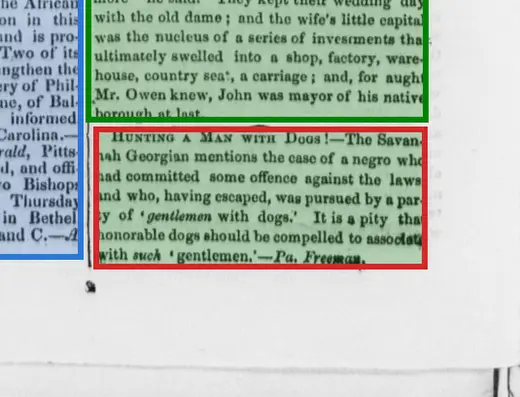
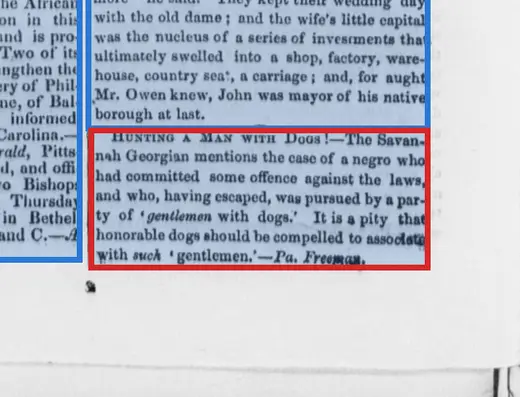
snewpapers
Hunting A Man With Dogs!The Savannah Georgian mentions the case of a negro who had committed some offence against the laws, and who, having escaped, was pursued by a party of 'gentlemen with dogs.' It is a pity that honorable dogs should be compelled to associate with such 'gentlemen.'—Pa. Freeman.
American Stories
HUNTING NAN WITH Docs The Savan- nah Georgian mentions the case of negro who had committed some offence against the laws, and who, having escaped, was pursued by par ty of 'gentlsmen with dogs 1t is pity that honorable dogs should be compelled to associata with such gentlemen. HssNs.Page 3
ours onlynot captured by ASepigraph p3-1
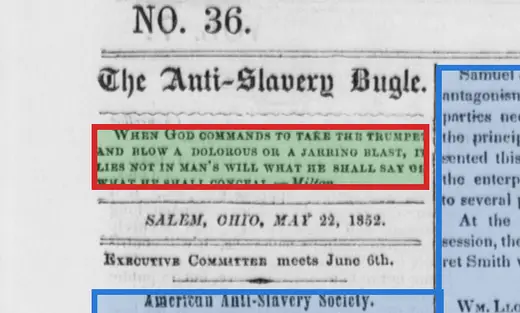
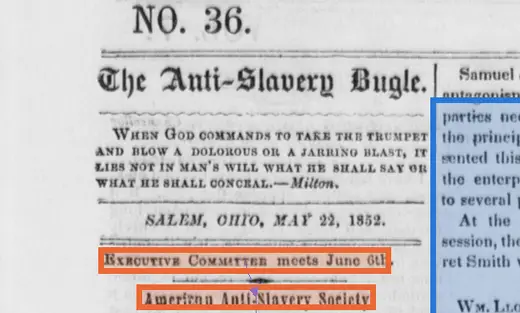
snewpapers
When God commands to take the trumpet And blow a dolorous or a jarring blast, it Lies not in man's will what he shall say or What he shall conceal.—Milton.American Stories
nothing1 ours : N ASsnewpapers rightdomestic_news ↔ AS #25, AS #19, AS #20, AS #12 p3-2 AS attaches text outside it AS puts a line of it in another article
- stated first: one component (snewpapers): snewpapers right (said one): The numbered pieces are continuous portions of a single report on the American Anti-Slavery Society anniversary meeting, with the text running on between them (e.g. [1] to [2] and [3] to [4] continue mid-sentence); it is one article.
- stated first: several components (American Stories): snewpapers right (said one): All four pieces are continuous narrative of the Anti-Slavery Society anniversary proceedings, with section heads like 'SECOND DAY' merely subdividing one report rather than starting new items.
American Stories also attaches: «BxRcurvE CoxmrrBn meets June 9th» (outside this component; AS article #25) snewpapers right
- stated first: the component includes it (American Stories): snewpapers right (said separate): The line "BxRcurvE CoxmrrBn meets June 9th" is a brief notice of an upcoming meeting, unrelated to the lengthy report on the American Anti-Slavery Society anniversary.
- stated first: the component does not include it (snewpapers): snewpapers right (said separate): The short notice 'BxRcurvE CoxmrrBn meets June 9th' is a brief meeting announcement, a distinct item separate from the long report on the American Anti-Slavery Society anniversary.
American Stories puts part of this component in another article: «THE ANTI-SLAVERY BUGLE.» (inside this component; AS article #10) page furniture, not counted
- stated first: the component includes it (snewpapers): page furniture, not counted (said furniture): «THE ANTI-SLAVERY BUGLE» is the newspaper's title/masthead, page furniture that should not determine which system is right.
- stated first: the component does not include it (American Stories): page furniture, not counted (said furniture): This is the newspaper's title/masthead, which is page furniture rather than part of the article's content.
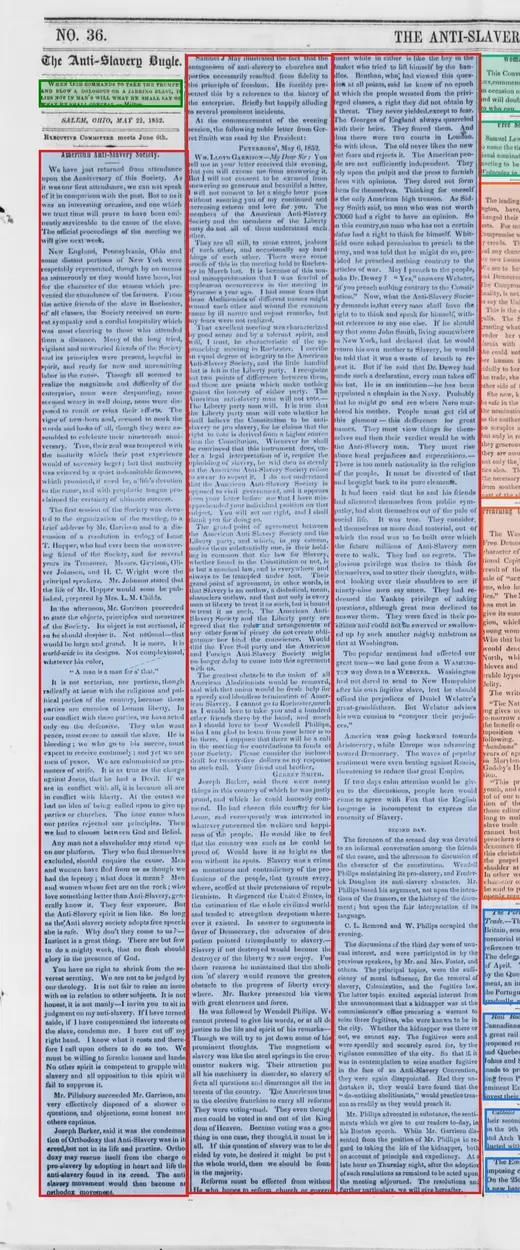
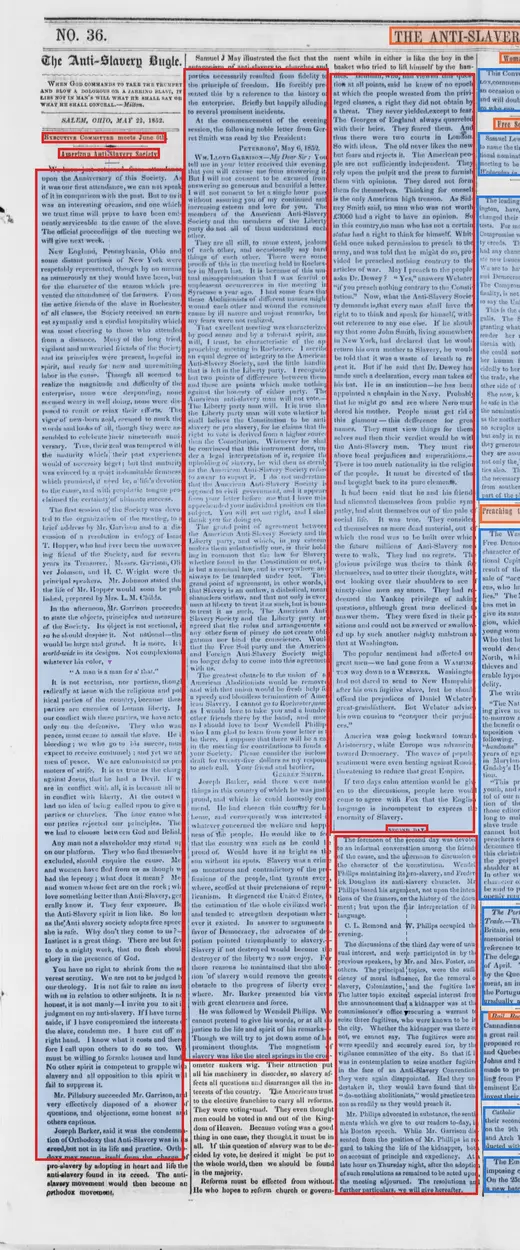
snewpapers
American Anti-Slavery SocietyWe have just returned from attendance upon the Anniversary of this Society. As it was our first attendance, we can not speak of it in comparison with the past. But to us it was an interesting occasion, and one which we trust time will prove to have been eminently serviceable to the cause of the slave. The official proceedings of the meeting we will give next week.
New England, Pennsylvania, Ohio and some distant portions of New York were respectably represented, though by no means as numerously as they would have been, but for the character of the season which prevented the attendance of the farmers. From the active friends of the slave in Rochester, of all classes, the Society received an earnest sympathy and a cordial hospitality which was most cheering to those who attended from a distance. Many of the long tried, vigilant and unwearied friends of the Society and its principles were present, hopeful in spirit, and ready for new and unremitting labor in the cause. Though all seemed to realize the magnitude and difficulty of the enterprise, none were desponding, none seemed weary in well doing, none were disposed to remit or relax their efforts. The vigor of new-born zeal, seemed to mark the words and looks of all, though they were assembled to celebrate their nineteenth anniversary. True, their zeal was tempered with the maturity which their past experience would of necessity beget; but that maturity was evinced by a quiet indomitable firmness, which promised, if need be, a life's devotion to the cause, and with prophetic tongue proclaimed the certainty of ultimate success.
The first session of the Society was devoted to the organization of the meeting, to a brief address by Mr. Garrison and to a discussion of a resolution in eulogy of Isaac T. Hopper, who had ever been the unwavering friend of the Society, and for several years its Treasurer. Messrs. Garrison, Oliver Johnson, and H. C. Wright were the principal speakers. Mr. Johnson stated that the life of Mr. Hopper would soon be published, prepared by Mrs. L. M. Childs.
In the afternoon, Mr. Garrison proceeded to state the objects, principles and measures of the Society. Its object is not sectional, if so he should despise it. Not national--that would be large and grand. It is more. It is world-wide in its designs. Not complexional, whatever his color, "A man is a man for a' that."
It is not sectarian, nor partisan, though radically at issue with the religious and political parties of the country, because these parties are enemies of human liberty. In our conflict with these parties, we have acted only on the defensive. They who want peace, must cease to assail the slave. He is bleeding; we who go to his succor, must expect to receive contumely; and yet we are men of peace. We are calumniated as promoters of strife. It is as true as the charge against Jesus, that he had a Devil. If we are in conflict with all, it is because all are in conflict with liberty. At the outset we had no idea of being called upon to give up parties or churches. The hour came when our parties rejected our principles. Then we had to choose between God and Belial.
Any man not a slaveholder may stand upon our platform. They who find themselves excluded, should enquire the cause. Men and women have fled from us as though we had the leprosy; what does it mean? Men and women whose feet are on the rock; who love something better than Anti-Slavery, generally know it. They fear exposure. But the Anti-Slavery spirit is lion like. So long as the Anti-slavery society adopts free speech she is safe. Why don't they come to us?— Instinct is a great thing. There are but few to do a mighty work, that no flesh should glory in the presence of God.
You have no right to shrink from the severest scrutiny. We are not to be judged by our theology. It is not fair to raise an issue with us in relation to other subjects. It is not honest, it is not manly-I invite you to sit in judgment on my anti-slavery. If I have turned aside, if I have compromised the interests of the slave, condemn me. I have cut off my right hand. I know what it costs and therefore I call upon others to do so too. We must be willing to forsake houses and lands. No other spirit is competent to grapple with slavery and all opposition to this spirit will fail to suppress it.
Mr. Pillsbury succeeded Mr. Garrison, and very effectively disposed of a shower of questions, and objections, some honest and others captious.
Joseph Barker said it was the condemnation of Orthodoxy that Anti-Slavery was in its creed, but not in its life and practice. Orthodoxy may rescue itself from the charge of pro-slavery by adopting in heart and life the anti-slavery found in its creed. The anti-slavery movement would then become an orthodox movement,
Samuel J. May illustrated the fact that the antagonism of anti-slavery to churches and parties necessarily resulted from fidelity to the principle of freedom. He forcibly presented this by a reference to the history of the enterprise. Briefly but happily alluding to several prominent incidents.
At the commencement of the evening session, the following noble letter from Gerrit Smith was read by the President:
Peterboro', May 6, 1852.
W. Lloyd Garrison—My Dear Sir: You tell me in your letter received this evening, that you will excuse me from answering it. But I will not consent to be excused from answering so generous and beautiful a letter. I will not consent to let a single hour pass without assuring you of my continued and increasing esteem and love for you. The members of the American Anti-Slavery Society and the members of the Liberty party do not all of them understand each other.
They are all still, to some extent, jealous of each other, and occasionally say hard things of each other. There were some proofs of this in the meeting held in Rochester in March last. It is because of this mutual misapprehension that I was fearful of unpleasant occurrences in the meeting in Syracuse a year ago. I had some fears that these Abolitionists of different names might wound each other and wound the common cause by ill nature and unjust remarks, but my fears were not realized.
That excellent meeting was characterized by good sense and by a tolerant spirit, and will, I trust, be characteristic of the approaching meeting in Rochester. I ascribe an equal degree of integrity to the American Anti-Slavery Society, and the little handful that is left in the Liberty party. I recognize but two points of difference between them, and these are points which make nothing against the honesty of either party. The American anti-slavery man will not vote.— The Liberty party man will. It is true that the Liberty party man will vote whether he shall believe the Constitution to be anti-slavery or pro slavery, for he claims that the right to vote is derived from a higher source than the Constitution. Whenever he shall be convinced that this instrument does, under a legal interpretation of it, require the upholding of slavery, he will then as sternly as the American Anti-Slavery-Society refuse to swear to support it. I do not understand that the American Anti-Slavery Society is opposed to civil government, and it appears from your letter before me that I have misapprehended your individual position on that subject. You will set me right, and I shall thank you for doing so.
The grand point of agreement between the American Anti-Slavery Society and the Liberty party, and which, in my esteem, makes them substantially one, is their holding in common that the law for Slavery, whether found in the Constitution or not, is but a nominal law, and is everywhere and always to be trampled under foot. Their grand point of agreement, in other words, is that Slavery is an outlaw, a diabolical, mean, shameless outlaw, and that not only is every man at liberty to treat it as such, but is bound to treat it as such. The American Anti-Slavery Society and the Liberty party are agreed that the rules and arrangements of any other form of piracy do not create obligations nor bind the conscience. Would that the Free Soil party and the American and Foreign Anti-Slavery Society might no longer delay to come into this agreement with us.
The greatest obstacle to the union of all American Abolitionists would be removed, and with that union would be fresh help for a speedy and bloodless termination of American Slavery. I cannot go to Rochester, much as I would love to take you and a hundred other friends there by the hand, and much as I should love to hear Wendell Phillips, who I am glad to learn from your letter is to be there. I suppose that there will be a call in the meeting for contributions to funds of your Society. Please consider the enclosed draft for twenty-five dollars as my response to such call. Your friend and brother,
GERRIT SMITH.
Joseph Barker said there were many things in this country of which he was justly proud, and which he could honestly commend. He had chosen this country for his home, and consequently was interested in whatever concerned the welfare and happiness of the people. He would like to feel that the country was such as he could be proud of. Would have it as bright as the sun without its spots. Slavery was a crime so monstrous and contradictory of the professions of the people, that tyrants everywhere scoffed at their pretensions of republicanism. It disgraced the United States, in the estimation of the whole civilized world, and tended to strengthen despotism wherever it existed. In answer to arguments in favor of Democracy, the advocates of despotism pointed triumphantly to slavery.— Slavery if not destroyed would become the destroyer of the liberty we now enjoy. For these reasons he maintained that the abolition of slavery would remove the greatest obstacle to the progress of liberty everywhere. Mr. Barker presented his views with great clearness and force.
He was followed by Wendell Phillips. We cannot pretend to give his words, or at all do justice to the life and spirit of his remarks— Though we will try to jot down some of his prominent thoughts. The magnetism of slavery was like the steel springs in the chronometer maker's wig. Their attraction put all his machinery in disorder, so slavery affects all questions and disarranges all the interests of the country. The Americans trust to the elective franchise to carry all reforms. They were voting-mad. They even thought men could be voted in and out of the Kingdom of Heaven. Because voting was a good thing in one case, they thought it must be in all. If this question of slavery was to be decided by vote, he desired it might be put to the whole world, then we should be found in the majority.
Reforms must be effected from without. He who hopes to reform church or government while in either is like the boy in the basket who tried to lift himself by the handles. Bentham, who had viewed this question at all points, said he knew of no epoch at which the people wrested from the privileged classes a right they did not obtain by a threat. They never yielded, except to fear. The Georges of England always quarreled with their heirs. They feared them. And thus there were two courts in London. So with ideas. The old never likes the new but fears and rejects it. The American people are not sufficiently independent. They rely upon the pulpit and the press to furnish them with opinions. They dared not form them for themselves. Thinking for oneself is the only American high treason. As Sidney Smith said, no man who was not worth £3000 had a right to have an opinion. So in this country, no man who has not a certain status had a right to think for himself. Whitfield once asked permission to preach to the army, and was told that he might do so, provided he preached nothing contrary to the articles of war. May I preach to the people, asks Dr. Dewey? "Yes," answers Webster, "if you preach nothing contrary to the Constitution." Now, what the Anti-Slavery Society demands is, that every man shall have the right to think and speak for himself, without reference to any one else. If he should say that some John Smith, living somewhere in New York, had declared that he would return his own mother to Slavery, he would be told that it was a waste of breath to repeat it. But if he said that Dr. Dewey had made such a declaration, every man takes off his hat. He is an institution-he has been appointed a chaplain in the Navy. Probably that he might go and see where Nero murdered his mother. People must get rid of this glamour-this deference for great names. They must view things for themselves and then their verdict would be with the Anti-Slavery men. They must rise above local prejudices and superstitions.— There is too much nationality in the religion of the people. It must be divested of that and brought back to its pure elements.
It had been said that he and his friends had alienated themselves from public sympathy, had shut themselves out of the pale of social life. It was true. They considered themselves as mere dead material, out of which the road was to be built over which the future millions of Anti-Slavery men were to walk. They had no regrets. The glorious privilege was theirs to think for themselves, and to utter their thoughts, without looking over their shoulders to see if ninety-nine men say amen. They had redeemed the Yankee privilege of asking questions, although great men declined to answer them. They were fixed in their positions and could not be swerved or swallowed up by such another mighty maelstrom as that at Washington.
The popular sentiment had affected our great men—we had gone from a Washington way down to a Webster. Washington had not dared to send to New Hampshire after his own fugitive slave, lest he should offend the prejudices of Daniel Webster's great-grandfathers. But Webster advises his own cousins to "conquer their prejudices."
America was going backward towards Aristocracy, while Europe was advancing toward Democracy. The waves of popular sentiment were even beating against Russia, threatening to reduce that great Empire.
If two days' calm attention would be given to the discussions, people here would come to agree with Fox that the English language is incompetent to express the enormity of Slavery.
SECOND DAY
The forenoon of the second day was devoted to an informal conversation among the friends of the cause, and the afternoon to discussion of the character of the constitution. Wendell Phillips maintaining its pro-slavery, and Frederick Douglass its anti-slavery character. Mr. Phillips based his argument, not upon the intentions of the framers, or the history of the document; but upon the fair interpretation of its language.
C. L. Remond and W. Phillips occupied the evening.
The discussions of the third day were of unusual interest, and were participated in by the previous speakers, by Mr. and Mrs. Foster, and others. The principal topics were the sufficiency of moral influence, for the removal of slavery, Colonization, and the fugitive law. The latter topic excited especial interest from the announcement that a kidnapper was at the commissioner's office procuring a warrant to seize three fugitives, who were known to be in the city. Whether the kidnapper was there or not, we cannot say. The fugitives were speedily and securely cared for, by the vigilance committee of the city. So that if it was in contemplation to seize another fugitive in the face of an Anti-Slavery Convention, they were again disappointed. Had they undertaken it, they would have found that the "do-nothing abolitionists," would practice treason as readily as they would preach it.
Mr. Phillips advocated in substance, the sentiments which we give to our readers to-day, in his Boston speech. While Mr. Garrison dissented from the position of Mr. Phillips in regard to taking the life of the kidnapper, both on account of principle and expediency. At a late hour on Thursday night, after the adoption of such resolutions as remained to be acted upon, the meeting adjourned. The resolutions and further particulars, we will give hereafter.
American Stories
Americnn Anli.Slayery Society.we nave just Tcturheu Houh htteuuuHCc upon the Anniversary Of this Society. AS it was our first attendance, we can not speak oft in comparison with the past. But to us il was an interesting OCCASION, and one which we trust time will prove to have been emf nently servceablo to the cause of the slave. The official proceedings Of the meeting we will give next week.
New England, Pennsylvania, Ohio and some distant portions OF New York were respectfully represented, though by no means rs numerousiy as they would have been, but for the character of the season which pre- vented tic attendance of the farmers. Fiom the active friends of the slave in Rochester, of all classes, the Society received an earn est sympathy and cordial hospitality which WINS most cheering to those who attended from distance. Many OF the long tried, vigiant and unwenried friends of the Society and its principles were present. hopeful in spirit, aud ready for new and unremiting labor in the cause. Though all seemed TO realize the magnitude and difficulty of the enterprise, nouo were despondng, none seemed weary in well doing, none were dis posed TO remit or relax their efforts. The vigor of newborn zeal, seemed TO mark the words aud Looks of all, though they were AS senlbed to celebrate their nineteenth uuui- vcrsary. True, their zeal was tempered with the maturity which their past experience would of Necessity bcgct; but that maturity WINS eyinccd 10y quiet udornilal'e firmness, which promised, If need be, II LIES devotion 10 tie cause, aud with prophetic tongue pro- clnimed the certainty Of ultimate SUCCESS.
The first session OF the Society was devo. ted 10 The organization OF the meeting, to II brief address hy Nlr. Garrison and to dis cl,ssion of resolution IN oulogy Of Isaac 4. Hopper, who had ever been the unwnyer- ing friend of the Society, aud for several years its Treasurer. Mcssrs. Garrison, Oil yer johnson, and II. c. Wight were the principal speakers. Mr. Johnson stated that the lilo of Mr.. Hopper would soon be pub lishcd, prepared 10y Mrs. l.. NJ. Childs.
In tho afternoon, Mr. Garrison proceeded to state the objects, principles aud measures Of the Socicty. Its Object is not sectional, it 20 he should dcspisc it. Not nhtional--tlIut would be large aud grand. 1t is more. Ills ,rorld-,eide in its designs. Not compleXional, whatever his color,
"a man is a man for a that"
It is not sectnrinn, nor partisan, though radically ut issue with the religious and pol iical parties of the country, because these parties nro enemies of human liberty. In our conflict with these parties, we have acted only oil the defensive. They who want peace, must cease 10 Hssnil the slave. lie is bleeding we who 90 to his succor, must expect to receive contuncly aud yet we are men Of peace. We are caIunniatcd as pro- moters of strife. 1t is rs true as the charge against Jesus, that Inc had Devil. II we are in conflict with all, it is because all are in conflict with liberty. AT the outset we had no idea Of being called upon TO give ur parties or churches. The hour came when our parties rejected our principles. Then we had TO choose bctwee God and lcliai.
Any man not a stakeholder may stand up on our platform. They who find themselves excluded, should enquire the cause. Men and women have fled from us as though We had the leprosy what does it mean? Men nnd women whose feet are on the rock; who love something better than Anti Slavery, gen orally know il. They fear exposure. Blu the Anti-Slavery spirit is lion like. So long us the Anti slavery society adopts free speecl she is safe. Why don't they come to us p Instinct is great thing. There are but few to do mighty work, that no flesh should glory in the presence of God.
You have no right 10 shrink from the Sc verest scrutiny. We nre not to be judged by our theology. tits not fair TO raise an issue with us in relation 10 other subjects. 1t is no honest, it is not manly-l invite you to sit il judgment on my anti-slavery. IfI have turned aside, if have compromised the interests o the slave, condemn me. have cut off my right hand. know what it costs and there fore call upon others to do SO too. W. must be willing to lorsnke houses and lands No other spirit is competent 10 grapple witt slavery and oil opposition to this spirit vii fail to suppress it.
MIR. Pillsbury succeeded Mr.. Garrison, an very effectively disposed of a shower { questions, and objections, some honest an others captious
Joseph Barker said it was the condemns ton of Orthodoxy that Ant-Slavery was in il sreed,but not in its life and practice. Orthc doxy may rescue itself from the charge {
parties necessarily resulted from fidelity to | tho principle of freedom. lie iorcibly pre- | scented this by reference TO the history of the enterprise. Briefly but happily olluding to several prominent incidents.
At the commencement of the evening session, the following noble letter from Ger ret Smith was read by the President:
PETrRBoRo May 6, 1852. Wm. LLOYD GAnMsoN-AH Dear Sir : You tell Inc in your letter received this evening, that YOU will excuse me from answering it. But will not consent TO be excused from answering so generous aud beautiful letter. | will not consent 20 let single hour pass without assuring you of my continued and increasing esteem and love for you. The members of the American Anti-Slavery Society aud the members of the Liberty party do not oil of them understand euch other.
They are all still, TO some extent, jealous of each other, and occasionally say hard things of each other. There were some proofs of this in tile meeting held IN lioches- Ter in March last. 1t is because of this mu- tinl misapprchonsion that wus fearful of unpleasant occurrences in the meeting in | Syracuse year ago. ] had some fears that these Aboitionists of different names might wound each other aud wound the common cause by i'll nature and unjust remarks, but | my fears were not realized.
Tint excellent meeting was characterized 10y good sense aud 10y tolerant spirit and will, | trust, he characteristic of the ap- preaching meeting in Rochester nscribe an equal degree of integrity to the American Anti-S slavery Society, and the little handful that is lclt in the Liberty party. | recognize but two points of difference between them, aud these are points which make nothing against the honesty of either puriy. The ! American unt-suvery man will not vote.- / The Liberty party man will. ltis true that / the Liberty party man will vote whether he shall believe the Constitution 10 he anti slavery or pro slavery, for he claims that the right to vote is derived from n higher source than tho Constitution. Whenever he shall he convinced that this instrument does, TN der legal Interpretation of il, require the upholding of slavery, he will then us s,crny as the American Auii.Slavory Society refuse TO swear TO support il. do not understand that the American Anli.Slavcry Society is opposed to civil government, and it appears iTom your letter before me thnt have mis- npprehcnded your individual position on That subject. You will set me right, aud shall thank you for doing so.
/ The grand point of agreement between the American An,iSlayeiy Society aud the Liberty party, aud which, ia my esteem, makes them substantially one, is their hold ing in common that the law for Slavery, whether found in the Constitution or not, Is is hut a nominal law, aud is everywhere and IL. ,I.,I ,,,,I,r 'Ihptr grand point of agreement, in other words, is that Slavery is an outlaw, diabOlcal, mean, shameless outlaw, and that not only is every man at liberty to treat it M such, hut is bound to trent il us such. The American Anti Slavery socicty and the Liberty party are agreed that the rules aud arrangements oi nny other form of piracy do not create obi. CATIONS nor bind the conscience. Would that the Free Soil party and the American and Foreign Ani-Savcry Society might no longer delay to come into this agreement with us.
The greatest obstacle TO the union Of al American hboliionists would be removed and with that union would he fresh help iOl speedy aud hloodIess termination Of Amer lean Slavery. ] cannot go to Rochcsier,mucl as | would love to take you aud hundred other friends there 10y the hand, aud mucl us should love to hear Wendell Phillips who am glad 10 learn from your letter is it he there. suppuse that there will he cal in the meeting for contributions to funds o your Society. Ploase consider The incloset draft for twenty-five dollars ns my response TO such call. Your friend and brother,
GgRRET SMITH.
Joseph Barker, said there were man! things in this country of which he was justly proud, aud which ho could honestly com mend. lie had chosen this country for h
home aud consequently was interested it whatever concerned the welfare aud Ilnppi ness of tic people. lie would like TO fee that the country was such us he could bt } proud of. Would have it as bright Os th' ! sun without It's spots. Slavery was n Grim, ; so monstrous aud contradictory of the pro fcssions Of the people, that tyrnnts every } where, scoffed at their pretensions of repub icnnism. 1t dsgrnced tie United States, il t the estimation of the whole civilized world ! aud tended tc strengthen despotsm where ! ever il existed. In answer TO arguments il
favor of Democracy, the advocates Of DIES potism pointed triumphun,ly TO slavery Slavery if not destroyed would become tn destroyer of the liberty We now enjoy. Fo these reasons lie maintained that the aboli , lion of slavery would remove the creates , obstacle TO the progress of liberty every where. Mr.. Barker presented his view ! with great clearness and force.
| lie was followed by Wendell Philips. w f cannot pretend to give his words, or at all d y justice to the life and spirit of his remarks Though we will try to jot down some of hi 9 prominent thoughts. The magnetism Q J. slavery was like the steel springs in the cron
dies. Benthnn, who, had viewed this ques- ton at all points, said he knew of no epoch at which the people wrested from the privi- legged classes, right they did not obtain by q threat They never yielded, except to fear. The Georges of England always quurreled with their heirs. They feared them. And thus there were two courts in London. So with ideas. The old never likes the new but fears and rejects it. The American peo- pie are not sufficiently independent. They rely upon the pulpit and the press to furnish them with opinions. They dared not form them for themselves. Thinking for oneself is the only American high treason. As Sid ney Smith said, no man who was not worth $4,000 had right TO have an opinion. So in this country,no man who has not certain SiaiuS had right to think for himself Whit field once asked permission to preach TO the army, and was told that he might do so, pro- vided he preached nothing contrary to the articles Of war. May preach to the people, asks DIR. Dewey? ayes" answers Webster, "ifyou preach nothing contrary TO the Constr tuition" Now, what the Anti-Slavery Socie- iy demands is,that every man shall have the right to to think and speak for himself, with out reference to any one olse. If he should say that some John Smith, living somewhere in New York, had declared that lac would return his own mother to Slavery, he would be told that it was waste of breath 10 re-. peat it. But if he said that DR.. Dewey had made such declaration, every man takes off his hat. lie is an instiulion-hc has been appointed n chaplain in the Navy. Probably that he might 60 and see where Nero mur- dcrcd his mother. People must get rid Of / this glamour - this Difference for great names. They must view things for them selves aud then their verdict would be with / the Anli-Slavery men. They must rise above local prejudices and superstiions.- There is too much nationality in the religion of the people. 1t must be divested of that and brought back to its pure clemens. | 1t had been said that he and his friends had alienntcd themselves from public SYM pnthy, had shut themselves out of the pale o social life. 1t was true. They consider ] cd themselves MS mere dead material, out o. which the road was 10 he built over which the future millions of Anti-Slavery mer were to walk. They had no regrets. TIL, glorious privilege was theirs to think fol themselves, and to utter their thoughts, with out looking over their shoulders to sec j nincty-nino men say amen. They had re deemed the Yankee privilege of asking questions, although great men declined tC answer them. They were fixed in their po sitons and could not be swerved or swallow ed up by such another mighty nialstrom as that at Washington.
The popular sentiment had affected our great mcn-wc had gone from WASHING TON way down to WEBSTER. Washington had not dared to send to New Hampshire after his own fugitive slave, lest he should offend the prejudiccs of Daniel Wcbster's grcat-grandlathers. But Webster advises
his own cousins TO "conqucr their prcjudi, ces."
America was going backward towards t Arisiocrncy, while Europe was advancing toward Democracy. The waves of popular sentiment were even beating against Russia
threatening TO reduce that great Empire.
If two days calm attention would he Civ, en- to the discussions, people here woul, come to agree with Fox that the Englisl ; language is incompetent to express Ill, enornity Of Slavery.
, SECOND DAY.
SECOND DAY.
The forenoon of the second day was devoted to an informal conversation among the friends of tho cause, and the afternoon to discussion Of the character of the constitution. Wendell Philips maintaining its slavery, and Frodcr- ick Douglass its anti slavery character. Mr.. Philips based his argument, not upon the inten- tons of the trainers, or the history of the docu- mcnt; but upon the fair Interpretation of its language.
C. l.. Rcmond and W. Philips occupied the evening.
The discussions of the third day were of unu- sual interest, and were participated in by the previous speakers, by Mr.. and Mrs, Foster, and others. The principal topics, were tho suiii- slavery, Colonization, and the fugitive law. The latter topic excited especial interest from the announcement that kidnapper was at the commissioners Office procuring a warrant to seize three fugitives, who were known to be in the city. Whether the kidnapper was there or not, we cannot say. The fugitves were and were speedily and securely cared for, by the vigilance committee of the city. So that if it was in contemplation to seize another fugitive in the face of an Anti.Slavery Convention, they were again disappointed. Had they un- dertakcn it, they would have found that the do-nothing abolitonists," would practice trea- son as readily as they would preach it.
Mr.. Philips advocated in substance, the senti- ! I = his Boston speech. While Mr.. Garrison dis sentcd from the position of Mr.. Phillips in re. gard to taking the life of the kidnapper, bott on account of principle and expediency. At late hour on Thursday night, after the adoption ofsuch resolutions as remained to be acted upon the meeting adjourned. The resolutions an( further particulars, we will give hereafter,
- the pieces asked about (American Stories):
- [1] AS #25: begins: "Americnn Anli.Slayery Society. we nave just Tcturheu Houh htteuuuHCc upon the Anniversary Of this Society." … ends: "not in its life and practice. Orthc doxy may rescue itself from the charge {"
- [2] AS #19: begins: "parties necessarily resulted from fidelity to | tho principle of freedom. lie iorcibly pre- |" … ends: "prominent thoughts. The magnetism Q J. slavery was like the steel springs in the cron"
- [3] AS #20: begins: "dies. Benthnn, who, had viewed this ques- ton at all points, said he knew of" … ends: "the Englisl ; language is incompetent to express Ill, enornity Of Slavery. , SECOND DAY."
- [4] AS #12: begins: "SECOND DAY. The forenoon of the second day was devoted to an informal conversation among" … ends: "be acted upon the meeting adjourned. The resolutions an( further particulars, we will give hereafter,"
1:1 matchmatchnotice ↔ AS #10 p3-3
snewpapers
Woman's Rights Convention.This Convention will be held in Massillon, commencing on Wednesday next. It is an occasion of much interest and importance, and will doubtless be well attended. Let all go who can.
American Stories
WOman's Rights Convention.This Convention will be held in MAssrL- LoN,commencing on WEDNESDAY next. Its an occasion of much interest and importance, and will doubtless bo well attended. Let all go who can.
1:1 matchmatchnotice ↔ AS #11 p3-4
snewpapers
Free Soil National Convention.Samuel Lewis, Chairman of the Committee, to name the time and place for holding the National nomination Convention, has notified the meeting to be held at Cleveland, on the first Wednesday in August next.
American Stories
Free Soil National Convention.Samuel Lewis, Chairman Of the Committee, TO name the time and place for holding the Ma tional nomination Convention, has notified the meeting to be held at CLEVELAND, on the first Wednesday in august nert.
1:1 matchmatcheditorial ↔ AS #2 p3-5
snewpapers
A New Dodge.The leading papers of both parties at Washington have, within a few days, entirely changed their ground in regard to presidential tests. For months we have been told that the Compromise was an inseparable part of the party creeds; that none but a pledged candidate had any chance of success. Now they repudiate new issues and revert to the old order.— We are to have only old fashioned Whiggery and Democracy in the nominating Convention. The Compromise, either as a temporality or a finality, is not to be thrust upon the candidates; so say the Union and the Republic.
This is the chaff that is to catch the northern gulls. The South is always magnanimous in granting what she cannot hold, or holding, can render her no service. She yielded California with great show of liberality, when she could not help it. And when she found her human flesh market in Washington decidedly to her detriment, with pious horror of the trade, she transferred her slave pens to the other side of the Potomac.
She now, knowing that the Compromise will be safe in the hands of any one who can receive the nomination or election from either party, and as the northern sticklers on the question, have no scruples about executing the Compromise, but only in regard to the pledge to execute it; they generously release them from the pledge as they are assured of the performance. So now not only the Union will be saved, but the parties also. This liberality will of course receive the necessary amount of cursing and blustering from southern impracticables. But that is a part of the play and will scare nobody.
American Stories
A New Dodge.The leading papers of both parties at Wash ington, have, within few days, entirely changed their ground in regard to presidential tests. For months we have been told that the Compromise was an inseperablo part Of tho par ty crcods. That none but pledged candidate had any chance of success. Now they repudi- ate new issues and revert to the old order We arc to have only old fashioned Whigcry and Democracy in the nominating Convention The Compromise, either as a temporarily or Q iinality, is not to be thrust upon the candidates SO say the Union and the Republic.
This is the chaf that is to catch tho northern gulls. The South is always magnanimous in granting what she cannot hold, or holding, can render her no service. She yielded Cal iIornia with great show of libcrality, when she could not help It. And when she found her human flesh market in Washington de- cdedly to her dctrimont, with pious horror oi the trade, she transferred her slave pens to tho other side of the Potomac.
She now, knowing that the Compromise will be safe in the hands of any one who can receive the nomination or election from either party, and as the northern sticklors on the question, have no seruplos about executing the Compromise but only in regard to the pledge to execute it they generously release them from the pledge al they are assured Of the performance. So nov not only the. Union will be saved, but the par tics also. This libcrality will of course receive the necessary amount of cursing and clustering from southern impracticables. But that is
part of the play and will scare nobody.
1:1 matchmatcheditorial ↔ AS #7 p3-6
snewpapers
Preaching the Gospel and Selling Young Women.The Washington Correspondent of the Free Democrat gives an exposition of the character of the gospel preached at our National Capital. The actual and legitimate result of their gospel, is the purchase and sale of "accomplished and handsome maidens, who have been raised in genteel families." The New School Presbyterian Church has met in that city, that it may especially give its sanction and fellowship to this religion, which sells innocent and industrious young women for purposes of lust and gain. Who that has intelligence and humanity, but would denounce the whining piety of the North, which strikes hands with women thieves and woman traders, as the most execrable hypocrisy and the most damning infidelity.
The writer under date of May 1st says:
"The National Intelligencer of this morning gives notice that there will be preaching to-morrow afternoon in several churches for the benefit of the youth; in immediate juxtaposition with this religious notice is the following. For sale, an accomplished and "handsome" lady's maid: she is just sixteen years of age, was raised in a genteel family in Maryland. A note directed to C. D., Gadsby's Hotel, will receive prompt attention.
"This preaching for the benefit of the youth, and selling young women at the capital of our nation, is a most striking illustration of the intelligence, and sincerity of those editors who labored so hard and so long to make the people believe that the slave trade had been abolished. Again, we cannot but inquire whether any of these preachers of the general assembly will dare denounce this practice of selling females in this christian land, while they labor to send the gospel among heathens who would shudder at the commission of such crimes. In other words, have we any claims to the character of a christian nation? Can men be said to preach the gospel, who dare not openly reprove iniquity."
American Stories
Preaching The Gospel and Selling YoungWomen.
The Washington Correspondent of tho Free Democrat, gives an exposition of the character of the gospel preached at our Ma tiona Cupiial. The actual and legitimate result of their gospel, is the purchase and sale of accomplished and handsome maid ems, who hnve been raised in genteel fami- lies" The New School Presbyterian Church has met in that city, that it may especially give its sanction and fellowship 10 this reli- gion, which sells innocent aud industrious young women for purposes Of lust and gain. Who that has intelligence and humanity, but would dehounce the whining piety of the thieves and woman traders, as the most exc cradle hypocricy aud the most damning inf deity.
The writer under date of may 1st says
"The National Intelligcncer Of this morn ing gives notice that there will he preaching tomorrow afternoon in several churches for the benefit of the youth; in immediate juX- Imposition with this religious notice is the following. For sale, nn accomplished and "hdnGSome" ludy's maid she is Just sixteen years of age, was raised in. n genteel lamily in Maryland. A note directed TO G. d., Gadsby's Hotel, will receive prompt atten- lion.
"This preaching for the benefit of the youth, and selling young women at the capi- | tol of our nation, is II most striking illustra- ton of the intelligence, and sincerity OF those editors who lnbored so hard and so | long 10 make the people believe That the slave trade had been abolished. Again, we cannot but inquire whether any Of these preachers Of the general assembly will dare denouncc this practice of selling females in this christian land, while they labor TO send the gospel among heathens who would shudder nt the commission of such crimes ln other words, lave we any claims To tho character of q christian nation? Can men he said 10 preach tho gospel, who dare moi openly roproye iuiquiiy."
1:1 matchmatchforeign_news ↔ AS #6 p3-7
snewpapers
The Portuguese Government and the Slave Trade.—The Society of Friends in Great Britain sent two of their number with a memorial to the Government of Portugal, in reference to Slavery and the Slave Trade.— The delegation arrived at Lisbon, on the 9th of April. They were promised an audience by the Queen, and received from the Government an intimation that the Slave Trade in the Portuguese possessions in Africa, will be gradually abolished.American Stories
The Portuguese Government and The Stare Trade.-Ihe Society of Friends in Great Britain, sent two of their number with a memorial to the Government of Portugal in reference to Slavery and the Slave Trade The delegation arrived Mt Lisbon, on the 9th of April. They were promised an audience by the Queen, and received from the Govern ment, an intimalion that the Slave Trade in the Portuguese possessions in Africa, will be gradually abolished.1:1 matchmatchforeign_news ↔ AS #8 p3-8
snewpapers
Rail Road in the British Provinces.—The Canadians are pressing the construction of a great railway from Halifax to Detroit. Its proposed route is via the cities of St. John and Quebec, and along the valleys of the St. Johns and St. Lawrence. Efforts are to be made to procure a grant of £7,000,000 sterling from Parliament; and in case of success, eminent English capitalists stand ready to invest their funds in the enterprise.American Stories
Rail Road in The B,iiish ProvincesRail Road in The British Provinces.-The Cannadians are pressing the construction OF a great rail way from Halifax to Detroit. Its proposed route, is via the cities of ST. John and Quebec, and along the valleys of tho St. Johns and st. Lawrence. Efforts are to be made to procure grant of e7,0O0,OOO stor- ling from Paliameut; and in case of success, eminent English capitalists stand ready to invest their funds in the enterprise.
1:1 matchmatchdomestic_news ↔ AS #17 p3-9
snewpapers
Catholic Convention.—The Catholics held their second National Convention at Baltimore, on the 9th inst. Upwards of thirty Bishops and Arch Bishops were present. It was conducted with much pomp and ceremony.American Stories
Catholic Conrention.-The Catholics held their second National Convention at Baltimore, on the 9th inst. Upwards of thirty Bishops and Arch Bishops were present. 1t was con- Quoted with much pomp and ceremony.1:1 matchmatchforeign_news ↔ AS #18 p3-10
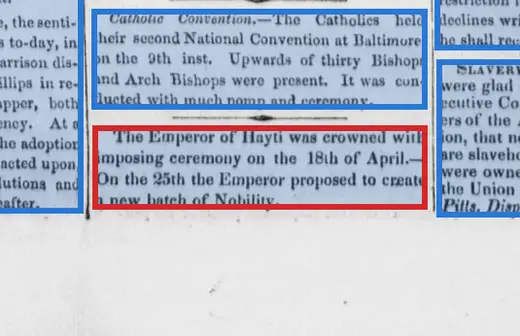
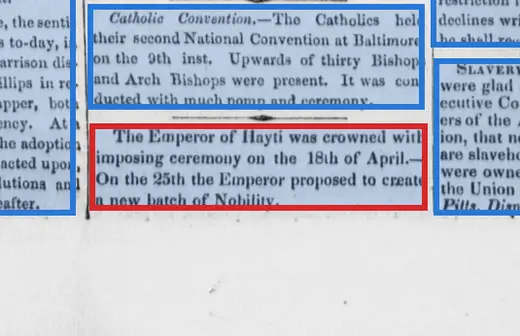
snewpapers
The Emperor of Hayti was crowned with imposing ceremony on the 18th of April.— On the 25th the Emperor proposed to create a new batch of Nobility.American Stories
The Emperor of Iiayti was crowned with imposing ceremony on the 18th of April On the 25th the Emperor proposed to create a new batch of Nobility.1:1 matchmatchletter_to_editor ↔ AS #1 p3-11 American Stories duplicated this text (articles #1 and #46)
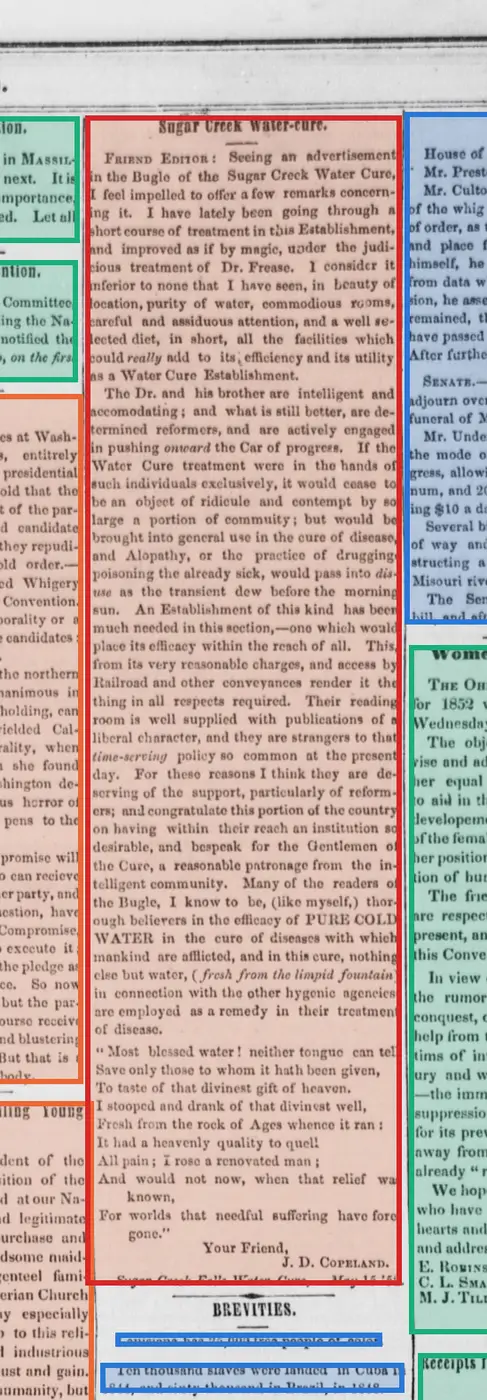
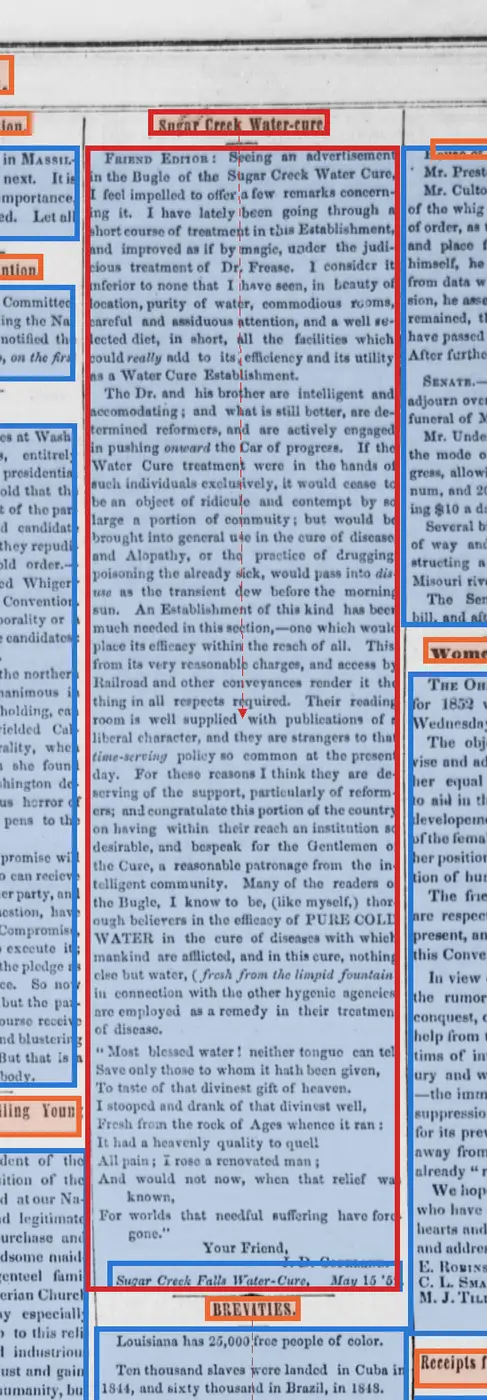
snewpapers
Sugar Creek Water-cure.Friend Editor: Seeing an advertisement in the Bugle of the Sugar Creek Water Cure, I feel impelled to offer a few remarks concerning it. I have lately been going through a short course of treatment in this Establishment, and improved as if by magic, under the judicious treatment of Dr. Frease. I consider it inferior to none that I have seen, in beauty of location, purity of water, commodious rooms, careful and assiduous attention, and a well selected diet, in short, all the facilities which could really add to its efficiency and its utility as a Water Cure Establishment.
The Dr. and his brother are intelligent and accommodating; and what is still better, are determined reformers, and are actively engaged in pushing onward the Car of progress. If the Water Cure treatment were in the hands of such individuals exclusively, it would cease to be an object of ridicule and contempt by so large a portion of community; but would be brought into general use in the cure of disease, and Allopathy, or the practice of drugging, poisoning the already sick, would pass into disuse as the transient dew before the morning sun. An Establishment of this kind has been much needed in this section,-one which would place its efficacy within the reach of all. This, from its very reasonable charges, and access by Railroad and other conveyances render it the thing in all respects required. Their reading room is well supplied with publications of a liberal character, and they are strangers to that time-serving policy so common at the present day. For these reasons I think they are deserving of the support, particularly of reformers; and congratulate this portion of the country on having within their reach an institution so desirable, and bespeak for the Gentlemen of the Cure, a reasonable patronage from the intelligent community. Many of the readers of the Bugle, I know to be (like myself) thorough believers in the efficacy of PURE COLD WATER in the cure of diseases with which mankind are afflicted, and in this cure, nothing else but water, (fresh from the limpid fountain) in connection with the other hygienic agencies, are employed as a remedy in their treatment of disease.
Most blessed water! neither tongue can tell Save only those to whom it hath been given, To taste of that divinest gift of heaven. I stooped and drank of that divinest well, Fresh from the rock of Ages whence it ran: It had a heavenly quality to quell All pain; I rose a renovated man; And would not now, when that relief was known, For worlds that needful suffering have foregone.
Your Friend,
J. D. COPELAND.
Sugar Creek Falls Water-Cure, May 15, '52.
American Stories
Sugar Creek Watsr.ture.FRIEND Enron: Seeing an advertisement in the Buglc of the Sugar Creek Water Cure, 1 feel impelled to offer a few remarks concern ing it. have lately been going through short course Of treatment in this Establishment, and improved as il by magic, undor the judi cious treatment Of DIR. Frease. l consider II inferior TO none that have seen, in beauty of location, purity of water, commodous rooms, careful and assiduous attention, and a we'll Sc lectcd diet, in short, all the facilities which could really add to its efficiency and its utility as Water Cure Establishment.
The DIR. and his brother are intelligent and accommodating; and what is still better, are de- termined reformers, and are actively engaged in pushing on,oard the Car of progress. If the Water Cure treatment were in the hands of such individuals exclusively, It would cease to be an object of ridicule and contempt by so large n portion of community; but would be brought into general use in the cure of disease, and Alopathy, or tho practice of drugging poisoning the already sick, would pass into dis tso as tho transient dew before the morning sun. An Establishment Of this kind has been much needed in this section, which would place its efficacy within the reach Of ALL This, from its very reasonable charges, and access by Railroad and other conveyances render it the thing in all respects required. Their reading room is we'll supplied with publications of liberal character, and they are strangers to that to,e-serriag policy so common at the present Ia, To- thoeo roooona tbi,L fhay ara do serving of the support, particularly of reform ors; nnl congratulate this portion Of the country on having within their reach an institution so desirable, and bespcak for the Gentlemen Of the Cure, reasonable patronage from the in tclligent community. Many of the readers of the Buglc, l know to be, Qikc myscf,) thor ough believers in the efficacy of PURE COLD WATER in the euro Of diseases with which mankind are afflicted, and in this cure, nothing else but water, fresh from TIC h0,pid .fouatail) in connection with the other hygcnic agencies, arc employed as a remedy in their treatment of disease.
"Most blessed water neither tongue can tell Save only those to whom it hath been given, To taste of that divinest gift of heaven. 1 stopped and drank of that divincst WE'LL Fresh from the rock of Ages whence it ran: 1t had heavenly quality to quel!
All pain / rose a renovated man;
And would not now, when that relief was
known,
For worlds that needful suffering have fore.
gone"
Your Friend,
]. ID. COPELAND.
Sugar Creek Falls Water Cure, May 10 '52
AS only, tinytiny, not askedAS #29 p3-12

snewpapers
nothingAmerican Stories
BREyITlES.N ours : 1 ASsnewpapers rightdomestic_news, foreign_news, filler, domestic_news, domestic_news, domestic_news, domestic_news, domestic_news, obituary, domestic_news, domestic_news, domestic_news, domestic_news ↔ AS #29 p3-13
- stated first: one component (American Stories): snewpapers right (said several): The passage is a column of short, unrelated news briefs (facts and items from different places), each a distinct item rather than one continuous article.
- stated first: several components (snewpapers): snewpapers right (said several): The passage is a column of unrelated one- and two-sentence news briefs (items), each a separate printed component; they share no continuing story or connection.
snewpapers
Louisiana has 25,000 free people of color.Ten thousand slaves were landed in Cuba in 1844, and sixty thousand in Brazil, in 1848.
One hundred thousand pounds of phosphorus are annually consumed in England in the manufacture of matches.
The people of Minnesota have ratified the act of the Legislature in passing the Maine Law by an overwhelming majority.
The Winsboro' (S. C.) Register parades the figure of a coffin in its columns, and announces the death of Secessionism, by strangulation, in the third year of its age, on occasion of the resignation of R. B. Rhett's seat in the United States Senate.
The Catholic population of the United States is said to be 1,900,000.
Robert Morris and C. L. Remond have advocated before the Military Committee of the Mass. Legislature, the organization of an independent colored Militia Company in Boston.
The Governor of Maryland has appointed James M. Buchanan and Richard Carmichael as commissioners to confer with Pennsylvania about the fugitive slave killing case.
Mrs. Adams, widow of John Quincy Adams, is dead.
An Anti-Liquor Law has passed the Legislature of Rhode Island; it goes into effect in July.
A meeting for the extension of Southern trade is to be held in Baltimore to-day.— Several Southern members of Congress are to attend.
The Supreme Court of New York has decided the Canal Enlargement law, of 1851, to be unconstitutional.
The bill for the further protection of personal liberty has been defeated in the Massachusetts Legislature.
American Stories
BREyITlES.Louisiana has $4,000 free people of color.
Ten thousand slaves were landed in Cuba in 1874, and sixty thousand in Brazil, in 1913.
One hundred thousand pounds of phospho- rus are annually consumed in England in the manufacture of matches.
The people of Minnesota have ratified the act of the Legislature in passing the Maine Law by an overwhelming majority.
The Winsboro' Is. c. Register purados the figure of coffin in its columns, and announces the death of Scccssionism, by strangulation, in the third year of its age, on occasion of the resignation of II. b. Rhctrs seat in the United States Senate.
The Catholic population of tho United Safes is said to be 100000.
Robert Morris and C. J.. Remond have advoca- ted before the Military Committee of the Mass. Legislature, the organization of an Independent colorcd Militia Company in Boston.
Tho Governor of Maryland has appointed James NJ. Buchanan and Richard Carmichael as commissioners to confer with Pennsylvania about the fugitive slave killing case.
Mrs. ADAMS, widow of John Quincy Adams is dead.
An Anti. Liquor Law has passed the Leg. | islntura of Rhode Island IL gocs into plIpr in July.
A meeting for the extension OF Southen trade is to be held in Baltimore to-day Several Southern members of Congress are TO attend
The Supreme Court of New York has de- cided the Canal Enlargement law, Of 1851 to be unconstitutional.
The bill for the further protection of per- | oonoI lihartu bac ham 1nf,ataI Il, tho NJ.
- the pieces asked about (snewpapers):
- [1] domestic_news: begins: "Louisiana has 25,000 free people of color." … ends: "Louisiana has 25,000 free people of color."
- [2] foreign_news: begins: "Ten thousand slaves were landed in Cuba in 1844, and sixty thousand in Brazil, in" … ends: "thousand slaves were landed in Cuba in 1844, and sixty thousand in Brazil, in 1848."
- [3] filler: begins: "One hundred thousand pounds of phosphorus are annually consumed in England in the manufacture of" … ends: "hundred thousand pounds of phosphorus are annually consumed in England in the manufacture of matches."
- [4] domestic_news: begins: "The people of Minnesota have ratified the act of the Legislature in passing the Maine" … ends: "ratified the act of the Legislature in passing the Maine Law by an overwhelming majority."
- [5] domestic_news: begins: "The Winsboro' (S. C.) Register parades the figure of a coffin in its columns, and" … ends: "on occasion of the resignation of R. B. Rhett's seat in the United States Senate."
- [6] domestic_news: begins: "The Catholic population of the United States is said to be 1,900,000." … ends: "The Catholic population of the United States is said to be 1,900,000."
- [7] domestic_news: begins: "Robert Morris and C. L. Remond have advocated before the Military Committee of the Mass." … ends: "Committee of the Mass. Legislature, the organization of an independent colored Militia Company in Boston."
- [8] domestic_news: begins: "The Governor of Maryland has appointed James M. Buchanan and Richard Carmichael as commissioners to" … ends: "and Richard Carmichael as commissioners to confer with Pennsylvania about the fugitive slave killing case."
- [9] obituary: begins: "Mrs. Adams, widow of John Quincy Adams, is dead." … ends: "Mrs. Adams, widow of John Quincy Adams, is dead."
- [10] domestic_news: begins: "An Anti-Liquor Law has passed the Legislature of Rhode Island; it goes into effect in" … ends: "Anti-Liquor Law has passed the Legislature of Rhode Island; it goes into effect in July."
- [11] domestic_news: begins: "A meeting for the extension of Southern trade is to be held in Baltimore to-day.—" … ends: "is to be held in Baltimore to-day.— Several Southern members of Congress are to attend."
- [12] domestic_news: begins: "The Supreme Court of New York has decided the Canal Enlargement law, of 1851, to" … ends: "Court of New York has decided the Canal Enlargement law, of 1851, to be unconstitutional."
- [13] domestic_news: begins: "The bill for the further protection of personal liberty has been defeated in the Massachusetts" … ends: "bill for the further protection of personal liberty has been defeated in the Massachusetts Legislature."
Text agreement inside AS's merged article (12 pieces): the merged article's text cut where our components begin and end; American Stories draws no boundary there, so these are no matches.
p3-14 domestic_news
snewpapers
Louisiana has 25,000 free people of color.American Stories (slice of #29)
Louisiana has $4,000 free people of color.p3-15 foreign_news
snewpapers
Ten thousand slaves were landed in Cuba in 1844, and sixty thousand in Brazil, in 1848.American Stories (slice of #29)
Ten thousand slaves were landed in Cuba in 1874, and sixty thousand in Brazil, in 1913.p3-16 filler
snewpapers
One hundred thousand pounds of phosphorus are annually consumed in England in the manufacture of matches.American Stories (slice of #29)
One hundred thousand pounds of phospho- rus are annually consumed in England in the manufacture of matches.p3-17 domestic_news
snewpapers
The people of Minnesota have ratified the act of the Legislature in passing the Maine Law by an overwhelming majority.American Stories (slice of #29)
The people of Minnesota have ratified the act of the Legislature in passing the Maine Law by an overwhelming majority.p3-18 domestic_news
snewpapers
The Winsboro' (S. C.) Register parades the figure of a coffin in its columns, and announces the death of Secessionism, by strangulation, in the third year of its age, on occasion of the resignation of R. B. Rhett's seat in the United States Senate.American Stories (slice of #29)
The Winsboro' Is. c. Register purados the figure of coffin in its columns, and announces the death of Scccssionism, by strangulation, in the third year of its age, on occasion of the resignation of II. b. Rhctrs seat in the United States Senate.p3-19 domestic_news
snewpapers
The Catholic population of the United States is said to be 1,900,000.American Stories (slice of #29)
The Catholic population of tho United Safes is said to be 100000.p3-20 domestic_news
snewpapers
Robert Morris and C. L. Remond have advocated before the Military Committee of the Mass. Legislature, the organization of an independent colored Militia Company in Boston.American Stories (slice of #29)
Robert Morris and C. J.. Remond have advoca- ted before the Military Committee of the Mass. Legislature, the organization of an Independent colorcd Militia Company in Boston.p3-21 domestic_news
snewpapers
The Governor of Maryland has appointed James M. Buchanan and Richard Carmichael as commissioners to confer with Pennsylvania about the fugitive slave killing case.American Stories (slice of #29)
Tho Governor of Maryland has appointed James NJ. Buchanan and Richard Carmichael as commissioners to confer with Pennsylvania about the fugitive slave killing case.p3-22 obituary
snewpapers
Mrs. Adams, widow of John Quincy Adams, is dead.American Stories (slice of #29)
Mrs. ADAMS, widow of John Quincy Adams is dead.p3-23 domestic_news
snewpapers
An Anti-Liquor Law has passed the Legislature of Rhode Island; it goes into effect in July.American Stories (slice of #29)
An Anti. Liquor Law has passed the Leg. | islntura of Rhode Island IL gocs into plIpr in July.p3-24 domestic_news
snewpapers
A meeting for the extension of Southern trade is to be held in Baltimore to-day.— Several Southern members of Congress are to attend.American Stories (slice of #29)
A meeting for the extension OF Southen trade is to be held in Baltimore to-day Several Southern members of Congress are TO attendp3-25 domestic_news
snewpapers
The Supreme Court of New York has decided the Canal Enlargement law, of 1851, to be unconstitutional.American Stories (slice of #29)
The Supreme Court of New York has de- cided the Canal Enlargement law, Of 1851 to be unconstitutional.in N ours : 1 ASsnewpapers rightdomestic_news ↔ AS #29 p3-14 inside AS's merged article, decided by p3-13
snewpapers
Louisiana has 25,000 free people of color.American Stories
Louisiana has $4,000 free people of color.in N ours : 1 ASsnewpapers rightforeign_news ↔ AS #29 p3-15 inside AS's merged article, decided by p3-13
snewpapers
Ten thousand slaves were landed in Cuba in 1844, and sixty thousand in Brazil, in 1848.American Stories
Ten thousand slaves were landed in Cuba in 1874, and sixty thousand in Brazil, in 1913.in N ours : 1 ASsnewpapers rightfiller ↔ AS #29 p3-16 inside AS's merged article, decided by p3-13
snewpapers
One hundred thousand pounds of phosphorus are annually consumed in England in the manufacture of matches.American Stories
One hundred thousand pounds of phospho- rus are annually consumed in England in the manufacture of matches.in N ours : 1 ASsnewpapers rightdomestic_news ↔ AS #29 p3-17 inside AS's merged article, decided by p3-13
snewpapers
The people of Minnesota have ratified the act of the Legislature in passing the Maine Law by an overwhelming majority.American Stories
The people of Minnesota have ratified the act of the Legislature in passing the Maine Law by an overwhelming majority.in N ours : 1 ASsnewpapers rightdomestic_news ↔ AS #29 p3-18 inside AS's merged article, decided by p3-13
snewpapers
The Winsboro' (S. C.) Register parades the figure of a coffin in its columns, and announces the death of Secessionism, by strangulation, in the third year of its age, on occasion of the resignation of R. B. Rhett's seat in the United States Senate.American Stories
The Winsboro' Is. c. Register purados the figure of coffin in its columns, and announces the death of Scccssionism, by strangulation, in the third year of its age, on occasion of the resignation of II. b. Rhctrs seat in the United States Senate.in N ours : 1 ASsnewpapers rightdomestic_news ↔ AS #29 p3-19 inside AS's merged article, decided by p3-13
snewpapers
The Catholic population of the United States is said to be 1,900,000.American Stories
The Catholic population of tho United Safes is said to be 100000.in N ours : 1 ASsnewpapers rightdomestic_news ↔ AS #29 p3-20 inside AS's merged article, decided by p3-13
snewpapers
Robert Morris and C. L. Remond have advocated before the Military Committee of the Mass. Legislature, the organization of an independent colored Militia Company in Boston.American Stories
Robert Morris and C. J.. Remond have advoca- ted before the Military Committee of the Mass. Legislature, the organization of an Independent colorcd Militia Company in Boston.in N ours : 1 ASsnewpapers rightdomestic_news ↔ AS #29 p3-21 inside AS's merged article, decided by p3-13
snewpapers
The Governor of Maryland has appointed James M. Buchanan and Richard Carmichael as commissioners to confer with Pennsylvania about the fugitive slave killing case.American Stories
Tho Governor of Maryland has appointed James NJ. Buchanan and Richard Carmichael as commissioners to confer with Pennsylvania about the fugitive slave killing case.in N ours : 1 ASsnewpapers rightobituary ↔ AS #29 p3-22 inside AS's merged article, decided by p3-13
snewpapers
Mrs. Adams, widow of John Quincy Adams, is dead.American Stories
Mrs. ADAMS, widow of John Quincy Adams is dead.in N ours : 1 ASsnewpapers rightdomestic_news ↔ AS #29 p3-23 inside AS's merged article, decided by p3-13
snewpapers
An Anti-Liquor Law has passed the Legislature of Rhode Island; it goes into effect in July.American Stories
An Anti. Liquor Law has passed the Leg. | islntura of Rhode Island IL gocs into plIpr in July.in N ours : 1 ASsnewpapers rightdomestic_news ↔ AS #29 p3-24 inside AS's merged article, decided by p3-13
snewpapers
A meeting for the extension of Southern trade is to be held in Baltimore to-day.— Several Southern members of Congress are to attend.American Stories
A meeting for the extension OF Southen trade is to be held in Baltimore to-day Several Southern members of Congress are TO attendin N ours : 1 ASsnewpapers rightdomestic_news ↔ AS #29 p3-25 inside AS's merged article, decided by p3-13
snewpapers
The Supreme Court of New York has decided the Canal Enlargement law, of 1851, to be unconstitutional.American Stories
The Supreme Court of New York has de- cided the Canal Enlargement law, Of 1851 to be unconstitutional.1 ours : N ASsnewpapers rightdomestic_news ↔ AS #44, AS #29 p3-26
- stated first: one component (snewpapers): snewpapers right (said one): The second piece is just a garbled OCR duplicate of the same short notice, so both pieces represent a single printed item.
- stated first: several components (American Stories): snewpapers right (said one): Both pieces are the same short notice about the personal liberty bill, with [2] being an OCR-garbled duplicate of the same item rather than a separate component.
snewpapers
The bill for the further protection of personal liberty has been defeated in the Massachusetts Legislature.American Stories
The bill for the further protection of per- sona liberty has been defeated in the Mas sachusetts Legislature.The bill for the further protection of per- | oonoI lihartu bac ham 1nf,ataI Il, tho NJ.
- the pieces asked about (American Stories):
- [1] AS #44: begins: "The bill for the further protection of per- sona liberty has been defeated in the" … ends: "the further protection of per- sona liberty has been defeated in the Mas sachusetts Legislature."
- [2] AS #29: begins: "The bill for the further protection of per- | oonoI lihartu bac ham 1nf,ataI Il," … ends: "for the further protection of per- | oonoI lihartu bac ham 1nf,ataI Il, tho NJ."
1:1 matchmatchreview ↔ AS #36 p3-27
snewpapers
Uncle Tom's Cabin.—The Wheeling Gazette says of this book, "We confess to having read it with deep interest, and to the admission that the main point made, and the main picture drawn, are to the life, though extreme cases."American Stories
Uncle Toms CaJia.-The Wheeling Gazettesays of this book, We confess to having read it with deep interest, and to the admission that the main point made, and the main picture drawn, arc to the life, though extreme cases.
1:1 matchmatchdomestic_news ↔ AS #16 p3-28
snewpapers
General Scott has assured prominent Maryland Whigs that he has thought and felt with them on the subject of the Compromise. He gave them every assurance, and imposed no restriction in regard to the conversation; but declines writing any letter on the subject unless he shall receive the nomination.American Stories
General Scott has assured prominent Mary land Wings that hc has thought and felt with them on the subject of tho Compromise. He gave them every assurance, and imposed no restriction in regard to the conversation but declines writing any letter on tho subject unless he shall receive the nomination.1:1 matchmatchdomestic_news ↔ AS #14 p3-29
snewpapers
SLAVERY AMONG THE CHEROKEES.—We were glad to learn, by the report of the Executive Committee of the Board of Managers of the American Baptist Missionary Union, that no Cherokees of that denomination are slaveholders. A year ago four of them were owners of slaves, but the exertions of the Union have since removed the evil.— Pitts. Dispatch.American Stories
SLAVERY AMONG THE CnERoKEEs.-We were glad to learn, by the report of the Ex- ecutlye Committee of the Board of Manag- ers OF the American Baptist Missionary Un- ion, that no Cherokees of that denomination are shareholders. A year ngo four of them were owners of slaves, but the exerlions OF the Union have since removed the evil Pills. Dispatch.1:1 matchmatchdomestic_news ↔ AS #4 p3-30
snewpapers
Congressional.House of Representatives, May 17th.
Mr. Preston spoke on the Compromise acts. Mr. Culver followed, vindicating the action of the whig caucus in ruling the resolutions out of order, as the caucus met only to fix the time and place for holding the Convention. For himself, he fully endorsed the finality, and from data which had been placed in his possession, he asserted that if those who seceded had remained, the Compromise resolutions would have passed the caucus by four of a majority. After further debate, the House adjourned.
Senate.—The Senate passed a resolution to adjourn over to Wednesday, to attend to the funeral of Mrs. Adams.
Mr. Underwood introduced a bill changing the mode of compensating members of Congress, allowing them a salary of $2000 per annum, and 20 cents per mile for mileage, deducting $10 a day for absence, except for sickness.
Several bills were passed, including the right of way and a donation of land to aid in constructing a railroad from the Wabash to the Missouri river.
The Senate then resumed the Deficiency bill, and after a short recess, adjourned.
American Stories
Congressional.Iou.e Of RepresentatIre., Nay ifih,
House Of Representatives., May fTthg
Mr.. Preston spoke on the Compromise soss .
Mr.. Cul,our followed, vindieating the sction Of tho whig caucus in ruling the resolution Qua Of order, as the caucus met only to IN the time and place for holding the Convention. Fos himself, he fully endorsed the fnality, and from data which had been placed in his posses- sion, he asserted that il those who seeded bad remained, the Compromise resolutions would have passed the caucus by four Of a majority. After further debate, the House adjourned.
SESArE.-Tho Senate passed a resolution to adjourn over to wedncday, to attend to tho funeral Of Mrs. Adams.
Mr.. Underwood introduced q bill changing the mode of compcnsating members Of Cons gross, allowing them a salary Of $4,000 per an mum, and 20 cents per mile for mileage, deduct ing $40 day for absence, except for sickness. Several bills were passed, Including the right of way and donation Of land to aid in con- structing railroad from the Wabash TO the Missouri river.
The Senate then resumed tho Deficiency bill, and after short recess, adjourned.
1:1 matchmatchnotice ↔ AS #3 p3-31
snewpapers
Women's Rights Convention.THE OHIO WOMEN'S RIGHTS CONVENTION, for 1852, will meet in MASSILLON, on Wednesday, 26th of May, at 10 o'clock A. M.
The object of the Convention, is to devise and adopt measures to secure to woman her equal privilege of elective franchise, to aid in the removal of obstacles to the full developement of the powers and capabilities of the female mind, and to ascertain and define her position and relations to the present condition of humanity.
The friends of this reform of both sexes, are respectfully and earnestly invited to be present, and take part in the deliberations of this Convention.
In view of the present aspect of society—the rumor of wars—the spirit of war, of conquest, of merciless revenge—the cry for help from the manacled slave, from the victims of intemperance, of injustice; of penury and want—the fearful increase of crime—the immense expenditure necessary for its suppression, and the inadequate provision for its prevention—What Woman will stay away from this Convention because she has already "rights enough."
We hope that the many interested friends who have on former occasions, cheered our hearts and strengthened our hands by letters and addresses, will renew their favors.
E. Robinson, K. G. Toms, C. L. Smalley, S. N. McMillan, M. J. Tilden, L. Irish, B. M. Cowles. Committee.
American Stories
women's Rights Convention.THE ONO WoMENs RIGHTs CONVENTION, for 1852 will meet in MASSILLON, on Wednesday, 2Gth of May, Mt 10 o'clock A. M.
The object of the Convention, is to de- wise and adopt measures to secure TO woman her equal privilege of elective franchise, to aid in the removal of obstacles to the full development Of the powers and capabilities ofthe female mind and to ascertain and define her position and relations to the present condi. ton of humanity.
The friends of this reform of both sexes, are respectfully and earnestly invited to bo present, and take part in the deliberations Of this Convention.
In view of the present aspect Of society," the rumor of wnrs-tbe spirit of war, az conquest, of merciless revepge-the cry for help from the munacled slave, from the VIC Tins of intemperunce, Of injustice of PEN ury and want-the fearful increase Of crime the immense expenditure necessary for its suppression, and the inadequate provision for its prevention-What Woman will stay away from this Convention because she has already "rights enough"
We hope that the many interested friends who have on former occasions, eheered cur hearts aud strengthened our hands by lettsrs and addresses, will renew their favors.
T.. ROBINSON, X. G. THOMAS,
G.. L. SMALLEY, S. N. MCMILLAN,
Nj. J. TILDEN, L. lRisH, B. NJ. CowLEs. Committee.
1:1 matchmatchnotice ↔ AS #30 p3-32
snewpapers
Receipts for The Bugle for the week ending May 19th.Wm. Brownell, Richfield, 3,00-388 A. Rood, Fort Recovery, 2,00-293 C. Brosius, Westville, 2,00-396 Peirce Garretson, Mt. Union, 2,00-391 Wm. Folger, Ravenna, 3,00-347 S. D. Smith, Litchfield, 1,50-395 J. D. Copeland, Columbiana, 75-372 Amos Marsh, Clarkson, 1,50-362 Miles Manzilla, Westville, 75-371 James Frame, N. Manchester, 5,00-416 A. Richardson, Achertown, 2,25-347 E. Whinery, New Garden, 2,20-398 W. Meredith, Berlin, 60-378 G. Garretson, N. Lisbon, 2,00-381 J. Moshure, Mt. Gilead, 6,00-383
American Stories
Receipts for The Bugle for the week endingMay 10Th.
Wm. Browncll. Richfcld, 3,00-3 $50 A. Rood, Fort Recovery, E00-293 G. Drosius, Wcstvillc. 2,00-3p6 Pcirce Garretson, Mt. Union, 2,00-39l VIM. Folgcr, Ravennn, 3,00-347 S. ID. Smith, Litchfeld, l,50.3o5 ]. ID. Copeland, Columbiana, 75-372 Amos Marsh, Clarkson, 100 363 Miles Manzilln, Westvillc, 1871 James Frame, N Manchester, 5,00-4l6 A. Richardson, Achortown, 2,25-34y L. Whinery, New Garden, 2,20- 1893
w. Meredith, Berlin, COSTS G. Gnrrctson, N. Lisbon, 2,00-3ol J. Moisture, Mt. Gilead, 6,00-3S3
1:1 matchmatchobituary ↔ AS #15 p3-33
snewpapers
DIED at 12 o'clock, on the 15th inst., at her residence in Washington township, Stark Co., O., Aza T., wife of Kirk McClain, aged 29 years, 10 mo., and 29 days.American Stories
DIED at ~ o'clock, on the 18th inst, 81 her residence in Washington township, Stark Co., o. AMzA II. wife Of Kirk McClnin |. aged % years, 10 mo-, and 30 days.AS onlycorrectly not servedAS #5 p3-34
- advertisement: It promotes a Water Cure establishment with its location, services, and weekly pricing, which are typical advertising content.
snewpapers
nothingAmerican Stories
Sugar Creek Falls Water Cure, TUSCARAWAS. Co n.'NHIS Institution, twelve miles south Of Mas l. sillon, on the road from Wooster 10 Now Philadelphia, II miles west of the latter place. and is accessible by stages daily from all tho above places. 1t is supplied with very
Soft Pure Spring Water. conducted to the Cure, from the neighboring hills, in Stone Pipes. 1t is under charge Of DIR. ii. FREASE, and conducted on pure Hydro pnthic principles. Our business is to take drugs out of the system, and not put them in. Tho Proprietors hatter themselves that their Fscili- ties, for successfully treating disease. arc not surpassed by any other establishment in tho country.
TERMS I'm ordinary cases 50 per week. payable weekly. Each patient should bring comfortablcs, 2 sheets, 2 blankets, and some linen for bandages, or they can be had at the Establishment for so cts. per week. Post Office address, Deardorf Mikks, Tiiscaraicas Co.,
SOLOMON FREAsE. pHOr~r'Os''
May 10, 1852.
AS onlycorrectly not servedAS #39 p3-35
- advertisement: This is a professional card for a water cure physician, giving her name, title, and location, which is a typical newspaper advertisement.
snewpapers
nothingAmerican Stories
MRS. Nj. M. PIERCE, WATER CURE PHYSICIAN.GREES-Sr., SALEM, CoLrNDIASA County, o. May |, 1852.
AS onlycorrectly not servedAS #9 p3-36
- advertisement: This is a professional card for a homeopathic physician announcing his services and office location, which is a paid commercial notice/advertisement.
snewpapers
nothingAmerican Stories
DIR. C. PEARSON. I III o M GOPATMIs STHAVING permanently located in Salem, Ill would respectfully announce to the Public that he is prepared to treat Homeopathically all diseases. whether Chronic or Acute. He givoa general invitation to all, and fiatters himself he can render general satisfaction.
OFFICE AND RESIDENCE, on MAss 81. OPPOSITE THE PosT-0FFIcR.
May l5, 1862,
1:1 matchmatchnotice ↔ AS #13 p3-37
snewpapers
Road Notice.NOTICE is hereby given that a petition will be presented to the Commissioners of Columbiana county, Ohio, at their next sitting, asking them to vacate the road commencing near the gate owned by John Stanly and William Blackburn, ending near the grist mill, formerly owned by Wm. Scott, dec'd., in Knox Township. Dated this 26th of the month, 1852.
American Stories
Road Notice.NOTICE is hereby given that petition will ~ be presented to the Commissioners of Of Columbiana county, Ohio, at their next sit ting, asking them TO vacate the road commence ing near the gate owned by John Stanly and
William Blackburn. ending near the gIist mill, formerly owned by VIM. Scott, dec d., in Knox Township Town Dated this 2eth Of tth month.
Page 4
1 ours : N ASsnewpapers rightstory ↔ AS #24, AS #14 p4-1 AS attaches text outside it
- stated first: several components (American Stories): snewpapers right (said one): The two pieces are continuous prose from the same story/essay, with [2] picking up mid-word ("eX-" / "niittee") where [1] breaks off, so they form a single printed item.
- stated first: one component (snewpapers): snewpapers right (said one): The passage is a continuous story/sketch about the farmer and his son, with [2] continuing directly from [1]'s mid-sentence break ('modes of eX-' / 'niittee'), so both numbered pieces belong to a single printed item.
American Stories also attaches: «Mtsrrlln» (outside this component; AS article #24) page furniture, not counted
- stated first: the component includes it (American Stories): page furniture, not counted (said furniture): «Mtsrrlln» is a garbled OCR fragment, likely a stray name or tagline, not part of the article's body text.
- stated first: the component does not include it (snewpapers): page furniture, not counted (said furniture): The text "Mtsrrlln" is an OCR fragment of a page header or dateline, i.e., page furniture rather than part of the article's content.
snewpapers
Secretiveness.The following is copied from the Phrenological Journal, in which it is used as an illustration of the manner by which the organ of secretiveness is too often and sadly cultivated:
Go out into the country, for example, to purchase a superior cow, and call on one of the honest sons of the soil, and it would not be very difficult to find a man who would show himself as cunning and as selfish as any trader or manufacturer. Let us illustrate such an interview by a colloquy between a Citizen and a Farmer, and we beg of the reader to watch the workings of Secretiveness to gratify Acquisitiveness.
Citizen. "I am in pursuit of a fine cow and understanding, at the hotel, that you kept a large flock of very excellent ones I have called to look at them, and to see if I could make a purchase to please me. I am not very particular as to price, so I but obtain one of the very best."
Farmer. "Well, yes, I have a large flock, and they have the reputation of being excellent. They have cost me much care and pains in their selection; but I can't say as I wish to sell any of them. When a man has a good article which he wants to use, it is not well to dispose of it."
C. "True; but I would like to look at them."
F. "Oh, certainly, I will show them with pleasure; but understand I don't promise to sell one at any price."
They go to the farm-yard, and a little son of the farmer follows to see and hear, and in doing so takes his first lesson in the tricks of trade; for, be it remembered, that every act of the parent stamps its impress upon the young mind, which becomes almost ineffaceable.
C. (Scanning a lean, common-looking animal, which, by the way, was one of the best milkers in the flock, and low in flesh from her milking qualities, yet it was in early winter when those qualities would not be apparent). "What is that cow worth?"
F. "I suppose about twenty-five dollars."
On an elevated place stands a large fleshy noble-looking cow, the poorest milker of the whole, and fat because her food went to flesh rather than to milk—catches the admiring eye of the inexperienced citizen, and he eagerly inquires, "What will you sell that one for?"
F. "O don't say anything to me about that cow; she is a very peculiar one, and more than that, she belongs to my wife. I told you I did not care to sell any, and this one I should hardly expect to sell at all; besides, I should not like to have my wife offended by selling a favorite of hers. John," (turning to his boy, who is surprised to see his father hesitate a moment about selling his miserable vicious, unruly beast, whose small mess of milk is as thin as that sold by Messrs. Croton, Pump & Co., in New York,) "John, mother will be in our hair if we sell 'Fill-pale.'"
That name strikes the buyer's ear just as it was intended to do, and he presses the farmer for a price.
F. "I will not say I will sell her at any price, unless my wife will consent. I don't believe in family quarrels."
The boy, John, is surprised at his father's reluctance to sell, and entertains not the slightest doubt but what his mother will joyously consent to the sale. The stranger is determined to have a price, and finally, the obliging farmer says—"Now, mind I don't agree to sell at any price without my wife's consent, and I will set such a price as will, doubtless, cool your ardor without the necessity of calling my wife. Forty dollars is the price."
C. "Suppose we consult the good lady, and see what she will say. If she will consent I will take the animal."
F. "I know what she will say, and if you insist upon it, we will refer it to her."
They proceed to the house, the farmer taking the lead to get the first word; and the boy following, anxious to have his mother assent to the sale and urge the bargain.
F. "Well, mother this gentleman is very anxious to buy 'old Fill-pale, and I told him"
"Yes," interrupted the wife in apparent anger, "and you told him 'he might have her.' I warrant it is just like you to sell the best cow we have. Well, do as you like. We might as well give up trying to make butter and cheese altogether."
With a red face and an angry air, she leaves the room, slamming the door after her. "There," says the farmer, "I knew just how it would be."
John, the honest boy, was astonished. He had heard that cow made the subject of censure for years by all the family; and now, when a double price is offered for her his father holds back and his mother gets angry. He don't understand it. No, indeed poor boy, you don't understand it, but you are in a fair way of doing so. Wait a little and you will be wise, and know more of the world.
The stranger takes the bait, counts out the forty dollars, and the farmer apparently draws back from it, saying, "I don't think I ought to take the money. You had better not take the cow." [All true, though not intended to be so regarded.]
He takes the money, and the stranger departs with his purchase. The mother returns, smiling like a summer's morning. The father, chuckling over his money, says, with an arch wink to his wife, "I think when he has had that cow half as long as we have, he will be glad to take less than half what he paid for her."
This unriddles to the boy's unsophisticated mind the hypocrisy of the whole transaction and he shrinks back from his parents as scheming liars. To him it looks like robbery to take twenty-five dollars more for the cow than she was worth; and like lying, thus to deceive the stranger by such back-handed means.
He has been whipped for lying, and taught that he must be honest; and he can see no difference between talking a lie and acting it.
Under the influence of filial love he begins to reason, and he is unwilling to condemn his parents to the degradation of liars and robbers. He reviews the guarded modes of expression by the father and mother. His father did not say it was the best cow in the flock, and told the man he "had better not take the animal"—that he "would not sell her unless his mother would consent to it." It was not exactly lying after all. Besides his father stood high in society; he was called, Colonel, and Esq.; had been a Representative; was a trustee of the Religious Society, school committee, and everybody looked up to him as a man of honor. His mother, too, was intimate in the family of the minister, and had the best company in town. Therefore they were good people, and their example worthy of imitation. Full of this pleasing unction to his outraged conscience, and possessing with all, hereditary transmission, a similar tendency to shrewdness and money-loving as that of his parents, he began to meditate a method of profiting by his first lesson in keen business management. "Why can't I sell that soft, worthless new knife I bought of the rascally pedlar the other day in the same manner that father sold the cow? Let me see, I have the plan, and I will have the money, and I won't tell a lie either. I can steer clear of that."
He carefully whets his knife, and as carefully pockets a soft stick, and then with a veil of honest looks proceeds to school. At recess, he very carelessly draws forth his knife and stick, and begins to whittle. It cuts finely. The boys flock around, eager to see it, and to learn what he paid for it.—"I got it cheap—only twenty-five cents—see it cut."
"I'll give you twenty-five," says one.
"I guess you will," says John, "after I have run the risk of getting a bad one, and proved it. See it cut."
"I'll give you thirty."
"I'll give you forty," says another; "and here's the money." Forty, being a golden number in the ear of John, he quietly pockets the money just as the school bell rings, and they all go into their books—John to rejoice in the success of his experiment; and Charley, to anticipate the pleasure his excellent cutting knife will afford him.
As soon as the school is dismissed—while Charley is hunting for a good hard stick to show the other boys how gloriously it will cut—John makes all haste for home, to announce his success, and to bank his money. Almost out of breath he enters the house exclaiming, "Father, I have sold that pewter-faced knife which I bought of the pedlar at twenty-five cents, for forty cents." "Ah! have you? But how did you manage? You didn't tell a lie, did you, Johnny? You must never lie, you know." "Oh, no, sir, I sharpened it very nicely—took a soft stick in my pocket, and kept whittling—said nothing, and let them bid."
"But who bought? and have you got your money?"
"Charley Sumner, who always has money, bought it, and here are the forty cents."
"That's right; you should never lie, and always get your pay down to prevent after trouble. I say, mother! Johnny is pretty smart. We must make a merchant of him, eh—what think you?"
"Well, he has done well with the knife, surely, and I always thought he would be somebody, and get rich; besides, Charley is better able to pay a high price for a poor knife than Johnny. Bring the money to me, my son, and I will save it for you."
This is lesson, number two, and the boy, from this propitious beginning, kept practice until he was old enough to enter a store as clerk. His father kept him short of change for his new situation, and desiring to appear well with his associates, he began by borrowing small sums from the money-drawer, designing to pay it out of the first remittance. But the economical father, desiring to keep him short, to teach him economy, neglected the penurious remittance until the boy had secretly borrowed the full amount of what he received from his father, and he cannot pay it then; and finally after some struggles with his defaced Conscientiousness, and urged by his necessities, decided not to pay it at all.
He went on in this way, borrowing, and never paying, until he robbed his master of a large amount, and ended his life a villain.
His parents pocketed a few extra dollars for a cow, by means of circuitous falsehood—their son imbibed the education, and that education shaped his future.
Who will say, "Go thou and do likewise?"
American Stories
Secretiveness.TO out into the country, for example, tC purchase n superior COW, aud call on one o the honest sons of the soil, and 1t would no
he very difficult TO find a man who would show himself as cunning and as selfish as any trader or manufacturer. Let us illustrate such mn interview by a colloquy between a CITIZEN aud a FARMER, and we beg of the reader to watch the workings of Secrevtive- ness TO crafty Acquisitiveness.
CITIZEN. 81 am in pursuit Of fine COW and understanding, at the hotel, that you kept large flock OF very excellent ones | have called to look at them, and to see if could make purchase to please me. am moi very particular as to price, 80 but obtain oneiof the very best"
FARMER. "Well, yes, ! have large flock and they have the reputation Of being excel lent. They have cost me much care and pains in their selection; but ! can't say us wish to sell any Of them. When man has good article which he wants to use, 1t is notswell to dispose of it,"
G. "True but would like to look at then."
+. "Ob, certainly, I will show them with pleasure; but understand don't promise to sell one at any price,
They go to the iarm-yard, aud a little son Of the farmer follows to see and hear, aud in doing so takes his first lesson in the tricks of trade for, be il remembered, that every act Of the parent stamps lis impress upon the young mind,which becomes almost inetface- nble.
g. (Scanning lean, communicating ami mai, which, 10y the way, was one of the best mixers in the flock, and low in flesh from her milking qualities, yet il was in enrly win ter when those qualities would not be nppar- entl "Whut is that COW worth Z"
+. 81 suppose about twenty-five dollars"
On an elevated place stands large fleshy noble-looking COW, the poorest mixer of the whole, and fat because her food went TO flesh rather than to milk-catcles the nd mring eye of tire inexperienced citizen, and he eagerly inquiries, "What will you sell that one for 2"
Il. 80 don't say anything 10 me about that COW; she is a very peculiar one, and more than that, she belongs to my wife. told you did not care to sell any, and this one ] should hardly expect TO sell at all /; be- sides, | should not like to have my wife Of Tended by selling favorite of hers. "John, turning to his boy, who is surprised to see his fnther hesiinte a moment about selling his miserable viscious unruly beast, whose small mess of milk is as thin as that sold by Messrs. Croton, Pump & Co, in New York" w John, mother will be in our hair if we sell "Fill pale.n
That name strikes the buyers enr Just ms il was intended TO do, aud he presses the far Iner for price.
+. :" will not say will sell her at nny price, unless my wife will consent. | don't believe in family qua-rels."
The boy, John, is surprised at his fathers MI ItHsfu In. IL slightest doubt but what his mother will oy- ousy consent 10 the SALE The stranger is determined to have price, and finally, the obliging Ermer says-"Now, mind don't agree to sell at any price without my wiie's consent, and will set such price as will, doubtless, copl your ardor without the ne cessiy of calling my wife. Forty dollars is the price"
@. Suppose we consult the good lady, and see what she will say. II she will con sent will take the animal"
+. 81 know what pho will say, and if you insist upon it, we will refer it to her"
They proceed TO the house, the farmer taking he,lead TO get the first word; aud the boy following, anxious to have his mother assent TO the sale aud urge the bargain.
+. "Well, mother this gentlemen is very anxious TO buy 'old Fill-pale, aud told him" =" Yes" interrupted the wife in apparent unger, sand you Tod him he might have her l warrant;,'i is Just like you 10 sell the best COW we hnye. Well, do as you like. We might as. well give up trying TO make but ter aud cheese altogether"
With a red iace and an angry air, she leaves the room, slamming the door after her. "There," says the farmer, 81 knew Just how il would be-"
John, the honest boy, was astonished. lie hal heard that COW made the subject Of cen sure for years 10y all the family aud now, when double price is offered for her his father holds bnck aud his mother gets angry. He dol't understand it, No,indeed poor hoy, YOU don't understand il, but you are in fair way OF doing so. Wait liile aud you will bc wise, and know more of the world.
The stranger takes the bait, counts out the forty dollars, and the farmer apparently draws back from il, saying, " don't think ought to take the money. You had better not take the cow" All true, though not intcn- ded 10 he so regarded.
lie takes the money, and the stranger de- parts with his purchase. The mother re- turns, smiling like summers morning. The ihther, chnckling over his money, says, with an arch wink 10 his wife, +" think when he has had That COW half as long as we hive, he will he glad to take less than half what he paid for her.
= This nnriddlcs TO the boys unsopl,stcnted mind the hypocrisy OF the whole transaction aud he sbrinks back from his parents ms scheming liars. TO him il looks like rohbe- ry to take twenty-five dollars more for the cow than she was worlil and like lying, thus to deceive the stranger by such back-handed means.
Tie has been whipped for lying, and taught that he must be honest; and he can see no difference between talking lie aud acting i.
Under the influence of filial love he begins | 10 reason, aud he is isunwilling TO condemn his parents 10 the degradation OF liars and rob bers. lie reviews the guarded modes Of eX-
niittee, and everybody looked up to him as a man of honor. His mother, too, was intimate in the family of the minister, and had the best company in town. Therefore they were good people, and their example worthy OF imitation. Full of this pleasing JUNCTION to his outraged conscience, and possessing with al, hereditary transmission, similar tenden- cy to shrewdness and money-loving as that of his parents lie began to mediate meth cd of proiting 10y his first lesson in keen business management "Why can't l sell that soft, worthless new knife bought of the ras. cally pedlar the other day in the same man ner that father sold the COW? Let me see, have the plan, aud will have the money, aud ! wOn'ttell lie either. | can steer clear of that"
lie carefully whets his knife, and as care | fully pockets n soft stick, and then with n veil of honest looks proceeds to school. AT recess, he very carelessly draws forth his knife and stick, and begins to whiitle. IL cuts finely. The boys flock around, eager to zee it, aud to learn what he paid for it, Igot i cheap-only twenty-five cents see il cut"
am give you twenty-five" says one. ~ guess you will, ;" says John, safer have run the risk of getting u bad one, and proved il. See il cut"
"Pll give you thirty"
"l'll give you forty" says another; "nnd here's the money" Forty, being golden number in the ear of John, he quietly pock cts the money Just as the school bell rings, aud they all go into their books-John TO rejoice in the success of his experiment; and Charley, to anticipate the pleasure his excellent cutting knife will afford him.
A. a,l,arI = ,I,gn,.gguI ,stb,la Charley is hunting for a good hard stick to show the other boys how gloriously it will cut - John makes all haste for home, TO announce his success, and TO bank his money. Almost out of breath he enters the house excaming, "Father, have sold that pewter-faced knife which bought of the pedlur at twenty-five cents, for forty cents" "Ah! have you? But how did you manage? You didn't tell lie, did you, Johnny? You must never lie, you know" "Oh, no. sir, | sharpened il very nicely-took a soft stick in my pocket, and kept whitting-sad nothing, aud let them bid"
But who bought? and have you got your money!"
"Charley Sumnerwho always has money, bought it, and here ure the forty cents"
"Thars right; you should never lie, and always get your pay down TO prevent after trouble. ! say, mother johnny is pretty smart. We mist make merchant Of him. eh-what think you ?
swell, he has done well with the knife, surely, aud always thought he would be somebody, and get rich; besides, Charley is better able to pay high price for n poor knife than johnny. Bring the money to me, my son, aud will save it for you"
This is lesson, number two, and the boy, | from this propitions beginning kept practice | until he was old enough to enter n store as clerk. His ihther kept him short of change for his new situation, and desiring to appear | well with his associates, he began by bor- rowing small sums from the money-drawer, | designing TO pay it out of the first remittance. | But the economical father, desiring TO keep | him Short TO teach him economy, neglected | the penurious remittance until the boy had | secretly borrowed the full amount of what | he received from his father, aud he cannot | pay it then; and finally after some struggles with his defaced Conscieniiousness, and urg- | ed by his necessities, decided not to pay it at all.
lie went on in this way. borrowing, and never paying, until he robbed his master of n large amount, aud ended his life vii lnin.
His parents pocketed few extra dollars for n COW, by means OF circuitous ialsehood their son imbibed the education, and that education shaped his future.
Who will say, "Gn thou and do likewise
- the pieces asked about (American Stories):
- [1] AS #24: begins: "Secretiveness. TO out into the country, for example, tC purchase n superior COW, aud call" … ends: "10 the degradation OF liars and rob bers. lie reviews the guarded modes Of eX-"
- [2] AS #14: begins: "niittee, and everybody looked up to him as a man of honor. His mother, too," … ends: "education, and that education shaped his future. Who will say, "Gn thou and do likewise"
1:1 matchmatchfiller ↔ AS #2 p4-2
snewpapers
Cloves.Cloves are the unopened flowers of a small evergreen tree that resembles in appearance the laurel or the bay. It is a native of the Molucca, or Spice Islands, but has been carried to all the warmer parts of the world, and is largely cultivated in the tropical regions of America. The flowers are small in size, and grow in large numbers in clusters at the very ends of the branches. The cloves we use, are the flowers gathered before they have opened, and whilst they are still green. After being gathered, they are smoked by a wood fire, and then dried in the sun. Each clove consists of two parts, a round head, which is the four petals or leaves of the flower rolled up, enclosing a number of small stalks or filaments. The other part of the clove is terminated with four points, and is, in fact, the flower-cup, and the unripe seed vessel. All these parts may be distinctly shown if a few leaves are soaked for a short time in hot water, when the leaves of the flowers soften, and readily unroll. The smell of cloves is very strong and aromatic, but not unpleasant. Their taste is pungent, acid, and lasting. But the taste and smell depend on the quantity of oil they contain. Sometimes the oil is separated from the cloves before they are sold, and the odor and taste in consequence is much weakened by this proceeding.
American Stories
Cloves.Cloves nre the unopened flowers ofa small evergreen tree that resembles in appearance the laurel or the bay. 1t is II native of the Molncca, or Spice Islands, but has been car ricd TO all the warmer parts Of the world, aud is largely cultivated in the tropical re- giOns of America. The flowers ARE small in size, and grow in large numbers in clusters AT the very ends of the branches. The cloves we use, are the flowers gathered before they have opened, aud whilst they are still green. Alter being gathered, they are smoked by n wood fire, and then dried in the sun. Each Glove consists of two parts, u round head, which is the four petals or leaves of the flower rolled up, enclosing n number OF small stalks or filamenis. The other part of the Glove is terminated with four points, and is, in fact, the lower-cnp, and the unripe- seed vessel. All these parts nIny he distinct
y shown il n few leaves nre soaked for n short time in hot water when the leaves of the flowers soften, and readily unrol. The smell of cloves is very strong aud aromatic, hut not unpleasant. Their taste is pungent, acid aud lasting. But the taste aud smell depend on the quantity OF oil they contain. Sometimes the oil is separated from the cloves before they nre sold, aud the Odor aud taste in consequence is much weakened by this proceeding.
1:1 matchmatchstory ↔ AS #6 p4-3
snewpapers
Presence of Mind.The herdsman of a farm in Scotland had occasion, lately, to send his daughter for the cattle under his charge. There were about eighty of them, and among them two bulls, one of which was occasionally in the habit of assaulting people. On the day in question the damsel unwarily approached the bull too closely, when he immediately gave chase. On a level field, without dykes, bogs or any other place of refuge to resort to, what would the reader have done—for, to run home, a distance of three quarters of a mile, was out of the question.— The girl, with great presence of mind, ran over to the other bull—a good-natured animal, and much stronger than her assailant. Standing close by his side, and tapping him kindly on the back, she drove him toward her father's house, followed by her enraged enemy, who kept roaring and fuming all the way; but when he came too close, her protector turned round, and with a shake and toss of his head, kept the assailant at bay. In this manner the fugitive arrived safely at home.
American Stories
Presence Of Mind.The herdsman Of a farm in Scotland had oe. casion, lately, to send his daughter for the cat tic under his charge. There were about eighty Of them, and among them two bulls, one OF which was occasionally in the habit of assault ing people. On the day in question the dam sci unwarly approached the bull too closely, when he Immediately gave chase. On level field, without dykes, bogs or any other place OF refuge to resort to, what would the reader have done-sor, to run home, distance of there quarters of mile, was out of the question: The girl, with great presence of mind, ran over to the other bull-a good natured animal, and much stronger than her assailant. Standing close by his side, and tapping him kindly on the back, she drove him toward her fathers honse, followed by her enraged enemy, who kept roaring and fuming all the way but when he came too close, her protector turned round, and with shake and toss of his head, kept the assailant at bay. In this manner the fugi- tive arrived safely at home.
1:1 matchmatchpoem ↔ AS #9 p4-4
snewpapers
The World Harvest.They are sowing their seed in the daylight fair, They are sowing their seed in the noon-day's glare, They are sowing their seed in the soft twilight, They are sowing their seed in the solemn night. What shall the harvest be?
They are sowing their seed of pleasant thoughts; In the spring's green light they have blithely wrought; They have bro't their fancies from wood and dell, Where the mosses creep and the flower buds swell. Rare shall the harvest be.
They are sowing the seed of word and deed, Which the cold know not nor the careless heed; Of the gentle word and the kindest deed, That have blest the heart in its sorest need. Sweet shall the harvest be.
And some are sowing the seed of pain, Of late remorse and a maddened brain; And the stars shall fail, and the sun shall wane, 'Ere they root the weeds from the soil again. Dark will their harvest be.
And some are standing with idle hand, Yet they scatter seed on their native land; And some are sowing the seed of care, Which their soil hath bore and still must bear. Sad will the harvest be,
They are sowing their seed of noble deed, With a sleepless watch and earnest heed; With a ceaseless hand o'er the earth they sow, And the fields are whitening where they go. Rich will the harvest be.
Sown in darkness, or sown in light Sown in weakness, or sown in might, Sown in meekness, or sown in wrath, In the broad work-field or the shadowy path— Sure will the harvest be:
American Stories
The World Harvest.They are sowing their seed in the daylight fair, They are sowing their seed in the mondays glare,
They are sowing their seed in the soft twilight, They are sowing their seed in the solemn night.
What shall the harvest be /, They arc sowing their seed of pleasant thoughts; In the springs green light they have blithely wrought;
They have bro't their fancies from wood and dell,
Where the MOSES creep and the flower buds swell.
Rare shall tho harvets be. They are sowing the seed of word and deed, Which the cold know not nor the careless need; OF the gentle word and the kindest deed, That have best the heart in its sorest need
Sweet shall the harvets be. And some are sowing the seed Of pain, Of late remorse and maddened brain; And the stars shall fail, and the sun shall wanc, Ere they root the weeds from the soil again.
Dark will their harvest be. And some are standing with idle hand, Yet they scatter seed on their native land; And some are sowing the seed of care, Which their soil hath bore and still must bear
Sad will the harvest be, They are sowing their seed of noble deed, With a sleeplcss watch and earnest heed; With a ceasless hand DER the earth they SOW, And the fields are whitening where they go.
Rich will the harvest be. Sown in darkness, or sown in light, Sown in weakness, or sown in might. Sown in mcekness, or sown in wrath, In the broad work-feld or the shadowy path
Sure will the harvest be;
1:1 matchmatchliterary ↔ AS #5 p4-5
snewpapers
Stick To it.The very doctrine of all others. 'Stick to it.' Who ever knew a mortal to enrol himself under this banner, and come out at the little end of the horn? Nobody, we'll be bound. Its principle, acted up to with rectitude, purpose, heart, soul, would keep any man above water and in blue sky.
'Stick to it.' It's the very history of success in epitome. All history, all experience; the triumph of mind, art, literature, every great and noble work in its direct and appropriate illustration. He who would be, do, gain, make, save, achieve any thing in whatever department of life, trade, politics, religion, philanthropy, or love, must make it his first and last object of solicitude—the Alpha and Omega of his aspiration and action.
Tell us young man, who ever did a thing worthy of note, that did not 'stick to it.'— Look around among your acquaintances, and see who is, and who is not 'Something.' In him who is deservedly famous and honored, you will find the man who, years ago, in the strength, determination, energy, and light of an all conquering resolution said, 'I'll stick to it,' and who did, and has stuck to it ever since.
What has made great lawyers, statesmen, divines, artists? What has made a Webster, a Choate, a Brougham, a Kossuth? Simply, and solely, and truly, by choosing something, real; vital, and sticking to it. And if you wish, or expect, or mean to do or be any thing, you have got to do likewise. Then choose, and 'stick to it.' Armed with its principle and inspiration, you may rise to undreamed of heights—wanting it, you may sink to unthought of depths.
Ver. Reporter.
American Stories
Stick To ii.The very doctrine of all others. Stick TO IL. - Who ever knew a mortal to enrol himself un- der this banner, and como out at the little end OF the horni Nobody, wc'll be bound. Its principle, acted up to with rcctitude, purpose, heart, soul, would keep any man above water and in blue sky.
"Stick to a." It's the very history of sue cess in epitomc. All history, all experience the triumph of mind, art, literature, every great and noble work in its direct and appropriate illustration. lie who would be, do, gain, make, save, achieve any thing in whatever department of life, trade, politics, religion, philanthrophy, or love, must make it his first and last object of solcitude-the Alpha and Omega of his aspi- ration and action.
Tell us young man, who ever did thing worthy Of note, that did not "stick to it. - Look around Omong your acquaintances, and see who is, and who is not "SOmething," In him who is deservcdly famous and honorod, you will find the man who, years ago, in the strength, determination, energy, and light of an all conqucring resolution said, "rR stick,to ~ and who did, and has stnck to it ever since.
What has made grea. lawyers, statesmen, di- vines, artists What has made Webster, O Choatc, Brougham, Kossuth Simply, and solely, and truly, by choosing something, real; vital, and sticking TO il. And if you wish, or expect, or mean to do or be any thing, you have got to do likewise. Then choose, and "stick to t." Armed with its principle and inspiration, you may rise to undrcamOd of heights-want- ing it, you may sink to unthought of depths Ter. Reporter.
1:1 matchmatchliterary ↔ AS #4 p4-6
snewpapers
Kindness.A little spring had lost its way Amid the spring and fern; A passing stranger scooped a well, Where weary men might turn; He walled it in, and hung with care A ladle at the brink; He thought not of the deed he did, But judged that toil might drink. He passed again—and lo! the well, By summer never dried, Had cooled ten thousand parching tongues, And saved a life beside.
Smooth and cheerful of aspect are the familiarities of every day life; but who can mistake their roving glances for the steadfast, tearful, unfathomable eyes of friendship! There was an everlasting truth in the words of that woman who, when asked why her love and interest clung so closely, so obstinately, unceasingly around one whom the world neglected, and who, perchance, deserved its neglect, said, "I have wept with him." And who questions the eternity of a tie thus cemented? We are joined together as by nails which pierce as they unite, but which cannot be extricated without shivering the wood they have penetrated.
American Stories
Kindness.A little spring had lost its way
Amid the spring and fern
A passing stanger scoopcd a we'll,
Where weary men might turn;
lie walled it in, and hung with care
A ladlo at the brink
He thought not of the decd he did,
But judged that toll might drink.
He passed asain-and 10 the well,
BY summer never dried,
Had cooled ten thousand parching tongues,
And saved life beside.
Smooth ard cheerful of aspect are the fa- miliartics of every day life; but who can mis- take their rowing glanccs for the stcadfast, tear full, unfathomable eyes of friendship ! There was an everlasting truth in tho words of that woman who, when asked why her love and in terest clung so closely, so obstinately, unceas- ingly around one whom the world neglected, and who, perchance, deserved its neglect, said, al have wept with him." And who questions the eternity of tie thus cemented; We are Joined together as by nails which pierce as they unite, but which cannot be extricated without shiver- ing the wood they have penetrated.
1 ours : N ASsnewpapers rightfiller ↔ AS #1, AS #13 p4-7 AS attaches text outside it
- stated first: one component (snewpapers): snewpapers right (said one): Both pieces are continuous parts of the same article about an electric clock; the second passage is clearly a continuation ('dulum' completing 'pendulum') of the first, with no new heading or item boundary.
- stated first: several components (American Stories): snewpapers right (said one): The passage is a single article about an electric clock; [2] is simply the continuation of [1]'s text (the OCR even splits mid-word, 'pen/dulum'), so the two pieces form one component.
American Stories also attaches: «THE ANTI-SLAVERY BUGLE.» (outside this component; AS article #13) page furniture, not counted
- stated first: the component does not include it (snewpapers): page furniture, not counted (said furniture): «THE ANTI-SLAVERY BUGLE.» is the newspaper's title, a page furniture element that should not decide which system is right.
- stated first: the component includes it (American Stories): page furniture, not counted (said furniture): This is the newspaper's title/masthead, a page furniture element that should not decide which system is right.
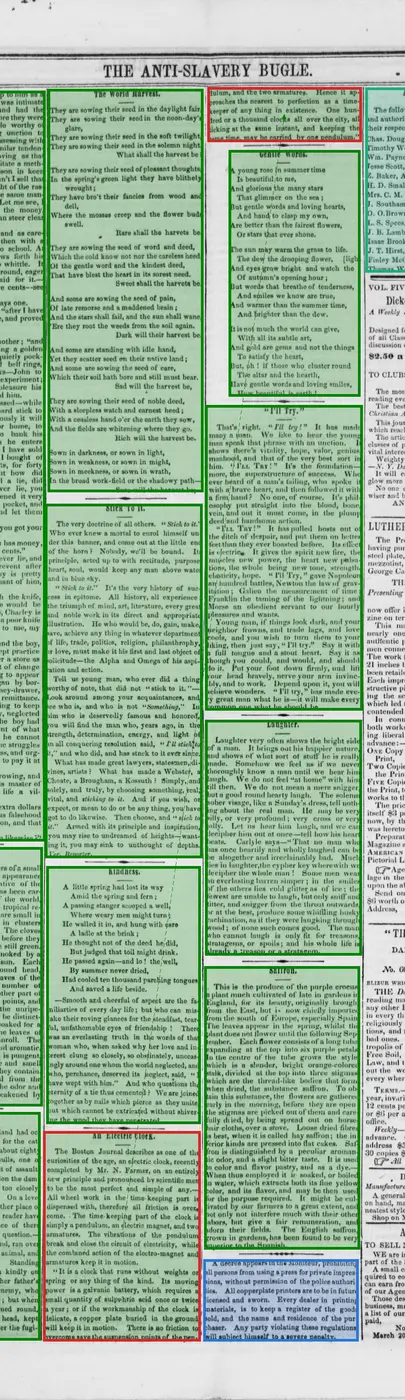
snewpapers
An Electric Clock.The Boston Journal describes as one of the curiosities of the age, an electric clock, recently completed by Mr. N. Farmer, on an entirely new principle and pronounced by scientific men to be the most perfect and simple of any.— All wheel work in the time-keeping part is dispensed with, therefore all friction is overcome. The time-keeping part of the clock is simply a pendulum, an electric magnet, and two armatures. The vibrations of the pendulum break and close the circuit of electricity, while the combined action of the electro-magnet and armatures keep it in motion.
"It is a clock that runs without weights or spring or any thing of the kind. Its moving power is a galvanic battery, which requires a small quantity of sulphuric acid once or twice a year; or if the workmanship of the clock is delicate, a copper plate buried in the ground will keep it in motion. There is no friction to overcome save the suspension points of the pendulum, and the two armatures. Hence it approaches the nearest to perfection as a time-keeper of any thing in existence. One hundred or a thousand clocks all over the city, all ticking at the same instant, and keeping the same time, may be carried by one pendulum."
American Stories
An Electric Clock.The Boston Journal describes as one of tho curiosties of the age, an electric clock, recently completed by Mr.. N Farmer, on an entirely new principle and pronounced by scientific men to be the most perfect and simple of any, All wheel work in the time. keeping part is dispensed with, therefore all friction is over. come. The time keeping part of the clock is simply pendulum, an electric magnet and two armatures. The vibrations of the pendulum break and close the circuit of electricity, while the combined action of the electro-magnet and armatures keep it in motion.
at is a clock that runs without weights or spring or any thing of the kind. Its moving power is galvanic battery, which requires a small quantity of sulpphric acid once or twice a year or if the workmanship of the clock is delicate, a copper plate buried in the ground will keep it in motion. There is no friction to overcome save the suspension points Of the pen
dulum, and the two armatures. Hence /; APP proaches the nearest to perfection as a time keeper of any thing in existence. One hun dred or thousand clocks all over the city, all ticking at the same instant, and keeping the same time, may be carried by one pendulum"
- the pieces asked about (American Stories):
- [1] AS #1: begins: "An Electric Clock. The Boston Journal describes as one of tho curiosties of the age," … ends: "in motion. There is no friction to overcome save the suspension points Of the pen"
- [2] AS #13: begins: "dulum, and the two armatures. Hence /; APP proaches the nearest to perfection as a" … ends: "at the same instant, and keeping the same time, may be carried by one pendulum""
1:1 matchmatchpoem ↔ AS #10 p4-8
snewpapers
Gentle Words.A young rose in summertime Is beautiful to me, And glorious the many stars That glimmer on the sea; But gentle words and loving hearts, And hand to clasp my own, Are better than the fairest flowers, Or stars that ever shone.
The sun may warm the grass to life, The dew the drooping flower, And eyes grow bright and watch the light Of autumn's opening hour; But words that breathe of tenderness, And smiles we know are true, And warmer than the summer time, And brighter than the dew.
It is not much the world can give, With all its subtle art, And gold are gems and not the things To satisfy the heart, But, oh! if those who cluster round The altar and the hearth, Have gentle words and loving smiles, How beautiful is earth!
American Stories
Gentle Words.A young rose in summer time
Is beautiful to me, And glorious the many stars
That glimmcr on the sea; But gentle words and loving hearts, And hand to clasp my own, Are better than the fairest flowers, Or stars that ever shone. The sun may warm the grass to life. The dew the dropping flower, [ligh And eyes grow bright and watch the Of autumn's opening hour; But words that breathe of tenderness, And smiles we know are true, And warmer than the summer time, And brighter than the dew. It is not much the world can give, With all its subtle art, And gold arc gems and not the things To satisfy the heart, But, oh if those who cluster round The altar and the hearth, Have gentle words and loving smiles. How beautiful is earth
1:1 matchmatchliterary ↔ AS #8 p4-9
snewpapers
'I'll Try.'That's right. 'I'll try!' It has made many a man. We like to hear the young man speak that phrase with an unction. It shows there's vitality, hope, valor, genius, manhood, and that of the very best sort in him. 'I'll Try!' It's the foundation—more, the superstructure of success. Who ever heard of a man's failing, who spoke it with a brave heart, and then followed it with a firm hand? No one, of course. It's philosophy put straight into the blood, bone, vein, and out it must come, in the plump deed and handsome action.
'I'll Try!' It has pulled hosts out of the ditch of despair, and put them on better feet than they ever boasted before. Its effect is electric. It gives the spirit new fire, the muscles new power, the heart new pulsations, the whole being new tone, strength, elasticity, hope. 'I'll Try,' gave Napoleon an hundred battles, Newton the law of gravitation; Galileo the measurement of time; Franklin the taming of the lightning; and Morse an obedient servant to our hourly pleasures and wants.
Young man, if things look dark, and your neighbor frowns, and trade lags, and love cools, and you wish to turn them to your liking, then just say, 'I'll try.' Say it with a full tongue and a stout heart. Say it as though you could, and would, and should do it. Put your foot down firmly, uplift your head bravely, nerve your arm invincibly, and to work. Depend upon it, you will achieve wonders. 'I'll try,' has made every great man what he is—it will make every common one what he should be.
American Stories
an Try"That's right "W by!" 1t has made many n man. We like 10 hear the young man speak that phrase with an unciioli. 1t shows there's vitality, hope, valor, genius, manhood, aud that Of the very best sort in him. "rLL TRY" It's the foundation more, the superstructure of success. Who ever heard of n mans failing, who spoke it with brave heart, and then followed it with n firm hand? No one, of course. It's phil osophy put straight into the blood, bone, vein, aud out it must come, in the plump deed aud handsome action.
"PLL TRY!" 1t has pulled hosts out of the ditch of despair, and put them on better feet than they ever boasted before. Its effect is clectrc- 1t gives the spirit new fire, the muscles new power, the heart new pnlsn- tons, the whole being new tone, strength, elasticity, hope. "Tll Try" gave Napoleon IN hundred battles, Newton the law of grav- itnton; Calico the measurement of time I; franklin the tanning of the lightning; and Morse an obedient servant to our hourly pleasures and wants.
Young man, if things look dark, and your neighbor frowns and trade lnss, aud love coos, and you wish to turn them to yonr liking, then Just say, "rll try" Say it with n full tongue and n stout heart. Say il as though you could, and would, and should do it. Put your foot down firmly, uud liii your head bravely, nerve your arm invuc- IDLY, and TO work. Depend upon it, you will achieve wonders. an iry," has made eve ry great man what he is-it will make every one what he should be.
1:1 matchmatchliterary ↔ AS #17 p4-10
snewpapers
Laughter.Laughter very often shows the bright side of a man. It brings out his happier nature, and shows of what sort of stuff he is really made. Somehow we feel as if we never thoroughly know a man until we hear him laugh. We do not feel "at home" with him till then. We do not mean a mere snigger, but a good round hearty laugh. The solemn sober visage, like a Sunday's dress, tells nothing about the real man. He may be very silly, or very profound; very cross or very jolly. Let us hear him laugh, and we can decipher him out at once—tell how his heart beats. Carlyle says—"That no man who has once heartily and wholly laughed can be altogether and irreclaimably bad. Much lies in laughter, the cipher key wherewith we decipher the whole man! Some men wear an everlasting barren simper; in the smiles of the others lies cold glitter as of ice: the fewest are unable to laugh, but only sniff and titter, and snigger from the throat outwards, or at the best, produce some whiffling husky cachination, as if they were laughing through wood; of none such comes good. The man who cannot laugh is only fit for treasons, stratagems, or spoils; and his whole life is already a treason or a stratagem."
American Stories
Laughter.Laughter very often shows the bright side of u man. 1t brings out his happier uature, aud shows of what sort OF stuff he is really made. Somehow we feel us if we never thoroughly know man until we hear him laugh. We do not feel "at home" with him till then. We do not mean a mere Singer, but good round hearty laugh. The solemn sober visage, like Sundays dress, tell moth ing about the real man. lie may he very silly, or very profound; very cross or very jolly. Let us hear him laugh, and we can decipher him out at once-tell how his heart heats. Carlyle says-"That no man who has once heartily and wholly laughed can be he altogether and irreclaniably bad. Much lies in laughter,the cypher key wherewiIh we decipher the whole man Some men wear nn everlasting barren simper; in the smiles Of the others lies cold glitter as of ice the iewest nrc unable to laugh, but only sniff aud litter, aud singer from the throat outwards, or at the best, produce some wl,illling husky cachinaiion, as il they were laughing through wood of none such comes good. The man who cannot laugh is only fit for trensons, strntagens, or spols; aud his whole life is already treason or a stratagem.
1:1 matchmatchfiller ↔ AS #22 p4-11
snewpapers
Saffron.This is the produce of the purple crocus, a plant much cultivated of late in gardens in England, for its beauty, originally brought from the East, but is now chiefly imported from the south of Europe, especially Spain. The leaves appear in the spring, whilst the plant does not flower until the following September. Each flower consists of a long tube, expanding at the top into six purple petals. In the centre of the tube grows the style, which is a slender, bright orange-colored stalk, divided at the top into three stigmas, which are the thread-like bodies that form, when dried, the substance saffron. To obtain this substance, the flowers are gathered early in the morning, before they are open; the stigmas are picked out of them and carefully dried, by being spread out on horse-hair cloths, over a stove. Loose dried fibres is best, when it is called hay saffron; the inferior kinds are pressed into flat cakes. Saffron is distinguished by a peculiar aromatic odor, and a slight bitter taste. It is used to color and flavor pastry, and as a dye.— When thus employed it is soaked, or boiled in water, which extracts both its fine yellow color, and its flavor, and may be then used for the purpose required. It might be cultivated by our farmers to a great extent, and not only not interfere much with their other labors, but give a fair remuneration, and adorn their fields. The English saffron, grown in gardens, has been found to be very superior to the Spanish.
American Stories
Saffron.This is the produce of the purple crocus, plant much cultivated of late in gardens in England, for its beauty, originally brought from the East, but j. now chiefly imported from the south of Europe, especially Spain. The leaves appear in the spring, whilst the plant does not flower until the following Sep tember. Each flower consists of long tube, expanding at the top into six purple petals. In the centre OF the tube grows the style, which is slender, bright orange-colored stalk, divided at the top into three siigmas, which are the thread-like bodies that form, when dried, the substance saffron. To oh tain this substance, the flowers are gathered early in the morning, before they are open the stignas are picked out Of them and care fully died, by being spread out on horse hair cloths, over Il stove. Loose dried fbres is best, when it is called hay saffron; the in. ferior kinds are pressed into flat cakes. SAT- from is distinguished by peculiar aroman- tic odor, and slight bitter taste. 1t is used to color and flavor pastry, AMI as a dye When thus employed il iC soaked, or boiled in water, which extracts both its fine yellow color, and its flavor, and may be then used for the purpose required. II might De cul- tiyated by our farmers to great extent, and not only not Interfere much with their other labors, hut give fair remuneration, aud adorn their fields. The English saffron, grown in gardens, has been found to be very superior TO the Spanish.
1:1 matchmatchforeign_news ↔ AS #15 p4-12
snewpapers
A decree appears in the Moniteur, prohibiting all persons from using a press for private impressions, without permission of the police authorities. All copperplate printers are to be in future licensed and sworn. Every dealer in printing materials, is to keep a register of the goods sold, and the name and residence of the purchaser. Any party violating these regulations, will subject himself to a severe penalty.American Stories
A decree appears in the Moniteur, prohibiting all persons from using apress for private impress sions, without permission of the police authori- ties. All copperplate printers are to be in future licensed and sworn. Every dealer in printing materials, is to keep register of the goods sold, and tho name and residence of the pur- chaser. Any party violating these regulations, will subject himself to severe penalty.1:1 matchmatchnotice ↔ AS #7 p4-13
snewpapers
Agents for the Bugle.The following named persons are requested and authorized to act as agents for the Bugle in their respective localities.
Chas. Douglass, Berea, Cuyahoga county, Ohio Timothy Woodworth, Litchfield, Medina co., O. Wm. Payne, Richfield, Summit co., Ohio. Jesse Scott, Summerton, Belmont Co. Z. Baker, Akron, Summit Co. H. D. Smalley, Randolph, Portage Co. Mrs. C. M. Latham, Troy, Geauga, Co., O. J. Southam, Brunswick. O. O. Brown, Bainbridge. L. S. Spees, Granger. J. B. Lambert, Bath, Isaac Brooks, Linesville, J. T. Hirst, Mercer, Finley McGrew, Painesville, Thomas Wooton, Winchester, Indiana.
American Stories
Agents for the Bugle.The following named persons are requested and authorized to act as agents for the Buglo in their respective localities. Chas Douglass, Berca, Cuyahogs county, Ohio. Timothy Woodworth, Litchfcld, Medina co., o. WIN. Payne, Richfeld, Summit co., Ohio. Jesse Scott, Summerton, Belmont Co. Y. Baker, Akron, Summit Co. II. d. Smalley, Randolph, Portage Co. Mrs. C. NJ. Latham, Troy, Gcauga, Co., o. ]. Southam, Brunswick. o. O.Brown, Bainbridge. L. s. Specs, Granger.
J. Il. Lambert, Bath, Isnac Brooks, Linesville,
J. T. Hirst, Mercer,
Finley McGrew, gainesville, Thomas wooton, Winchester, Indiana.
AS onlycorrectly not servedAS #49 p4-14
- advertisement: The text promotes Dickens's 'Household Words' weekly journal with descriptive marketing language and subscription style, rather than being newspaper masthead or subscription terms for the Anti-Slavery Bugle.
snewpapers
nothingAmerican Stories
VOL. FIVE WILL COMMENCE IN APRILDickens "lIOuSehOld Words"
A Weekly Journal, and /" TiaiuaJIe Whispers,
or american Items.
Designed for the Instruction and Entertainment OF all Glasses of Readers. and to assist in the discussion Of the Social Questions OF the times.
AS onlycorrectly not servedAS #21 p4-15
- subscription terms or colophon: The text gives a subscription price ($3.50 a year) and per-number cost (6 cents), which are subscription terms for the newspaper.
snewpapers
nothingAmerican Stories
$3.50 n Year by MniI--6 Cents aNumber.
AS onlycorrectly not servedAS #51 p4-16
- advertisement: The passage promotes Sartain's Magazine and describes an engraved plate offered to subscribers, which is advertising content.
snewpapers
nothingAmerican Stories
LUTHER AND HIS ADHERENTS.The Propriotors of Sartain's Magazine having purchased the large aud handsome steel plate, carefully engraved in line and mezzotint, from the celebrated design by George Cattermos, representing
AS onlycorrectly not servedAS #19 p4-17
- advertisement: This is a promotional notice for a print and magazine subscription offer with prices, club terms, and an address to send orders, which is advertising copy rather than editorial content.
snewpapers
nothingAmerican Stories
THE FIRST REFORMERsgeorge ChtteruiOlS, representing
THE FIRST REFORMERs Presenting their Famous Protest at The Dict Of
Spres, in 1929,
now offer il in connexion with their Muga- zine on terms unpreccdcntly low.
This magnificent composition contains nearly one hundred figures, and includes authentic portraits of the most prominent men connected with that important event. The work Exclusive Of margin) measures II inches 10y 10, aud the print has never been retailed at price less than ;s3 per copy. Each impression is accompanied by an in- structive pictorial key of reference, describ- ing the scene, the characters, the history which led to the event, aud the principles Contended for.
In connexion with Sarian's Magazine both works will he furnished on the follow ing liberal terms, which are invariably in advanced
ONE Copy of the Magazine, aud one of the Print, So. Two Copies of the Magazine, aud two OF the Prints, S. FIVE Copies of the Magazine, and five o the Print, together with one copy OF both works TO the getter up of the Club, SI2.
The price Of Snrtan's Magazine being OF itself S3 per annuni, both works jointly mny now, by the above offer, be had for wnt was heretofore the price of each separately. Preparations are making to publish in the Magazine series of illustrated articles on AMERICAN HEROES, commencing with IL Pictorial Life of General Jackson.
0FAgeprs wanted in every town and vii lage in the United States, 10 get up Clubs upon the above liberal terms.
Send on your Subscriptions, and secure SO worth of reading and cngravings for So. Address, JOHN SARrAIN & Co,
PhiIddeiphid.
AS onlycorrectly not servedAS #16 p4-18
- subscription terms or colophon: This is a publisher's promotional notice and subscription terms for The Commonwealth, listing prices and agents rather than a goods/services advertisement or a masthead.
snewpapers
nothingAmerican Stories
TIE C0MM0NWEIs PUBLISHED DAILY AND WEEKLY BY L. WRIGHT g. Co.,
No. 60 Washington Sired, Boston.
ELIzUR WRIGHT, Editor. cHAs LIST, Asst Ed.
THE Daily Commonwealth contains more reading matter, aud more fresh NEWS, than any other Boston paper. 1t is independent in every thing, and neutral in nothing. 1t is religiously conservative OF all good insttu- tions, and radically destructive towards all bad ones. IL is The only paper in the me- tropolis of New England winch advocates Free Soil, the Repeal of the Fugitive Slave Law, aud the union of free people through out the world for the defence of Liberty every where.
TERMs.-Daiiy-(sunday excepted) s5 a year, invariably in avance. City subscribers, II ceuis per week, payable to the carriers or S6 per annum, payable in advance at the office.
Weekiy-Saturday mornings, 80 year in advance. Clubs ordering copies to one address IS; 10 copies SIS; 20 copies S25 30 copies $50.
0P AL POstmaSters are Agents.
AS onlycorrectly not servedAS #23 p4-19
- advertisement: It is a business card-style promotion for a carriage manufacturer, listing his products, location, and shop details.
snewpapers
nothingAmerican Stories
DAVID WOODRUFF.Manufacturer Of Carriages, Buggies, Sulkies, Sc
A general assortment of carriage constantly on hand, made of the best mi .erial nd in the neatest style. All v orls war; mted
Shop on Main sire t. Sa-sR o.
AS onlycorrectly not servedAS #12 p4-20
- advertisement: The text solicits agents to sell books, promises earnings, and gives a contact address, which are hallmarks of a commercial advertisement.
snewpapers
nothingAmerican Stories
AGENTS WANTED,TO SELL NEW AND POPULAR BOO
TO SELL NEW AND POPULAR BOOKS. WE are in want of Agents to canvass this part of the State for our new Books.
A small capital Of but $40 or $l5 will be re- quired to commence with, and an active person can earn from $500 TO $500 per day. Some of our Agents earn much more.
Those desirous of engaging in this profitable business, may obtain our plan of operation, and a list of our Publications, by addressing, post paid, M. +. ToOKER & Co..
No. lo2, Superior St., Cleveland, o. March 20, 1859.
AS onlymissed by snewpapersAS #54 p4-21
- other content: This appears to be a book advertisement or listing for Littell's Living Age with endorsements, which reads as a promotional notice rather than subscription terms, masthead, or page furniture.
snewpapers
nothingAmerican Stories
VOL. z.LITTELL'S LIVING AGE.
Extracts Of letters from Judge Story, ChGncsl7o, | Kent, and President adams.
AS onlycorrectly not servedAS #11 p4-22
- advertisement: The text consists of multiple testimonials praising a periodical's prospectus and plan, which is typical advertising endorsement copy for a publication.
snewpapers
nothingAmerican Stories
Kent, and President adams.CAMBRIDGE, April "a, 1874.
have read the prospectus with great plea sure, aud entirely approve the plan. If il can only Obtain the public patronage long enough, and large enough, and securely enough to attain its true ends, it will contri- butte in an eminent degree to give healthy tone not only to our literature, but to public opinion. II will enable us TO possess in a. moderate compass select library of the best productions OF the age. 1t will do more it will redeem our periodical literature from the reproach of being devoted to light and superficial reading, to transitory speculntions, to sickly and ephemeral seDtimentnliiies, and false and extravagnnt sketches of life and character. JOSEPH STORY.
New YoRK, 7ib May, 1S4f.. approve very much of the plan of the Living Age;' and IL il be conducted witlt the intelligence, spirit and TASTE that the ~ iospectus indicates, (of which j have no reason to doubt,) ii will be one of the most instructive aud popular periodicals of tho day. JAMES KENT.
WAsnNGToN, 27ih Dec, 1914.
Of all the periodical journals devoted TO literature and science which abound in Eu- rope aud in this country, this lnis appeared. to the the most useful. II contains indeedi the exposition only of the current literature of the English language, but this by its inn mense extent aud comprehension, includes u portraitufe of the huinnn mind in the Ut most expansion OF the present age.
J. q. ADAMS.
AS onlycorrectly not servedAS #3 p4-23
- advertisement: This is a promotional prospectus for a periodical (The Living Age), including subscription prices and publisher details, which functions as an advertisement soliciting subscribers.
snewpapers
nothingAmerican Stories
PROSPECTUS.This work is conducted in the spirit OF Lltell's Museum of Foreign Literature, (which was iuvornhly received ly the rublic for twenty years. but MS 1t is twice as large, aud appears so often, we not only give spirit aud freshness to it hy many things which were excludcdby months delay, hut While we arc thus extending Our scope and gather ing II greater aud more attractive variety, nre able so to increase the solid aud substantial part of our literary, historical, aud political harvest, us fully to satisfy the waits Of tie American render.
The elaborate aud stately Essays Of the Edinburgh Quarterly, aud other Reviews aud Dlackwood's noble criticisms on Poetry, his keen political Commentaries, highly wrought Tales aud vivid descriptions oi ~ raj and mountain Scenery aud Tie rouiii- buttons to Literature, History, aud Con non Life, 10y the sagociOus Spectator, tle spnlk- ling Examiner, the judicious AiIrnruu,. tie busy and industrious Gazette, The sensible and comprehensive Britannia, the sober and respectable Christian Observer; these ale intermiXed with the Milury and Naval reni- nSccncCs of the United Service, and with the best articles of the Dublin University, New Mouthly, Fruzcr's, Tuil's, Ainsw orili's, Hoods, and Sporting Magazines, nnd of Chambers admirable Journal. We do not consider it hencaih Our dignity TO borrow wit and wisdom from Punch and, when we think il good enough, to make use of the thunder of The Times. We IN II incrcase our variety of importutions from the conti- nent of Europe, aud lion the new growth of the British Colonies.
We hope that. by 'winnowing The wheat from the chafl,' by providing abuidanlly for the Imagination, and 10y n large collection of Biography, Voyages, Travels, History, aud more solid matter, We may produce work which shall he popular, while ut tie same time it will aspire TO raise the standard of public taste.
The LIVING AGE is published every Sn- mrdoy, by Il. Littcl g. Co., corner of Tre- mont aud Bromfeld streets, Boston Price l2 l-2 cents u number, or six dollars a year in advance. RemittancPs for any period will be thankfully received and promptly attcndedto.
PosTAGE FREE.-To all subscribers with in 1900 miles, who remit in advance, direct ly TO the office of publication, at Boston, the SUN of Six dollars, we will continue the work beyond the yenr, as longns shnll he an equivalent to the cost OF the postage thus virtually carrying out the plan Of sending every mnns copy 10 him PosTAGE FREE; placing our distant subscribers on the same footing hs those nearer to MS and mixing the whole country our neighborhOod.
We hope for such future change in the law, or in the Interpretation thereof, as will enable us TO make this offer to subscribers at any distance.
f.. LiTTELL, & CO., Boston.
AS onlycorrectly not servedAS #20 p4-24
- advertisement: It promotes the Galen Institute's upcoming term, listing tuition prices, board rates, and contact information for the principal, which are characteristic of a paid advertisement.
snewpapers
nothingAmerican Stories
Galen 1nstitutr.THE next term of this Institution will COM mcncc March Goth, 1852, and continue Is weeks-Tuiton per quarter of IL weeks from $500 to $500; with moderate extra charges Tor the French and German Languages, Pencil and Pen Drawing and Painting in Water Colors and Oil.
During the term DIR. X. II. MACK of Ceve- land will deliver course of Lectures on Ana tony and Physiology, illustrating his subjects by an excellent French Manikin and Skeleton, and a full course oil Lessons in Penmanship will be given by an Accomplished Instructor, of both of which pupils may have the advan tages on very moderate terms.
Board can be had in private families at 81, ,26 per week.
For further information address
VIM. McCLAIN, Principal. Salem, Col. co., o., March s, 1862.
AS onlycorrectly not servedAS #18 p4-25
- advertisement: The text promotes and gives subscription details for The Evening Post newspaper, including prices and contents, which is a paid promotional notice rather than the publishing paper's own subscription terms.
snewpapers
nothingAmerican Stories
The Evening Post, Semi Weekly,PUBLISHED EVERY TUESDAY AND FRIDAY, At 50 per annunl, payable IN adrancs, At No. l8
Nassau, near Pine street, Nsi0 York.
WILLIAM C. BRYANT & Co.
Each Number contains the latest intelli- gence, political, foreign, and domestic and is sent off by the earliest mails to subscribers in every part of the Union.
Four dollars will be charged when the subscription is not paid within the first six months.
The Epening Post is published daily at the same office at $40 per annum. II contains full account of the occurrences of the day; and regularly by correspondence, &C., the the latest foreign nteligence-reprints all public documents of interest and impor- tance--contains special, full and accurate report of Commercial and Financial Affairs, New York Markets &c, &c,