sn83045634 1798-06-11 ed-1: segmentation, region by region
LoC issue · American Stories revision 77e27fa6
Same LoC scan for 4 of 4 pages.
Scorecard
Each comparison starts from a snewpapers component. "=" means both systems drew the same article. Where they differ, a language model, shown only the text, was asked which is right, twice, with the two claims stated in each order.
Where the two segmentations agree or differ
| times | snewpapers right | AS right | neither | unsure | page furniture, not counted | |
|---|---|---|---|---|---|---|
| Same article on both sides (=) | 14 | – | – | – | – | – |
| One snewpapers component, several AS articles (1 : N) | 8 | 6 | 0 | 0 | 2 | – |
| Several snewpapers components, one AS article (N : 1) | 6 | 6 | 0 | 0 | 0 | – |
| One snewpapers component, one AS article running on into other text | 0 | 0 | 0 | – | 0 | 0 |
| AS text attached outside a snewpapers component | 5 | 0 | 0 | – | 0 | 5 |
| A line of a snewpapers component in another AS article | 2 | 1 | 0 | – | 0 | 1 |
Where only one side has text
| times | |
|---|---|
| snewpapers component, AS has no text, no AS box there (an AS error) | 5 |
| snewpapers component, AS has no text, AS marked it illegible (an AS error) | 0 |
| snewpapers component, AS has text for under 90% of it, the rest in no AS box (an AS error) | 2 |
| snewpapers component, AS has text for under 90% of it, the rest marked illegible (an AS error) | 0 |
| AS text in no snewpapers component: ads, terms or page furniture (left out on purpose) | 1 |
| … of which ads (AS says it leaves ads out) | 0 |
| AS text in no snewpapers component: other content snewpapers does not serve | 0 |
| AS text in no snewpapers component: too short to ask | 1 |
| AS boxes in no snewpapers component with no text at all (AS read nothing) | 1 |
| AS text in no snewpapers component: no verdict | 0 |
What the decisions judged
| judged wrong | judged right | |
|---|---|---|
| American Stories articles | 22 | 0 |
| snewpapers components | 0 | 29 |
American Stories errors found
| errors | decisions | |
|---|---|---|
| items of ours AS merged into one article | 25 | 6 |
| fragment articles AS split our components into | 16 | 6 |
| lines of ours AS put in another article | 1 | 1 |
| AS articles running on into other items | 0 | 0 |
| AS articles missing part of a component (under 90%) | 2 | – |
| our components AS has no text for | 5 | – |
| pages of our components AS lacks the text for | 0 | – |
| text AS has twice | 0 | – |
| ads AS kept (it says it leaves ads out) | 0 | – |
| AS boxes it marked illegible that snewpapers read | 3 | – |
Text quality: words found in an English word list
| real words | words | share | |
|---|---|---|---|
| snewpapers | 6,977 | 7,006 | 99.6% |
| American Stories | 5,770 | 6,660 | 86.6% |
| American Stories boxed area it marked illegible and did not read | – | – | 0.3% |
How this was scored
Every comparison is anchored on a snewpapers component and the American Stories boxes inside it. Where those boxes belong to several AS articles (or several of our components lie inside one AS article), the model was shown the passage as the numbered pieces and asked whether it is one component, several or mixed, twice, with the two beliefs stated, unattributed, in each order. A verdict that changed with the order is unstable and counts for neither side. AS text inside none of our components was asked whether it is advertisements, terms or page furniture, which snewpapers leaves out on purpose. Where AS attaches text outside one of our components (text of an AS article our component otherwise has), the model was shown our component's text and the attached text and asked whether the text belongs to the component, twice, the two beliefs stated in each order: "separate" means snewpapers is right, "belongs" American Stories. Where two AS articles inside one of our components hold the same text (the shorter sharing at least 50% of its 4-word phrases with the longer), the longer is kept and the text counted as duplicated by American Stories; so is attached text another AS article also holds. Where American Stories has a line or two of our component (at most 12 words and 5% of its area) in another AS article while one article holds the rest, the line is no split: the model was shown the rest of the AS text and the line and asked whether the line belongs to the component, both ways; "belongs" means snewpapers is right and judges only the article holding the line wrong (lines in another AS article). One AS article counts as a match only when the two cover each other, both ways: AS text covers at least 90% of our component, and our component at least 90% of that AS article's text. Coverage is measured line by line down each column (how much of its height the other side's boxes span, so a centred headline narrower than its column still counts). Under 90% the first way, the component is partly captured by AS (the rest in no AS box, or marked illegible): not asked, an AS error by the geometry, its AS article judged wrong (AS articles missing part of ours). Under 90% the second way, the AS article runs on beyond our component into other text: that text is asked about as text attached outside, and "separate" judges the AS article wrong (AS articles running on into other items). Decisions are the unit counted above; the last table counts what they judged: an as_split decided "one" is one decision and every AS article inside our component judged wrong, an N ours : 1 AS decided "several" one decision and each of our N components judged right (an article or component judged both ways by different decisions counts in both rows). AS errors count what the decisions for snewpapers found American Stories got wrong, next to those decisions: an N ours : 1 AS is N errors, the N items of ours AS failed to separate (items AS merged), a 1 ours : N AS N errors, the N AS fragment articles. A component inside an N ours : 1 AS (its AS text a slice of the merged article) is counted in the components table by that decision's outcome. A component running over pages is one comparison across them (American Stories never links an article across pages): its AS articles on all its pages, labelled by page, are the pieces asked about, once; it counts once among our components, and a decision for snewpapers judges every one of those AS articles wrong, each a fragment article.
| groups | 61 |
|---|---|
| 1:1 match | 14 |
| 1 ours : N AS | 8 |
| N ours : 1 AS | 6 |
| in N ours : 1 AS | 22 |
| continued | 1 |
| ours only | 5 |
| AS only | 1 |
| AS only, tiny | 1 |
| AS only, no text | 1 |
| 1:1, AS partial | 2 |
| 1:1, AS article wider | 0 |
| snewpapers covered by AS (area) | 87.7% |
| AS covered by ours (area) | 96.7% |
| median text ratio over matches | 91.2 |
| AS duplicated text | 0 |
| AS text attached outside ours | 5 |
How to read this
Each group is the same crop of the scan twice: snewpapers' boxes on the left, American Stories' on the right. The group's own boxes are outlined in red. Groups are in page position order (column by column), not reading order. A component can appear twice: in its own case and in an N ours : 1 AS group. Text of a component's own AS articles printed outside the component is left out of the comparison and shown beneath the group as "American Stories also attaches: «…» (outside this component)".
| 1:1 match | the AS text inside our component (boxes, or the slices of boxes it overlaps) all belongs to one AS article (or to several that duplicate one another: American Stories duplicated the text) |
|---|---|
| 1 ours : N AS | the AS text inside our component belongs to several AS articles: one component or several? |
| N ours : 1 AS | two or more of our components lie inside one AS article (80% or more of each, or 50% or more with a slice of the article): one component or several? |
| in N ours : 1 AS | all the AS text inside our component is a slice of an AS article that holds other components of ours too: no agreement (the slice is cut along our boundaries, not AS's); decided by that N ours : 1 AS |
| continued | a later page of a component of ours running over pages: compared, asked and decided once, across its pages, in the group on its first page |
| ours only | no AS box overlaps our component enough to give it a slice: not captured by American Stories |
| AS only | AS text inside none of our components (one AS article's): left out on purpose, or missed? |
| AS only, tiny | AS text inside none of our components, under 20 characters: not asked |
| AS only, no text | an AS article inside none of our components with no text at all (AS boxed it but read nothing, most often marking it illegible): nothing to ask, counted for neither side |
| 1:1, AS partial | the AS text inside our component all belongs to one AS article, but AS has text for under 90% of our component, measured line by line (the rest is in no AS box, or AS marked it illegible): partly captured by American Stories, not asked; its AS article counts as an AS error |
| 1:1, AS article wider | one AS article holds our component, but runs on beyond it into other text (our component covers under 90% of the article's text, measured line by line): the text it runs into is asked about, and decides it |
snewpapers:newsopinionnoticescommercepeopleliterarylistingsother
American Stories:articleheadlineauthor
only in snewpapersonly in American Stories(words compared lowercase, without punctuation)
Page 1
1:1 matchmatchletter_to_editor ↔ AS #4 p1-1 AS attaches text outside it AS puts a line of it in another article
American Stories also attaches: «honday, June II, 1898.
POLITICS..» (outside this component; AS article #17) page furniture, not counted
- stated first: the component includes it (American Stories): page furniture, not counted (said furniture): This is a dateline and section heading printed above the page content, serving as page furniture rather than part of the Brutus political address.
- stated first: the component does not include it (snewpapers): page furniture, not counted (said furniture): This is a masthead-style dateline and section heading ('POLITICS..'), page furniture that merely labels the page rather than being part of the letter/essay printed beside it.
American Stories puts part of this component in another article: «tie CITIZENS Of the United States.» (inside this component; AS article #17) snewpapers right
- stated first: the component does not include it (American Stories): snewpapers right (said belongs): The text "CITIZENS Of the United States" is the salutation/addressing line that the following speech text ("ever there was a time when...") directly continues, so it is part of the same printed address.
- stated first: the component includes it (snewpapers): snewpapers right (said belongs): The phrase 'CITIZENS Of the United States' is the salutation/heading of this address, which opens by directly addressing the citizens and continues with exhortations to them, so it is part of the same printed item.
American Stories
Patskl 'He ~ LIENS y 'NE CHIlco OldttS' g to- / f ever there was a time when 7 d&n Eional excrtion, firmnels and unanim- ! PsSY were neccdary TO the prefervation al VSi the liberties Of the people, that time raaJ ssow exits. Menaced with fubiugation ptass'g nation whole only Object is her al u wa aggrandizcment, and whole AFRO 1s Pasance is unparalleled in the annals Ofs:.',aa.iitory, it behoves you as Americans 10 b.,s ',ake firm and undaunted rally round ,sdsS' lat fandard which with your blood
s'sd Sou erected, and which with your blood and you mutt maintain. The only hopes a' ST your enemies are in divifionS and .r = @sii dentions amongyourielves, which they nat ,,l pink they have already excited, and ..sasafhich they are by all pofible means Onaa andeavouring to foment: But your !. 9a ardor in the cauie of the independence ) II. If your country, will, am confident, uades oon undeceive them, & convince them lf:a pshat although you can be grateful for Ut imsenefa6ionS, and remember fervices !. q while you lupPofe them to proceed from ]. pure and dihnterelted motives; vet which eEhen you are fatished that thofe very were levelled at your own in nd "a dependence, by wrefting you from the !. vS 1rmS of Britain, merely to bring you / BoasEithin thofe of your pretended benefac- oatuatorS you will not be lulled into fatal r-delufon, but rife with the fpirit Of 10 ;
ia. 35!'iand if you mutt be Aaves, make at leaft ga; ~ one united ftru gle to be free. Suffer arsrait not to be faid, the fons Of America !: red eierve not TO be free, for they are inca aagapable Of maintaining their indepen- = Hence but rather let it be faid, in fo II little eitimation do Americans hold their
Mblood, when put in competition with 4 uEtheir freedom, that rather than fuffer the fnallef portion of it to be facrifced n.arIs.they would mott cheerfully content to ] nsthe efulon of every drop in the de- ieh fence of their country.
us4i Form yonrfelveS, fellow citizens, into nd . a firm, determined phalanx, feadfaf- ,nn,sly refolving to cruih any thing like op- = petition to thole meafureS which alone = 9acan fecure TO you thoGe invaluable rights ned which, if firm and united, you can new Ter be deprived Of, but which France is by all Pohible means endeavoring tc via undermine. Not only unite in thi;
grand cauie, but on all public occafon' s.ss proclaim your unanimity, and hold uE apHto deteltation thofe characters who even
bas swifh to impair it. BY this means you S.I viii convince France that her hope Of sds deitroying by difuniting you,i perfectly .se falaciouS, and that neither fhe, nor any
Other nation upon earth, need ever, fol o. one moment, entertain the idea, that tc ,5q divide the Americans upon the great and inG glorious caule Of their freedom and in
he dependence, is even within the verge i51 OF remoteR Pohibllity. BRUTU6.
rr
1 ours : N ASsnewpapers righteditorial ↔ AS #2, AS #1 p1-2
- stated first: several components (American Stories): snewpapers right (said one): The two pieces are a continuous run of a single essay on self defence; [2] picks up mid-word from [1] ('re-' / 'fource'), so they belong together as one component.
- stated first: one component (snewpapers): snewpapers right (said one): The second piece picks up mid-word ('fource' continuing 're-/fource') and continues the same essay signed 'MinerVa'; it is a single article split across a column break, not two components.
snewpapers
SELF DEFENCEThe necessity of self defence is as plain as the noon day sun. The capacity of the United States to defend its trade and navigation is greater than most persons have believed. No nation, except Britain, has so much trade and a great trade will support a strong navy. France has not more sea coast, nor at this time more sailors, ships or commerce than we had in 1784. Her wealth, credit or naval resources are not in greater proportion; and after paying her vast armies, her means to equip and maintain a powerful fleet are not so great as those of America, whose credit is established, and whose sources of taxation are yet scarcely made to yield a quarter part of their practicable resource. It is evident that America may be, and sad events prove that she must resolve that she will be, and soon too, a great naval power. A few ships would check piracies on our coast, and straiten the rapacity of the Westindia Algerines. Fully to realize this desirable state of defence, there must be some years preparation, in time of peace, when labor and materials will be cheaper than at present. It will be our folly if we remain twenty years longer under guardianship to any European nation. There is treachery in all foreign protection, and we shall be branded as cowards if we seek safety in any way but by the exertion of our own strength and resources. It has cost a good deal to cure us of our foolish and almost fatal fondness for the French. We shall not love nor blindly trust the English Court. Let us build ships, fortify our ports and provide troops and arms sufficient to keep off invaders and suppress insurrections. [Minerva.]
American Stories
SELF DEFENCE.f" THE necefity Of feif defence is as plain as the noon day fun. The capaci- ty Of the United States to defend its trade and navigation is greater thanmoft perions have believed. No nation, ex- cept Britain, has 70 much trade-and a great trade will fupPort frong navy. France has not more 1ea coat, nor at this time more failors, hips or COM mercc than we had in 1884. Her wealth, credit or naval relources are not in greater proportion and after paying her y2it armies, her means to equip and maintain powerful feet are not 70 great as thofe Of America, Whole credit is elablilhed, and Whole fources Of taxation are yet fcarcely made to yield a quarter part of their practicable re-
fource. 1t is evident that America may be, and fad events prove that ihe mutt retolve that ihe will be, ard foon too, great naval power. A few ihips would check piracies on orr coat, and Itraiten the rapacity Of the Weitindia AlgerlneS. Fully to realize this defra- bic itate of defence, there mutt be fcme years preparation, in time Of peace, when labor ard materials will be cheap er than at prefent. 1t will be our folly II we remain twenty years longer under guardianfhiP to any European nation. There is treachery in all foreign pro- te6tiOn, and we Alall be branded as towards if we feek iafety in any way but by the exertion Of our own ifrength and relourceS. 1t has colt good deal to cure US of our foolifh and almoft ia tai fondneiS for the French. We fhaIl not love nor bIindly truf the Englifh Court. Let us build fhipS, fortify our ports and provide troops and arms fuf- tcient to keep of invaders and fupprels niurrectionS. MinerVa.
- the pieces asked about (American Stories):
- [1] AS #2: begins: "SELF DEFENCE. f" THE necefity Of feif defence is as plain as the noon day" … ends: "Of taxation are yet fcarcely made to yield a quarter part of their practicable re-"
- [2] AS #1: begins: "fource. 1t is evident that America may be, and fad events prove that ihe mutt" … ends: "and provide troops and arms fuf- tcient to keep of invaders and fupprels niurrectionS. MinerVa."
1 ours : N ASsnewpapers rightdomestic_news ↔ AS #3 (p. 1), AS #5 (p. 1), AS #6 (p. 1), AS #7 (p. 1), AS #3 (p. 2) p1-3 continued in p2-1
- stated first: several components (American Stories): snewpapers right (said one): The pieces are consecutive portions of a single item: the list of legislators followed by the Governor's speech, which continues in mid-sentence from page 1 to page 2.
- stated first: one component (snewpapers): snewpapers right (said one): The numbered pieces are consecutive portions of a single item: the list of Massachusetts legislature members followed by the governor's speech, which runs continuously from page 1 into page 2; the divisions merely split one printed item at arbitrary points.
snewpapers
Legislature of Massachusetts.GOVERNOR, His Excellency INCREASE SUMNER. LIEUT. GOVERNOR, His Honor MOSES GILL. COUNSELLORS, The Hon. THOMAS DAWES, ELEAZER BROOKS, OLIVER WENDELL, STEVEN CHOATE, JOSIAH STEARNS, ELISHA MAY, SIMON FRYE, DANIEL WHITNEY and JOHN HASTINGS. Senators, for Maine. York—Hon. Nathaniel Wells and Simon Frye, Esq'rs. Cumberland—Hon. Stephen Longfellow and Daniel Davis, Esq'rs. Lincoln, &c.—Hon. Alexander Campbell and Nathaniel Dummer, Esq'rs. Representatives for Maine. YORK. York, Col. Esaias Preble, Wells, John Storer, Esq. Berwick, John Lord, Esq. Biddeford, Mr. Daniel Hooper, Pepperelboro' Thomas G. Thornton, Esq. CUMBERLAND. Portland, Mr. Woodbury Storer. North Yarmouth, Samuel P. Russell, Esq. Brunswick, Mr. William Stanwood, Freeport, Mr. James Curtis, Buckfield, Mr. Samuel Andrews. LINCOLN, &c. Georgetown, Mark Langdon Hill, Esq. Woolwich, Samuel Harnden, Esq. Winthrop, Col. N. Fairbanks, Bath, Francis Winter, Esq. Pittston, Hon. Henry Dearborn, Esq. Cushing, Mr. Edward Killeran, Camden, Mr. Samuel Jacobs, Augusta, James Bridge, Esq. Farmington, Supply Belcher, Esq. Penobscot, Mr. Pelatiah Freeman, Castine, Dr. Oliver Mann. JUNE 5.
His Excellency the Governor, being duly qualified, met the two houses this day, and delivered the following SPEECH:
Gentlemen of the Senate, and Gentlemen of the House of Representatives,
You are now assembled, pursuant to the wise provision in our excellent Constitution of civil government, for the purpose of making and establishing such wholesome and reasonable statute and ordinances as in your judgment the welfare of this Commonwealth shall require, and for the necessary support and defence of the government thereof: A delegation highly honorable to yourselves, as well as important to the community. When this duty is faithfully performed, you cannot fail of receiving the approbation and applause of your constituents, whose interests cannot be forgotten or neglected, because they are so inseparably connected with your own. Unfounded therefore must be the sentiment that the officers of a free government have a different interest from that of the people, whom they represent, to whom they return at the expiration of their office, divested of all authority, and subject to the consequences of all the laws and regulations made, while they were vested with the powers of government. The opposite position, I conceive, cannot be maintained on any other ground, than upon supposition, that the officers of government, elected by the people, and responsible for their conduct while in office, will counteract their own interest, infringe their own rights and liberties, with those of their families and connections, for the purpose of oppressing the people. A supposition extremely absurd and unnatural. I therefore hold it an article in my political creed, that the people and their government are inseparably united; and that whoever attempts to divide them, cannot be viewed in any other light, than as aiming a blow at the main pillar, on which the whole superstructure rests.
The good sense of the American people, I trust will not suffer them to listen to suggestions, at once so erroneous, and so dangerous to the very existence of a free government, but instead of countenancing unreasonable jealousies, will give a firm support to the constitutional measures of the government of their own choice; without which, no people can long enjoy the invaluable blessings of such a government.
The events of the present day draw our attention from the more local concerns of the Commonwealth, to contemplate those of our nation at large. The situation of our foreign relations, you are not insensible has become critical and alarming, and calls for the United Wisdom, Decision and Firmness of the American government; and for the unequivocal aid and assistance of each member of the Union. We were led to flatter ourselves, that the system of impartial neutrality adopted by the Executive, and which we have struggled so long to maintain, would have sheltered us from the calamities incident to a state of war.—When the troubles of Europe commenced, the United States were at peace with the world, and happy in the reflection that no obligation compelled them to intermeddle in their contest; but had every inducement to avoid it:—Having wisely adopted this system, our government endeavored to avoid every just cause of complaint, and when unjustifiable depredations were committed on our commerce by one of the belligerent powers, a treaty opened a way for removing just grounds of uneasiness by adjusting mutual demands. Thus a contest with that power which then threatened us was happily prevented, and peace and harmony restored: When similar causes of complaint and uneasiness with another of those powers existed, the President of the United States, anxious to preserve the good understanding which had so long subsisted between the French and American Republics, pursued similar measures, for the restoration of amity and friendship between them. These overtures, after a contemptuous rejection in the first instance, from an extreme desire to remove every reasonable ground of complaint, were renewed; and with what success, let the communications from the Envoys to our Executive, declare! Could they have been furnished with powers more ample, or have addressed the government of France in language more respectful, pathetic or conciliating. They assure that government of “the deep regret which the President of the United States feels at the loss or suspension of the harmony and friendly intercourse which had subsisted between the Republics, and of his sincere desire to restore them; to discuss candidly the complaints of France, and to offer frankly those of the United States; that he had authorized a review of existing treaties, and such alterations thereof, as shall consist with the mutual interest and satisfaction of the contracting parties:”—“At the same time warmly expressing the happiness they should feel, if their exertions could in any degree contribute to restore that friendship and mutual interchange of good offices, which is alike their wish and their duty to effect between the citizens of the two republics:” But instead of listening to those respectful, conciliatory overtures, our envoys have been treated with a marked contempt heretofore unknown among civilized nations, and exorbitant sums of money demanded—on what pretence I know not, unless it be to compensate the citizens of France for the trouble they have been put to, in capturing and condemning our property.
The calamities of war, we sincerely deprecate, but are fully satisfied that every effort has been made, short of national dishonor and degradation, to prevent them. The United States, contented with the station which Heaven has been pleased to assign them, have no unreasonable wish for aggrandizement, no desire of conquest or extension of territory; but are only solicitous for peace and that security to their Property and independence, which the God of Nature hath given them a right to claim and enjoy:—And while the ears and hearts of the citizens of these States will always be open to every reasonable proposition for accommodation, I believe, I am not mistaken in saying, they are determined never to submit to plans of coercion: For they well know that a people united in a just cause, and roused by injuries and indignities to resentment, cannot be easily conquered.
Notwithstanding individual citizens may have entertained different opinions, as to the motives and consequences of the wars and revolutions in Europe, yet I am confident, they will not disagree in one point; I mean the necessity of union among ourselves, in order successfully to defend our liberties and independence. These inestimable blessings have been transmitted to us entire, by the virtuous struggles of our fathers, who despised every danger and encountered every difficulty in their just defence; and should we resign them to any nation on earth, without “one manly struggle,” should we not be considered as unfaithful guardians of the sacred trust? Rather let us endeavour honourably to discharge the debt by united efforts to transmit the fair inheritance undiminished to posterity.
In such a contest, all nations will do us the justice to believe, that nothing hath been omitted on our part, to prevent the evils and distresses of war—and that if a sincere desire to maintain the rights of neutrality, and to keep up a friendly intercourse with all nations—if exemplary moderation and forbearance, under accumulated injuries—if the candid and liberal declaration of our Executive, that “if we have committed errors, we will rectify them”—if the most sincere and reiterated attempts at friendly negotiation, and even a predilection for the French nation, whom we have been wont to regard with the most sincere friendship; could have shielded the United States from depredation and war, our tranquillity would not have been interrupted:—And that, if mercenary, exorbitant de-
demands of money for the privilege of being heard, joined to the most pointed contempt for our envoys and nation, aggravated by continued hostility on our commerce, can afford ground for claim of the Right of Defence against further outrages, that this right of the United States will remain undisputed.
May we not therefore, if driven to defence, with humble confidence, look up to the Supreme 'Arbiter of Nations,' for his protection and blessing, by granting success to our exertions against those, who without any just cause alleged, seem to be disposed to compel the United States to withdraw their friendship and become their enemy.—
Do not the facts before the public, justify the observation, that to separate the people from their government is a measure unremittingly pursued, thereby destroying the energy of government, and turning the force of a nation against itself. What then is the duty of a private citizen? Is it not to exert his utmost ability to counteract so dangerous, so fatal a policy? What more especially is the duty of all our constituted authorities and such of our fellow citizens as have officially bound themselves by the most solemn of all obligations, to support the Constitution of the United States?
In this unhappy exigency of affairs, I recommend to your immediate consideration, the necessary means of defence, within this Commonwealth, that they may be used with effect, whenever it shall be considered necessary by the government of the United States; particularly the important fortification on Castle-Island; this fortress, so essential to the defence of the harbour and town of Boston, in case of assault or invasion, requires much labour, and some expence, to give it that effect in repelling an enemy, which its very advantageous situation would command. Some improvements have been made, and with but little cost to the Commonwealth; but to render it capable of internal defence, it is necessary a small work for security against small arms, should be constructed in the centre of the place; this might be done with great ease, and at a small expence, by employing the convicts on the island in that service.
I have the satisfaction to announce to you, that the militia of this State (with the exception of a few corps) is in very good order, and capable of performing such services as the exigencies of the times may possibly require;—if, however, any thing can be done to make it more efficient, I shall be happy to concur with you in the measure.
I will detain you no longer, than to suggest to your consideration the expediency of providing a few heavy Brass Field Pieces, to be distributed upon the sea-coasts; they would be highly useful in case of assault and depredation from single ships, as they might be easily transported from place to place, as occasion may require:—While we indulge the hope that the French Republic may yet alter its measures respecting the United States, and render these precautionary steps unnecessary: yet I apprehend a sense of our duty and interest will not suffer us to remain unprepared for disagreeable events, which so strongly threaten the peace of the United States.
In every measure, which shall have for its object the security, peace and prosperity of the people of this Commonwealth, I shall be happy in affording my most hearty concurrence.
The renewed evidence of the esteem and confidence of my fellow citizens, strongly impresses my mind:—It shall be my endeavour not to disappoint them.
INCREASE SUMNER.
Council Chamber, Boston, June 5, 1798.
American Stories
Legislature Of Maf1achufettsGOVERNOR, His Excellency INCREASE SUMNER.
His Honor MOSES GILL.
COUNSELLoRS, The Hon. THOMAS DAWES, Flea FER BROOKS, OLIVER WENDELL. STEVEN CHOATE, JOSIAH STEARNS, ELISHA MAY, SIMON FRYE. DANIEL WHITNEY and JOHN HASTINGS.
Senators, far Maine. Iork-Hon. Nathaniel Wells and SIMON Frye, Efqr's.
Capitalization. Stephen Longfel- low and Daniel Davis, Lfq'rs. Lincoln, 3c-Hon. Alexan der Camp bell and Nathaniel Drummer, Efq'rs.
Representatives for Maine. T1ork, Col. Efaias Preble, Wells, John Storer, Efq. BergOick, John Lord, Efq. Biddeford, Mr.. Daniel Hooper, PePPerei60r0 Thomas G.. Thornton, Efq.
CUMBERLAND. Portland, Mr.. Woodbury. Storer. A0rtb yarmouth, Samuel P. Rufel, Efq. Brugjaoick, Mr.. William Stanwood, Eeep0rt, Mr.. James Curtis, BuckfeId, Mr.. Samuel Andrews.
LINCOLN, &c. Gforgeto7Vn, Mark Langdon Hill, EGq. Wo0l20icb, Samuel Harnden, Elq. Nntbrop, Col. N. Fairbanks, Bath, Francis Winter, Efq. Pitfon, Hon. Henry Dearborn, Efq. Cgtbing, Mr.. Edward Killeran, Camden, Mr.. Samuel Jacobs, Angyfa, James Bridge, Efq. Farmingf0n, Supply Belcher, Efq. Penobic0t, Mr.. Pelatiah Freeman, Cqfine, DR.. Oliver Mann.
YUNF {.
His Excellency the Governor, being duly qualified, met the two houles this day, and delivered the following
SPEECH
Gentlemen oftbe Senatr, and
Gentlemen Of The SENATE, and
Ge1tlema" ef'bs HogE Of KfPr5Fntntive5, NOU are now attended, purfuant to = the wife provifcn in our excellent Contribution of civil government, for the Purpofe of making and eGablifhin} iuch wholelome and feafonable ffatute and ordinances as in your judgmcn the welfare Of this Commonwealth fhall require, and for the ncceaary fupport and defence Of the government thereof A delegation highly honorable to your ielves, as well as important TO the com muhity. When this duty is faithfully performed, you cannot fail Of receiving the appreciation and applaufe of your conttituents, whole interelts cannot be forgotten or neglected, becaufe they are 70 infePa1ably connected with your
| Tie lGnumcnt that the officers OF . tree government hare a dLBsreut intersF from that Of the people, whom they repre- tent, to whom they return at the expi- ration Of their Office, divefed of all authority, and fubjea to the COME quenccS Of all the laws and regulations made, while they were velted with the powers OF government. The oppofte petition, | conceive, cannot be main tanned on any other ground, than upon iuppohtion, that the officers Of govern ment, elated by the people, and relpon- fible for their conduct while in Office, will countera6 their own intcrca, in fringe their own rights and liberties, with tho1e of their families and con ne6tions, for the Purpoie of oppreAing the people. A iuppoftion extremely abiurd and unnatural. Therefore hold it an article in my political creed, that the people and their government are inleparably united and that whoever attempts to divide them, cannot be viewed in any other light, than as aim ing blow at the main pillar, on which the whole fuPerffru6ture refs.
The good fenfe Of the American peo- pie, trult will not fuffer them to Iiitcn TO iuggeltions, at once 70 erroneous, and 70 dangerous to the very exifence OF free government, but infead Of countenancing UNREASONABLE jealoufes, will give firm lupPOrt to the con&itu- tional mealures of the government Of | their own choice without which, no people can long enjoy the invaluable bleflings Of fuch a government.
The events Of the prefent day draw our attention from the more local con Germs Of the Commonwealth, To con- template thofe Of ouI nation AZ large.
The Gtuation Of our foreign relations, you are not inlenGble has become criti- cal and alarming, and calls for the Uni ted Wifdom, Decihon and FirmnelS Of the American government and for the uneQuivocal aid and aiiiltance Of each member Of the Union. We were led to hatter OurielveS, that the fyfem of impartial neutrality adopted by the | Executive, and which we have frug | gled 70 long to maintain, would have iheltered us from the caIamitieS incident TO fate Of War.-When the troubles Of Europe commenced, the United States were at peace with the W0rlt. and happy in the reflection that no o. legation compelled them to intermeddIg in their CONTEXT but had every induce ment to avoid it Having wiIely a dopted this fyfem, our government en- deayOred to avoid every juf cauie Of complaint, and when uniultihable de | precautions were committed on our COM mcrce by one of the belligerent powers a treaty opened a way for removing juf grounds Of unealinelS by adiufin
mutual demands. Thus CONTEXT witt that power which then threatened US was happily prevented, and peace an harmony refored: When Gnilar eau
les Of complaint and uneafneES Will another Of thofe powers exiHcd, the PRECEDENT Of the United States, anxiou. TO preicrve the good underfandin. which had 70 long fubffed between the French and American Republics, pur-
ued Gmilar meafures, for the reltora-
ion of amity and friendihiP betweet
hem. Theie overtureS, after a. con ! lcmptuous rejection in the frI infance, from an extreme deGre to remove every reafonablc ground of complaint, were renewed and with what fuccefs, let | the communication from the Enunra
OF the harmony and friendly intercourse which had 1ubflted between the Re publicS, and of his fncere defre to re- fore them to dicul8 candidly the complaints of France, and to offer frankly thofe of the United States ; that he had authorized a review Of ex- iiting treaties, and fuch alterations thereof, as lhaIl confit with the mutual interett and 1atisfa6tion Of the contract ing parties -" AT the fame time warmly exprefing the happinels theY ihould teel, if their exertionS could i'll any degree contribute to reGore that friendfhiP and mutual interchange Of good Offices, which is alike their Win and thor duty to ehed b~sWecn the CT tizonS Of the -wo republics - But n ltoad OF lif~aing to thofc re{pe5,fuI, concilatOry oVertures, cur envoy have been treated with mark. .-zs-+-t7rgN heretofore unknown among cl.iEz-J nations, and exorbi5an. .lu,- 81 -oar- demanded-on what prerc~ce / --1ly not, unIlls it be to compenlate the ci-i- zcnS Of France for the trouble th4y have been put to, in capturing and con- domning our property.
The calarnities Of war, I'VE fncerelyde- Frecate, but are fully Iatished that every effort has been made, fhort Of national dilhonor and degradation, TO prevent them. The United States, contented with the Gation which Heaven has been Pleaied to align them, have no unreal tOnable with for ACKNOWLEDGMENT, no deiire Of cOnqueG or eXtenGon Of ter ritory; but are only folicitQus for peace and that tecuritY to their Property and independence. which the God OF Ma ture hath given them right to claim and ENJOY and while the ears and hearts oI the citizens Of thele States Will always be open to every reaGonable proposition for accommodation BE- Ileve, | am not miltaken in laying, they are determined never TO lubmit to plans OF coercion For they well know that a people united in a iuf caule, and routed by injuries and indignities to re- lentment, cannot be eafly conquered. notwithstanding individual citizens mayha entertained different opinions. as TO the motives aud consequences Of the wars and revolutions in Europe, yet | am confident, they will not difa- gree in one point; mean the neccllity of union among ourtclveS, in order fuc- ce1sfully to defend our liberties and in dependence. Iheic incftimable bIef- llngs have been tranimitted To us intire, ~7T the vittuous fruBgleS of our fathers, who deipiied every danger and encoun-
cred every difficulty in their juf de- -enCe; and 1hould we reign them TO
ny nation on earth, without 9 one
uanly itruggie," ihould We nor be coa-
idered as unfai hful guardians 1T the
acred rult F? Rather let Us ondeavour aonOurably to dilcharge the deot by united efforts 10 traulInit the fair i1
lcritancc unLimin lhed To poitclitv.
In luch a contc,t, all nations WI 5o rs the ju0ice to believe, that nothing hath been omitted on our part, to pre- vent the evils and diltreHes Of war nd that if a fincore deGre to maintain
he rights Of neutrality, and to keep up friendly intercourse with all nations if exemplary moderation and forbear- ence, under accumulated injuries-if he candid and liberal declaration of our Executive, that " if We have COM mitted errors, we will ratify thom''- if the mott fnccrc and reiterated al. tnrnntc ~ Erie-,LLr 11no.c-iatinn al any,,
aggravated by continued nobility on our commerce, can afford ground for claim of the Right Of Defence againt further outrages, that this right Of the United States will remain undiIputed. May we not therefore, if driven to de- fence, with humble confidence. look up to the Supreme 'Arbiter of Nations for his protection and blelling, by granting fucceiS to our exertions againf thofe, who without any juf caufe al lodged, feem to be dilpoled to compel the United States to Withdraw their ffiendhip and become their enemy DO not the faas before the public, iuf- tify the obieryation, that TO feparate the people from their government is mea- fure unremittingly purified, thereby delroying the energy of government, and turning the force Of a nation againf itlelf. What then is the duty of pri- vate citizen Is it not to exert his ut mott ability to counterad 70 dangerous, 70 fatal policy? What more Especially is the duty Of all our contributed au- thorities and iuch of cur fellow citizens as have officially bound themfelves by the mott folemn of all obligations, to fupport the Contribution Of the United States
In this unhappy exigency Of affairs, | recommend TO your immediate con- liberation, the necefary means of de- fence, within this Commonwealth, that they may be ufed with effect, whenever it fhall be confdered necedary by the government Of the United States par ticularly the important ratification on C4jfIe-IQand; this fortrefs, 70 efential TO the defence Of the harbour and town Of Bottom, in cafe Of afault or invafion, requires much labour, and fome ex- pence, to give it that effect in rePelling an enemy, which its very advantageous ftuation would command. Some i'm provements have been made, and with but little c0t TO the Commonwealth !; but to render it capable of internal de- fence, it is necefary fmall work for fecurity againf fmall arms, fhould be contracted in the centre OF the place !; this might be done with great cafe, and at frnali expence, by employing the convi6S on the iland in that iervice.
have the fatisfa6tion to announce to you, that the militia Of this State with the exception of a few corps is in very good order, and capable Of performing fuch fervices as the exigencieS Of the times may politely require j-if, how ever, any thing can be done to make it more efficient, fhall be happy to con- cur with you in the meafure.
will detain you no longer, than TO fuggef to your confederation the expe- diency of providing few heavy BrafS Field Pieces, to be attributed upon the fea-coafs they would be highly uleful in cafe of anault and depreciation from Jingle ihips, as they might be eaGly transported from place to place, as oc- cation may require.-While we indulge the hope that the French Republic may yet alter its meafures refpe6ing the United States, and render thefe Precau- tionary feps unnecedary yet | appre- bend a fenfe Of our duty and interef will not fuffer us to remain unprcpared for difagreeable events, which 70 ftrong- ly threaten the peace of the United States.
In every meafure, which fhall have for its Object the fecurity, peace and PROPERTY of the people of this Com monwealth, fhall be happy in afford ing my mott hearty concurrence.
ri &C - N -
- the pieces asked about (American Stories):
- [1] AS #3 (p. 1): begins: "Legislature Of Maf1achufetts GOVERNOR, His Excellency INCREASE SUMNER. His Honor MOSES GILL. COUNSELLoRS, The Hon." … ends: "James Bridge, Efq. Farmingf0n, Supply Belcher, Efq. Penobic0t, Mr.. Pelatiah Freeman, Cqfine, DR.. Oliver Mann."
- [2] AS #5 (p. 1): begins: "YUNF {. His Excellency the Governor, being duly qualified, met the two houles this day," … ends: "whole interelts cannot be forgotten or neglected, becaufe they are 70 infePa1ably connected with your"
- [3] AS #6 (p. 1): begins: "| Tie lGnumcnt that the officers OF . tree government hare a dLBsreut intersF from" … ends: "of complaint, were renewed and with what fuccefs, let | the communication from the Enunra"
- [4] AS #7 (p. 1): begins: "OF the harmony and friendly intercourse which had 1ubflted between the Re publicS, and of" … ends: "ratify thom''- if the mott fnccrc and reiterated al. tnrnntc ~ Erie-,LLr 11no.c-iatinn al any,,"
- [5] AS #3 (p. 2): begins: "aggravated by continued nobility on our commerce, can afford ground for claim of the Right" … ends: "fhall be happy in afford ing my mott hearty concurrence. ri &C - N -"
Page 2
continuedsnewpapers rightdomestic_news ↔ AS #3 p2-1 continues p1-3: compared, asked and decided there
1:1, AS partialpartly captured by AS (the rest in no AS box)domestic_news ↔ AS #1 p2-2
snewpapers
Committees were appointed from the two branches of the Legislature to prepare answers to the foregoing Speech. A joint committee, composed of the Hon. Messrs. Dane, Dwight, and D. Davis— Messrs. Sprague, Williams, Ward and Pickman, is raised to report an address to the President of the U. S.A committee was appointed to consider the law respecting the reversion of estates to the Commonwealth in default of heirs, &c. A petition for a turnpike road thro' Saco woods was committed. Messrs, Goodwin, Jackson & Woodbury Storer, were appointed a committee to report a statement of the ordnance arms and military stores belonging to the Commonwealth, and where the same are deposited. Hon. Messrs. Bridge, Jones, and D. Davis, of the senate, and Messrs. May, Barnes, Goodwin, and W. Storer of the house were appointed a committee to consider that part of the Governor's speech which relates to the Defence of the Commonwealth.
June 7: A message was received from the Governor, mentioning that he had received a letter from the Secretary at War, stating, that owing to the failure of a contract, the cannon necessary for the upper battery of the frigate Constitution, were not ready; and requesting the loan of a number of cannon now useless on Castle Island, which were designed for ship's use. The Secretary engages to return them as soon as others can be procured, and in the mean time to order a number of 32 pounders round from Providence to Boston for the defense of the harbor. A committee was directed to consider the expediency of ceding Castle Island to the government of the United States.
Address to the President. Yesterday the committee appointed by the Legislature reported an address to the President. In the Senate it was unanimously adopted. In the House the yeas and nays were called--the yeas one hundred and fourteen—nays 30. It is a most excellent performance.
The ANSWERS, To the Governor's speech, have been reported and accepted, and the committees directed to present them. They shall be published in the next Gazette.
American Stories
A committee was appointed TO con- fder the law rclpe8ing the reverilon OF eifates to the Commonwealth in default of heirs, &c.A petition for turnpike road thro' Saco woods was committed.
Menrs. Goodwin, Jackion & Wood bury Storer, were appointed a commit tee to report itatement ofthe ordnance arms and military flores belonging TO the Commonwealth, and where the fame are depofted.
Hon. Mears. Bridge, Jones, and D Davis, of the fenate, and Mehrs. May, Barnes, Goodwin, and w. Storer OF the houfe were appointed a committee to confder that part Of the Governor fpecch which relates to the Defence OF the Commonwealth.
Tne 7. A mefage was received from the Governor, mentioning that he had received letter from the Secretary at War, Eating, that owing to the fail ure Of a contract, the cannon neceiiary for the upper battery of the frigate Can fitnfi0n, were not ready; and requet- ing the loan of number of cannon now uGelefs on Cattle IHand, which were defgned for fhip'S ufe. The Sc cretary engages to return them as loon as others can be procured, and IN the mean time to order a number OF 81 Founders round from Providence to Bottom for the defence ofthe harbor.
A committee was directed to confider the expediency of ceding Cattle Ihand to the government Of the United States.
Addrejj to The Prefdent.
Yeferday the committee appointed by the Legislature reported an addreiS to the PRECEDENT. In the Senate it was unanim0gly adopted. In the H2ule the yeas and nays were called-the J eas one hundred ard toRrteen--nayS 80. It IS mott excellent performance.
The ANSwERS,
To the Governors lpeech, have Peen reported and accepted, and the COM mittees directed to prefent them. THEY JbaA be bubEjbed in The next Gazette.
AS only, no textno text, not askedAS #2 p2-3
snewpapers
nothingAmerican Stories
nothing1:1 matchmatcheditorial ↔ AS #2 p2-4 AS attaches text outside it
American Stories also attaches: «PORTLAND.» (outside this component; AS article #2) page furniture, not counted
- stated first: the component does not include it (snewpapers): snewpapers right (said separate): «PORTLAND.» is a place-name dateline heading for an adjacent item, not part of the article's content; it serves as a separate label rather than continuing or introducing the article's text.
- stated first: the component includes it (American Stories): page furniture, not counted (said furniture): «PORTLAND.» is a dateline/place heading for a news item, not part of the essay's content.
snewpapers
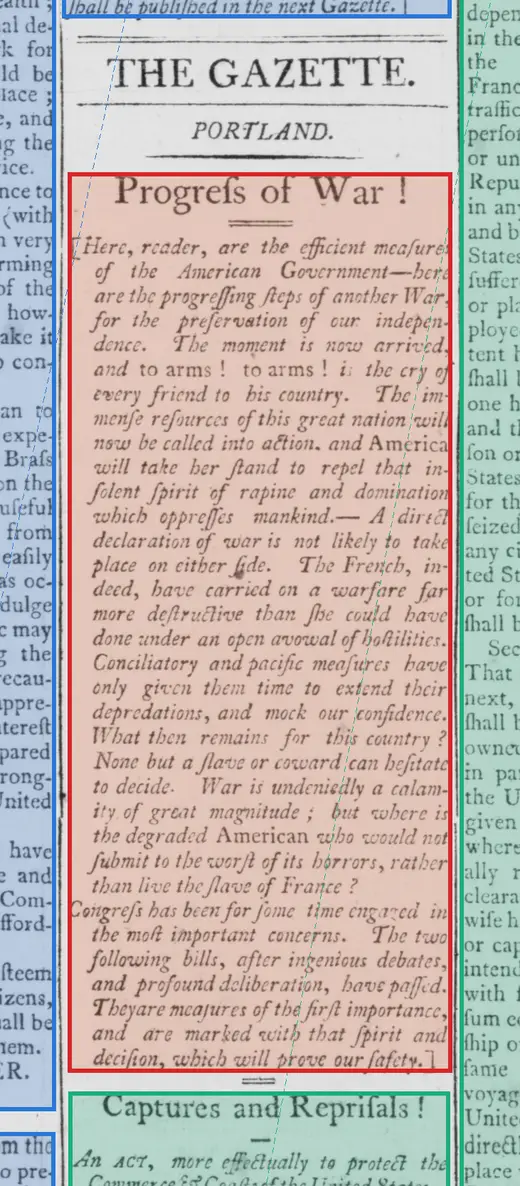
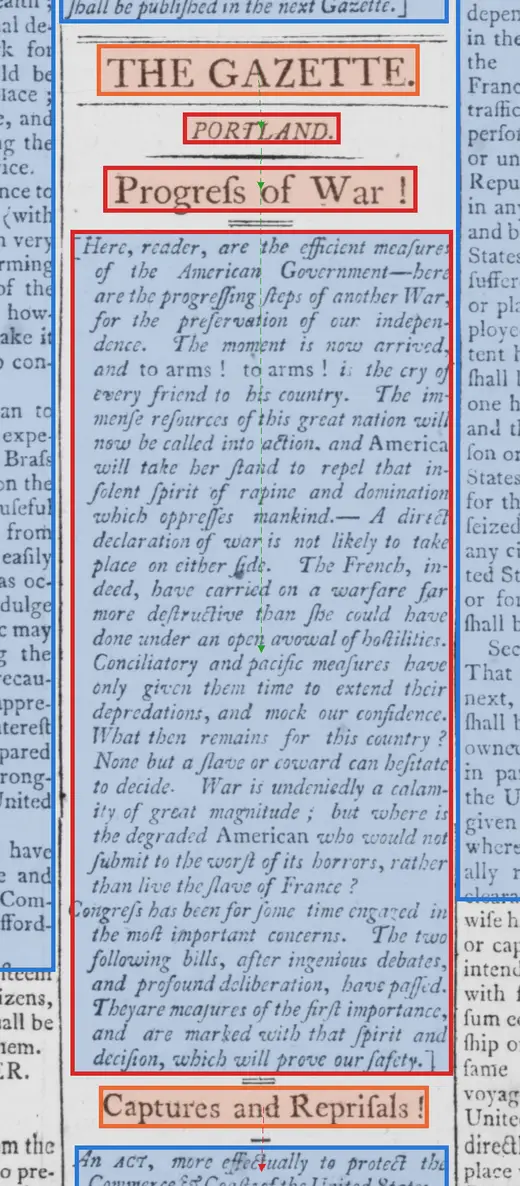
Progress of War!Here, reader, are the efficient measures of the American Government—here are the progressing steps of another War, for the preservation of our independence. The moment is now arrived, and to arms! to arms! is the cry of every friend to his country. The immense resources of this great nation will now be called into action, and America will take her stand to repel that insolent spirit of rapine and domination which oppresses mankind.—A direct declaration of war is not likely to take place on either side. The French, indeed, have carried on a warfare far more destructive than she could have done under an open avowal of hostilities. Conciliatory and pacific measures have only given them time to extend their depredations, and mock our confidence. What then remains for this country? None but a slave or coward can hesitate to decide. War is undeniably a calamity of great magnitude; but where is the degraded American who would not submit to the worst of its horrors, rather than live the slave of France?
Congress has been for some time engaged in the most important concerns. The two following bills, after ingenious debates, and profound deliberation, have passed. They are measures of the first importance, and are marked with that spirit and decision, which will prove our safety.
American Stories
Progrefs of War /!Here, reader, are the efficient mcaJurst Of The american GoVernment-bers are the PrQgrsDfng feps Of another War, far The PreieYvati0n Of 0ur ndepen- dcnee. The moment is n0q0 arrived, and to arms to arms Is the cry Of sgery friend TO bis country. TIE i'm megis r5I9nrce5 gftbi5 great nation 7OiH no7O be called into Action. and America qOiH take Der fand TO rebeI that in /6lent IPirit Of rabine and domination a0bieb otpreDe5 mankind.- Il duta declaration Of 7Oar is nat likely TO take place on either Ede. The French, in deed, bave carried on a z0ayfare far mare defyuHiVe than Jbe coaId haze done urdsr an open avO7OaI 0fb0RiE!ies. COnciAat0ry and pacific meglure5 baVe dny giccn them time to extend their depredati0n5, and mack our confidence. Wbat tbcn remains FIR this country /? None but a fare or c07Oard can beftatc TO decide. Var is undoubtedly cnlam- ity Of great magnitude bit 90bere is the degraded American qUb0 z00uld nat (u6mit TO the 9Ooya gifts horrors, rather than Hve the Rave Of Frame
CongreG has BEEN far Jane time engaged in the nlof important concerns. The t700 toLlO7Oing bills, after ingenious debates, and profound dcH6eratiOn, bavc ba0fd. Tbeyare nleajnref 0ftbe frJf Importance, and are marked q0itb that lpiri and deafon, 9Obieb zOiH pr0ve our atety.l
1 ours : N ASsnewpapers rightnotice ↔ AS #12, AS #10, AS #7 p2-5
- stated first: several components (American Stories): snewpapers right (said one): The pieces form a single continuous item: an act of Congress with its preamble and enacting clause, split only by OCR column/line breaks, not by separate printed items.
- stated first: one component (snewpapers): snewpapers right (said one): All three pieces form a single continuous Act of Congress, with the title, preamble ("WHEREAS...") and the enacting section running together as one legal item.
snewpapers
Captures and Reprisals!An Act, more effectually to protect the Commerce & Coasts of the United States.
WHEREAS armed vessels, sailing under authority or pretence of authority, from the republic of France, have committed depredations on the commerce of the United States, and have recently captured the vessels and property of citizens thereof, on and near the coasts, in violation of the law of nations, and treaties between the United States and the French nation.—
Therefore,
Section 1. BE it enacted by the Senate and House of Representatives of the United States of America, in Congress assembled, That it shall be lawful for the President of the United States, and he is hereby authorized to instruct and direct the commanders of the armed vessels belonging to the United States to seize, take and bring into any port of the United States, to be proceeded against according to the laws of nations, any such armed vessels, which shall have committed, or which shall be found hovering on the coasts of the United States, for the purpose of committing depredations on the vessels belonging to the citizens thereof, and also to retake any ship or vessel of any citizen or citizens of the United States, which may have been captured by any such armed vessel.
[For passing this act, 50 members appeared in the affirmative, and 40 in the negative. Our armed vessels will, therefore, bring in for legal adjudication, those French pirates who infest our coast.]
American Stories
Captures and Reprifals |!in ACT, more efff7uaLly TO protect the
C0mmerce u C0aRs0ftbe United States.
WHEREAS armed veG1els, falling under authority or pretence Of authori- ty, from the republic of France, have committed depredations on the COM merce of the United States, and have recently captured the veGels and pro-
PSIt4 Oh CItIZSIS tl4CtCOA3 OAA "- the COATS, in violation Of the law Of nations, and treaties between the Uni ted States and the French nation Therefore,
Sedion /. BE it enacted by the SEN ate and HouGe Of Representatives OF the United States Of America, in Con grefS afembled, That it lhall be lawful for the PRECEDENT Of the United States, and he is hereby authorized to initruct and direct the commanders Of the arm ed vedels belonging to the United States.to feize, take and bring into any port of the United States, to be pro- cecded againG according to the laws Of nations, any fuch armed vefels, which fhall have committed, or which ihall be found lowering on the COATS OF the United States, for the PurPoie OF com hitting depredations on the veiiels be- longing to the citizens thereof, and alio 10 retake any Ghip or vedel Of any clti- zen or citizens Of the United States, which may have been captured by any UGH armed vellel.
CF0r ba6ng this 0d, 50 members np- 3eued in the affirmative, end 40 IN the negatiVe. oar armed Vs1sL5 7OiH, Fbere- fare, bring in far legal adjudication, tbgjF Erencb pirates e0bo igflf our c0GEJ
- the pieces asked about (American Stories):
- [1] AS #12: begins: "Captures and Reprifals |! in ACT, more efff7uaLly TO protect the C0mmerce u C0aRs0ftbe United" … ends: "and Reprifals |! in ACT, more efff7uaLly TO protect the C0mmerce u C0aRs0ftbe United States."
- [2] AS #10: begins: "WHEREAS armed veG1els, falling under authority or pretence Of authori- ty, from the republic of" … ends: "the COM merce of the United States, and have recently captured the veGels and pro-"
- [3] AS #7: begins: "PSIt4 Oh CItIZSIS tl4CtCOA3 OAA "- the COATS, in violation Of the law Of nations," … ends: "7OiH, Fbere- fare, bring in far legal adjudication, tbgjF Erencb pirates e0bo igflf our c0GEJ"
N ours : 1 ASsnewpapers rightnotice, notice ↔ AS #7 p2-6
- stated first: several components (snewpapers): snewpapers right (said several): The passage contains two distinct legislative items: an act about captures and reprisals and a separate bill suspending commercial intercourse with France, each with its own title and subject.
- stated first: one component (American Stories): snewpapers right (said several): The passage contains two distinct items: an act about captures and reprisals, and a separate bill suspending commercial intercourse with France, each with its own heading and content.
snewpapers
Captures and Reprisals!An Act, more effectually to protect the Commerce & Coasts of the United States.
WHEREAS armed vessels, sailing under authority or pretence of authority, from the republic of France, have committed depredations on the commerce of the United States, and have recently captured the vessels and property of citizens thereof, on and near the coasts, in violation of the law of nations, and treaties between the United States and the French nation.—
Therefore,
Section 1. BE it enacted by the Senate and House of Representatives of the United States of America, in Congress assembled, That it shall be lawful for the President of the United States, and he is hereby authorized to instruct and direct the commanders of the armed vessels belonging to the United States to seize, take and bring into any port of the United States, to be proceeded against according to the laws of nations, any such armed vessels, which shall have committed, or which shall be found hovering on the coasts of the United States, for the purpose of committing depredations on the vessels belonging to the citizens thereof, and also to retake any ship or vessel of any citizen or citizens of the United States, which may have been captured by any such armed vessel.
[For passing this act, 50 members appeared in the affirmative, and 40 in the negative. Our armed vessels will, therefore, bring in for legal adjudication, those French pirates who infest our coast.]
Suspension of Intercourse!
A bill to suspend the Commercial Intercourse between the United States and France, & the dependencies thereof.
Sec. 1. BE it enacted by the Senate and House of Representatives of the United States of America, in Congress assembled, That no ship or vessel, owned, hired, or employed, wholly or in part, by any person resident within the United States, and which shall depart therefrom after the ____ day of ____ next, shall be allowed to proceed directly, or from any intermediate port or place, to any port or place within the territory of the French Republic, or the dependencies thereof, or to any place in the West Indies, or elsewhere, under the acknowledged government of France, or shall be employed in any traffic or commerce with or for any person resident within the jurisdiction, or under the authority of the French Republic. And if any ship or vessel, in any voyage thereafter commencing, and before her return within the United States, shall be voluntarily carried, or suffered to proceed to any French port or place as aforesaid, or shall be employed as aforesaid, contrary to the intent hereof, every such ship or vessel shall be forfeited, and shall accrue, the one half to the use of the United States, and the other half to the use of any person or persons, citizens of the United States, who will inform and prosecute for the same, and shall be liable to be seized, prosecuted and condemned in any circuit or district court of the United States which shall be holden within or for the district where the seizure shall be made.
Sec. 2. And be it further enacted, That after the ____ day of ____ next, no clearance for a foreign voyage shall be granted to any ship or vessel, owned, hired, or employed, wholly or in part by any person resident within the United States, until a bond shall be given to the use of the United States, wherein the owner or employer, if usually resident or present, where the clearance shall be required, and otherwise his agent or factor; and the master or captain of such ship or vessel for the intended voyage, shall be parties, and with sufficient surety or sureties, in a sum equal to double the value of the ship or vessel, with condition that the same shall not, during her intended voyage, or before her return within the United States, proceed, or be carried, directly or indirectly to any port or place within the territory of the French Republic, or the dependencies thereof, or any place in the West Indies, or elsewhere, under the acknowledged government of France, unless by distress of weather, or want of provisions, or by actual force and violence, to be fully proved and manifested before the acquittance of such bond; and that such vessel is not, and shall not be employed during her intended voyage, or before her return as aforesaid, in any traffic or commerce with or for any person resident within the territory of that Republic, or in any of the dependencies thereof.
Sec. 3. And be it further enacted, That from and after ____, no French ship or vessel, armed or unarmed, commissioned by or for, or under the authority of the French Republic, or owned, fitted, hired or employed by any person resident within the territory of that Republic, or any of the dependencies thereof, or sailing or coming therefrom; shall be allowed an entry or to remain within the territory of the United States, unless driven there by distress of weather, or in want of provisions. And if contrary to the intent hereof any such ship or vessel shall be found within the jurisdictional limits of the United States, not being liable to seizure for any other cause, the company having charge thereof shall be required to depart and carry away the same, avoiding all unnecessary delay; and if they shall, notwithstanding, remain, it shall be the duty of the collector of the district wherein or nearest to which such ship or vessel shall be, to seize and detain the same, at the expense of the United States: Provided, That ships or vessels which shall be bona fide the property of, or hired or employed by citizens of the United States not actually resident in France, or the dependencies thereof, shall be excepted from this prohibition until the ____ day of ____ next, and no longer; and provided that in the case of vessels hereby prohibited, which shall be driven by distress of weather, or the want of provisions into any port or place of the United States, they may be suffered to remain under the custody of the collector there or nearest thereto until suitable repairs or supplies can be obtained, and as soon as may be thereafter shall be required and suffered to depart; but no part of the lading of such vessel shall be taken out or disposed of, unless by the especial permit of such collector, to defray the unavoidable expense of such repairs or supplies.
Sec. 4. And be it further enacted, That this act shall continue and be in force until the end of the next session of Congress, and no longer.
Sec. 5. Provided, And be it further enacted, that if, before the next session of Congress, the French Republic, or the government of France, and all persons acting by or under their authority, shall clearly disavow, and shall be found to refrain from the aggressions, depredations and hostilities which have been and are by them encouraged and maintained against the vessels and other property of the citizens of the United States, and against their national rights and sovereignty, in violation of the faith of treaties, and the laws of nations, and shall thereby acknowledge the just claims of the United States to be considered as in all respects neutral, and unconnected in the present European war, if the same shall be continued, then and thereupon it shall be lawful for the President of the United States, being well ascertained of the premises, to remit and discontinue the prohibitions and restraints hereby enacted and declared; and he shall be, and is hereby authorized to make proclamation thereof accordingly.
This bill passed on the 2d instant—Yeas 55, nays 25. The blanks in the first and second sections were filled with the 1st of July; the first blank in the third section was filled with after due notice of the passing of this bill shall be given; and the second after the 1st of Dec., next. On motion of Mr. Gallatin, and by general consent, the words in the third section “now actually resident in France, and the dependencies thereof,” were struck out.]
American Stories
PSIt4 Oh CItIZSIS tl4CtCOA3 OAA "- the COATS, in violation Of the law Of nations, and treaties between the Uni ted States and the French nation Therefore,Sedion /. BE it enacted by the SEN ate and HouGe Of Representatives OF the United States Of America, in Con grefS afembled, That it lhall be lawful for the PRECEDENT Of the United States, and he is hereby authorized to initruct and direct the commanders Of the arm ed vedels belonging to the United States.to feize, take and bring into any port of the United States, to be pro- cecded againG according to the laws Of nations, any fuch armed vefels, which fhall have committed, or which ihall be found lowering on the COATS OF the United States, for the PurPoie OF com hitting depredations on the veiiels be- longing to the citizens thereof, and alio 10 retake any Ghip or vedel Of any clti- zen or citizens Of the United States, which may have been captured by any UGH armed vellel.
CF0r ba6ng this 0d, 50 members np- 3eued in the affirmative, end 40 IN the negatiVe. oar armed Vs1sL5 7OiH, Fbere- fare, bring in far legal adjudication, tbgjF Erencb pirates e0bo igflf our c0GEJ
Sufpenfion of Intercourie A bill to fpend the Commercial IN
tercourfe between the United States
and France, & the dePencieS thereof.
Sec. I. BE it enacted by the Senate and Houfe Of Representatives of the United States Of America, in CongrelS Attended, That no lhip or vehel, own ed, hired, or employed, wholly or in part, by any perfon rcfdent within the United States, and which fhall depart therefrom after the day Of
I, fhall be allowed to proceed d. r. v,or from any intermediate port o. pI 5, to any port or place within the territory Of the French Republic, or the dependencies thereof, or to any place in the Weltindies, or elfewhere, under the acknowledged government of France, or fhall be employed in any traffic or commerce with or for any perfon reGdcnt within the jurildi6tion, or under the authority Of the French Republic. And if any ihip or vedel, in any voyage thereafter commencing, and before her return within the United States, A1alI be voluntarily carried, or fufercd to proceed to any French port or place as aforefaid, or ihall be en- ployed as aforefaid. contrary to the in tent hereof, every fuch flip OF vedel lhall be forfeited, and fhalI accrue, the one half to the ufe ofthe United States, and the other half to the ule Of any per- fon or perlons, citizens Of the United States, who will inform and Profecute for the fame, and fhall be liable to be Geized, profecuted and condemned in any circuit or diltri6t court Of the Uni ted States which fhall be holden within or for the difri6 where the 1eizure fhall be made.
Sec. Z. And be it further enaaed, That after the day Of next, no clearance for foreign voyage lhall be granted to any flip or velel, owned, hired, or employed, wholly or IN part by any perlon relident within the United States, until a bond fhall Be given to the ufe Of the United States, wherein the owner or employer, if u(u- ally rehdent or prefcnt, where the clearance G1aL ha ren1ired- and ntha-
- the pieces asked about (snewpapers):
- [1] notice: begins: "Captures and Reprisals! An Act, more effectually to protect the Commerce & Coasts of the" … ends: "vessels will, therefore, bring in for legal adjudication, those French pirates who infest our coast.]"
- [2] notice: begins: "Suspension of Intercourse! A bill to suspend the Commercial Intercourse between the United States and" … ends: "the third section “now actually resident in France, and the dependencies thereof,” were struck out.]"
1 ours : N ASsnewpapers rightnotice ↔ AS #7, AS #4 p2-7
- stated first: several components (American Stories): snewpapers right (said one): Both pieces are continuous sections of the same enacted bill (sections 1 through 5), so they form a single printed item despite the column break.
- stated first: one component (snewpapers): snewpapers right (said one): Both pieces are continuous sections of the same enacted bill (sections 1-5 of the suspension of commercial intercourse act), with [2] simply continuing the statute text where [1] ends; the numbered pieces belong to one printed item, not separate components.
snewpapers
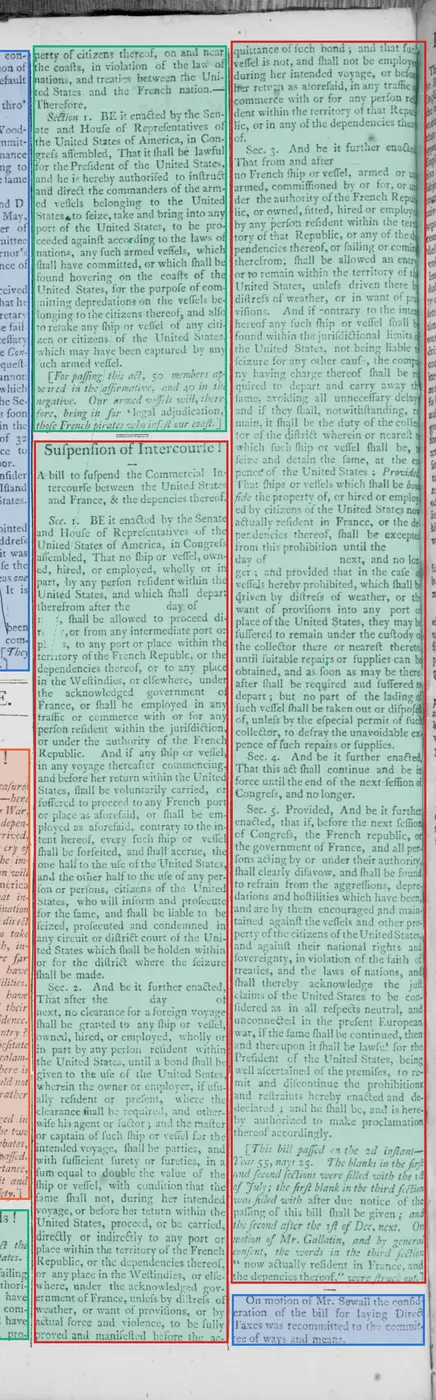
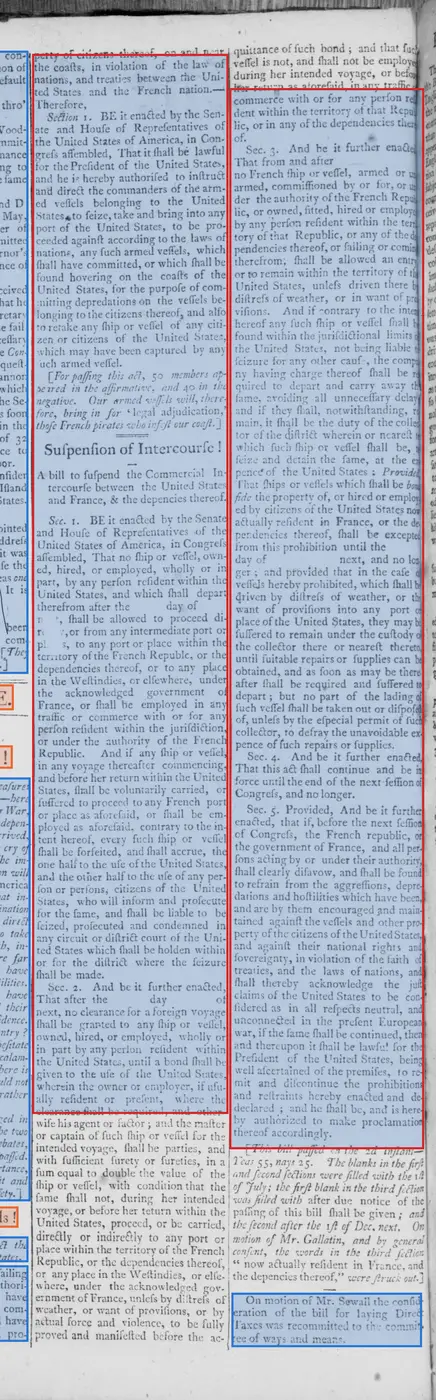
Suspension of Intercourse!A bill to suspend the Commercial Intercourse between the United States and France, & the dependencies thereof.
Sec. 1. BE it enacted by the Senate and House of Representatives of the United States of America, in Congress assembled, That no ship or vessel, owned, hired, or employed, wholly or in part, by any person resident within the United States, and which shall depart therefrom after the ____ day of ____ next, shall be allowed to proceed directly, or from any intermediate port or place, to any port or place within the territory of the French Republic, or the dependencies thereof, or to any place in the West Indies, or elsewhere, under the acknowledged government of France, or shall be employed in any traffic or commerce with or for any person resident within the jurisdiction, or under the authority of the French Republic. And if any ship or vessel, in any voyage thereafter commencing, and before her return within the United States, shall be voluntarily carried, or suffered to proceed to any French port or place as aforesaid, or shall be employed as aforesaid, contrary to the intent hereof, every such ship or vessel shall be forfeited, and shall accrue, the one half to the use of the United States, and the other half to the use of any person or persons, citizens of the United States, who will inform and prosecute for the same, and shall be liable to be seized, prosecuted and condemned in any circuit or district court of the United States which shall be holden within or for the district where the seizure shall be made.
Sec. 2. And be it further enacted, That after the ____ day of ____ next, no clearance for a foreign voyage shall be granted to any ship or vessel, owned, hired, or employed, wholly or in part by any person resident within the United States, until a bond shall be given to the use of the United States, wherein the owner or employer, if usually resident or present, where the clearance shall be required, and otherwise his agent or factor; and the master or captain of such ship or vessel for the intended voyage, shall be parties, and with sufficient surety or sureties, in a sum equal to double the value of the ship or vessel, with condition that the same shall not, during her intended voyage, or before her return within the United States, proceed, or be carried, directly or indirectly to any port or place within the territory of the French Republic, or the dependencies thereof, or any place in the West Indies, or elsewhere, under the acknowledged government of France, unless by distress of weather, or want of provisions, or by actual force and violence, to be fully proved and manifested before the acquittance of such bond; and that such vessel is not, and shall not be employed during her intended voyage, or before her return as aforesaid, in any traffic or commerce with or for any person resident within the territory of that Republic, or in any of the dependencies thereof.
Sec. 3. And be it further enacted, That from and after ____, no French ship or vessel, armed or unarmed, commissioned by or for, or under the authority of the French Republic, or owned, fitted, hired or employed by any person resident within the territory of that Republic, or any of the dependencies thereof, or sailing or coming therefrom; shall be allowed an entry or to remain within the territory of the United States, unless driven there by distress of weather, or in want of provisions. And if contrary to the intent hereof any such ship or vessel shall be found within the jurisdictional limits of the United States, not being liable to seizure for any other cause, the company having charge thereof shall be required to depart and carry away the same, avoiding all unnecessary delay; and if they shall, notwithstanding, remain, it shall be the duty of the collector of the district wherein or nearest to which such ship or vessel shall be, to seize and detain the same, at the expense of the United States: Provided, That ships or vessels which shall be bona fide the property of, or hired or employed by citizens of the United States not actually resident in France, or the dependencies thereof, shall be excepted from this prohibition until the ____ day of ____ next, and no longer; and provided that in the case of vessels hereby prohibited, which shall be driven by distress of weather, or the want of provisions into any port or place of the United States, they may be suffered to remain under the custody of the collector there or nearest thereto until suitable repairs or supplies can be obtained, and as soon as may be thereafter shall be required and suffered to depart; but no part of the lading of such vessel shall be taken out or disposed of, unless by the especial permit of such collector, to defray the unavoidable expense of such repairs or supplies.
Sec. 4. And be it further enacted, That this act shall continue and be in force until the end of the next session of Congress, and no longer.
Sec. 5. Provided, And be it further enacted, that if, before the next session of Congress, the French Republic, or the government of France, and all persons acting by or under their authority, shall clearly disavow, and shall be found to refrain from the aggressions, depredations and hostilities which have been and are by them encouraged and maintained against the vessels and other property of the citizens of the United States, and against their national rights and sovereignty, in violation of the faith of treaties, and the laws of nations, and shall thereby acknowledge the just claims of the United States to be considered as in all respects neutral, and unconnected in the present European war, if the same shall be continued, then and thereupon it shall be lawful for the President of the United States, being well ascertained of the premises, to remit and discontinue the prohibitions and restraints hereby enacted and declared; and he shall be, and is hereby authorized to make proclamation thereof accordingly.
This bill passed on the 2d instant—Yeas 55, nays 25. The blanks in the first and second sections were filled with the 1st of July; the first blank in the third section was filled with after due notice of the passing of this bill shall be given; and the second after the 1st of Dec., next. On motion of Mr. Gallatin, and by general consent, the words in the third section “now actually resident in France, and the dependencies thereof,” were struck out.]
American Stories
Sufpenfion of Intercourie A bill to fpend the Commercial INtercourfe between the United States
and France, & the dePencieS thereof.
Sec. I. BE it enacted by the Senate and Houfe Of Representatives of the United States Of America, in CongrelS Attended, That no lhip or vehel, own ed, hired, or employed, wholly or in part, by any perfon rcfdent within the United States, and which fhall depart therefrom after the day Of
I, fhall be allowed to proceed d. r. v,or from any intermediate port o. pI 5, to any port or place within the territory Of the French Republic, or the dependencies thereof, or to any place in the Weltindies, or elfewhere, under the acknowledged government of France, or fhall be employed in any traffic or commerce with or for any perfon reGdcnt within the jurildi6tion, or under the authority Of the French Republic. And if any ihip or vedel, in any voyage thereafter commencing, and before her return within the United States, A1alI be voluntarily carried, or fufercd to proceed to any French port or place as aforefaid, or ihall be en- ployed as aforefaid. contrary to the in tent hereof, every fuch flip OF vedel lhall be forfeited, and fhalI accrue, the one half to the ufe ofthe United States, and the other half to the ule Of any per- fon or perlons, citizens Of the United States, who will inform and Profecute for the fame, and fhall be liable to be Geized, profecuted and condemned in any circuit or diltri6t court Of the Uni ted States which fhall be holden within or for the difri6 where the 1eizure fhall be made.
Sec. Z. And be it further enaaed, That after the day Of next, no clearance for foreign voyage lhall be granted to any flip or velel, owned, hired, or employed, wholly or IN part by any perlon relident within the United States, until a bond fhall Be given to the ufe Of the United States, wherein the owner or employer, if u(u- ally rehdent or prefcnt, where the clearance G1aL ha ren1ired- and ntha-
commerce with or for any perfon red dent within the territory Of that Repul lie, or in any of the dependencies ther Of.
Sec. :. And be it further enaaej That from and after
no French flip or vehel, armed or u armed, CONDITIONED by or for, OF u der the authority Of the French Repua lie, or owned, fitted, hired or emploYd BY any perfon reGdent within the ten tory of that Republic, or any Of thedl Tendencies thereof, or falling comm therefrom; fhall be allowed an entry or to remain within the territory Of I'll United States, unlefs driven there difrefs Of weather, or in want Of Prd vifons. And if contrary to the inted hereof any fuch hip or vefel ihall II found within the juriIdidional limits
the United States, not being liable d fcizure for any other cauf=, the comp4 ny having charge thereof ihall be I'd quired to depart and carry away TN fame, avoiding all unnecefary delay and if they fhall, notwithstanding, ID main, it ihall be the duty Of the colled tor Of the difri6 wherein or ncaref d which fuch fhip or vefel ihall be, Y feize and detain the fame, at the ed | pence Of the United States Prouidel
That !hipS or vcnels which fhall be bgaI fde the property Of, or hired or EMPLOY ed BY citizens Of the United States nov actually refdent in France, or the de- perdencics thereof, fhall be exceptet from this prohibition until the
day Of next, and no Ion ger; and provided that in the cafe veGels hereby prohibited, which lhalI b | driven by diltrefs Of weather, or TIL want of provifons into any port d place Of the United States, they may b fufered to remain under the cufody d the collector there or nearef thereto until fuitabIe repairs or fupplie8 can b obtained, and as foon as may be there after fhaIl be required and fufered To- depart; but no part of the lading 81 iuch vefel fhall be taken out or difpofaI Of, unlels by the efpecial permit of flch collector, TO defray the unavoidable exl pence Offuch repairs or fupplies. Sec. 4. And be it further enacted, That this act fhall continue and be i'll force until the end Of the next felton, Of Congrei8, and no longer.
Sec. s. Provided, And be it furthcrI enacted, that if, before the next fefion of CongrefS, the French republic, OF the government Of France, and all per- ions acting by or under their authority, lhall clearly difavow, and fhaIl be found to refrain from the aggrefIions, depre. dations and hOltilities which have been, and are by them encouraged and main. tanned againf the vehels and other pro. perty ofthc citizens Of the United States.l and aGainlt their national rights and iovereignty, in violation Of the faith oil treaties, and the laws Of nations, and fhali thereby acknowledge the iuf claims Of the United States to be con. fidered as in all relpe6tS neutral, and uhconne6ed in the prefent European war, if the fame fhall be continued, then and thereupon it fhall be Lawful for the PRECEDENT Of the United States, being we'll aicertained Of the premifes, 10 re- nit and dilcontinue the prohibitions and refr2intS hereby enacted and de- declared and he hall be, and is here. by authorized to make proclamation thereof accordingly.
TTL: L;U 1.n-J
- the pieces asked about (American Stories):
- [1] AS #7: begins: "Sufpenfion of Intercourie A bill to fpend the Commercial IN tercourfe between the United States" … ends: "employer, if u(u- ally rehdent or prefcnt, where the clearance G1aL ha ren1ired- and ntha-"
- [2] AS #4: begins: "commerce with or for any perfon red dent within the territory Of that Repul lie," … ends: "hall be, and is here. by authorized to make proclamation thereof accordingly. TTL: L;U 1.n-J"
1:1 matchmatchdomestic_news ↔ AS #14 p2-8
snewpapers
On motion of Mr. Sewall, the consideration of the bill for laying Direct Taxes was recommitted to the committee of ways and means.American Stories
On motion of Mr.. Sewail the confd Grafton Of the bill for laying Dire6 Taxes was recommitted to the commit rec Of ways and means,Page 3
AS only, tinytiny, not askedAS #8 p3-1
snewpapers
nothingAmerican Stories
REVIEW of News.in N ours : 1 ASsnewpapers rightforeign_news ↔ AS #8 p3-2 inside AS's merged article, decided by p3-3
snewpapers
The latest news from Europe is by the British packet arrived at Newyork. English gazettes have been received to the middle of April. These gazettes contain nothing very important, more than has been already published. It appears, however, that the invasion of England is the grand topic of conversation among Frenchmen, although the subject has grown tiresome in this country. General Buonaparte has received directions from the Directory to repair immediately to Brest and take command of all the sea and land forces destined for this expedition; the forces collecting in the vicinity of Brest, are immense. A cabinet council has been held in London to consider the propriety of a general arming; and circular letters have been sent to all the maritime counties, enjoining the most vigorous exertions. It is contemplated to drive the live stock of such parts of the country as may become exposed to the inroads of the French, into such places as they may be secure. A plan has also been formed for an association of the nobility and yeomanry, to supply waggons, horses, &c. and to aid the supplies for the soldiers, with the most necessary articles, in case of invasion. A requisition of every fifth man in Holland was to be enforced by the abominable Directory of France. Thus it is that this odious republic fulfils its faith to its allies. May the many lessons daily exhibited of French perfidy be a solemn warning to Americans!American Stories
contain nothing very important, more than has been already publifhed. 1t appears, however, that the inva6on Of England is the grand topic Of converla- ton among Frenchmen, although the fubje6t has grown tirefome in this country. General Buona3arte has re- ceiyed directions from the Directory to repair immedi tcly TO Brett and take command of all the fca and land forces defined for this expedition the forces collecting in the vicinity of Brett, are immenle. A cabinet council has been held in London 70 conGder the Proprie- ty of a general arnling and circular letters have been fent to all the mara time counties, cnjoining the mott vigor- Gus eXertions. 1t is contemplated to drive the live 2ock Of fuch parts Of the country as may become expofcd to the inroads of the French, into luch places as they may be fecure. A plan has al 70 been formed for an adociation of the nobility and yeomanry, to lupply wag- CONS, horfes, &c. and to aid the fupPlies for the folders, with the mott necehary articles, in cafe of invaGcn. A requi- fition of every fifth man in Holland was TO be enforced by the abominable Diyec- tory of France. Thus it is that this odious republic fulhls its faith to its al lies. May the many lefonS daily ex- hibited Of French Perfdy be loIemn warning to AmericansN ours : 1 ASsnewpapers rightforeign_news, foreign_news, foreign_news, domestic_news, domestic_news, domestic_news, domestic_news, domestic_news ↔ AS #8 p3-3
- stated first: several components (snewpapers): snewpapers right (said several): The passage consists of multiple distinct, self-contained news items (European news, Hamburgh contribution, Spanish edict, American Commissioners report, Dupont, Mozard, insurance resolution, Barckley's arrival), each a separate printed paragraph/component.
- stated first: one component (American Stories): snewpapers right (said several): The passage consists of separate short news items or paragraphs on distinct topics (European news, Hamburg, Spain, American commissioners, various consuls, an insurance resolution, and Barckley's arrival), each a distinct printed notice rather than one continuous article.
snewpapers
The latest news from Europe is by the British packet arrived at Newyork. English gazettes have been received to the middle of April. These gazettes contain nothing very important, more than has been already published. It appears, however, that the invasion of England is the grand topic of conversation among Frenchmen, although the subject has grown tiresome in this country. General Buonaparte has received directions from the Directory to repair immediately to Brest and take command of all the sea and land forces destined for this expedition; the forces collecting in the vicinity of Brest, are immense. A cabinet council has been held in London to consider the propriety of a general arming; and circular letters have been sent to all the maritime counties, enjoining the most vigorous exertions. It is contemplated to drive the live stock of such parts of the country as may become exposed to the inroads of the French, into such places as they may be secure. A plan has also been formed for an association of the nobility and yeomanry, to supply waggons, horses, &c. and to aid the supplies for the soldiers, with the most necessary articles, in case of invasion. A requisition of every fifth man in Holland was to be enforced by the abominable Directory of France. Thus it is that this odious republic fulfils its faith to its allies. May the many lessons daily exhibited of French perfidy be a solemn warning to Americans!The city of Hamburgh has paid the sum of six millions of livres as a contribution, to be excused from a loan of 12 millions of ducats!
The king of Spain has published an edict ordering all the French emigrants to quit the country. This is one of the first acts of the new administration, and proves the ascendency of the French government!
A late London paper mentions a report that the American Commissioners at Paris, have been ordered to depart, & that all American property in France which is supposed to amount to near 3,000,000l. is to be confiscated.
A letter from Philadelphia, informs, that Citizen Dupont, late Consul from the French republic at Charleston, lately appointed Consul General at Philadelphia, not having been received by the Executive, has taken his passage in the cartel-ship for France. This is good, and every insolent Frenchman should be treated just so.
Mozard, the French Consul at Boston, has fled. Before his flight he wrote an insolent letter to the Governor, which has since been delivered to him, on the subject of a fraternal hug, which the said Mozard received from an American sailor. We shall soon get rid of the Consul-gentry at this rate. It is clever to get the blockheads off with so little trouble.
The Insurance Company of Philadelphia have come to a resolution not to insure any vessel or cargo bound to a French port! [An excellent resolution; Americans ought to display their resentment by every means possible. We have to deal with a nation destitute of faith, or honor.]
Mr. Barckley Commissioner on the part of Great Britain for settling the eastern boundary of the United States, has arrived at New York with his family in the Earl Moira.
American Stories
REVIEW of News.contain nothing very important, more than has been already publifhed. 1t appears, however, that the inva6on Of England is the grand topic Of converla- ton among Frenchmen, although the fubje6t has grown tirefome in this country. General Buona3arte has re- ceiyed directions from the Directory to repair immedi tcly TO Brett and take command of all the fca and land forces defined for this expedition the forces collecting in the vicinity of Brett, are immenle. A cabinet council has been held in London 70 conGder the Proprie- ty of a general arnling and circular letters have been fent to all the mara time counties, cnjoining the mott vigor- Gus eXertions. 1t is contemplated to drive the live 2ock Of fuch parts Of the country as may become expofcd to the inroads of the French, into luch places as they may be fecure. A plan has al 70 been formed for an adociation of the nobility and yeomanry, to lupply wag- CONS, horfes, &c. and to aid the fupPlies for the folders, with the mott necehary articles, in cafe of invaGcn. A requi- fition of every fifth man in Holland was TO be enforced by the abominable Diyec- tory of France. Thus it is that this odious republic fulhls its faith to its al lies. May the many lefonS daily ex- hibited Of French Perfdy be loIemn warning to Americans
The city Of Hamburger has paid the fun Of fix millions Of liyreS as a contri- button, to be executed from loan of 2 millions of ducats
The king of Spain has publifhed an edia ordering all the French emigrants 10 quit the country. This IS one Of the hrf ats Of the new administration, and proves the alcendency of the French government
a late London paper mentions re- port that the American CommifIoners at Paris, have been ordered to depart, & that all American property in France which is fuPPoled to amount to near 1900, oool. is TO be conhlcated.
A letter fr ON Philadelphia, informs, shat Citizen Dupont, late Conful from the French republic at CharIefon, late F. ly appointed Conful General at Phila- delphia, not having been received by the Executive, has taken his pafage in the cartel-fhip for France. I This is good, and every infolent Frenchman fhould be treated juf fol-
Mozard, the French Conful at Bof- ton, has fed. Before his flight he wrote an inlolcnt letter to the Govern or, which has fnce been delivered to him, on the fubiea Of fratcrnaI bug, which the Eaid Mozard received from an American failor. rive ihall foon get rid of the ConjAgentry at this rate. It is clever to get the blockheads Oft with. 70 little trouble.
The Infurancc Company Of Phila- delPhia have come to a relolution not 70 in(ure any veGel or cargo BOUND TO FRENCH PORT An excellent rcloIution Americans ought to difPlay their recruitment by every means pofl- bic. We have to deal with a nation deiitute of faith, or honor
Mr.. Barcklcy CommiGioner on the part Of Great Britain for 1ettling the cafern boundary Of the United States, has arrived at Newyork with his fami- ly in the Earl MORA.
- the pieces asked about (snewpapers):
- [1] foreign_news: begins: "The latest news from Europe is by the British packet arrived at Newyork. English gazettes" … ends: "May the many lessons daily exhibited of French perfidy be a solemn warning to Americans!"
- [2] foreign_news: begins: "The city of Hamburgh has paid the sum of six millions of livres as a" … ends: "livres as a contribution, to be excused from a loan of 12 millions of ducats!"
- [3] foreign_news: begins: "The king of Spain has published an edict ordering all the French emigrants to quit" … ends: "the first acts of the new administration, and proves the ascendency of the French government!"
- [4] domestic_news: begins: "A late London paper mentions a report that the American Commissioners at Paris, have been" … ends: "property in France which is supposed to amount to near 3,000,000l. is to be confiscated."
- [5] domestic_news: begins: "A letter from Philadelphia, informs, that Citizen Dupont, late Consul from the French republic at" … ends: "cartel-ship for France. This is good, and every insolent Frenchman should be treated just so."
- [6] domestic_news: begins: "Mozard, the French Consul at Boston, has fled. Before his flight he wrote an insolent" … ends: "at this rate. It is clever to get the blockheads off with so little trouble."
- [7] domestic_news: begins: "The Insurance Company of Philadelphia have come to a resolution not to insure any vessel" … ends: "every means possible. We have to deal with a nation destitute of faith, or honor.]"
- [8] domestic_news: begins: "Mr. Barckley Commissioner on the part of Great Britain for settling the eastern boundary of" … ends: "the United States, has arrived at New York with his family in the Earl Moira."
Text agreement inside AS's merged article (8 pieces): the merged article's text cut where our components begin and end; American Stories draws no boundary there, so these are no matches.
p3-2 foreign_news
snewpapers
The latest news from Europe is by the British packet arrived at Newyork. English gazettes have been received to the middle of April. These gazettes contain nothing very important, more than has been already published. It appears, however, that the invasion of England is the grand topic of conversation among Frenchmen, although the subject has grown tiresome in this country. General Buonaparte has received directions from the Directory to repair immediately to Brest and take command of all the sea and land forces destined for this expedition; the forces collecting in the vicinity of Brest, are immense. A cabinet council has been held in London to consider the propriety of a general arming; and circular letters have been sent to all the maritime counties, enjoining the most vigorous exertions. It is contemplated to drive the live stock of such parts of the country as may become exposed to the inroads of the French, into such places as they may be secure. A plan has also been formed for an association of the nobility and yeomanry, to supply waggons, horses, &c. and to aid the supplies for the soldiers, with the most necessary articles, in case of invasion. A requisition of every fifth man in Holland was to be enforced by the abominable Directory of France. Thus it is that this odious republic fulfils its faith to its allies. May the many lessons daily exhibited of French perfidy be a solemn warning to Americans!American Stories (slice of #8)
contain nothing very important, more than has been already publifhed. 1t appears, however, that the inva6on Of England is the grand topic Of converla- ton among Frenchmen, although the fubje6t has grown tirefome in this country. General Buona3arte has re- ceiyed directions from the Directory to repair immedi tcly TO Brett and take command of all the fca and land forces defined for this expedition the forces collecting in the vicinity of Brett, are immenle. A cabinet council has been held in London 70 conGder the Proprie- ty of a general arnling and circular letters have been fent to all the mara time counties, cnjoining the mott vigor- Gus eXertions. 1t is contemplated to drive the live 2ock Of fuch parts Of the country as may become expofcd to the inroads of the French, into luch places as they may be fecure. A plan has al 70 been formed for an adociation of the nobility and yeomanry, to lupply wag- CONS, horfes, &c. and to aid the fupPlies for the folders, with the mott necehary articles, in cafe of invaGcn. A requi- fition of every fifth man in Holland was TO be enforced by the abominable Diyec- tory of France. Thus it is that this odious republic fulhls its faith to its al lies. May the many lefonS daily ex- hibited Of French Perfdy be loIemn warning to Americansp3-4 foreign_news
snewpapers
The city of Hamburgh has paid the sum of six millions of livres as a contribution, to be excused from a loan of 12 millions of ducats!American Stories (slice of #8)
The city Of Hamburger has paid the fun Of fix millions Of liyreS as a contri- button, to be executed from loan of 2 millions of ducatsp3-5 foreign_news
snewpapers
The king of Spain has published an edict ordering all the French emigrants to quit the country. This is one of the first acts of the new administration, and proves the ascendency of the French government!American Stories (slice of #8)
The king of Spain has publifhed an edia ordering all the French emigrants 10 quit the country. This IS one Of the hrf ats Of the new administration, and proves the alcendency of the French governmentp3-6 domestic_news
A
snewpapers
A late London paper mentions a report that the American Commissioners at Paris, have been ordered to depart, & that all American property in France which is supposed to amount to near 3,000,000l. is to be confiscated.American Stories (slice of #8)
a late London paper mentions re- port that the American CommifIoners at Paris, have been ordered to depart, & that all American property in France which is fuPPoled to amount to near 1900, oool. is TO be conhlcated.A
p3-7 domestic_news
snewpapers
A letter from Philadelphia, informs, that Citizen Dupont, late Consul from the French republic at Charleston, lately appointed Consul General at Philadelphia, not having been received by the Executive, has taken his passage in the cartel-ship for France. This is good, and every insolent Frenchman should be treated just so.American Stories (slice of #8)
letter fr ON Philadelphia, informs, shat Citizen Dupont, late Conful from the French republic at CharIefon, late F. ly appointed Conful General at Phila- delphia, not having been received by the Executive, has taken his pafage in the cartel-fhip for France. I This is good, and every infolent Frenchman fhould be treated juf fol-p3-8 domestic_news
snewpapers
Mozard, the French Consul at Boston, has fled. Before his flight he wrote an insolent letter to the Governor, which has since been delivered to him, on the subject of a fraternal hug, which the said Mozard received from an American sailor. We shall soon get rid of the Consul-gentry at this rate. It is clever to get the blockheads off with so little trouble.American Stories (slice of #8)
Mozard, the French Conful at Bof- ton, has fed. Before his flight he wrote an inlolcnt letter to the Govern or, which has fnce been delivered to him, on the fubiea Of fratcrnaI bug, which the Eaid Mozard received from an American failor. rive ihall foon get rid of the ConjAgentry at this rate. It is clever to get the blockheads Oft with. 70 little trouble.p3-9 domestic_news
snewpapers
The Insurance Company of Philadelphia have come to a resolution not to insure any vessel or cargo bound to a French port! [An excellent resolution; Americans ought to display their resentment by every means possible. We have to deal with a nation destitute of faith, or honor.]American Stories (slice of #8)
The Infurancc Company Of Phila- delPhia have come to a relolution not 70 in(ure any veGel or cargo BOUND TO FRENCH PORT An excellent rcloIution Americans ought to difPlay their recruitment by every means pofl- bic. We have to deal with a nation deiitute of faith, or honorp3-10 domestic_news
snewpapers
Mr. Barckley Commissioner on the part of Great Britain for settling the eastern boundary of the United States, has arrived at New York with his family in the Earl Moira.American Stories (slice of #8)
Mr.. Barcklcy CommiGioner on the part Of Great Britain for 1ettling the cafern boundary Of the United States, has arrived at Newyork with his fami- ly in the Earl MORA.in N ours : 1 ASsnewpapers rightforeign_news ↔ AS #8 p3-4 inside AS's merged article, decided by p3-3
snewpapers
The city of Hamburgh has paid the sum of six millions of livres as a contribution, to be excused from a loan of 12 millions of ducats!American Stories
The city Of Hamburger has paid the fun Of fix millions Of liyreS as a contri- button, to be executed from loan of 2 millions of ducatsin N ours : 1 ASsnewpapers rightforeign_news ↔ AS #8 p3-5 inside AS's merged article, decided by p3-3
snewpapers
The king of Spain has published an edict ordering all the French emigrants to quit the country. This is one of the first acts of the new administration, and proves the ascendency of the French government!American Stories
The king of Spain has publifhed an edia ordering all the French emigrants 10 quit the country. This IS one Of the hrf ats Of the new administration, and proves the alcendency of the French governmentin N ours : 1 ASsnewpapers rightdomestic_news ↔ AS #8 p3-6 inside AS's merged article, decided by p3-3
snewpapers
A late London paper mentions a report that the American Commissioners at Paris, have been ordered to depart, & that all American property in France which is supposed to amount to near 3,000,000l. is to be confiscated.American Stories
a late London paper mentions re- port that the American CommifIoners at Paris, have been ordered to depart, & that all American property in France which is fuPPoled to amount to near 1900, oool. is TO be conhlcated.A
in N ours : 1 ASsnewpapers rightdomestic_news ↔ AS #8 p3-7 inside AS's merged article, decided by p3-3
snewpapers
A letter from Philadelphia, informs, that Citizen Dupont, late Consul from the French republic at Charleston, lately appointed Consul General at Philadelphia, not having been received by the Executive, has taken his passage in the cartel-ship for France. This is good, and every insolent Frenchman should be treated just so.American Stories
letter fr ON Philadelphia, informs, shat Citizen Dupont, late Conful from the French republic at CharIefon, late F. ly appointed Conful General at Phila- delphia, not having been received by the Executive, has taken his pafage in the cartel-fhip for France. I This is good, and every infolent Frenchman fhould be treated juf fol-in N ours : 1 ASsnewpapers rightdomestic_news ↔ AS #8 p3-8 inside AS's merged article, decided by p3-3
snewpapers
Mozard, the French Consul at Boston, has fled. Before his flight he wrote an insolent letter to the Governor, which has since been delivered to him, on the subject of a fraternal hug, which the said Mozard received from an American sailor. We shall soon get rid of the Consul-gentry at this rate. It is clever to get the blockheads off with so little trouble.American Stories
Mozard, the French Conful at Bof- ton, has fed. Before his flight he wrote an inlolcnt letter to the Govern or, which has fnce been delivered to him, on the fubiea Of fratcrnaI bug, which the Eaid Mozard received from an American failor. rive ihall foon get rid of the ConjAgentry at this rate. It is clever to get the blockheads Oft with. 70 little trouble.in N ours : 1 ASsnewpapers rightdomestic_news ↔ AS #8 p3-9 inside AS's merged article, decided by p3-3
snewpapers
The Insurance Company of Philadelphia have come to a resolution not to insure any vessel or cargo bound to a French port! [An excellent resolution; Americans ought to display their resentment by every means possible. We have to deal with a nation destitute of faith, or honor.]American Stories
The Infurancc Company Of Phila- delPhia have come to a relolution not 70 in(ure any veGel or cargo BOUND TO FRENCH PORT An excellent rcloIution Americans ought to difPlay their recruitment by every means pofl- bic. We have to deal with a nation deiitute of faith, or honorin N ours : 1 ASsnewpapers rightdomestic_news ↔ AS #8 p3-10 inside AS's merged article, decided by p3-3
snewpapers
Mr. Barckley Commissioner on the part of Great Britain for settling the eastern boundary of the United States, has arrived at New York with his family in the Earl Moira.American Stories
Mr.. Barcklcy CommiGioner on the part Of Great Britain for 1ettling the cafern boundary Of the United States, has arrived at Newyork with his fami- ly in the Earl MORA.ours onlynot captured by ASdomestic_news p3-11
snewpapers
On Wednesday arrived at Boston the ship Sarah from Algiers, having on board the seamen who went out in the Crescent frigate, sent by our government as a present to the Dey. He was highly pleased with her, insomuch that he made valuable presents to the captain and crew; and passed the highest encomiums on the American character. The Dey was in a poor state of health.American Stories
nothingours onlynot captured by ASdomestic_news p3-12
snewpapers
Counterfeit Federal Dollars are in circulation. Their milling will betray them.American Stories
nothing1:1 matchmatchdomestic_news ↔ AS #7 p3-13
snewpapers
More Dispatches!From Philadelphia, June 3.
"Further dispatches are received from our envoys, as late as the 4th of April; contents unknown not being yet decyphered. Mr. King, our minister at London, writes that Mr. Pinckney and Mr. Marshall were about to return, but that Mr. Gerry will tarry behind."
American Stories
More Dispatches I!Fr0w PbikadeLbbia. "
IT0W fDllaaFlPDIa, June 8.
" Further dispatches are received from our ENJOYS, as late as the 4th OF April contents unknown not be- ing yet decyphered. Mr.. King, our minifter at London, writes that Mr.. Pinckney and Mr.. Marlhall were about TO return, but that Mr.. Gerry will tarry behind"
1:1 matchmatchletter_to_editor ↔ AS #9 p3-14
snewpapers
MR. JENKS,Through the medium of your paper, I wish to suggest to the Young Men of this town, the forming and disciplining of a new military company. It is shameful that military accomplishments should be so much neglected, especially at this eventful period, when the situation of our country loudly calls for all to be in readiness. While the Young men in every part of the Union are forming themselves into companies, it is hoped the hardy sons of Portland will not be backward. Let this hint suffice, and may your next paper announce the formation of a company that will be an honor to the town.
AN OLD SOLDIER.
American Stories
Mr.. TENKS,Mr.. JENNS,
Through the medium Of your pa per, with to fugget TO the Young Men Of this town, the forming and diff ciplining of new military company. It is fhameful that military accomplish ments fh0uld be 70 much neglected, ef- pecially at this eventful period, when the ftuation of our country loudly calls for all to be in readiness. While the Young men in every part of the u Mon are formingthcmlelves into com panicS, it is hoped the hardy ions Of Portland will not be backward. Let this hint fufice, and may your next paper announce the formation of company that will be an honor to the town.
AN OLD SOLDIER.
1:1 matchmatchdomestic_news ↔ AS #23 p3-15
snewpapers
This town and port, it is said, are to be fortified with additional pieces of cannon; and a detachment of engineers are to be stationed here. It is no matter how soon this takes place, for we are in a very exposed situation at present.American Stories
This town and port, it is faid, are to be fortified with additional pieces of cannon; and a detachment of engi- neerS are to be fationed here. It is no matter how foon this takes place, for we are in a very exPoGed ftua- ton at prelent.1:1 matchmatchdomestic_news ↔ AS #21 p3-16
snewpapers
Jacobinism!-A handful of Jacobins in the town of Buxton, have signed an address to the President against the arming of merchantmen! This address has been sent to the Jacobin press in this town for publication. A judicious step truly! It is recommended to the wise-heads of Buxton, to peruse Mr. O-tis's Letter, and the Memorial of our envoys.American Stories
JacobinJM "A handful of Jacobins in the town of Buxton, have Ggned an address to the PRECEDENT againf the arming Of merchantmen! This addrels has been fent TO the Jacobin prels in this town for publication. A judicious lteP truly 1t is recommended to the wife-headS Of Buxton, toperule Mr.. O. tis'S Letter, and the Memorial of our ENJOYS.N ours : 1 ASsnewpapers rightwedding, obituary, obituary, obituary, obituary, notice ↔ AS #2 p3-17
- stated first: one component (American Stories): snewpapers right (said several): The passage consists of several distinct items: brief marriage and death notices ([1], [2], [4]), a longer obituary with verse ([3]), a funeral account ([5]), and a separate acknowledgement of thanks ([6]). These are separate printed components rather than continuations of one another.
- stated first: several components (snewpapers): snewpapers right (said several): The passage contains distinct, separately headed items: a marriage notice, a death notice, a lengthy obituary with verse, a drowning report, a funeral account, and a thank-you notice — each is its own printed component.
snewpapers
MARRIED-Last evening, Mr. Nathaniel Marcu to Miss Nancy Hate.DIED-At Berwick Hon. Humphrey Chadbourne, Esq. aged 82 years.
Portland, June 11, 1798.
Last Thursday died suddenly, and yesterday were committed to the earth, the mortal remains of Mrs. Elizabeth M'Lellan, wife of Capt. William M'Lellan of this town. Her age was 51 years. From her youth she had been a communicant in the church and has adorned the doctrine of her Saviour, by a sober, righteous and godly life. Her only child, Mrs. Joses, survives to deplore the exit of an excellent and much loved parent; in which she is joined, not only by the afflicted husband, but by numerous relatives and acquaintance, to whom her memory is dear.
"Farewell, bright soul, a short farewell, Till we shall meet in light above, In blooming groves where pleasures dwell, And trees of life bear fruits of love. There glory sits on every face, There friendship smiles in every eye; There shall we celebrate the grace That led us safely to the sky."
DROWNED, At Buxton, in the falls, Mr. William Gooding. He fell in between the logs, as he was getting them into the boom.
On Thursday last, the remains of Mr. Daniel Boyington, of the ship President, were decently interred from the Rev Mr. Kellogg's meeting house, followed by a respectable number of citizens. He was a young man of unblemished reputation; and his death is much regretted by his numerous friends.
Capt. Boyington returns his thanks to the liberal citizens of Portland, for their kind attendance at the funeral of his late brother.
American Stories
MARRTED--Lan evening, Mr. NAruANIzL MARcu toMiis NANcY HArcA.DIED-At Berwick Hon Hunf5ry CbalJeg-,, Erq aged g. years.
Porti1H4 Jane n, 1903. Ian Thurlday died fuddenly. and yeRerdav were committed e the Garth, the mortal remain, of Mrs ELIEABETH MLELLAH. wife of Capt William Mill Ian OF this town Her age was 81 years. From. fer youth fhe had btel commitment in the church and has adorned the do1rnc az her Saviour bv ! G,bcr righteous and gOdy life. Her only child Mrs low, furvives dePore the exit Of an excellent and mrcb loved parent IN which fhe is Joined not only bv rbe afflicted hufband. but by numerous relatives and &C. quaintance % whom her memory il dear
g Farewell, bright foul, 1lnrt farewell. WY Till We lhall meet in high. above,
In blooming groves where plcafures dwell
And trees Of life bear fruits Of love.
There glory fits every face,
There friendlhip lmcs in every eve;
There fha we celebrate the grace
That led Us lately 10 the Ky
DROWNED, At Burton. in the falls. Mr. william Cooling Re fell in between the logs, as he was pet ting them into the boom.
On Thurfday aa, the remains Of Mr. Daniel Bow ngion Of The lhP PRECEDENT, were deccntly inferred from the Rev MIR, kellogg meeting houfe, followed ~ Respectable number Of ciuzens He was young man Of undermined reputation and his death IS much re- greeted by his numerous friends
Capt Boyngton returns Ms thanks 10 the liberal c tzens Of Portland for their kind attendance at the fune raj Of his late brother.
- the pieces asked about (snewpapers):
- [1] wedding: begins: "MARRIED-Last evening, Mr. Nathaniel Marcu to Miss Nancy Hate." … ends: "MARRIED-Last evening, Mr. Nathaniel Marcu to Miss Nancy Hate."
- [2] obituary: begins: "DIED-At Berwick Hon. Humphrey Chadbourne, Esq. aged 82 years." … ends: "DIED-At Berwick Hon. Humphrey Chadbourne, Esq. aged 82 years."
- [3] obituary: begins: "Portland, June 11, 1798. Last Thursday died suddenly, and yesterday were committed to the earth," … ends: "every eye; There shall we celebrate the grace That led us safely to the sky.""
- [4] obituary: begins: "DROWNED, At Buxton, in the falls, Mr. William Gooding. He fell in between the logs," … ends: "Gooding. He fell in between the logs, as he was getting them into the boom."
- [5] obituary: begins: "On Thursday last, the remains of Mr. Daniel Boyington, of the ship President, were decently" … ends: "young man of unblemished reputation; and his death is much regretted by his numerous friends."
- [6] notice: begins: "Capt. Boyington returns his thanks to the liberal citizens of Portland, for their kind attendance" … ends: "liberal citizens of Portland, for their kind attendance at the funeral of his late brother."
Text agreement inside AS's merged article (6 pieces): the merged article's text cut where our components begin and end; American Stories draws no boundary there, so these are no matches.
p3-18 wedding
snewpapers
MARRIED-Last evening, Mr. Nathaniel Marcu to Miss Nancy Hate.American Stories (slice of #2)
MARRTED--Lan evening, Mr. NAruANIzL MARcu toMiis NANcYp3-19 obituary
DIED-At Berwick Hon Hunf5ry CbalJeg-,, Erq aged g. years.
snewpapers
DIED-At Berwick Hon. Humphrey Chadbourne, Esq. aged 82 years.American Stories (slice of #2)
HArcA.DIED-At Berwick Hon Hunf5ry CbalJeg-,, Erq aged g. years.
p3-20 obituary
Last Thursday died suddenly, and yesterday were committed to the earth, the mortal remains of Mrs. Elizabeth M'Lellan, wife of Capt. William M'Lellan of this town. Her age was 51 years. From her youth she had been a communicant in the church and has adorned the doctrine of her Saviour, by a sober, righteous and godly life. Her only child, Mrs. Joses, survives to deplore the exit of an excellent and much loved parent; in which she is joined, not only by the afflicted husband, but by numerous relatives and acquaintance, to whom her memory is dear.
"Farewell, bright soul, a short farewell, Till we shall meet in light above, In blooming groves where pleasures dwell, And trees of life bear fruits of love. There glory sits on every face, There friendship smiles in every eye; There shall we celebrate the grace That led us safely to the sky."
g Farewell, bright foul, 1lnrt farewell. WY Till We lhall meet in high. above,
In blooming groves where plcafures dwell
And trees Of life bear fruits Of love.
There glory fits every face,
There friendlhip lmcs in every eve;
There fha we celebrate the grace
That led Us lately 10 the Ky
snewpapers
Portland, June 11, 1798.Last Thursday died suddenly, and yesterday were committed to the earth, the mortal remains of Mrs. Elizabeth M'Lellan, wife of Capt. William M'Lellan of this town. Her age was 51 years. From her youth she had been a communicant in the church and has adorned the doctrine of her Saviour, by a sober, righteous and godly life. Her only child, Mrs. Joses, survives to deplore the exit of an excellent and much loved parent; in which she is joined, not only by the afflicted husband, but by numerous relatives and acquaintance, to whom her memory is dear.
"Farewell, bright soul, a short farewell, Till we shall meet in light above, In blooming groves where pleasures dwell, And trees of life bear fruits of love. There glory sits on every face, There friendship smiles in every eye; There shall we celebrate the grace That led us safely to the sky."
American Stories (slice of #2)
Porti1H4 Jane n, 1903. Ian Thurlday died fuddenly. and yeRerdav were committed e the Garth, the mortal remain, of Mrs ELIEABETH MLELLAH. wife of Capt William Mill Ian OF this town Her age was 81 years. From. fer youth fhe had btel commitment in the church and has adorned the do1rnc az her Saviour bv ! G,bcr righteous and gOdy life. Her only child Mrs low, furvives dePore the exit Of an excellent and mrcb loved parent IN which fhe is Joined not only bv rbe afflicted hufband. but by numerous relatives and &C. quaintance % whom her memory il dearg Farewell, bright foul, 1lnrt farewell. WY Till We lhall meet in high. above,
In blooming groves where plcafures dwell
And trees Of life bear fruits Of love.
There glory fits every face,
There friendlhip lmcs in every eve;
There fha we celebrate the grace
That led Us lately 10 the Ky
p3-21 obituary
snewpapers
DROWNED, At Buxton, in the falls, Mr. William Gooding. He fell in between the logs, as he was getting them into the boom.American Stories (slice of #2)
DROWNED, At Burton. in the falls. Mr. william Cooling Re fell in between the logs, as he was pet ting them into the boom.p3-22 obituary
snewpapers
On Thursday last, the remains of Mr. Daniel Boyington, of the ship President, were decently interred from the Rev Mr. Kellogg's meeting house, followed by a respectable number of citizens. He was a young man of unblemished reputation; and his death is much regretted by his numerous friends.American Stories (slice of #2)
On Thurfday aa, the remains Of Mr. Daniel Bow ngion Of The lhP PRECEDENT, were deccntly inferred from the Rev MIR, kellogg meeting houfe, followed ~ Respectable number Of ciuzens He was young man Of undermined reputation and his death IS much re- greeted by his numerous friendsp3-23 notice
snewpapers
Capt. Boyington returns his thanks to the liberal citizens of Portland, for their kind attendance at the funeral of his late brother.American Stories (slice of #2)
Capt Boyngton returns Ms thanks 10 the liberal c tzens Of Portland for their kind attendance at the fune raj Of his late brother.in N ours : 1 ASsnewpapers rightwedding ↔ AS #2 p3-18 inside AS's merged article, decided by p3-17
snewpapers
MARRIED-Last evening, Mr. Nathaniel Marcu to Miss Nancy Hate.American Stories
MARRTED--Lan evening, Mr. NAruANIzL MARcu toMiis NANcYin N ours : 1 ASsnewpapers rightobituary ↔ AS #2 p3-19 inside AS's merged article, decided by p3-17
snewpapers
DIED-At Berwick Hon. Humphrey Chadbourne, Esq. aged 82 years.American Stories
HArcA.DIED-At Berwick Hon Hunf5ry CbalJeg-,, Erq aged g. years.
in N ours : 1 ASsnewpapers rightobituary ↔ AS #2 p3-20 inside AS's merged article, decided by p3-17
snewpapers
Portland, June 11, 1798.Last Thursday died suddenly, and yesterday were committed to the earth, the mortal remains of Mrs. Elizabeth M'Lellan, wife of Capt. William M'Lellan of this town. Her age was 51 years. From her youth she had been a communicant in the church and has adorned the doctrine of her Saviour, by a sober, righteous and godly life. Her only child, Mrs. Joses, survives to deplore the exit of an excellent and much loved parent; in which she is joined, not only by the afflicted husband, but by numerous relatives and acquaintance, to whom her memory is dear.
"Farewell, bright soul, a short farewell, Till we shall meet in light above, In blooming groves where pleasures dwell, And trees of life bear fruits of love. There glory sits on every face, There friendship smiles in every eye; There shall we celebrate the grace That led us safely to the sky."
American Stories
Porti1H4 Jane n, 1903. Ian Thurlday died fuddenly. and yeRerdav were committed e the Garth, the mortal remain, of Mrs ELIEABETH MLELLAH. wife of Capt William Mill Ian OF this town Her age was 81 years. From. fer youth fhe had btel commitment in the church and has adorned the do1rnc az her Saviour bv ! G,bcr righteous and gOdy life. Her only child Mrs low, furvives dePore the exit Of an excellent and mrcb loved parent IN which fhe is Joined not only bv rbe afflicted hufband. but by numerous relatives and &C. quaintance % whom her memory il dearg Farewell, bright foul, 1lnrt farewell. WY Till We lhall meet in high. above,
In blooming groves where plcafures dwell
And trees Of life bear fruits Of love.
There glory fits every face,
There friendlhip lmcs in every eve;
There fha we celebrate the grace
That led Us lately 10 the Ky
in N ours : 1 ASsnewpapers rightobituary ↔ AS #2 p3-21 inside AS's merged article, decided by p3-17
snewpapers
DROWNED, At Buxton, in the falls, Mr. William Gooding. He fell in between the logs, as he was getting them into the boom.American Stories
DROWNED, At Burton. in the falls. Mr. william Cooling Re fell in between the logs, as he was pet ting them into the boom.in N ours : 1 ASsnewpapers rightobituary ↔ AS #2 p3-22 inside AS's merged article, decided by p3-17
snewpapers
On Thursday last, the remains of Mr. Daniel Boyington, of the ship President, were decently interred from the Rev Mr. Kellogg's meeting house, followed by a respectable number of citizens. He was a young man of unblemished reputation; and his death is much regretted by his numerous friends.American Stories
On Thurfday aa, the remains Of Mr. Daniel Bow ngion Of The lhP PRECEDENT, were deccntly inferred from the Rev MIR, kellogg meeting houfe, followed ~ Respectable number Of ciuzens He was young man Of undermined reputation and his death IS much re- greeted by his numerous friendsin N ours : 1 ASsnewpapers rightnotice ↔ AS #2 p3-23 inside AS's merged article, decided by p3-17
snewpapers
Capt. Boyington returns his thanks to the liberal citizens of Portland, for their kind attendance at the funeral of his late brother.American Stories
Capt Boyngton returns Ms thanks 10 the liberal c tzens Of Portland for their kind attendance at the fune raj Of his late brother.1:1 matchmatchshipping ↔ AS #1 p3-24
snewpapers
Marine Articles.Port of Portland.
Arrived on Tuesday last, sloop Endeavor, Capt. Choate, from Demarara. Also, on Thursday, brig Joseph, Capt. Zones, who sailed with the late convoy. Friday arrived Captains Drinkwater and Knight, from Boston. Arrived yesterday, schooner Atlas, Capt. Morse, from Alexandria, 10 days from the Capes. He was boarded by a French pirate, but on seeing one or two other vessels, she left him, being short of men, and went in pursuit of them, supposing them to be more valuable. Capt. Brightman, in the armed schooner Harriet, sailed from this port on Saturday last. Government on application, has granted a convoy from Newyork to Philadelphia, for the ship Adriana. Her cargo is said to be worth 450,000 dollars. The Ganges, was left in full pursuit of a French privateer, 10 miles within Delaware bay, May 30. Capt. Cole at Philadelphia from R. I. inside of Cape May was examined by a French privateer schooner, who quitted him to go in pursuit of a brig. Capt. Cole immediately afterwards fell in with the General Greene, American Cutter, gave information, and she went in pursuit of the pirate.
American Stories
7ieEE. Marine &c. sss Articles. Port Of Portland.Marine
Articles.
AriVtd o. 7atJaa, LAP, Noqb EHdaavor, CAPT. Cb0afs, from Demarara.
AJo, o. 7bn1fAay, brig J9Id85, Capt. 7onc5, qvbo )ailed 7piib he late eonvoy
Friday arrivsd Captain DJl7k4uater and knight, from BgRon.
Arrived y;Rerlqy, fIo7aer atlas, CAPT. Morf, fran Aif*andria, ID day. nrom tie Cqpe5. he qoa5 boarded By F,encb pirate, Int on fing one or tcvo otber rGGsl5, DE hti bin, 5eing bOrt IF men, and Qvfnt IN f"JHt9 Of them, J4e99fqg 'Atm to 5t mare vaIuabLe.
CAPT. B,ig5tman, in be armed laoqs Karie:, JHiAed fran fbi5 part on Saturday LgF.
Government on application, has granted a convoy from Ncwyork to Philadelphia, for the ihid Adiana. Her cargo is faid to be worth 100000 dollars.
The Gan8es, was left in fill purfnt Of French privateer, 10 miles within Delaware bay, May 50.
Ctpt. Cole at Philadelphia from R. 7. infde OF Cape May was examined BY French priya- teer fchooaer, who quilted him to 60 in puriuit Of 2 brig. Capt. Cole Immediately afterwards fell in with tire General Greene, American Cutter. gave information, and fhe went il pur- iuir Of the pirate.
1:1, AS partialAS has the headline only (body in no AS box)notice ↔ AS #13 p3-25
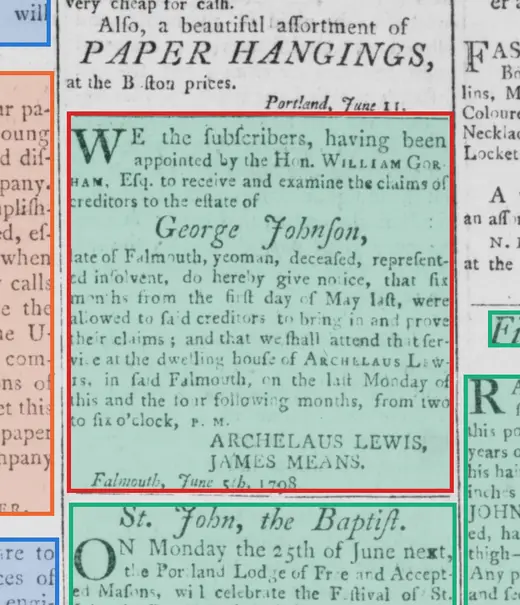
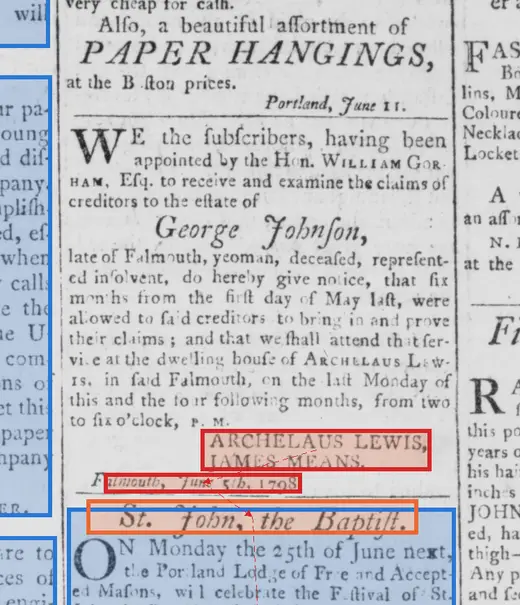
snewpapers
WE the subscribers, having been appointed by the Hon. William Gora, Esq. to receive and examine the claims of creditors to the estate of George Johnson, late of Falmouth, yeoman, deceased, represented insolvent, do hereby give notice, that six months from the first day of May last, were allowed to said creditors to bring in and prove their claims; and that we shall attend that service at the dwelling house of Archelaus Lewis, in said Falmouth, on the last Monday of this and the four following months, from two to six o'clock, P. M.ARCHELAUS LEWIS. JAMES MEANS.
Falmouth, June 5th, 1798.
American Stories
ARCHELAUS LEWIS, JAMES MEANS.almoufb, June 5tb, 1898
1:1 matchmatchnotice ↔ AS #13 p3-26 AS puts a line of it in another article
American Stories puts part of this component in another article: «My 90.» (inside this component; AS article #26) page furniture, not counted
- stated first: the component includes it (snewpapers): AS right (said separate): The fragment "NV 40." already appears to close the Masonic notice with a name/signature, and "My 90." is a distinct short item or mark, not part of the lodge announcement.
- stated first: the component does not include it (American Stories): page furniture, not counted (said furniture): «My 90.» is a short, fragmentary line (likely a misprinted date or tagline) and does not determine which system is correct.
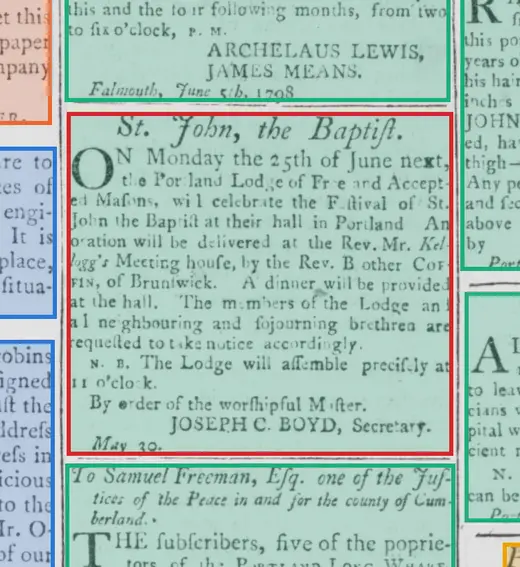
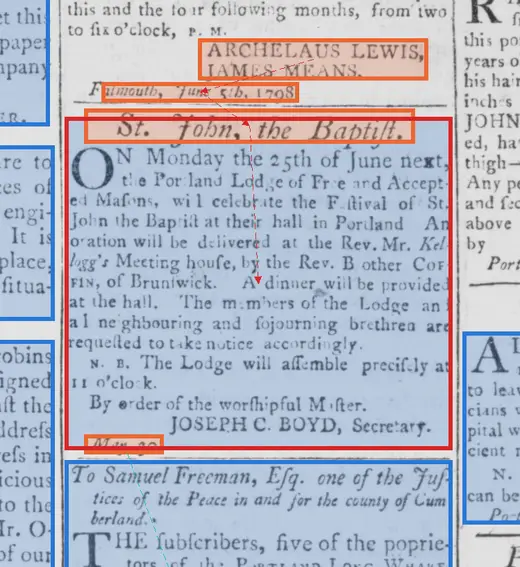
snewpapers
St. John, the Baptist.On Monday the 25th of June next, the Portland Lodge of Free and Accepted Masons, will celebrate the Festival of St. John the Baptist at their hall in Portland. An oration will be delivered at the Rev. Mr. Kellogg's Meeting house, by the Rev. Brother Cor-Fis, of Brunswick. A dinner will be provided at the hall. The members of the Lodge and neighbouring and sojourning brethren are requested to take notice accordingly.
N. B. The Lodge will assemble precisely at 11 o'clock.
By order of the worshipful Master.
JOSEPH C. BOYD, Secretary.
May 30.
American Stories
81. jain, The BaPtjF. IN Monday the 18th of June next, " tie Portland Lodge Of Ere ard Accept ed Mafons, wi / celebrate the F Rival Of St. John The Bap-ia at their hall in Portland An o'ation will be delivered at the Rev. Mr.. Kck hgg'S Meeting houfe, BY the Rev. B other Cor FIN, OF Bruniwick. "A Dime. will be provided at The hall. The m-mhers Of the Lodge an al neghbouring and fojournjng brethren are requelted to take notice accordingly.y. 3. The Lodge will aGamble Precif,ly at III O'Clock.
BY order Of the wor(hipful NJ fer
JOSEPH c. BOYD, Secretary. NV 40.
1 ours : N ASunstablenotice ↔ AS #26, AS #18 p3-27
- stated first: several components (American Stories): AS right (said several): The two pieces are distinct printed items: a subscribers' petition/notice to proprietors, and a separate legal warrant from Justice Samuel Freeman directing Daniel Tucker to warn the meeting. They are separate documents, not parts of a single article.
- stated first: one component (snewpapers): snewpapers right (said one): The numbered pieces are an application by the wharf proprietors and the justice's warrant and notification convening the meeting—all one connected legal notice/meeting call, not separate printed items.
snewpapers
To Samuel Freeman, Esq. one of the Justices of the Peace in and for the county of Cumberland.THE subscribers, five of the proprietors of the Portland Long Wharf, hereby request you would authorize a meeting of said proprietors, to be holden on Thursday the 14th day of June current, at 4 o'clock, p. m. at the Counting-house of M. James Deering, on said wharf, for the following purposes, viz.
1st. To choose a Moderator. 2d. To choose a Clerk, Treasurer, Collector of taxes, a Wharfinger, and any Committees that may be thought necessary. 3d. To see if they will repair, or make any additions to said wharf the current year. 4th. To receive accounts and allow such as they judge to be right. 5th. To determine what commission or other allowance shall be made the Clerk, Treasurer, or other officers. 6th. To vote such sums of money as may be necessary to pay accounts, and such repairs and additions as may be agreed upon. 7th. To determine how their Collector shall proceed with delinquent proprietors. 8th. To determine on the manner of calling future meetings.
DANIEL TUCKER, LEMUEL WEEKS, MATTHEW COBB, JOHN DEERING, for E. Deering. JOSEPH H. INGRAHAM.
Portland, June 9, 1798.
CUMBERLAND, To Daniel Tucker, one of the proprietors of the Portland Long Wharf, and one of the subscribers of the foregoing application.
YOU are hereby required in the name of the Commonwealth of Massachusetts, to notify and warn a meeting of said proprietors, to be holden at the time and place and for the purposes therein mentioned.
Given under my hand and seal the 9th June, 1798.
SAMUEL FREEMAN, Justice of the Peace for the county aforesaid.
Pursuant to the foregoing warrant, I hereby notify the proprietors of the Portland Long Wharf to meet at the time and place, and for the purposes mentioned in the foregoing application.
DANIEL TUCKER.
Portland, June 9, 1798.
American Stories
To Samuel Freeman, EJq. ons eftbs Jyc tfcS Of tbe Praee IL and TAR The County Of Cum 6,rianG.THE fublcriberS, five Of the poprie- u tors Of The PORTLAND Losc WHAKF, hereby requea You would authorize meeting fflid proPrietors, 70 be holden on ThuIfIay the 18th day Of June currenr, at 4 o'clock, ?. NJ at the Counting houlc Of M. JAMES DktRINc, on l4id wharf, for the following purpoles, viz. ut. To cho0le q Moderator.
I'd. To chooe Geek, Treafnrer, c llsaor Of taxes, Whardrger, and any Committees that my be thought nsc4GIry.
sd 10 Zee ( they vii repair, or make any addition, to fad wharf the curreutyetr. 18th. 70 receive accounts and allow fuch as they j0 lge to be right.
S'h. To determine what commidi0n or other allowance (hlll be made the Clerk, Tre4furer, or other officers.
9th. t. vote flch funs Of m 7ney as NAV BE neceGlry to pay Accounts, and fuch repairs and additions as nay be agreed upon.
7h. To determine how their Collector lhall proceed WI h del nq lent Propretors.
9Th. TO determine IN The manner Of calling future meetings.
DANIEL TUCKER,
LEMUEL WEEKS,
MATTHEW COBB,
JOHN DEERING. for Z. D.cring.
JOSEPH II. INGRAHAM. Portland, June 9, 1898.
CUMBERLAND, IT. To Daniel Tucker, one gftbe Pr9brietor5 9fhf Portland LeHg Wbarf, and ene Of TIKI yGb Jcribrrs oftbe foregoing apbfcctian.
YOU are hereby required in the name Of the Commonwealth Of Maflchulttts, TO notify and warn NEE ing Of lad Proprie tors, to be holden at h time and place and for The PurPof-s Their in mentioned. Given under my hand and lcal the 9th Jure. 1898.
SAMUEL FREEMAN, Jnnice Of II
Peace for the county aiorelad. Purfuant to the foregoing warrant, ! hereby notify the proPrietors Of the Port land Long Wharf TO meet al the time and place, and for the purPolcs mentioned in the foregoing application.
DANIEL TUCKER. Portland, Tnns 9, 1903.
- the pieces asked about (American Stories):
- [1] AS #26: begins: "To Samuel Freeman, EJq. ons eftbs Jyc tfcS Of tbe Praee IL and TAR The" … ends: "WEEKS, MATTHEW COBB, JOHN DEERING. for Z. D.cring. JOSEPH II. INGRAHAM. Portland, June 9, 1898."
- [2] AS #18: begins: "CUMBERLAND, IT. To Daniel Tucker, one gftbe Pr9brietor5 9fhf Portland LeHg Wbarf, and ene Of" … ends: "and for the purPolcs mentioned in the foregoing application. DANIEL TUCKER. Portland, Tnns 9, 1903."
ours onlynot captured by ASpersonal_ad p3-28
snewpapers
Wanted, A NEW Milch Cow of the first quality, for which Cash will be given. No one need be offered, unless warranted good. Inquire of the Printer. June 4.American Stories
nothingours onlynot captured by AScost_of_goods p3-29
snewpapers
Prices Current at Boston, PER QUANTITY-JUNE 3Leather. soal. dried lb 16 10 200 ASHES, Pot. T. 144d 76 Pearl, 160d to 166d 670 Butter, soi ping, lb. 18 to 20c Beef, ship stores, bbl 11 to12. aarga, 8d 50c to 10d Brandy, Fr. gal. id 4tctox 75 Spanifb, 1d 20 to 1d 50 Naples, 1d25 to 1 30 Coffee, green, tb. 24 Cotton, Foreign, lb. 30 to 40c American, 201035€ Chocolate, common lb. 16 to 200 Wel/b's 1 No 2to1,25t030 Rumney's§No 2 to 1,241029c Candles, tall. mo. lb. 17c dipt 15c Spermac. 50c Cheefe, Englifh, 2510330 American, 6to 1 c Coal, pit, Foreign,ch. 15d A nerizan, 12 to 14d Cod Lines, D. 8 to 91 Dack, Rusfia, bolt, 18 to 201 Ravent, Ird FISH, Table, cwt. 6 to 10d Mirchant, 41 to 4d 25 W. India, 2d 75c to 3d Scal, 2d to 2d 50c Alewiver, bbl 4 Salmon, 81t0 8d 75c Herrings .3d to 3d 330 Mackerell, bay,7:500 Nova-Scotia,6d to6d50c FURS Be ver, pelt lb. Ito2d Bear,fk 50c 10 4d Fox, crofs, 1d 33cto 2d 25c red, 83c to 1d 25c Minks, 10 10 50c Mufguafb 9 to 170 Otter, 1 to 41 Fishers, 33 to 83c Sables, 2510670 Flour, Sup. frefh, 7dto 7d 50c Fine, 6d 500 to 7d X Brand, 61 Middliags, 5d50c Feathers, l ve geefe, lb. 58c Lisbon, 17c Sea Forwl, 41c Flaxfeed, cafks of 8 bbl. 12d Gunporwder, lb. 75€ Geneva, 1.olland, ca 5d 50 cafe, gal. 91e to 1d 170 American, 65 to 750 GLASS, Brino! er bx. 10 by 8, 12d 50c 7by9, I2d 6 by 8, 10 Hamburgb, 7 by 9, 9d 5c 8 by 10, 9d 50c Bofton, to by 8, 15d 7 by 9, 12d 67c 6by8, 10d 50c GRAIN, Barley,lu. 8stooc Corn, Ind. South, 55c North, 60 10 660 Rys, 75 Oa.s, 41c Hemp, T. 7504 to 260d605 Hops, 1110546 Hoops, bhd. 12 feet, M. 20d Hogs Lard, lb 14 10 15€ IRON, Pig, T. 35d Philadel bar, 11o te.115d Rusfia, 110d 67c to 113d Squzdes 113d 33eto 125d Indigo, Caroli lb 6oc to 1d Lumber,Boards,slear. M. 11d merch. 8.1 50€ Shingles, 14 506 10 24 500
American Stories
nothingours onlynot captured by ASrunaway p3-30
snewpapers
Five Dollars Reward.Ran away, with the boat, from the snow Harriot, Capt. Brightman. lying in this port, DANIEL CAMPBELL, about 18 years old, dark complexion, something freckled, his hair dark and curly - about five feet four inches high. - Also, a boy by the name of JOHN SMITH, light complexion, long favored, has a scar of a ball shot through his left thigh - about four feet eight inches high. Any person who will take up said runaways, and secure them in any jail, shall receive the above reward, and all necessary charges paid, by HENRY BRIGHTMAN.
Portland, June 7, 1798.
American Stories
nothing1:1 matchmatchnotice ↔ AS #5 p3-31
snewpapers
Small Pox.All persons who intend being inoculated with the Small Pox, are desired to leave their names with either of the Physicians who attended the last season, as the Hospital will be opened again, as soon as a sufficient number apply.
N. B. Not more than one hundred can be accommodated in a class.
Portland. May 16.
American Stories
Small P0x.4 Ii perfons who intend being in ( y nocula,ci with the Small Pox, are delred to leave their names with ether Of he PhyG- clans who ATTENDED he lat leaon, as tn Hor- pital will be opened again, as loon as a fulfil Gent number apply.
n. B. Not more than one hundred can be accommod tied 10 4 cl4E.
Pa-liand Nag 8.
Page 4
1 ours : N ASunstablepoem ↔ AS #11, AS #2 p4-1 AS attaches text outside it
- stated first: one component (snewpapers): neither (said mixed): Piece [1] is a short advertisement/notice ending with a name (PETER DLBDEN), while piece [2] is a distinct poem ('POOR TOM. OR, THE SAILORS EPITAPH'); these are separate printed items, so the passage should be divided as the second system says.
- stated first: several components (American Stories): AS right (said several): Piece [1] is a short advertisement/notice signed by Peter Delden, while piece [2] is a distinct poem ('Poor Tom. Or, The Sailor's Epitaph'); they are separate printed items.
American Stories also attaches: «POETRY.» (outside this component; AS article #11) page furniture, not counted
- stated first: the component includes it (American Stories): page furniture, not counted (said furniture): «POETRY.» is a section heading printed over the poetry column and is page furniture, not part of this particular song/item.
- stated first: the component does not include it (snewpapers): page furniture, not counted (said furniture): «POETRY.» is a section heading printed over items, a piece of page furniture rather than part of the song itself.
snewpapers
MR. JENES,Be so kind as to insert the following handsome Song, which is much sung at present, and oblige Yours, PETER DIBDEN.
POOR TOM. OR, THE SAILOR'S EPITAPH.
Here a sheer hulk, lies poor Tom Bowling, The darling of our crew, No more he'll hear the tempest howling For Death has broached him too. His form was of the manliest beauty, His heart was kind and soft; Faithful below he did his duty, And now he's gone aloft.
Tom never from his word departed, His virtues were so rare; His friends were many and true hearted, His Poll was kind and fair. And then he'd sing so blyth and jolly, Ah! many's the time and oft But mirth is turn'd to melancholy, For Tom is gone aloft.
Yet shall poor Tom find pleasant weather When HE who all commands, Shall give, to call life's crew together, The word to pipe all hands. Thus Death, who kings and tars dispatches Tom's life has vainly doff'd; For though his body's under hatches, His soul is gone aloft.
American Stories
ZIP. JEEgS, IL n Kind p infrf he E477qpizg taHdl5me Soa,, 7ytila5 i maeb in. Ct 3rsiaaf, and oJlgr1oRr's PETER DLBDEN. 4
POOR TOM.
OR, TIE SAILORS EPITAPR. IT ERE, heer hulk, lies poor Tn Be-giisr, Ill Il The darling Of our crew, No more hell hear the :empea bowling,
For Death has preached him too. Ills form was Of the maEliea beauty,
lis heart was kind and foft Faithful below he did hs duty,
And now he's gone aloft. Tsz never from lis word departed,
Hs virtues were 70 rare lbs friends were many and true hearted, lis Pei was kind and fair. And then he'd seh 70 blyth and Jolly,
an manys Ire time and OF but mirth IS turnd TO melancholy,
For Ton is gone aIofr. Yet nhall poor Ts. snd pleafant weather, When He Who all c0rlrranG5, Shall give, 70 call Iifs's crew 4. ether,
TIE word 20 Pipe al hands. Thus Death, who kings ard Ears diPsicLes Tsz's life has vain'y tcHds For though his bodyf ur41r hatctta, Ills foGl Is goEc alCf
- the pieces asked about (American Stories):
- [1] AS #11: begins: "ZIP. JEEgS, IL n Kind p infrf he E477qpizg taHdl5me Soa,, 7ytila5 i maeb in." … ends: "E477qpizg taHdl5me Soa,, 7ytila5 i maeb in. Ct 3rsiaaf, and oJlgr 1oRr's PETER DLBDEN. 4"
- [2] AS #2: begins: "POOR TOM. OR, TIE SAILORS EPITAPR. IT ERE, heer hulk, lies poor Tn Be-giisr, Ill" … ends: "life has vain'y tcHds For though his bodyf ur41r hatctta, Ills foGl Is goEc alCf"
1:1 matchmatchpoem ↔ AS #7 p4-2
snewpapers
FROM THE TASK.Oh for a lodge in some vast wilderness, Some boundless contiguity of shade, Where rumor of oppression and deceit, Of unsuccessful or successful war, Might never reach me more. My ear is pain'd, My soul is sick with every day's report Of wrong and outrage with which the earth is fill'd. There is no flesh in man's obdurate heart. It does not feel for man. The natural bond Of brotherhood is sever'd as the flax That falls asunder at the touch of fire.
American Stories
OH for lodge "a fore vtf rsr-lrl, Some boundlels contFuaV Cd #atc, Where rumcur Of oprrcilen aE4 lcc-lti or unfuceelsiul or iucccf II. var. Might never reach me more. sly car j. pain q, Ny fol Is fick with every DAVIS report OF wrong and Outrage with which the earth IS hid. There IS no heih in mans obdurate heart. Il does not feel for MAJ. The nat'raI bond @ motherhood is lcver'd g the FAX Thar falls alundsT At the touch Of fire.1:1 matchmatchpoem ↔ AS #5 p4-3
snewpapers
THE NEWSPAPER.This folio of four pages, happy work! Which not e'en critics criticise, that holds Inquisitive attention—while I read, Fast bound in chains of silence, which the fair, Though eloquent themselves, yet fear to break; What is it but a map of busy life, Its fluctuations and its vast concerns? 'Tis pleasing through the loopholes of retreat To peep at such a world; to see the stir Of the great Babel, and not feel the crowd.
American Stories
TIE NEWSPAPER.THIS folio Of four pages, happy work Which not cen critics criticize, that holds InquiGiive attention while read,
Fsf bound in chains Of 6lence, which the fair, Though eloquent themltlves, yet fear 70 break /; What Is it but map Of bUfy lie,
Its huduatiors and It's van eoncerns IT'S pieafing through the Ioophoies OF retreat To peep At flch World to Zee the hir Of the great Babel, and not feel the croud.
AS onlycorrectly not servedAS #4 p4-4
- page furniture: The heading-like phrase 'THE COLLECTION' followed by a short garbled title line appears to be a section or feature heading rather than a printed item such as an advertisement or notice.
snewpapers
nothingAmerican Stories
THE COLLECTION.+" q THING or sEREDs AxD R4rczE5."
N ours : 1 ASsnewpapers rightfiller, filler, filler ↔ AS #4 p4-5
- stated first: several components (snewpapers): snewpapers right (said several): The passage consists of three distinct short items, each with its own title (Grecian Nuns, Arabian Women, Beware of strong Teas), indicating separate components rather than one continued item.
- stated first: one component (American Stories): snewpapers right (said several): Each numbered piece is a distinct standalone item—separate short notices/paragraphs with their own headings (Grecian Nuns, Arabian Women, Beware of strong Teas), not continuations of one another.
snewpapers
Grecian Nuns.—The Greek nuns know nothing of the severities of a monastic life. Their characteristic is that of being Magdalenes reformed; who, towards the decline of life make a vow to observe some virtues they have neglected in their youth, and so retire into a monastery, there to lead lives less scandalous, or perhaps less publicly so, under the inspection of a good natured abbess, who is not very rigid. Hence travellers may be accommodated with certain favors, if they will put up with the autumn of beauty.Arabian Women.—No man must see the face of an Arabian woman without subjecting himself either to marry her or lose his eyes; for after a young woman has been seen by a man no other will marry her.
Beware of strong Teas, ladies.—The women, by the delicacy of their constitutions are most sensibly affected by the pernicious practice of drinking strong and tepid teas, to which they have so much addicted themselves. The importance of their welfare to the general weal, and their peculiar aptness to felicitate the life and enjoyments of man, renders their health an object of particular concern to every good mind.— In the morning, when the stomach is empty, & the digestive faculties strong, nature indicates some solid food for it to operate upon. How pernicious then must it be to farther slacken the already relaxed fibres, and destroy their elasticity by a quantity of tepid diluting liquors? The poorer sort of women, who are subject to great inconvenience, are by far the most vigorous & healthy. Would the fair in general, receive instruction from them, and be persuaded to live more agreeable to nature and reason, the rosy bloom would not so quickly and frequently fade ; nor would they be obliged to reckon so many tedious hours of their lives by the throbbing pulse.
American Stories
THE COLLECTION.+" q THING or sEREDs AxD R4rczE5."
GREcIAN NUNs.-The Greek nuns know nothing Of the feverities Of mo- naltic life. Their charaaerific is that Of being Magdalenes reformed who, towards the decline oflife make vow to obierve fome virtues they have ne elected in their youth, and 70 retire into a monafry, there to lead lives Iefs fcan- dalous, or perhaps lefs publicly 70, un- de- ne infPedion ola good naturedab- bels, who is not very rigid. Hence travellers may be accommodated with certain favors, if they will put up with the autumn Of beauty.
ARABIAN WoMEE.-NO man mutt fee the face of an Arabian woman with out fubjeding himlelf either to marry her or loOle his eyes for after ayoung woman has been ieen by man no 9TH er will marry her.
Beg0are Of Rrong Teas, Ladis;.-Thc women, by the delicacy Of their confi- tutions are mott fenfibly affected by the pernicious practice of drinking frong and tepid teas, TO which they have 70 much addicted themfeIyes. The i'm portance of their welfare to the general veal, and their peculiar adaPtnels to felicitatethe life and enjoyments of man, renders their health an Object Of Parti- cular concern to every good mind In the morning, when the ltomach is empty, & the digeltive faculties frong, nature indicates fome fold food for it TO operate upon. How pernicious then mutt it be to farther 1acken the already relaxed fbres, and dellroy their elati- city by quantity Of tePid diluting IL quors The poorer fort of women. who are fubjed to great inconvenience, are by far the mott vigorous & healthy. Would the fair in general, receive in ftru6tion from them, and be perfuaded to live more agreeable to nature and realon, the rofy bloom would not f quickly and frequently fade (; nor wouIc they be obliged TO reckon 70 many te dious hours Of their lives by the throb bing DGae-
- the pieces asked about (snewpapers):
- [1] filler: begins: "Grecian Nuns.—The Greek nuns know nothing of the severities of a monastic life. Their characteristic" … ends: "be accommodated with certain favors, if they will put up with the autumn of beauty."
- [2] filler: begins: "Arabian Women.—No man must see the face of an Arabian woman without subjecting himself either" … ends: "after a young woman has been seen by a man no other will marry her."
- [3] filler: begins: "Beware of strong Teas, ladies.—The women, by the delicacy of their constitutions are most sensibly" … ends: "be obliged to reckon so many tedious hours of their lives by the throbbing pulse."
Text agreement inside AS's merged article (3 pieces): the merged article's text cut where our components begin and end; American Stories draws no boundary there, so these are no matches.
p4-6 filler
snewpapers
Grecian Nuns.—The Greek nuns know nothing of the severities of a monastic life. Their characteristic is that of being Magdalenes reformed; who, towards the decline of life make a vow to observe some virtues they have neglected in their youth, and so retire into a monastery, there to lead lives less scandalous, or perhaps less publicly so, under the inspection of a good natured abbess, who is not very rigid. Hence travellers may be accommodated with certain favors, if they will put up with the autumn of beauty.American Stories (slice of #4)
GREcIAN NUNs.-The Greek nuns know nothing Of the feverities Of mo- naltic life. Their charaaerific is that Of being Magdalenes reformed who, towards the decline oflife make vow to obierve fome virtues they have ne elected in their youth, and 70 retire into a monafry, there to lead lives Iefs fcan- dalous, or perhaps lefs publicly 70, un- de- ne infPedion ola good naturedab- bels, who is not very rigid. Hence travellers may be accommodated with certain favors, if they will put up with the autumn Of beauty.p4-7 filler
snewpapers
Arabian Women.—No man must see the face of an Arabian woman without subjecting himself either to marry her or lose his eyes; for after a young woman has been seen by a man no other will marry her.American Stories (slice of #4)
ARABIAN WoMEE.-NO man mutt fee the face of an Arabian woman with out fubjeding himlelf either to marry her or loOle his eyes for after ayoung woman has been ieen by man no 9TH er will marry her.p4-8 filler
snewpapers
Beware of strong Teas, ladies.—The women, by the delicacy of their constitutions are most sensibly affected by the pernicious practice of drinking strong and tepid teas, to which they have so much addicted themselves. The importance of their welfare to the general weal, and their peculiar aptness to felicitate the life and enjoyments of man, renders their health an object of particular concern to every good mind.— In the morning, when the stomach is empty, & the digestive faculties strong, nature indicates some solid food for it to operate upon. How pernicious then must it be to farther slacken the already relaxed fibres, and destroy their elasticity by a quantity of tepid diluting liquors? The poorer sort of women, who are subject to great inconvenience, are by far the most vigorous & healthy. Would the fair in general, receive instruction from them, and be persuaded to live more agreeable to nature and reason, the rosy bloom would not so quickly and frequently fade ; nor would they be obliged to reckon so many tedious hours of their lives by the throbbing pulse.American Stories (slice of #4)
Beg0are Of Rrong Teas, Ladis;.-Thc women, by the delicacy Of their confi- tutions are mott fenfibly affected by the pernicious practice of drinking frong and tepid teas, TO which they have 70 much addicted themfeIyes. The i'm portance of their welfare to the general veal, and their peculiar adaPtnels to felicitatethe life and enjoyments of man, renders their health an Object Of Parti- cular concern to every good mind In the morning, when the ltomach is empty, & the digeltive faculties frong, nature indicates fome fold food for it TO operate upon. How pernicious then mutt it be to farther 1acken the already relaxed fbres, and dellroy their elati- city by quantity Of tePid diluting IL quors The poorer fort of women. who are fubjed to great inconvenience, are by far the mott vigorous & healthy. Would the fair in general, receive in ftru6tion from them, and be perfuaded to live more agreeable to nature and realon, the rofy bloom would not f quickly and frequently fade (; nor wouIc they be obliged TO reckon 70 many te dious hours Of their lives by the throb bing DGae-in N ours : 1 ASsnewpapers rightfiller ↔ AS #4 p4-6 inside AS's merged article, decided by p4-5
snewpapers
Grecian Nuns.—The Greek nuns know nothing of the severities of a monastic life. Their characteristic is that of being Magdalenes reformed; who, towards the decline of life make a vow to observe some virtues they have neglected in their youth, and so retire into a monastery, there to lead lives less scandalous, or perhaps less publicly so, under the inspection of a good natured abbess, who is not very rigid. Hence travellers may be accommodated with certain favors, if they will put up with the autumn of beauty.American Stories
GREcIAN NUNs.-The Greek nuns know nothing Of the feverities Of mo- naltic life. Their charaaerific is that Of being Magdalenes reformed who, towards the decline oflife make vow to obierve fome virtues they have ne elected in their youth, and 70 retire into a monafry, there to lead lives Iefs fcan- dalous, or perhaps lefs publicly 70, un- de- ne infPedion ola good naturedab- bels, who is not very rigid. Hence travellers may be accommodated with certain favors, if they will put up with the autumn Of beauty.in N ours : 1 ASsnewpapers rightfiller ↔ AS #4 p4-7 inside AS's merged article, decided by p4-5
snewpapers
Arabian Women.—No man must see the face of an Arabian woman without subjecting himself either to marry her or lose his eyes; for after a young woman has been seen by a man no other will marry her.American Stories
ARABIAN WoMEE.-NO man mutt fee the face of an Arabian woman with out fubjeding himlelf either to marry her or loOle his eyes for after ayoung woman has been ieen by man no 9TH er will marry her.in N ours : 1 ASsnewpapers rightfiller ↔ AS #4 p4-8 inside AS's merged article, decided by p4-5
snewpapers
Beware of strong Teas, ladies.—The women, by the delicacy of their constitutions are most sensibly affected by the pernicious practice of drinking strong and tepid teas, to which they have so much addicted themselves. The importance of their welfare to the general weal, and their peculiar aptness to felicitate the life and enjoyments of man, renders their health an object of particular concern to every good mind.— In the morning, when the stomach is empty, & the digestive faculties strong, nature indicates some solid food for it to operate upon. How pernicious then must it be to farther slacken the already relaxed fibres, and destroy their elasticity by a quantity of tepid diluting liquors? The poorer sort of women, who are subject to great inconvenience, are by far the most vigorous & healthy. Would the fair in general, receive instruction from them, and be persuaded to live more agreeable to nature and reason, the rosy bloom would not so quickly and frequently fade ; nor would they be obliged to reckon so many tedious hours of their lives by the throbbing pulse.American Stories
Beg0are Of Rrong Teas, Ladis;.-Thc women, by the delicacy Of their confi- tutions are mott fenfibly affected by the pernicious practice of drinking frong and tepid teas, TO which they have 70 much addicted themfeIyes. The i'm portance of their welfare to the general veal, and their peculiar adaPtnels to felicitatethe life and enjoyments of man, renders their health an Object Of Parti- cular concern to every good mind In the morning, when the ltomach is empty, & the digeltive faculties frong, nature indicates fome fold food for it TO operate upon. How pernicious then mutt it be to farther 1acken the already relaxed fbres, and dellroy their elati- city by quantity Of tePid diluting IL quors The poorer fort of women. who are fubjed to great inconvenience, are by far the mott vigorous & healthy. Would the fair in general, receive in ftru6tion from them, and be perfuaded to live more agreeable to nature and realon, the rofy bloom would not f quickly and frequently fade (; nor wouIc they be obliged TO reckon 70 many te dious hours Of their lives by the throb bing DGae-in N ours : 1 ASsnewpapers rightfiller ↔ AS #18 p4-9 inside AS's merged article, decided by p4-10
snewpapers
Talleyrand & the Cook Maid.—When Talleyrand (now minister of foreign affairs in France) was in this country, he travelled by land from Frenchman's bay to Boston. In a town not far from Kennebeck river, he called at an inn for some refreshment. As his ill stars would have it, he presently introduced himself to the maid of the house, and offered to administer the 'fraternal embrace' sans ceremonie; but the girl instantly repelled the attempt, by severely cuffing his ears. The right reverend Bishop, apologized by saying 'it was a very grand custom in his country;' but the indignant fair one, not inclining to admit the custom, told him 'he was one very great puppy,' and by the aid of the tongs, compelled him to quit the republic.American Stories
htuUeDeCk IlF6I lac SdilC0 O. 90 $500for fome refrefhment. As his i'll itars
would have it, he prefently introduced
himfelf to the maid of the houfe, and
offered to adminiler the " fraternal
embrace" fans ccremonie but the girl | infantly repealed the attempt, by ievere- ly CUTTING HIS EARS. The right req
ersnd Bjbop, apologized by laying " il va5 von Dery grand cgJ20m in Bis e0nafry;" but the indignant fair one, not inclining
to admit the cgf0m, told him & be 7Oa5 enc Vsry great bnbpy," and BY the aid Of the 'tongs,' compelled him to quit the republic
N ours : 1 ASsnewpapers rightfiller, filler, filler, filler ↔ AS #18 p4-10
- stated first: one component (American Stories): snewpapers right (said several): The passage consists of four distinct titled anecdotes or short items (Talleyrand, A Traveller's Story, The Human Passions, To Sunday-Sleepers), each a self-contained piece with its own heading.
- stated first: several components (snewpapers): snewpapers right (said several): The passage consists of four clearly distinct titled items (Talleyrand & the Cook Maid, A Traveller's Story, The Human Passions, To Sunday-Sleepers), each a self-contained anecdote or essay, so the numbered pieces are separate components.
snewpapers
Talleyrand & the Cook Maid.—When Talleyrand (now minister of foreign affairs in France) was in this country, he travelled by land from Frenchman's bay to Boston. In a town not far from Kennebeck river, he called at an inn for some refreshment. As his ill stars would have it, he presently introduced himself to the maid of the house, and offered to administer the 'fraternal embrace' sans ceremonie; but the girl instantly repelled the attempt, by severely cuffing his ears. The right reverend Bishop, apologized by saying 'it was a very grand custom in his country;' but the indignant fair one, not inclining to admit the custom, told him 'he was one very great puppy,' and by the aid of the tongs, compelled him to quit the republic.A Traveller's Story.—Some persons relating to each other the many wonderful objects they had seen in the course of their travels, one of them asserted that he had seen in Africa, some grass growing that was as tall as a house, and applied to his companion for the truth of the story! this his companion made no hesitation in confirming, & declared, that in the very field where the grass grew, after having walked some time, he sat down to rest himself, and in the course of a few minutes found himself raised thirty feet from the ground, in consequence of having sat upon a mushroom that was growing! [a good one.]
The Human Passions, &c.—Our nature, diversely cultivated, decides upon our faculties, as well corporeal as intellectual—upon our qualities as well moral as physical. A man who is sanguine and robust, must have strong passions; a bilious and melancholy man will have fantastical and gloomy passions; a man of a gay and sprightly imagination will have cheerful passions; a man in whom phlegm abounds, will have gentle passions and slightly violent. It is upon the equilibrium of the humours that appears to depend the state of those whom we call virtuous; their temperament appears to be the produce of a combination in which the elements or principles balance themselves with sufficient precision so that no one passion carries more than another into the machine. Habit as we have seen, is the nature of man modified, this furnishes the matter; education, domestic and national manners, example, &c. give it the form; and of the temperament which nature presents to them, they make men reasonable or irrational—fanatics or heroes—enthusiasts for the public weal or unbridled criminals—men enlightened or stupid—wise men smitten with the advantages of virtue, or libertines plunged into every kind of vice. All the varieties of the moral man depend upon the diverse ideas which arrange themselves and combine themselves in the brain, various by the intervention of the sense. The temperament is the produce of physical substances; the opinions good or bad—true or false, which arrange themselves in the human mind, are never more than the effect of those physical impulses which it has received by its senses.
To Sunday-Sleepers.—A certain delirious man went to meeting on Sunday, and peaceably seated himself. In sermon time, looking round the meeting house, observing some of the congregation sleeping, and being accidentally armed with a pocket full of rotten apples he drew them forth one by one, and taking good aim, let them fly slap into the faces of the sleeping christians. This was repeated several times, to the no small diversion of the audience; but the parson observing his conduct, desired the people to take care of that crazy man—who instantly replied, Do you mind your preaching, I'll keep the dogs awake.
American Stories
htuUeDeCk IlF6I lac SdilC0 O. 90 $500for fome refrefhment. As his i'll itars
would have it, he prefently introduced
himfelf to the maid of the houfe, and
offered to adminiler the " fraternal
embrace" fans ccremonie but the girl | infantly repealed the attempt, by ievere- ly CUTTING HIS EARS. The right req
ersnd Bjbop, apologized by laying " il va5 von Dery grand cgJ20m in Bis e0nafry;" but the indignant fair one, not inclining
to admit the cgf0m, told him & be 7Oa5 enc Vsry great bnbpy," and BY the aid Of the 'tongs,' compelled him to quit the republic
Il TraUeHer's St0ry.-SOme Pcr{Ons relating to each other the many wond- erful objects they had feen in the coure Of their travels, one of them aderted that he had feen in Africa, fome graG growing that was as tall as houfe, ana applied to his companion for the truth OF the lfory this his companion made no hehtation in confirming, & declared, that in the very field where the grals grew, after having walked fome time, he fat down to reit himfelf, and in the courfe Of few minutes found himfelt RATED thirty feet from the ground, in cOntequence of having fat upon mgb- ram that was growing Ag0Od 0He. J.
Tie Human Pa6fon5, J't.-Our nature, diverfeIy cultivated, decides upon our faculties, as well corporeal as intellectual upon our qualities as we'll moral as Phyfcal. A man who is languine and robuf, mutt have frong PaGions BIZ lious and melancholy man will have fantaGical and gloomy pafions a man of gay and brightly Imagination will have cheerful pafions man in whom phlegm abounds, will have gentle paf- lioRs and Tightly violent. 1t is upon the equilibrium Of the humours that ap- pears to depend the fate Of thofe whom we call virtuous their temperament appears to be the produce Of combi- nation in which the elements or princi- pies balance themfeIveS with fuficient preciGon 70 that no one pafion carries more than another into the machine. Habit as we have feen, is the nature Of man modified, this furnilhes the mat ter education, domeitic and national manners, example, &c. give it the form and Of the temperament which nature Preients to them, they make men realonable or irrational-fanatics or heroes-enthuGafs for the public veal or unbridled crimInalS-men enlight- ened or fuPid-wile men fmitten with the advantages Of virtue, or libertineS plunged into every kind of vice. All the varieties Of the moral man depend upon the diverle ideas which arrange themlelveS and combine themielves in the brain, various by the intervention Of the fenGe. The temperament is the produce Of phyfcal fubfances the O. Pinions good or bad-true or falfe, which arrange themleives in the human mind, are never more than the efed of thOle Phyfcal imPulions which it has received by its fenies.
To Sunday-SIeeper5.-A certain deli riouS man went to meeting on Sunday, and peaceably feated himfelf. In fer mon time, looking round the meeting houfe, Oblerving fome Of the congre- CATION AeePing, and being accidentally armed with pocket full Of rotten ap- pies he drew them forth one by one, and taking good aim, let them fly flap into the faces of The 1eenino chrinians
- the pieces asked about (snewpapers):
- [1] filler: begins: "Talleyrand & the Cook Maid.—When Talleyrand (now minister of foreign affairs in France) was in" … ends: "great puppy,' and by the aid of the tongs, compelled him to quit the republic."
- [2] filler: begins: "A Traveller's Story.—Some persons relating to each other the many wonderful objects they had seen" … ends: "ground, in consequence of having sat upon a mushroom that was growing! [a good one.]"
- [3] filler: begins: "The Human Passions, &c.—Our nature, diversely cultivated, decides upon our faculties, as well corporeal as" … ends: "more than the effect of those physical impulses which it has received by its senses."
- [4] filler: begins: "To Sunday-Sleepers.—A certain delirious man went to meeting on Sunday, and peaceably seated himself. In" … ends: "that crazy man—who instantly replied, Do you mind your preaching, I'll keep the dogs awake."
Text agreement inside AS's merged article (4 pieces): the merged article's text cut where our components begin and end; American Stories draws no boundary there, so these are no matches.
p4-9 filler
for fome refrefhment. As his i'll itars
would have it, he prefently introduced
himfelf to the maid of the houfe, and
offered to adminiler the " fraternal
embrace" fans ccremonie but the girl | infantly repealed the attempt, by ievere- ly CUTTING HIS EARS. The right req
ersnd Bjbop, apologized by laying " il va5 von Dery grand cgJ20m in Bis e0nafry;" but the indignant fair one, not inclining
to admit the cgf0m, told him & be 7Oa5 enc Vsry great bnbpy," and BY the aid Of the 'tongs,' compelled him to quit the republic
snewpapers
Talleyrand & the Cook Maid.—When Talleyrand (now minister of foreign affairs in France) was in this country, he travelled by land from Frenchman's bay to Boston. In a town not far from Kennebeck river, he called at an inn for some refreshment. As his ill stars would have it, he presently introduced himself to the maid of the house, and offered to administer the 'fraternal embrace' sans ceremonie; but the girl instantly repelled the attempt, by severely cuffing his ears. The right reverend Bishop, apologized by saying 'it was a very grand custom in his country;' but the indignant fair one, not inclining to admit the custom, told him 'he was one very great puppy,' and by the aid of the tongs, compelled him to quit the republic.American Stories (slice of #18)
htuUeDeCk IlF6I lac SdilC0 O. 90 $500for fome refrefhment. As his i'll itars
would have it, he prefently introduced
himfelf to the maid of the houfe, and
offered to adminiler the " fraternal
embrace" fans ccremonie but the girl | infantly repealed the attempt, by ievere- ly CUTTING HIS EARS. The right req
ersnd Bjbop, apologized by laying " il va5 von Dery grand cgJ20m in Bis e0nafry;" but the indignant fair one, not inclining
to admit the cgf0m, told him & be 7Oa5 enc Vsry great bnbpy," and BY the aid Of the 'tongs,' compelled him to quit the republic
p4-11 filler
snewpapers
A Traveller's Story.—Some persons relating to each other the many wonderful objects they had seen in the course of their travels, one of them asserted that he had seen in Africa, some grass growing that was as tall as a house, and applied to his companion for the truth of the story! this his companion made no hesitation in confirming, & declared, that in the very field where the grass grew, after having walked some time, he sat down to rest himself, and in the course of a few minutes found himself raised thirty feet from the ground, in consequence of having sat upon a mushroom that was growing! [a good one.]American Stories (slice of #18)
Il TraUeHer's St0ry.-SOme Pcr{Ons relating to each other the many wond- erful objects they had feen in the coure Of their travels, one of them aderted that he had feen in Africa, fome graG growing that was as tall as houfe, ana applied to his companion for the truth OF the lfory this his companion made no hehtation in confirming, & declared, that in the very field where the grals grew, after having walked fome time, he fat down to reit himfelf, and in the courfe Of few minutes found himfelt RATED thirty feet from the ground, in cOntequence of having fat upon mgb- ram that was growing Ag0Od 0He.p4-12 filler
Tie Human Pa6fon5, J't.-Our nature, diverfeIy cultivated, decides upon our faculties, as well corporeal as intellectual upon our qualities as we'll moral as Phyfcal. A man who is languine and robuf, mutt have frong PaGions BIZ lious and melancholy man will have fantaGical and gloomy pafions a man of gay and brightly Imagination will have cheerful pafions man in whom phlegm abounds, will have gentle paf- lioRs and Tightly violent. 1t is upon the equilibrium Of the humours that ap- pears to depend the fate Of thofe whom we call virtuous their temperament appears to be the produce Of combi- nation in which the elements or princi- pies balance themfeIveS with fuficient preciGon 70 that no one pafion carries more than another into the machine. Habit as we have feen, is the nature Of man modified, this furnilhes the mat ter education, domeitic and national manners, example, &c. give it the form and Of the temperament which nature Preients to them, they make men realonable or irrational-fanatics or heroes-enthuGafs for the public veal or unbridled crimInalS-men enlight- ened or fuPid-wile men fmitten with the advantages Of virtue, or libertineS plunged into every kind of vice. All the varieties Of the moral man depend upon the diverle ideas which arrange themlelveS and combine themielves in the brain, various by the intervention Of the fenGe. The temperament is the produce Of phyfcal fubfances the O. Pinions good or bad-true or falfe, which arrange themleives in the human mind, are never more than the efed of thOle Phyfcal imPulions which it has received by its fenies.
snewpapers
The Human Passions, &c.—Our nature, diversely cultivated, decides upon our faculties, as well corporeal as intellectual—upon our qualities as well moral as physical. A man who is sanguine and robust, must have strong passions; a bilious and melancholy man will have fantastical and gloomy passions; a man of a gay and sprightly imagination will have cheerful passions; a man in whom phlegm abounds, will have gentle passions and slightly violent. It is upon the equilibrium of the humours that appears to depend the state of those whom we call virtuous; their temperament appears to be the produce of a combination in which the elements or principles balance themselves with sufficient precision so that no one passion carries more than another into the machine. Habit as we have seen, is the nature of man modified, this furnishes the matter; education, domestic and national manners, example, &c. give it the form; and of the temperament which nature presents to them, they make men reasonable or irrational—fanatics or heroes—enthusiasts for the public weal or unbridled criminals—men enlightened or stupid—wise men smitten with the advantages of virtue, or libertines plunged into every kind of vice. All the varieties of the moral man depend upon the diverse ideas which arrange themselves and combine themselves in the brain, various by the intervention of the sense. The temperament is the produce of physical substances; the opinions good or bad—true or false, which arrange themselves in the human mind, are never more than the effect of those physical impulses which it has received by its senses.American Stories (slice of #18)
J.Tie Human Pa6fon5, J't.-Our nature, diverfeIy cultivated, decides upon our faculties, as well corporeal as intellectual upon our qualities as we'll moral as Phyfcal. A man who is languine and robuf, mutt have frong PaGions BIZ lious and melancholy man will have fantaGical and gloomy pafions a man of gay and brightly Imagination will have cheerful pafions man in whom phlegm abounds, will have gentle paf- lioRs and Tightly violent. 1t is upon the equilibrium Of the humours that ap- pears to depend the fate Of thofe whom we call virtuous their temperament appears to be the produce Of combi- nation in which the elements or princi- pies balance themfeIveS with fuficient preciGon 70 that no one pafion carries more than another into the machine. Habit as we have feen, is the nature Of man modified, this furnilhes the mat ter education, domeitic and national manners, example, &c. give it the form and Of the temperament which nature Preients to them, they make men realonable or irrational-fanatics or heroes-enthuGafs for the public veal or unbridled crimInalS-men enlight- ened or fuPid-wile men fmitten with the advantages Of virtue, or libertineS plunged into every kind of vice. All the varieties Of the moral man depend upon the diverle ideas which arrange themlelveS and combine themielves in the brain, various by the intervention Of the fenGe. The temperament is the produce Of phyfcal fubfances the O. Pinions good or bad-true or falfe, which arrange themleives in the human mind, are never more than the efed of thOle Phyfcal imPulions which it has received by its fenies.
p4-13 filler
snewpapers
To Sunday-Sleepers.—A certain delirious man went to meeting on Sunday, and peaceably seated himself. In sermon time, looking round the meeting house, observing some of the congregation sleeping, and being accidentally armed with a pocket full of rotten apples he drew them forth one by one, and taking good aim, let them fly slap into the faces of the sleeping christians. This was repeated several times, to the no small diversion of the audience; but the parson observing his conduct, desired the people to take care of that crazy man—who instantly replied, Do you mind your preaching, I'll keep the dogs awake.American Stories (slice of #18)
To Sunday-SIeeper5.-A certain deli riouS man went to meeting on Sunday, and peaceably feated himfelf. In fer mon time, looking round the meeting houfe, Oblerving fome Of the congre- CATION AeePing, and being accidentally armed with pocket full Of rotten ap- pies he drew them forth one by one, and taking good aim, let them fly flap into the faces of The 1eenino chriniansin N ours : 1 ASsnewpapers rightfiller ↔ AS #18 p4-11 inside AS's merged article, decided by p4-10
snewpapers
A Traveller's Story.—Some persons relating to each other the many wonderful objects they had seen in the course of their travels, one of them asserted that he had seen in Africa, some grass growing that was as tall as a house, and applied to his companion for the truth of the story! this his companion made no hesitation in confirming, & declared, that in the very field where the grass grew, after having walked some time, he sat down to rest himself, and in the course of a few minutes found himself raised thirty feet from the ground, in consequence of having sat upon a mushroom that was growing! [a good one.]American Stories
Il TraUeHer's St0ry.-SOme Pcr{Ons relating to each other the many wond- erful objects they had feen in the coure Of their travels, one of them aderted that he had feen in Africa, fome graG growing that was as tall as houfe, ana applied to his companion for the truth OF the lfory this his companion made no hehtation in confirming, & declared, that in the very field where the grals grew, after having walked fome time, he fat down to reit himfelf, and in the courfe Of few minutes found himfelt RATED thirty feet from the ground, in cOntequence of having fat upon mgb- ram that was growing Ag0Od 0He.in N ours : 1 ASsnewpapers rightfiller ↔ AS #18 p4-12 inside AS's merged article, decided by p4-10
snewpapers
The Human Passions, &c.—Our nature, diversely cultivated, decides upon our faculties, as well corporeal as intellectual—upon our qualities as well moral as physical. A man who is sanguine and robust, must have strong passions; a bilious and melancholy man will have fantastical and gloomy passions; a man of a gay and sprightly imagination will have cheerful passions; a man in whom phlegm abounds, will have gentle passions and slightly violent. It is upon the equilibrium of the humours that appears to depend the state of those whom we call virtuous; their temperament appears to be the produce of a combination in which the elements or principles balance themselves with sufficient precision so that no one passion carries more than another into the machine. Habit as we have seen, is the nature of man modified, this furnishes the matter; education, domestic and national manners, example, &c. give it the form; and of the temperament which nature presents to them, they make men reasonable or irrational—fanatics or heroes—enthusiasts for the public weal or unbridled criminals—men enlightened or stupid—wise men smitten with the advantages of virtue, or libertines plunged into every kind of vice. All the varieties of the moral man depend upon the diverse ideas which arrange themselves and combine themselves in the brain, various by the intervention of the sense. The temperament is the produce of physical substances; the opinions good or bad—true or false, which arrange themselves in the human mind, are never more than the effect of those physical impulses which it has received by its senses.American Stories
J.Tie Human Pa6fon5, J't.-Our nature, diverfeIy cultivated, decides upon our faculties, as well corporeal as intellectual upon our qualities as we'll moral as Phyfcal. A man who is languine and robuf, mutt have frong PaGions BIZ lious and melancholy man will have fantaGical and gloomy pafions a man of gay and brightly Imagination will have cheerful pafions man in whom phlegm abounds, will have gentle paf- lioRs and Tightly violent. 1t is upon the equilibrium Of the humours that ap- pears to depend the fate Of thofe whom we call virtuous their temperament appears to be the produce Of combi- nation in which the elements or princi- pies balance themfeIveS with fuficient preciGon 70 that no one pafion carries more than another into the machine. Habit as we have feen, is the nature Of man modified, this furnilhes the mat ter education, domeitic and national manners, example, &c. give it the form and Of the temperament which nature Preients to them, they make men realonable or irrational-fanatics or heroes-enthuGafs for the public veal or unbridled crimInalS-men enlight- ened or fuPid-wile men fmitten with the advantages Of virtue, or libertineS plunged into every kind of vice. All the varieties Of the moral man depend upon the diverle ideas which arrange themlelveS and combine themielves in the brain, various by the intervention Of the fenGe. The temperament is the produce Of phyfcal fubfances the O. Pinions good or bad-true or falfe, which arrange themleives in the human mind, are never more than the efed of thOle Phyfcal imPulions which it has received by its fenies.
in N ours : 1 ASsnewpapers rightfiller ↔ AS #18 p4-13 inside AS's merged article, decided by p4-10
snewpapers
To Sunday-Sleepers.—A certain delirious man went to meeting on Sunday, and peaceably seated himself. In sermon time, looking round the meeting house, observing some of the congregation sleeping, and being accidentally armed with a pocket full of rotten apples he drew them forth one by one, and taking good aim, let them fly slap into the faces of the sleeping christians. This was repeated several times, to the no small diversion of the audience; but the parson observing his conduct, desired the people to take care of that crazy man—who instantly replied, Do you mind your preaching, I'll keep the dogs awake.American Stories
To Sunday-SIeeper5.-A certain deli riouS man went to meeting on Sunday, and peaceably feated himfelf. In fer mon time, looking round the meeting houfe, Oblerving fome Of the congre- CATION AeePing, and being accidentally armed with pocket full Of rotten ap- pies he drew them forth one by one, and taking good aim, let them fly flap into the faces of The 1eenino chrinians1 ours : N ASsnewpapers rightfiller ↔ AS #25, AS #6 p4-14
- stated first: one component (snewpapers): snewpapers right (said one): The pieces form a single continuous anecdote about Lavater and the shoemakers; [2] directly continues the sentence begun in [1] mid-word, so they are one printed item.
- stated first: several components (American Stories): snewpapers right (said one): The second piece continues the same anecdote about Lavater and shoemakers mid-sentence from the first piece, so together they form a single article.
snewpapers
Lavater and the Shoemakers.—Lavater having asserted, in his treatise on physiognomy, that shoemakers have generally a sickly appearance, and weak constitutions, and that at Zurich, of twenty-four children born of parents exercising that profession, seven only were boys, all the craft of that place rose up against him in a riotous manner. Lavater finding it necessary to quell the tumult as amicably as possible, declared publicly that he had been mistaken, for the just proportion was twenty eight males to thirty of the other sex. He begged, however that the shoemakers would permit him to stand god-father to all the males; and they cheerfully accepted his offer.American Stories
LaVater aHdtbe Observation-Disclosures having aferted, in his treatile on phyf- ognomy, that lhoemakers have generally a iickly appearance, and weak conlHtu- tons, and that At Zurich, Of twentyfour children born Of parents exerelhn8 that protection, Geven only were boys all the craft of thar place r0fe Up agalnit him IN ariotous manner. Lavater find ing it nee eGary to quel the tumult as am9icablv as poliblc, declared publicly thatbe had been mifaken, for the juit proportion was twenty eight males to thirty of the other fex. He begged however that the fhoemakers would per- NIT him to Gand godfather to all the males, and they cheeTfully accepted his offer.
- the pieces asked about (American Stories):
- [1] AS #25: begins: "LaVater aHdtbe Observation-Disclosures having aferted, in his treatile on phyf- ognomy, that lhoemakers have generally" … ends: "have generally a iickly appearance, and weak conlHtu- tons, and that At Zurich, Of twenty"
- [2] AS #6: begins: "four children born Of parents exerelhn8 that protection, Geven only were boys all the craft" … ends: "NIT him to Gand godfather to all the males, and they cheeTfully accepted his offer."
N ours : 1 ASsnewpapers rightfiller, filler ↔ AS #6 p4-15
- stated first: several components (snewpapers): snewpapers right (said several): The passage contains two distinct printed items: an anecdote about Lavater and the Shoemakers and a separate set of Maxims, each with its own heading.
- stated first: one component (American Stories): snewpapers right (said several): Piece [1] is a complete anecdote about Lavater, while piece [2] is a separate item of Maxims with its own heading; they are distinct printed items.
snewpapers
Lavater and the Shoemakers.—Lavater having asserted, in his treatise on physiognomy, that shoemakers have generally a sickly appearance, and weak constitutions, and that at Zurich, of twenty-four children born of parents exercising that profession, seven only were boys, all the craft of that place rose up against him in a riotous manner. Lavater finding it necessary to quell the tumult as amicably as possible, declared publicly that he had been mistaken, for the just proportion was twenty eight males to thirty of the other sex. He begged, however that the shoemakers would permit him to stand god-father to all the males; and they cheerfully accepted his offer.Maxims.—Slovenliness and indelicacy of character, commonly go hand in hand. Who makes too much or too little of himself, has a false measure for every thing.
American Stories
four children born Of parents exerelhn8 that protection, Geven only were boys all the craft of thar place r0fe Up agalnit him IN ariotous manner. Lavater find ing it nee eGary to quel the tumult as am9icablv as poliblc, declared publicly thatbe had been mifaken, for the juit proportion was twenty eight males to thirty of the other fex. He begged however that the fhoemakers would per- NIT him to Gand godfather to all the males, and they cheeTfully accepted his offer.MAxims.-Slovenlinefs and indeiica- cy Of character, commonly 60 hand IN hand.
Who makes too much or too little OF himfelf, has a falfe meafure for every thing.
- the pieces asked about (snewpapers):
- [1] filler: begins: "Lavater and the Shoemakers.—Lavater having asserted, in his treatise on physiognomy, that shoemakers have generally" … ends: "permit him to stand god-father to all the males; and they cheerfully accepted his offer."
- [2] filler: begins: "Maxims.—Slovenliness and indelicacy of character, commonly go hand in hand. Who makes too much or" … ends: "makes too much or too little of himself, has a false measure for every thing."
Text agreement inside AS's merged article (1 pieces): the merged article's text cut where our components begin and end; American Stories draws no boundary there, so these are no matches.
p4-16 filler
Who makes too much or too little OF himfelf, has a falfe meafure for every thing.
snewpapers
Maxims.—Slovenliness and indelicacy of character, commonly go hand in hand. Who makes too much or too little of himself, has a false measure for every thing.American Stories (slice of #6)
MAxims.-Slovenlinefs and indeiica- cy Of character, commonly 60 hand IN hand.Who makes too much or too little OF himfelf, has a falfe meafure for every thing.
in N ours : 1 ASsnewpapers rightfiller ↔ AS #6 p4-16 inside AS's merged article, decided by p4-15
snewpapers
Maxims.—Slovenliness and indelicacy of character, commonly go hand in hand. Who makes too much or too little of himself, has a false measure for every thing.American Stories
MAxims.-Slovenlinefs and indeiica- cy Of character, commonly 60 hand IN hand.Who makes too much or too little OF himfelf, has a falfe meafure for every thing.
1 ours : N ASsnewpapers rightreview ↔ AS #9, AS #1 p4-17 AS attaches text outside it
- stated first: several components (American Stories): snewpapers right (said one): The two pieces are a continuous extract from one book review/article, with the sentence and quotation flowing directly from the end of [1] into [2]; the split is only a page/column continuation, not separate printed items.
- stated first: one component (snewpapers): snewpapers right (said one): The passage is a single continuous item (a review/extract of a life of Catherine the Great); piece [2] simply continues the quoted dialogue and sentence begun at the end of [1], so the two parts belong together.
American Stories also attaches: «BIOGRAPHY.» (outside this component; AS article #9) page furniture, not counted
- stated first: the component includes it (American Stories): page furniture, not counted (said furniture): «BIOGRAPHY.» is a short section heading/tagline printed over the item, not part of the article itself.
- stated first: the component does not include it (snewpapers): page furniture, not counted (said furniture): «BIOGRAPHY.» is a short section heading/tagline printed over or beside the item, i.e., page furniture rather than part of the article's content.
snewpapers
THE LATE EMPRESS OF RUSSIA.This woman possessed much strength and grandeur of mind: but it appears that history must reproach her with two great crimes—the death of Peter III. and the death of Prince Iwan. May not these crimes be ascribed to the ferocity and ambition of her lovers? She was not only endowed with that vigor and elevation of mind which is the best preservation from guilt, but even possessed benevolence and sensibility of heart: she was weak to her favorites; she loved children, and the apartments of her palace were filled with them: she loved and sought for the approbation of all enlightened men: finally, and what will tend most to remove the impression of the reproaches with which she has been loaded, she reigned thirty-four years with dignity, and even with serenity, while Orloff died in the agonies of a tortured conscience. If Catharine was the monster she is described to have been, it must be admitted as a principle, that conscience is an organ of which it is possible a rational being may be deprived—a discovery in human nature which cannot be made without pain.
A life of the Empress has lately been published at Paris, attributed to the pen of count de Segur.
The character of the Empress, her Lovers, her Favorites, and her Generals, are correctly described in this history; and the motives of their actions are well developed. All the details besides that interest which is exclusively their own, possess a precision by which they contribute to render the work a more perfect whole. The portrait of the Empress runs through every part of the book. In each page some characteristic trait is to be found.—The mystery of her political conduct since the revolution in France is this unriddled by Catharine herself, in a dialogue in which the author supposes her to take a part.
“I deemed it expedient to take advantage of the disturbances that prevailed in Europe, in order to accomplish the invasion of Poland, and it was necessary that I should not be the only sovereign who should invade it, in order to keep alive and prolong those disturbances. The portion of Poland which I permitted the king of Prussia and the emperor to seize on, is only a deposit in their hands, for which they shall soon be accountable to me. Let the one continue to lavish away the treasures which the tyrannical avarice of his uncle had amassed, and permit the discipline and activity which made the Prussian armies so formidable, decay and perish; let the other completely exhaust his resources in a war which has already cost him one half of his dominions; to this issue I naturally look forward.—As soon as these Princes shall have nothing to oppose to me but their weakness, I will reclaim whatever I think proper in Poland, and then, reinforced by the Sarmatian legions, my armies will turn towards Turkey their triumphant standards.”
When the countess Potocky expresses her surprise that it was not to favor the cause of kings that Catharine excited the kings of Europe to arm against France, tho she herself was the first to swear that she would take part in the coalition, Catharine made this reply:
“I doubtless take a deep interest in the cause of kings; but while I give it my support, it is far from being my intention to support them.—There is none of them whose name and power I can patiently observe to increase and flourish in the vicinity of my power and name.
“Invited to join in the convention at Pilnitz, I signed the treaty with surprising alacrity, not from the motives of friendship and good-will which were then supposed to actuate my conduct, but because I saw the Roman Gustavus II, prevailed on by the instigations of Fersen, doughtily espouse the cause of the feeble Louis XVI, and of the imprudent and too unfortunate Antoinette, and plunge headlong into enterprises in which it was natural to suppose that the remainder of the Swedish forces must be swallowed up; because I foresaw that the king of Prussia must derange his finances and tarnish the lustre of his arms; because I was convinced that the emperor must be despoiled of a great portion of his hereditary dominions, perhaps even of the imperial sceptre, and that, deprived of money and of men, he could no longer rival me in the glory of humbling the pride of the Crescent; and, finally, because I entertained a hope that all the coalessed powers must weaken themselves, some emulously, others reluctantly; and whatever vigor should be displayed by France, that country must long smart under the wounds by which she must purchase her successes. &c. &c.”
American Stories
THIS woman pofeGed much frength and grandeur Of mind but it appears that hiftory mutt reproach her with two great crimes-the death Of Peter III. and the death of Prince Ivan. May not thefe crimes Be aGcribed to the fero- CITY and ambition Of her lovers ? She was not only endowed with that vigor and elevation Of mind which is the belt prefervation from guilt, bat even poi fefed benevolence and fcnfbility Of heart fne was weak to her fayorites he loved children, and the apartments Of her palace were filled with them Ghe loved and fought for the aPproba- ton Of all enlightened men: finally, and what will tend mott to remove the imprefion of the reproaches withwhich fhe has been loaded, lhe reigned thirty four years with dignity, and even with ferenity, while Orlof died in the ago MES Of a tortured confidence. II Ca tharine was the monfer fhe is defcribed to have been, it mutt be admitted as a principle, that confidence is an organ of which it is pofible q rational being may be deprived difcovery in hu- man nature which cannot be made without pain.A life Of the Empress has lately been Publilhed at Paris, attributed to the pen Of count de Segur.
The character Of the Emprefs, her Lovers, her Favorites, and her Gene rails, are correctly deicribed in this hif- tory and the motives Of their actions are well developed. All the details befdeS that interef which is excluively their own, poGefs a precifion BY which they contribute to render the work more perfect whole. The portrait Of the Emprefs runs through every part Of the book. In each page fome char a6erittic trait is to be found.-The myfery Of her political conduct fince the revolution in France is this unrid- died by Catharine hcrfelf, in dialogue in which the author fuPpoles her to take part.
" deemed it expedient to take ad- vantage Of the disturbances that prevail ed in Europe, in order to accomplish the invaiion Of Poland, and 1t was ne cefary thatI fhould not be the only fov- ereign who lhould invade II. in order ~ keep alive and prolong thore dil}ur Dances. The portion Of Poland which | permitted the king of PruiIia and the emperor to feize on, is only depohtin their hands, for which they fhall fooa be accountable to me. Let the one continue to lavih away the treafures which the tyrannical avaricc Of his IN Gle had amafIed, and permit the diGci- pine and activity which made the Prur- fan armies 70 formidable, decay and PERTH; let theother completely exhauf his relources in a war which has already colt him one half Of his dominions TO this iflue | naturally look forward As foOn as thefe Princes fhalI have no thing TO opP0ie to me but their weak neis, | will reclaim whatever | think proper in Poland, and then, reinforced by the Sarmatian legions, my armies will turn towards Turkey their trium- plant fandards."
When the countefs Potocky expreGes her iurPrife that It was not to favor the cauie OF kings that Catharine excited the kings of Europe to arm arainf
France. tho he herfelf was the frft "a fwear that fhe would take part in the coalition, Catharine made this reply
"I doubtlefs take deep interef in the caufe Of kings but while | give Il nv fuPport, il is far from being my in tention to fupport them--Fhere isnone ofthem whole name and power | can patiently obferve to increafe and fourth in the vicinity of my power and name.
z Invited to Join in the convention at Pilnitz, ! fgncd the treaty With fur. prifng alacritv, not from the motiYes Of friend(hip and goodwill which were then fuppofed to a6tuate my Condnd, but becaufe law the Roman Outlaws II, prevailed on by the inltigations Of Ferlon, doughtily efPoule the caule Of the feeble Louis XVI, and Of the i'm prudent and too unfortunate AntOinctte, and plunge headlOng into enterprises in which it was natural to iupPole that the remainder Of the Swediih forces mutt be fwaIlowed UP becaafe / forelaw that the king Of Prufia mutt derange his finances and tarnilh the lufre Of his arms becaule | was convinced that The emperor mutt be delPoiIed Of a great. portion Of his hereditary dominions, perhaps even of the imperial fceptre, and that, deprived Of money and Of men, he couldn no longer rival me in the glory Of humbling the pride Of the Crefcent and, finally, becaufe l en- tertained 4 hope that all the coalefced powers mutt weaken themfelyes, fome. emulou1y, others reluctantly and whatever vigor hould be dilPlayed by France, that country mutt long lmarr under the wounds by which fhe muG purchafe her GuccefIes. &c. SC"
- the pieces asked about (American Stories):
- [1] AS #9: begins: "THIS woman pofeGed much frength and grandeur Of mind but it appears that hiftory mutt" … ends: "favor the cauie OF kings that Catharine excited the kings of Europe to arm arainf"
- [2] AS #1: begins: "France. tho he herfelf was the frft "a fwear that fhe would take part in" … ends: "mutt long lmarr under the wounds by which fhe muG purchafe her GuccefIes. &c. SC""
1:1 matchmatchfiller ↔ AS #3 p4-18 AS attaches text outside it
American Stories also attaches: «AGRICULTURE.» (outside this component; AS article #3) page furniture, not counted
- stated first: the component includes it (American Stories): page furniture, not counted (said furniture): “AGRICULTURE.” is a section heading printed over several items, so it should not decide which system is right.
- stated first: the component does not include it (snewpapers): page furniture, not counted (said furniture): «AGRICULTURE.» is a section title printed over items, a page-furniture heading that should not decide segmentation.
snewpapers
ENERATE THE PLOUGH. PLOUGHING.To plough well, and with ease to your horses, make use of a large bar share, but add thereto a wheel to run in the furrow after the share, and in such a manner as to receive the whole weight of the plough.—The wheel may be made of a solid piece of seasoned oak or ash, about a foot in diameter, about two inches broad, and as it turns, to extend about an inch and a quarter below the bar—By means of such a wheel, the pressure and friction on the lower part of the bar is removed, and the small degree of friction which remains on the side of the furrow, tends to steady the plough. Whoever at the expense of about one dollar will make the experiment, will find his time and money well spent, and be surprised to see the great effect a simple wheel will have on the whole machine.
American Stories
yFHERAzE TIE PL0gGE. "PLCUGHING.
TO plough well, and with cafe to your horles, make ule Of large bar fhare, but add thereto a zCbsei to run in the furrow after the fhare, and in fucr a manner as to receive the whole weight Of the Plough.-The wheel may Be made Of a.folid piece Of feafoned oak or alh, about foot in diameter, about two inches broad, and as it turns, to extend about an inch and quarter be- low the bar-By means Of fuch wheel. the pref1ure and friction on the lower part of the bar is removed, and the 1naH degree Of friction which remains on the fde Of the furrOw, tends to flea dy the plough. Whoever at the ex- pence of about one dollar will make the experiment, will find his time and money well fPent, and be fur priced to fee the great efe6 a fmple wheel will have on the whole machine.
1:1 matchmatchliterary ↔ AS #8 p4-19
snewpapers
FaRmeRs take Notice!The breeding of sheep claims your attention. There were killed during the last year, near two millions of Ewes, altho five millions, in addition to the present number, would not form a moderate stock for the United States. Calculate the saving that the sparing of the Ewes and Lambs for this year may produce to your country, and you will withhold the bloody knife at least for one season.—England owes its present strength to their attention to these important little animals; as a memento of which, their judges and rulers are seated on sacks of wool.