snewpapers
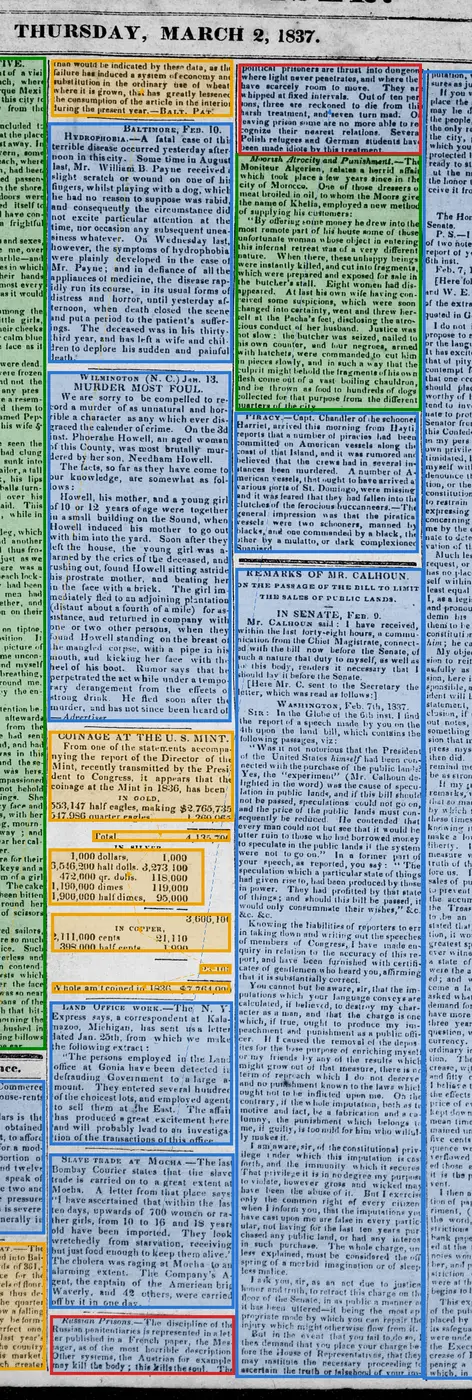
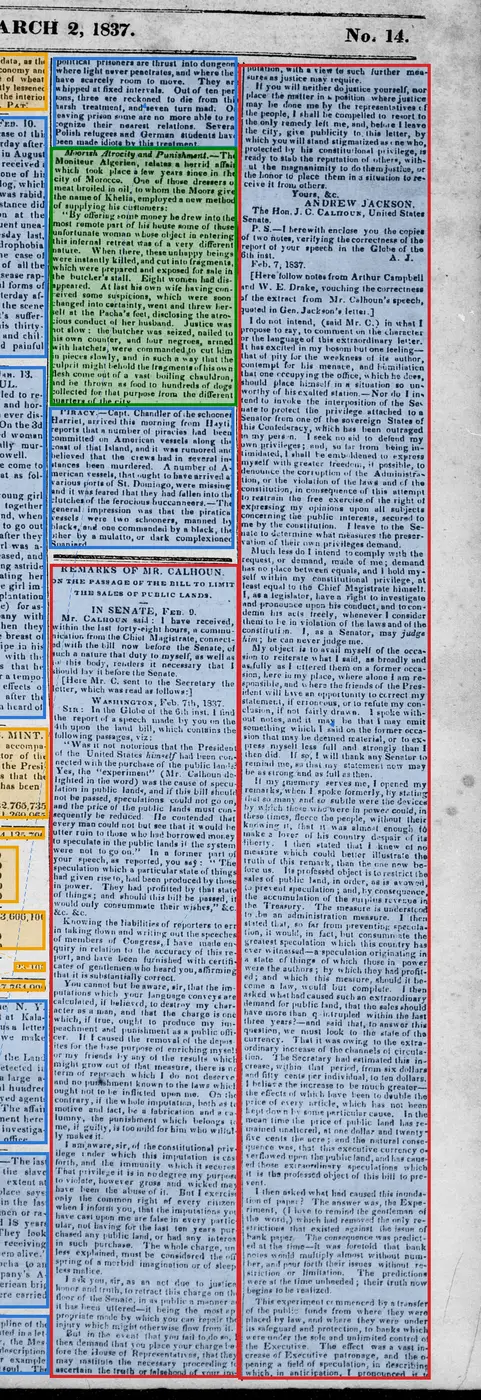
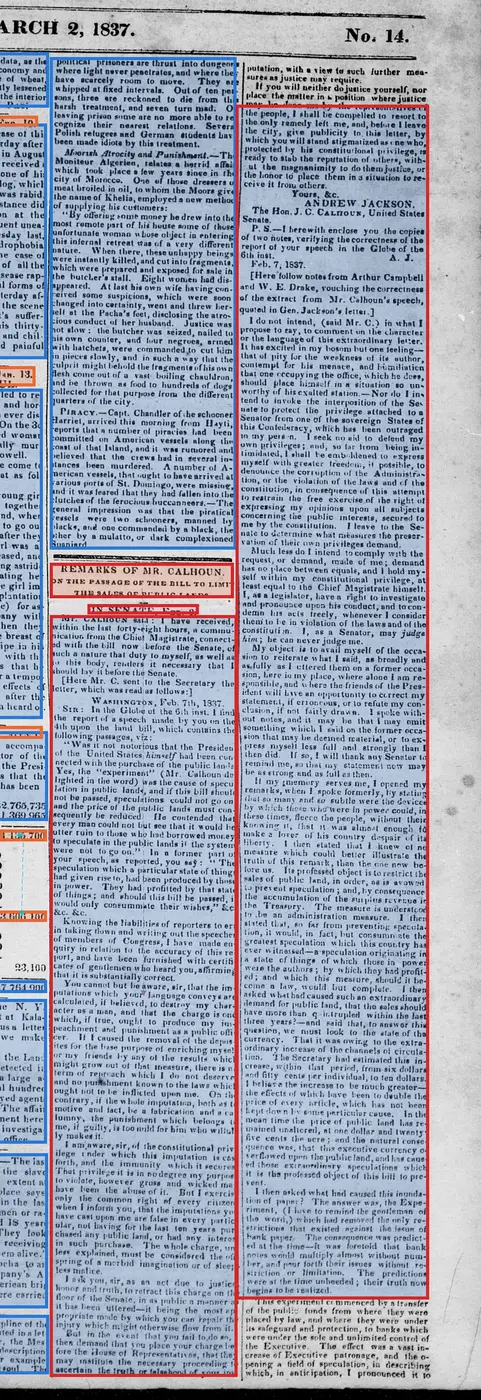
REMARKS OF MR. CALHOUN.
ON THE PASSAGE OF THE BILL TO LIMIT THE SALE OF PUBLIC LANDS.
IN SENATE, FEB. 9.
Mr. Calhoun said: I have received, within the last forty-eight hours, a communication from the Chief Magistrate, connected with the bill now before the Senate, of such a nature that duty to myself, as well as to this body, renders it necessary that I should lay it before the Senate.
[Here Mr. C. sent to the Secretary the letter, which was read as follows:]
WASHINGTON, Feb. 7th, 1837
Sir: In the Globe of the 6th inst. I find the report of a speech made by you on the 4th upon the land bill, which contains the following passages, viz:
"Was it not notorious that the President of the United States himself had been connected with the purchase of the public lands? Yes, the 'experiment' (Mr. Calhoun delighted in the word) was the cause of speculation in public lands, and if this bill should not be passed, speculations could not go on, and the price of the public lands must consequently be reduced. He contended that every man could not but see that it would be utter ruin to those who had borrowed money to speculate in the public lands if the system were not to go on." In a former part of your speech, as reported, you say: "The speculation which a particular state of things had given rise to, had been produced by those in power. They had profitted by that state of things; and should this bill be passed, it would only consummate their wishes," &c. &c. &c.
Knowing the liabilities of reporters to err in taking down and writing out the speeches of members of Congress, I have made enquiry in relation to the accuracy of this report, and have been furnished with certificates of gentlemen who heard you, affirming that it is substantially correct.
You cannot but be aware, sir, that the imputations which your language conveys are calculated, if believed, to destroy my character as a man, and that the charge is one which, if true, ought to produce my impeachment and punishment as a public officer. If I caused the removal of the deposits for the base purpose of enriching myself or my friends by any of the results which might grow out of that measure, there is no term of reproach which I do not deserve, and no punishment known to the laws which ought not to be inflicted upon me. On the contrary, if the whole imputation, both as to motive and fact, be a fabrication and a calumny, the punishment which belongs to me, if guilty, is too wild for him who willfully makes it.
I am aware, sir, of the constitutional privilege under which this imputation is cast forth, and the immunity which it secures. That privilege it is in no degree my purpose to violate, however gross and wicked may have been the abuse of it. But I exercise only the common right of every citizen, when I inform you, that the imputations you have cast upon me are false in every particular, not having for the last ten years purchased any public land, or had any interest in such purchase. The whole charge, unless explained, must be considered the offspring of a morbid imagination or of sleepless malice.
I ask you, sir, as an act due to justice, honor and truth, to retract this charge on the floor of the Senate, in as public a manner as it has been uttered--it being the most appropriate mode by which you can repair the injury which might otherwise flow from it. But in the event that you fail to do so, I then demand that you place your charge before the House of Representatives, that they may institute the necessary proceeding to ascertain the truth or falsehood of your imputation, with a view to such further measures as justice may require.
If you will neither do justice yourself, nor place the matter in a position where justice may be done me by the representatives of the people, I shall be compelled to resort to the only remedy left me, and, before I leave the city, give publicity to this letter, by which you will stand stigmatized as one who, protected by his constitutional privilege, is ready to stab the reputation of others, without the magnanimity to do them justice, or the honor to place them in a situation to receive it from others.
Yours, &c.
ANDREW JACKSON.
The Hon. J. C. Calhoun, United States Senate.
P. S.--I herewith enclose you the copies of two notes, verifying the correctness of the report of your speech in the Globe of the 6th inst.
A. J.
Feb. 7, 1837.
[Here follow notes from Arthur Campbell and W. E. Drake, vouching the correctness of the extract from Mr. Calhoun's speech, quoted in Gen. Jackson's letter.]
I do not intend, (said Mr. C.) in what I propose to say, to comment on the character or the language of this extraordinary letter. It has excited in my bosom but one feeling--that of pity for the weakness of its author, contempt for his menace, and humiliation that one occupying the office, which he does, should place himself in a situation so unworthy of his exalted station.--Nor do I intend to invoke the interposition of the Senate to protect the privilege attached to a Senator from one of the sovereign States of this Confederacy, which has been outraged in my person. I seek no aid to defend my own privileges; and, so far from being intimidated, I shall be emboldened to express myself with greater freedom, if possible, to denounce the corruption of the Administration, or the violation of the laws and of the constitution, in consequence of this attempt to restrain the free exercise of the right of expressing my opinions upon all subjects concerning the public interests, secured to me by the constitution. I leave to the Senate to determine what measures the preservation of their own privileges demand.
Much less do I intend to comply with the request, or demand, made of me; demand has no place between equals, and I hold myself within my constitutional privilege, at least equal to the Chief Magistrate himself. I, as a legislator, have a right to investigate and pronounce upon his conduct, and to condemn his acts freely, whenever I consider them to be in violation of the laws and of the constitution. I, as a Senator, may judge him; he can never judge me.
My object is to avail myself of the occasion to reiterate what I said, as broadly and as fully as I uttered them on a former occasion, here in my place, where alone I am responsible, and where the friends of the President will have an opportunity to correct my statement, if erroneous, or to refute my conclusion, if not fairly drawn. I spoke without notes, and it may be that I may omit something which I said on the former occasion that may be deemed material, or to express myself less full and strongly than I then did. If so, I will thank any Senator to remind me, so that my statement now may be as strong and as full as then.
If my memory serves me, I opened my remarks, when I spoke formerly, by stating that so many and so subtle were the devices by which those who were in power could, in these times, fleece the people, without their knowing it, that it was almost enough to make a lover of his country despair of its liberty. I then stated that I knew of no measure which could better illustrate the truth of this remark, than the one now before us. Its professed object is to restrict the sales of public land, in order, as is avowed, to prevent speculation; and, by consequence, the accumulation of the surplus revenue in the Treasury. The measure is understood to be an administration measure. I then stated that, so far from preventing speculation, it would, in fact, but consummate the greatest speculation which this country has ever witnessed--a speculation originating in a state of things of which those in power were the authors; by which they had profited; and which this measure, should it become a law, would but complete. I then asked what had caused such an extraordinary demand for public land, that the sales should have more than quintupled within the last three years?--and said that, to answer this question, we must look to the state of the currency. That it was owing to the extraordinary increase of the channels of circulation. The Secretary had estimated this increase, within that period, from six dollars and fifty cents per individual, to ten dollars. I believe the increase to be much greater--the effects of which have been to double the price of every article, which has not been kept down by some particular cause. In the mean time the price of public land has remained unaltered, at one dollar and twenty-five cents the acre; and the natural consequence was, that this executive currency overflowed upon the public land, and has caused those extraordinary speculations which it is the professed object of this bill to prevent.
I then asked what had caused this inundation of paper? The answer was, the Experiment, (I love to remind the gentleman of the word,) which had removed the only restriction that existed against the issue of bank paper. The consequence was predicted at the time--it was foretold that bank notes would multiply almost without number, and pour forth their issues without restriction or limitation. The predictions were at the time unheeded; their truth now begins to be realized.
This experiment commenced by a transfer of the public funds from where they were placed by law, and where they were under its safeguard and protection, to banks which were under the sole and unlimited control of the Executive. The effect was a vast increase of Executive patronage, and the opening of a field of speculation, in describing which, in anticipation, I pronounced it to
be so ample, that Rothschild himself might envy the opportunity which it afforded. Such it has proved to be.
The administration has profited by this vast patronage and the prejudice which it has excited against the bank, as the means of sustaining themselves in power. It is unnecessary to repeat the remarks, in illustration of this. The truth of the statement is known to all the Senators, who have daily witnessed the party topics which have been drawn from this fruitful source. I then remarked that, if rumor were to be trusted, it was not only in a political point of view that those in power had profited by the vast means put in the hands of the Executive by the experiment, they had profited in a pecuniary, as well as in a political point of view. It has been frequently stated, and not contradicted, that many, in high places, are among the speculators in public lands; and that an individual connected with the President himself, one of his nephews, was an extensive adventurer in this field of speculation. I did not name him, but I now feel myself called upon to do so. I mean Mr. McLemore.
Having established these points, I next undertook to show that this bill would consummate those speculations, and establish the political ascendancy which the experiment had given to the Administration. In proof of the former, I avail myself of the declaration of the Chairman of the Committee on Public Lands, who had stated that the speculators had already purchased and held a vast amount of public land, not less, as I understood him, than twenty-five or thirty millions of acres, and that if this bill did not pass, the scenes of the last two years would be repeated in this and the coming year. I then undertook to show, from the showing of the Chairman himself, that these speculations would prove ruinous without the aid of this bill. He had stated that the annual demand for public land, resulting from our increased population, could not exceed five millions of acres.
Now, assuming that the quantity on hand is thirty millions of acres, there would be six years' supply in the hands of speculators, even if the land offices of the United States be closed; and that if the bill did not pass, according to his showing, it would take double or treble the time to dispose of the lands, which, in that case, will be in the hands of speculators. All must see the certain ruin, in that event, of those who have borrowed money to speculate in land; particularly if the sales of public land should be free and open to every one, as it now is, to purchase to the extent of his means. I next showed that the contest was between the Government, as a dealer in public land, and the speculators; that they held in market at least an equal quantity in value to that which the Government now has offered for sale, and that every restriction imposed upon the sales of Government land, must of necessity increase the advantages of its rival dealers.
I then showed that the very onerous and oppressive restrictions, of an odious character, upon the sales of the public lands, would be imposed, if the bill should pass. No one thereafter could purchase land of the Government without license—a license, in my opinion, as offensive and odious as would be a license on the press. To obtain this license, the oath of the applicant was required; and then it could only be obtained on payment of one dollar and twenty-five cents per acre, for which the citizen may now receive a grant in fee simple. After he had made his purchase, under authority of his license, the purchaser has to comply with the condition of settlement and cultivation, and must, within the period of five years, prove to the satisfaction of the Register and Receiver, who are made high judicial officers, a compliance with these conditions, before he can receive his title: and if he failed to comply, by accident or otherwise, he forfeits both his money and the land. I stated that this was a virtual increase of the price of the public lands to the actual settler; so much so that any sober minded man would prefer to give the speculators two dollars per acre for land of the same quality, to giving the Government one dollar and twenty-five cents for a license, with these oppressive conditions.
Having established this point, I then undertook to show that it would increase vastly the power of the Government in the new States, if they choose to exercise this patronage for political purposes. That they would so use it, we have ample proof in the past conduct of the Administration, and in the principles which have been avowed by its friends. A former Senator from New York, high in the confidence of the party, and now Chief Magistrate of that State, had openly avowed, in his place on this floor, that to the victor belongs the spoils, for which he was reprimanded, at the time, by the Senator from Massachusetts, [Mr. Webster,] in a manner worthy of his distinguished talents.
Assuming, then, that the power would be exercised with a view to political influence, I showed that it would place a vast number of the citizens of the new States, probably not less than one hundred thousand, in a condition of complete dependence on the Receivers, and of vassalage to the Government.
These are the sentiments which I delivered on a former occasion, and which I now reiterate to the full extent—omitting nothing that is material as far as connected with the letter of the President; and for the delivery of which my privileges as a Senator, and those of this body, have been so grossly outraged.
Mr. Grundy and Mr. Walker rose and stated that they had been attentive listeners during the debate alluded to in the President's letter, and corroborated the correctness of Mr. Calhoun's statement of what he had said on that occasion.
Mr. Calhoun then said that he was gratified at what had been said, and that all might now see, from their statement and the acquiescence of others, what little cause the President had for the outrage upon his privilege, and that of the Senate, and for applying language to him which is never used in intercourse between gentlemen, and better suited to the purlieus of Billingsgate than to the mansion of the Chief Magistrate.American Stories
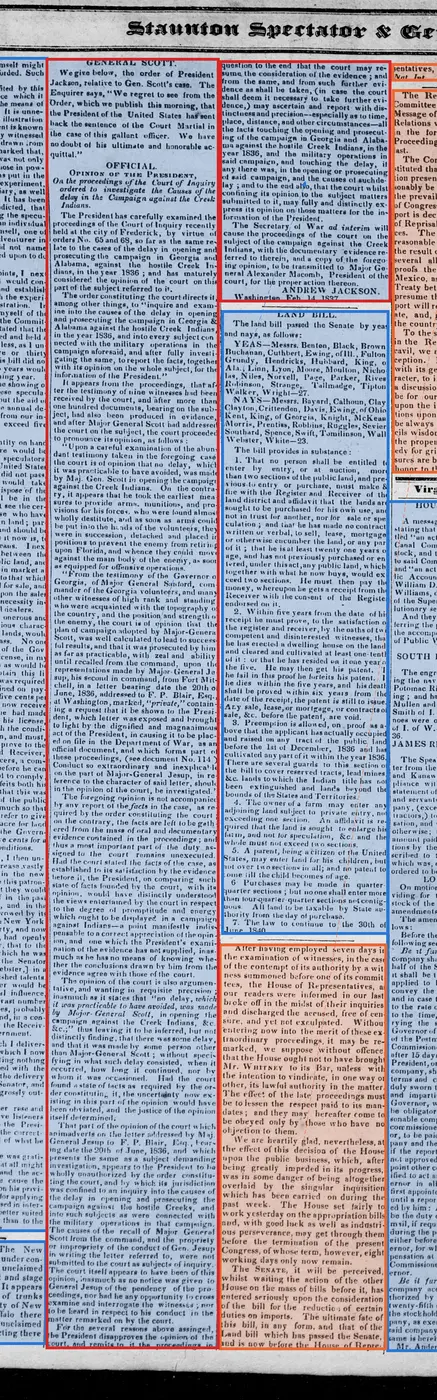
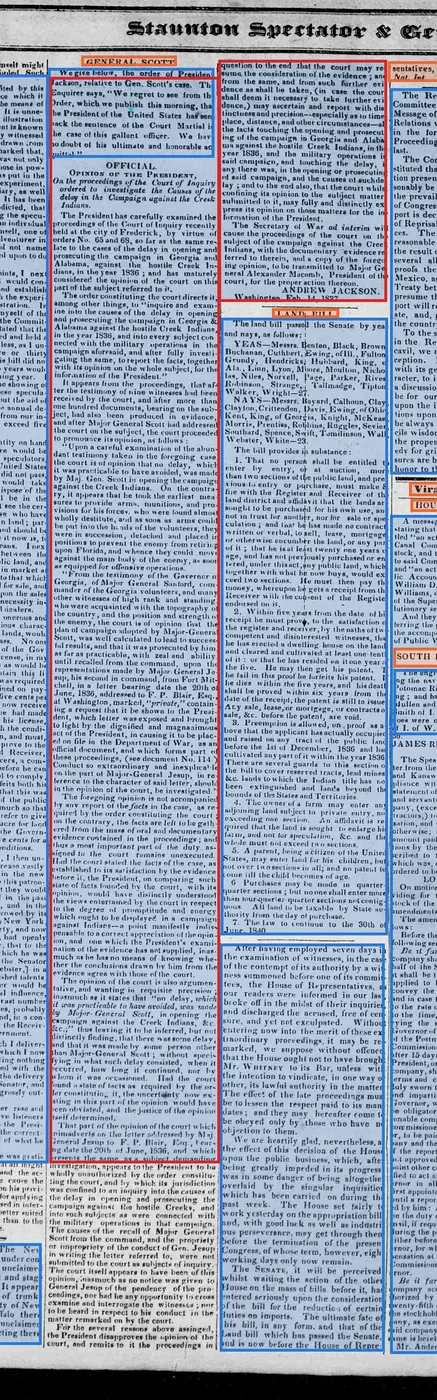
REMARKS OF MIR. CALHOUN. ON THE PASSAGE OF THE DILL TO LIMIT
THE SALES OF PUBLIC LANDS.
IN SENATE. Fen @
Mr.. CALHOUN sail: | have received. whhin The last forty.eight hours, u com,nu- nicaiior from the Chief Magistrate, connect ed with the till now before the Senate. of such nature that duty 10 myself as we'll as I" this body, renders il necessary tba, ! should lay il before The Senate.
There MIR. C. sent TO the Secretary the letter, which was read as iollows:l
w AsuINGToN, Feb. 7,h, 1887.
SiH: In the Globe q! the 9Th inst find Inc report OF a speech made by YOU .,n the am upon the land bill, which contains the following passages, viz:
as II not notorious that the President OF The United States himself hail been con. nected with The purchase of the pubic Iao,.s, es, the experiment" (Mr. Calhoun de- lighted IN the word) was The cause OF spccu- i"'ion In public lands, and if this bill should mol De passed, sPeculaiions could moi 90 on ana Inc price OF The public lands must con sequenfiy be reduced. He contended thst every man could not but see that it would he utter ruin TO tbuse who ha.. borrowed moray 10 speculate in the public lands il the system were not TO go on" In u former part OF your speech, as reported, you say: "The speculation which particular state Of things nad gwen rise 10, had been produced by thnse In power. They had proft,ed by tina, state 4" 'hings; and should this bill be passed. il &c. &c.
Knowing The liabilities of reoorters n ar, IN taking down aud writing out The sucechcs OF members Of Congress, | have made en-. curry IN relation 10 the accuracy Of This re : port, and have been furnished with cerlifi. cafes OF gentlemen who heard you alfirmipe ihat IL IS substantially correct
o" cannot but he aware, sir, that the i'm. Pu'a'ions which your language conveys are calculated, II believed, 10 destroy nv char. acter as man, and That the charge is one which, II true, ought TO produce INV i'm peachment and punishment as II public Off. Ger. If caused the removal Of The ,lenns
'es iof The base purpose OF enrichng INV self OF my friends i'y any Of The results viii !, nish' grow out OF thnt measure there is r. o term OF reproach which DO not deserve anu no punishment known 10 the laws which ouSh' moi 10 he inflicted upon me. On the contrary, u The hole imputation, both as to motive and TACT, he fabrication and a ia : lumny, the punishment which belongs 10 me, u guilty, is too mild for him who wIli,,i ly makes IT, unaware, sir, ii The constitutional criv. uege Under which this imlu,a,ion is cas-, ,nf'h, ana The immunity which il secures
hat PtiS'ieseH Is in no degree my ,urpose 70 'ioiale, however gross mud wicked ma nave neen The abuse of IT, But | exercise 'hiy The common right Of every citizen. when 'niofn' you, that The im,m,ations you nave Cast upon me are false in every uariic. "ldr, moi having for The last ten years rar- chased any public land, or had any interest," IN such purchase. The whole CHARGE I'm. less explained, must be considered The off. spring Of mcrbid imagination or Of sleep
less malice.
ask you, sir, as an act due 10 ius!ice Soo"' enn truth, 10 retract this charge on The | moor OF the Senaic, in as public rnapncr az !" oas heeD uttered--it being the most ap- propr's'e mode by which you can repair The ''lrty which might otherwise flow from il. | gu, IN The event that you fal 10 do sn. then demand that YOU place your charge f,e. lore The House OF Representatives., thai they may institute the necessary proceeding 10 ascertain The truth or tslsebooi Of your inv
, I..sJ "o ""ue me ny the representatives, al
me people, shall be Compelled 10 resort TO the only remedy left me, and, bei.,e leave the city, give publicity to. this letter, by
winch you will stand stigma,ized as ne who.
protected hy his constitutional privilege, is
ready 10 stab the reputation of others, with.
ut the nagnsnimity to do them Justice. o..
the honor 10 place them in sitsa,ion 10 re.
ceire IL irom others
Yours. &c.
ANDREW JACKSON.
Senate
| p. ST. here wiih enclose you the copies OF two notes. verifying the correctness of The REPORT OF your speech in the Globe of the 9Th inst Feb. 7; 1887.
Here follow notes from Arthur Campbell ard w. +. Drake, vouching the correctness Of the extrsc. from Mr.. Cslhoun's speech, quoted in Gen. JACK son e le,ts,.]
l do not intend, (said MIR. C.) in wha, propose TO cay, 10 comment ON the character or the Language Of this extraordinary letter. II has excited in my bosom hut one feeling That ot pity Tor the weakness of its author. contempt for his menace, and humiliation that one occupying the Office, is hich be does, should place himself in a situation SO un. | worthy OF his exalted station Moor do in, tend to invoke the inlerpostion of the Sc. male 70 protect tue privilege attached 10 Senator from one Of the sovereign States o! TINS Coniedsracy, which has been outraged | IN my persan. ! seek no aid TO defend NV | own privileges; and, so lar from being in | undated, shall he emboldened to exsross myself with greater freedom, i possible 10 denouhce the corruption of the Administers | lion, or The violation of the laws and cf the ! in Il, | to restrain the free exercise of The RICH, of expressing my opinions upon all subjects CONCERNING the public interests, secured TO me by the constitution. leave 10 the Sc male 10 determine VIVA; measures The preser- WALTON Of their own privileges demand. | Much less do intend 10 comply with the ! request, or demand, made Of me; demand mas no Place between equals, and ] hold my sell within my constitutional privilege, at ieast equal TO the Chief Magistrate himself
1, az legislator, have right to investigate and pronounce upon his conduct, and to con. demn has acts freely, whenever consider | 'hem 10 he In violation of the laws aud of The constIfuti'n j, as a Senator, may Judge am; he can never judge me.
MY Object 10 10 avail myself Of the occa. sion TO reiiera!e what said, as broadly and as'iuiiy as uttered them on a former occa- SION, here IN my place, where alone am re- spnnsihle, aud here the friends Of the Pres iheh' VIII t,ve an opportunity TO correct my statement, if erroneous, or 10 refu,e NV con- ciasion, if moi fairly drawn. spoke with out notes, and II may he that may omit something which said on the former occa- sion that may he deemed material, or TO ex.
press myself less full and strongly than
then did II SO, will thank any Senator to
reiniad me, SO thai my s.a.cmen, now may
be as strong end as ,uil as then
u my ;nemory serves me, opened my
remarks, when spoke formerly, by stating
,"e' so many anf so subtle were the devices
by which those srbowere in power could in these times, fleece the people, without their Knowing II, That II. VAS almost enouqh "a
make love! oi his country DESPAIR Of iis hperiy then stated thai knew Of mn
measure which could better illustrate the truth ui lhis remark. than the one now be-
lore us: lis protested object is 10 restric, he
saies OF public land, in order, ns ia avowed
~ prevent speculation and, by Consequence
me accumulation OF the surplus reyeGue in
me treasury. The measure is understood
10 Us an administration measure. i then
slated that, So far from proven, jnr snscula.
ton, il would, in fact, but consnmn, ate the
greatest speculation which Ibis country has
ever "itnesssd-a speculation originating in
state Of things Of which those in power
were the authors; by which they had profit.
ed; aud which this neasure. should il he
GENE lazy, would but complete then asked hat had caused such an extraordinary demand for public land, that the sales should
nave more than g -irtsupled within the last
three yeaFs!-and said that, 10 answ or this question, we must look to The stale of the
currency. That il was owing 10 the extra { ordinary Increase of the channels OF circu,s , lion. The Secretary had estimated this in crease, within that period, from six dollars
and tiiiy cents per individual, 10 len dollars. , belisTe the increase TO be much greater The effects Of which have been to double the price OF every article, which has no; been Kept doun iY some particular cause. In the mean time The price ct public land has re- tnained unalicre,], nj one dollar and TWENTY
I've cents the acre and The natural Conse- Guehce WINS, that tbs executive currency O. , 'erfiowed upon the pubic land, and has caus.
ed those extraordinary specuIations which , " 10 tbs proiesscd object of this bill 10 pre- , vent
/. then asked what Ind caused this inunds- , ton Of paper? The answer vas, the Expe- rimeni, q love 10 remind the gentleman Of Tie word,) which had removed The only re- s'rictions that existed against tbe issue of I hank paper The consequence was predict
ed al The iime-it was foreiold that bank
noes would multiply almost without pCsu- . Der, and pour forth their issues without re-
s,siciion or limitation. The predictions
were ST The time UNDECIDED their truth now . begins 10 he realized.
ii has proved to be.
The administration has profed by this | vast patronage, and the prejudice which il | mas excited against the bank, as the means OF sustaining themselves in power. II is unne- cessary 10 repeatthe remarks, in illustration OF this. The truth of the statement is known TO all the Senators, who have daily witnessed | the party topics which have been drawn rom | this fruitful source. I then remark ed that. il rumor were tn be trusted, 1t was not only in political Poin, of view lha, those in pow :. er Lad pIohied by the vast means pu, i'm the hands OF the Executive by tie experiment, they had profited in q pecuniary. as we'll ss IN political point of view. Il has been frequently stated, and not con,radicied. tina, many, in high places, are among the specu. ia'ors in public lands; and that an individual connected with the Presiden, himself. one of nus nephews, was an extensive adventurer in this held Of speculation. I did not name him, but now feel my self called upon 10 do 90. mean Mr.. McLemore.
Having established these points. I mex, undertook TO show that this bill would Con. eummate those speculations, and establish The political ascendancy which the expert. ment mad given TO the Administrations In prso' OF the former, | avail myself OF the declaration OF the Chairman of the Commit. tee on Public Lands, who had stated thai the spectators bad already purchased and held a vast amount OF public land, no, less, as un- derstood him, than twenty five or thirty millions OF acres, and ii.at il this hill did no, pass, The scenes Of the last two wears would be repeated in this and the coming wear. I Then undertook 10 show, from the showjn OF The Chairman himself, that these specula lions would prove ruinous without, the aid of TINS mn. He had stated that the annual de- mand Tor public land, resulting from our in creased population, could moi exceed five millions Of acres.
Now, assuming that the quantity on hand Is thirty millions of acres, there would he SIX years supply in the hands of spectators even IT the land Offices of the United States be closed and that if the bill did not pass, according TO his showing, it would take double or treble the time 10 dispose of the lands. which, in that case, will be in the hands OF spectators. All must see the GER tam ruin, In that event, Of those who have borrowed money TO speculate in land; par t'cuiariy II The sales OF public land should be
ree ana open 10 every one, as II now rs, 10 purchase TO the extent Of his means. Inext showed that tho contest was between the government. as dealer in public land. and the spectators; that they held in market Al ieast an equal quantity m value 10 that which the Government now has offered for sale, and that every restriction imposed upon the sales OF Government land, mus: of necessity in, crease the advantages OF lis rival dealers.
'hen showed that the very onerous and oppressive restrictions, Of an odous charac. ter, upon the sales Of the public lands. would De imposed, il the bill should pass. No one thereafter could purchase land of the Gov eminent without iicense-a license. i'm nv opinion, as offensive and od,ous as would he license on The press. 10 obtain this H. cense, the oath of the applicant was required: and then il could only he obtained on paw
menl OF one dollar and TWENTY-FIVE cents per acre, for which the citizen may now receive grant in fee simple. After lie had made ms purchase. under authority OF his license, The purchaser has 10 comply with The condi- non OF settlement aad cultivation, and must. wi!nin Inc period OF five years, prove to the sa!'s'acsion OF the Register aud Receiver, who are made high judicial officers, com. piiance with these conditions. before he Can receive his title: and if he failed TO comply. by accident OF otherwise, he forfeits both his money and The land. | stated that this was virtual increase OF the price at the public lanes 10 the actual settler so much so that any sober minded man would prefer to give the spectators two dollars per acre for laod OF The same quality, to giving The Govern meht one dollar and twenty-five cents for license, with these oppressive conditions.
Having established this point, then un- dertook to show that il would mere ase vastly the power of the Government in the new States, II they choose 10 exercise This patron age Tor political purposes. Tha, they would 80 use il, we have ample proof in Inc ;,ssi conduct OF the Administration, and in the principles which have been avnwc,i bv its friends. A former Senator from New York. high in the confidence OF The party, and now Chief Magistrate OF that State, had openIy avowed, in his place on this iuur, that 10 the victor belongs the spoils, tor which he was reprimanded, at The time, by The Senator from Massachusetts. mir. Webster i in manner worthy of his distinguished talents. Assuming, then, tha, The power would be exercised with view Ia political influence, showed that II would place q FAST number Of The citizens OF the new States, In ohably no. less than one hundred thousand, in con dition of complete dependence on the Rcceiv. ers, and oil Yassa!age 10 the Government.
These are The sentiments which deliver. cd on former occasion, and which | now reIterate TO the full extent---omi,finp nothing That IS material as far as connected with The letter OF the President and for the delivery Of which my privileges rs y Senator and | those OF this body, have been So grossly out | ragged. = Mr.. Grundy and Mr.. Walker rose ard slated that they had been attentive listeners during The debate alluded 10 in the Presi oeht 8 icttar, and corrObofaed the correct. ness Oh MIR. Calhnnn's statement of what he bad said on that OCCASION
Mr. Calhoun then said that lie was gtati- n had k1f u ,