sn90065027 1886-04-25 ed-1: segmentation, region by region

LoC issue · American Stories revision 77e27fa6

Same LoC scan for 4 of 4 pages.

Scorecard

Each comparison starts from a snewpapers component. "=" means both systems drew the same article. Where they differ, a language model, shown only the text, was asked which is right, twice, with the two claims stated in each order.

Where the two segmentations agree or differ

timessnewpapers rightAS rightneitherunsurepage furniture, not counted
Same article on both sides (=)11–––––
One snewpapers component, several AS articles (1 : N)66000–
Several snewpapers components, one AS article (N : 1)65001–
One snewpapers component, one AS article running on into other text000–00
AS text attached outside a snewpapers component600–06
A line of a snewpapers component in another AS article110–00

Unsure: the verdict changed when the two claims were stated in the other order, or no valid answer came back. Neither: the model found both segmentations wrong. Page furniture: the text was a line or two that could be a title, section title or the like, which one system leaves out by design, so it decides nothing.

Where only one side has text

times
snewpapers component, AS has no text, no AS box there (an AS error)1
snewpapers component, AS has no text, AS marked it illegible (an AS error)18
snewpapers component, AS has text for under 90% of it, the rest in no AS box (an AS error)0
snewpapers component, AS has text for under 90% of it, the rest marked illegible (an AS error)12
AS text in no snewpapers component: ads, terms or page furniture (left out on purpose)9
… of which ads (AS says it leaves ads out)9
AS text in no snewpapers component: other content snewpapers does not serve0
AS text in no snewpapers component: too short to ask4
AS boxes in no snewpapers component with no text at all (AS read nothing)8
AS text in no snewpapers component: no verdict0

What the decisions judged

judged wrongjudged right
American Stories articles320
snewpapers components031

Each article or component a decision was about, once per side: one story split into 15 AS articles and decided for snewpapers is 15 AS articles judged wrong.

American Stories errors found

errorsdecisions
items of ours AS merged into one article255
fragment articles AS split our components into146
lines of ours AS put in another article11
AS articles running on into other items00
AS articles missing part of a component (under 90%)13–
our components AS has no text for19–
pages of our components AS lacks the text for1–
text AS has twice0–
ads AS kept (it says it leaves ads out)9–
AS boxes it marked illegible that snewpapers read23–

Text quality: words found in an English word list

real wordswordsshare
snewpapers7,5597,58399.7%
American Stories5,2045,52894.1%
American Stories boxed area it marked illegible and did not read––35.2%

Over the 37 components of ours AS has text inside, the same text on both sides; words of 3 or more letters, a long s read as f allowed. Components where more of the text is real words: snewpapers 24 · AS 5 · the same 8. AS marked 23 boxes illegible over 35 of our components and read no text from them; snewpapers' text of those components is 99.7% real words.

How this was scored

Every comparison is anchored on a snewpapers component and the American Stories boxes inside it. Where those boxes belong to several AS articles (or several of our components lie inside one AS article), the model was shown the passage as the numbered pieces and asked whether it is one component, several or mixed, twice, with the two beliefs stated, unattributed, in each order. A verdict that changed with the order is unstable and counts for neither side. AS text inside none of our components was asked whether it is advertisements, terms or page furniture, which snewpapers leaves out on purpose. Where AS attaches text outside one of our components (text of an AS article our component otherwise has), the model was shown our component's text and the attached text and asked whether the text belongs to the component, twice, the two beliefs stated in each order: "separate" means snewpapers is right, "belongs" American Stories. Where two AS articles inside one of our components hold the same text (the shorter sharing at least 50% of its 4-word phrases with the longer), the longer is kept and the text counted as duplicated by American Stories; so is attached text another AS article also holds. Where American Stories has a line or two of our component (at most 12 words and 5% of its area) in another AS article while one article holds the rest, the line is no split: the model was shown the rest of the AS text and the line and asked whether the line belongs to the component, both ways; "belongs" means snewpapers is right and judges only the article holding the line wrong (lines in another AS article). One AS article counts as a match only when the two cover each other, both ways: AS text covers at least 90% of our component, and our component at least 90% of that AS article's text. Coverage is measured line by line down each column (how much of its height the other side's boxes span, so a centred headline narrower than its column still counts). Under 90% the first way, the component is partly captured by AS (the rest in no AS box, or marked illegible): not asked, an AS error by the geometry, its AS article judged wrong (AS articles missing part of ours). Under 90% the second way, the AS article runs on beyond our component into other text: that text is asked about as text attached outside, and "separate" judges the AS article wrong (AS articles running on into other items). Decisions are the unit counted above; the last table counts what they judged: an as_split decided "one" is one decision and every AS article inside our component judged wrong, an N ours : 1 AS decided "several" one decision and each of our N components judged right (an article or component judged both ways by different decisions counts in both rows). AS errors count what the decisions for snewpapers found American Stories got wrong, next to those decisions: an N ours : 1 AS is N errors, the N items of ours AS failed to separate (items AS merged), a 1 ours : N AS N errors, the N AS fragment articles. A component inside an N ours : 1 AS (its AS text a slice of the merged article) is counted in the components table by that decision's outcome. A component running over pages is one comparison across them (American Stories never links an article across pages): its AS articles on all its pages, labelled by page, are the pieces asked about, once; it counts once among our components, and a decision for snewpapers judges every one of those AS articles wrong, each a fragment article.

groups84
1:1 match11
1 ours : N AS6
N ours : 1 AS6
in N ours : 1 AS8
continued1
ours only19
AS only9
AS only, tiny4
AS only, no text8
1:1, AS partial12
1:1, AS article wider0
snewpapers covered by AS (area)95.8%
AS covered by ours (area)89.7%
median text ratio over matches95.9
AS duplicated text0
AS text attached outside ours6

How to read this

Each group is the same crop of the scan twice: snewpapers' boxes on the left, American Stories' on the right. The group's own boxes are outlined in red. Groups are in page position order (column by column), not reading order. A component can appear twice: in its own case and in an N ours : 1 AS group. Text of a component's own AS articles printed outside the component is left out of the comparison and shown beneath the group as "American Stories also attaches: «…» (outside this component)".

1:1 matchthe AS text inside our component (boxes, or the slices of boxes it overlaps) all belongs to one AS article (or to several that duplicate one another: American Stories duplicated the text)
1 ours : N ASthe AS text inside our component belongs to several AS articles: one component or several?
N ours : 1 AStwo or more of our components lie inside one AS article (80% or more of each, or 50% or more with a slice of the article): one component or several?
in N ours : 1 ASall the AS text inside our component is a slice of an AS article that holds other components of ours too: no agreement (the slice is cut along our boundaries, not AS's); decided by that N ours : 1 AS
continueda later page of a component of ours running over pages: compared, asked and decided once, across its pages, in the group on its first page
ours onlyno AS box overlaps our component enough to give it a slice: not captured by American Stories
AS onlyAS text inside none of our components (one AS article's): left out on purpose, or missed?
AS only, tinyAS text inside none of our components, under 20 characters: not asked
AS only, no textan AS article inside none of our components with no text at all (AS boxed it but read nothing, most often marking it illegible): nothing to ask, counted for neither side
1:1, AS partialthe AS text inside our component all belongs to one AS article, but AS has text for under 90% of our component, measured line by line (the rest is in no AS box, or AS marked it illegible): partly captured by American Stories, not asked; its AS article counts as an AS error
1:1, AS article widerone AS article holds our component, but runs on beyond it into other text (our component covers under 90% of the article's text, measured line by line): the text it runs into is asked about, and decides it
snewpapers:newsopinionnoticescommercepeopleliterarylistingsother
American Stories:articleheadlineauthor
only in snewpapersonly in American Stories(words compared lowercase, without punctuation)

Page 1 (11 groups)

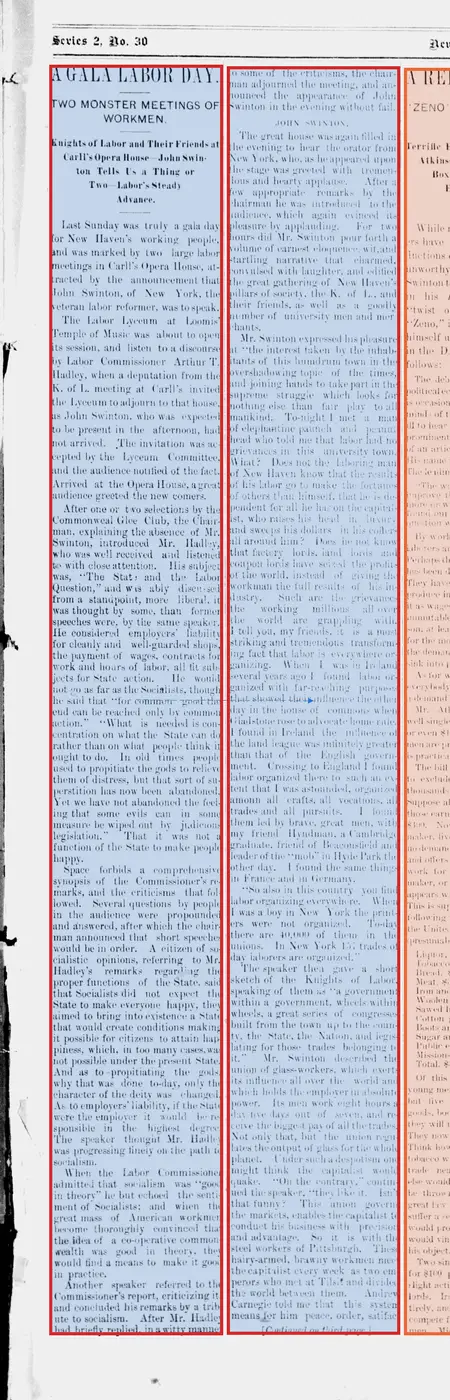
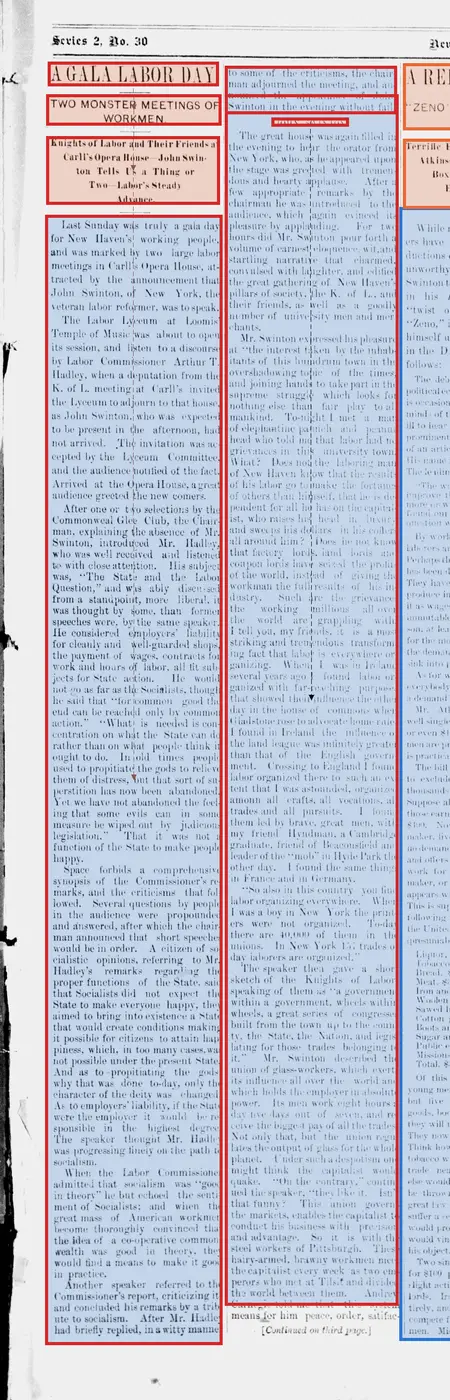
1 ours : N ASsnewpapers rightdomestic_news ↔ AS #12 (p. 1), AS #30 (p. 1), AS #19 (p. 1), AS #3 (p. 3) p1-1 one component across p. 1–3 · 1 snewpapers : 4 AS · ratio 82.1 · token set 86.4 · real words: snewpapers 100%, AS 95% continued in p3-2
  • asked whether snewpapers' component is one item (AS marked part of it illegible): said one: This is a single news report on the two labor meetings, continuing from page 1 to page 3 with a jump line; headings and the continuation notice are page furniture, not separate items.
snewpapers boxes
snewpapers, p. 1
American Stories boxes
American Stories, p. 1
snewpapers boxes
snewpapers, p. 3
American Stories boxes
American Stories, p. 3

snewpapers

A GALA LABOR DAY.

TWO MONSTER MEETINGS OF WORKMEN.

Knights of Labor and Their Friends at Carll's Opera House—John Swinton Tells Us a Thing or Two—Labor's Steady Advance.

Last Sunday was truly a gala day for New Haven's working people, and was marked by two large labor meetings in Carll's Opera House, attracted by the announcement that John Swinton, of New York, the veteran labor reformer, was to speak.

The Labor Lyceum at Loomis Temple of Music was about to open its session, and listen to a discourse by Labor Commissioner Arthur T. Hadley, when a deputation from the K. of L. meeting at Carll's invited the Lyceum to adjourn to that house, as John Swinton, who was expected to be present in the afternoon, had not arrived. The invitation was accepted by the Lyceum Committee, and the audience notified of the fact. Arrived at the Opera House, a great audience greeted the new comers.

After one or two selections by the Commonweal Glee Club, the Chairman, explaining the absence of Mr. Swinton, introduced Mr. Hadley, who was well received and listened to with close attention. His subject was, "The State and the Labor Question," and was ably discussed from a standpoint, more liberal, it was thought by some, than former speeches were, by the same speaker.

He considered employers' liability for cleanly and well-guarded shops, the payment of wages, contracts for work and hours of labor, all fit subjects for State action. He would not go as far as the Socialists, though he said that "for common good the end can be reached only by common action." "What is needed is concentration on what the State can do rather than on what people think it ought to do. In old times people used to propitiate the gods to relieve them of distress, but that sort of superstition has now been abandoned. Yet we have not abandoned the feeling that some evils can in some measure be wiped out by judicious legislation." That it was not a function of the State to make people happy.

Space forbids a comprehensive synopsis of the Commissioner's remarks, and the criticisms that followed. Several questions by people in the audience were propounded and answered, after which the chairman announced that short speeches would be in order. A citizen of socialistic opinions, referring to Mr. Hadley's remarks regarding the proper functions of the State, said that Socialists did not expect the State to make everyone happy, they aimed to bring into existence a State that would create conditions making it possible for citizens to attain happiness, which, in too many cases, was not possible under the present State. And as to propitiating the gods, why that was done to-day, only the character of the deity was changed. As to employers' liability, if the State were the employer it would be responsible in the highest degree. The speaker thought Mr. Hadley was progressing finely on the path to socialism.

When the Labor Commissioner admitted that socialism was "good in theory" he but echoed the sentiment of Socialists; and when the great mass of American workmen become thoroughly convinced that the idea of a co-operative commonwealth was good in theory, they would find a means to make it good in practice.

Another speaker referred to the Commissioner's report, criticizing it, and concluded his remarks by a tribute to socialism. After Mr. Hadley had briefly replied, in a witty manner to some of the criticisms, the chairman adjourned the meeting, and announced the appearance of John Swinton in the evening without fail.

JOHN SWINTON.

The great house was again filled in the evening to hear the orator from New York, who, as he appeared upon the stage was greeted with tremendous and hearty applause. After a few appropriate remarks by the chairman he was introduced to the audience, which again evinced its pleasure by applauding. For two hours did Mr. Swinton pour forth a volume of earnest eloquence, wit, and startling narrative that charmed, convulsed with laughter, and edified the great gathering of New Haven's pillars of society, the K. of L., and their friends, as well as a goodly number of university men and merchants.

Mr. Swinton expressed his pleasure at "the interest taken by the inhabitants of this humdrum town in the overshadowing topic of the times, and joining hands to take part in the supreme struggle which looks for nothing else than fair play to all mankind. To-night I met a man of elephantine paunch and peanut head who told me that labor had no grievances in this university town. What? Does not the laboring man of New Haven know that the results of his labor go to make the fortunes of others than himself, that he is dependent for all he has on the capitalist, who raises his head in luxury and sweeps his dollars in his coffers all around him? Does he not know that factory lords, land lords and coupon lords have seized the profits of the world, instead of giving the workman the full results of his industry. Such are the grievances the working millions all over the world are grappling with.

I tell you, my friends, it is a most striking and tremendous transforming fact that labor is everywhere organizing. When I was in Ireland several years ago I found labor organized with far-reaching purposes that showed their influence the other day in the house of commons when Gladstone rose to advocate home rule. I found in Ireland the influence of the land league was infinitely greater than that of the English government. Crossing to England I found labor organized there to such an extent that I was astounded, organized among all crafts, all vocations, all trades and all pursuits. I found them led by brave, great men, with my friend Hyndman, a Cambridge graduate, friend of Beaconsfield and leader of the "mob" in Hyde Park the other day. I found the same things in France and in Germany.

"So also in this country you find labor organizing everywhere. When I was a boy in New York the printers were not organized. To-day there are 40,000 of them in the unions. In New York 15? trades of day laborers are organized."

The speaker then gave a short sketch of the Knights of Labor, speaking of them as "a government within a government, wheels within wheels, a great series of congresses built from the town up to the county, the State, the Nation, and legislating for those trades belonging to it." Mr. Swinton described the union of glass-workers, which exerts its influence all over the world and which holds the employer in absolute power. Its men work eight hours a day five days out of seven, and receive the biggest pay of all the trades. Not only that, but the union regulates the output of glass for the whole planet. Under such a despotism one might think the capitalist would quake. "On the contrary," continued the speaker, "they like it. Isn't that funny? This union governs the markets, enables the capitalist to conduct his business with precision and advantage. So it is with the steel workers of Pittsburgh. These hairy-armed, brawny workmen meet the capitalist every week as two emperors who met at Tilsit and divided the world between them. Andrew Carnegie told me that this system means for him peace, order, satisfac-

[Continued on third page.]

A GALA DAY FOR LABOR.

Continued from first page.]

tion, and said he: I wouldn't employ a non-union man in my shop.

"Now, my friends, this is an interesting fact. But there is another organization that covers the whole United States, that throws its tendrils out all over the world, admitting women, provided they are honest,—a secret body, a nameless body, united under the pledge of fraternity, ruling the industries of this vast country under its magic sway—a body known to the newspaper editors and reporters, who don't know anything, as the K. of L. which opens the portals of its temple which he who hath seen becomes henceforth and forever transformed. It deals with the land question, with the currency question, the relation of capital to labor, grasping all the economic forces as Jupiter grasped the forked lightning. This body is a secret body. Once in New York there were no secret bodies. Now there are 6,000 secret bodies, corporations with that monster Jay Gould at the head. Once the Knights of Labor were opposed to secrecy, but found the only way to fight Satan was by his own brimstone. Their motto is that of the philosopher who wrote that that is the best governed State in which an injury to one is the concern of all, and if anything loftier ever dropped from human lips it was because they were not human.

There is no use in opposing this order, my pumpkin-headed friend; there is no use trying to keep this cyclone down. Join it and help to make it more majestic, more full, every man of you who works with his hands. Young gentlemen of Yale, don't study law, but join the K. of L. and give momentum to this grand gigantic force. It is a uniform rule that the unorganized trade is the worst off. In the same way, organized trade gets higher pay and shorter hours.

"Within the past 20 years the world's mechanical power has risen from 13,000,000 to 30,000,000 horse power," he said, "and that of this country has increased since 1870 from 2,300,000 to 4,500,000 horse power; and has made the battle between men and mechanism more unequal. One horse power equals the labor of 10 men, so that it is seen that the strength of the capitalist has been increased by the capacity of 22,000,000 slaves. This is a fact and can't be argued."

In closing, Mr. Swinton urged organization against this growing mechanical strength. Organization enables the horny-handed masses to unite on those practical issues that concern their lives and welfare, to secure the fruits of their own labor and to grapple with the hideous wrongs of modern times.
American Stories

A GALA LABOR DAY.

TWO MONSTER MEETINGS OF

WORKMEN.

Knights Of Labor and Their Friends at Carlfs Opera IIOuse-JUhn Swim. ton Tells Is Thing or TW0-Lab0r's Steady

Advance.

Last Sunday was truly a gala day for New llaven's working people, and was marked by two large labor meetings IN Carll's Opera House, at tracted by the announcement that John Swlnton, Of New York, the veteran labor reformcr, was to speak.

The Labor Lyceum at Loomis' Temple of Music Was about to open Its session, and listen to Il discourse by Labor Commissioner Arthur T. lladley, when deputation from the X. of l.. meeting at Carll's invited the Lyceum to ad lourn to that house, as John Swlnton, who WAS expected to be present in the afternoon, had not arrived. The invitation was &C cepted by the Lyceum Committee, and the audience nollied of the fact. Arrived at the Opera House, great audience greeted the new comers.

After one or two selections by the Commonweal Glee Club, the Chair man, explaining the absence of Mr.. Swinton, introduced Mr.. l{adley, who was well received and listened to with close attention. His subject was, 1.-The Stat and the Labor Question:" and WIS ably discu: :sed from standpoint, more liberal, it was thought by some, than former speeches were, by the same speaker lie considered employers liability for clearly and well-guarded shops, the payment Of wages, contracts for work and hours Of labor, all fit sub, jects for State action. lie would not 20 as far as the Socialists. though he said that ''for common good the end can be reached only by common action" "What is needed is con- centration on what the State can do rather than on what people think it ought to do. In old times people used to propitiate the gods to relieve them of distress, but that sort of su- perstition has now been abandoned. Yet we have not abandoned the feel ing that some evils can in some measure be wiped out by jrdicIous legislation" That it was not a function of the State to make people happy.

Space forbids comprehensive synopsis Of the Commissioners re- marks, and the criticisms that fol- lowed. Several questions by people in the audience were propounded and answered, after which the chair man announced that short speeches would be in order. A citizen Of So cialistic opinions, referring to Mr.. Hadley's remarks regarding the proper functions Of the State, said that Socialists did not expect the State to make everyone happy, they aimed to bring into existence a State that would create conditions making it possible for citizens to attain hap piness, which, in too many cases, was not possible under the present State. And as to -propitiating the gods, why that was done to-day, only the character of the deity was changed. As to employers liability, if the State were the employer it would be re- sponsihle in the highest degree. The speaker thought Mr.. Hadley was progressing finely on the path to socialism.

When the Labor Commissioner admitted that socialism was good in theory he but echoed the senti- ment of Socialists: and when the great mass of American workmen become thoroughly convinced that the idea of a cooperative common wealth was good in theory, they would find Il means to make it good in practice.

Another speaker referred to the Commissioners report, criticizing it, and concluded his remarks bv u trib- ute to socialism. After Mr.. Hadley had briefly

replied, in witty manner

to some Of the criticisms, the chair man adjourned the meeting, and an nounced the appearance Of John >winton in the evening without fail.

JOHN SWINTON.

lloullccu Ille appearance Oh JOllll SWlntOn in the evening without fail

JOHN NWINTON.

The great house was again filled in the evening to hear the orator from New \ lork, who, as heappearrd upon the stage was greeted with Ucmcn- dous and hearty applause. After Il few appropriate remarks by the chairman he was introduced to the audience, which again cyinccd its pleasure by applaudmg. For two hours did Mr.. Swinton pour forth a volume of earnest cloqucncp, wit, and startling narrative that charmed, conyulscd with laughter. and edited the great gathering of New IIayen's pillars Of society, the X. of h., and their friends, as well as Il goodly number Of university men and mcr chants.

Mr.. Swinton expressed his pleasure at 1.-THE interest taken by the inhab- itants Of this humdrum town in the ovcrshadowing topic of the times, and joining hands to take part in the supreme struggle which looks for nothing else than fair play to all mankind. Tonight met man Of elephaHtlno pAunch and peanut head who told me that labor had no grievances in this university town. What? Does not the Mborjng man Of New Haven know that the results Of his labor 90 to make the fortunes Of others than himself, that he is de- pendent for all he has on the capital ist, who raises his head iii luxury and sweeps his dollars in his Golfers all around him? Does he not know that factory lords, land lorGs md coupon lords have seized the profits Of the world, instead Of giving the workman the full results Of his in dustry, Such are the grievances the working millions all over the world are graphing with. | tell you, my friends, it is a most striking and tremendous transform ing fact that labor is everywhere or ganizing. When was in Ireland several years ago found labor or ganlzed with far-reaching purposes that showed their influence the other day in the house Of commons when Gladstone rose to advocate home rule. found in Ireland the influence Of the land league WAS infinitely greater than that Of the English govern ment. Crossing to England found labor organized there to such an cX- tent that | was astounded, organized amonn all crafts, all yocations, all trades and all pursuits. | found them led by brave, great men, with my friend ilyndman, a Cambridge graduate, friend Of Beaconsticld and leader of the mob" in Hyde Park the other day. | found the same things III France and in Germany.

$50 also in this country you find labor organizing everywhere. When | was boy in New York the print ers were not organized, To-day there are 10000 of them in the unions. In New York ID trades of day IabOrers are organized"

The speaker then gave a short sketch Of the Knights of Labor, speaking of them as "a government within government, wheels within wheels, great series of congresses built from the town up to the coun- ty, the State. the Nation, and lcgis- lating for those trades belonging to it. Mr.. Swlnton described the union Of gIass-workers, which eXerts its influence all over the world and which holds the employer in absolute power. Its men work eight hours a day tive days out Of seven, and re- ceiye the biggest pay Of all the trades. Not only that, but the union regu- lates the output Of glass for the whole planet. Under such a despotism one might think the capitalist would ! quake. ION the contrary" contin- ued the speaker, ''they like it. Isn't that funny: This union governs the markets, enables the capitalist to conduct his business with precision and advantage. So it is with the steel workers of Pittsburgh. These hairy-armed, brawny workmcn meet the capitalist every week as two en- perors who met at Tils,t and divided ! the world between them. Andrew ! lnrnnnin toll mn thnt this s..stnn-
A GALA DAY FOR LABOR.
  • the pieces asked about (American Stories):
  • [1] AS #12 (p. 1): begins: "A GALA LABOR DAY. TWO MONSTER MEETINGS OF WORKMEN. Knights Of Labor and Their Friends" … ends: "bv u trib- ute to socialism. After Mr.. Hadley had briefly replied, in witty manner"
  • [2] AS #30 (p. 1): begins: "to some Of the criticisms, the chair man adjourned the meeting, and an nounced the" … ends: "the meeting, and an nounced the appearance Of John >winton in the evening without fail."
  • [3] AS #19 (p. 1): begins: "JOHN SWINTON. lloullccu Ille appearance Oh JOllll SWlntOn in the evening without fail JOHN NWINTON." … ends: "and divided ! the world between them. Andrew ! lnrnnnin toll mn thnt this s..stnn-"
  • [4] AS #3 (p. 3): begins: "A GALA DAY FOR LABOR." … ends: "A GALA DAY FOR LABOR."
1 ours : N ASsnewpapers righteditorial ↔ AS #15, AS #5 p1-2 1 snewpapers : 2 AS · ratio 95.0 · token set 88.0 · AS covers 100% · real words: snewpapers 100%, AS 96%
  • stated first: several components (American Stories): snewpapers right (said one): Both pieces are continuous portions of the same satirical article replying to and mocking Atkinson's economy scheme; the second piece simply continues the argument from where the first leaves off mid-sentence.
  • stated first: one component (snewpapers): snewpapers right (said one): The two pieces are consecutive portions of a single satirical article replying to Zeno/Atkinson; [2] continues directly from [1] mid-sentence ("...useless for wC / shall soon have harbarism..."), so together they form one printed item.
snewpapers boxes
snewpapers
American Stories boxes
American Stories

snewpapers

A REPLY TO A FOOL.

"ZENO" READS BRADSTREET AND SMILES.

Terrific Economy Taught by Edward Atkinson—Salvation in a Pine Box—The "Economist" Eats Meat—Cooked For One Cent.

While most thinking labor reformers have scorned the asinine productions of Capital's chief scribe, as unworthy of notice, and which John Swinton tossed aside so appropriately, in his Paper, with the slightest "twist of the wrist" imaginable, "Zeno," in a playful mood expresses himself upon the "folly of the fool," in the Denver Labor Enquirer, as follows:

The debilitated condition of popular political economy and the present system, is occasionally revealed by the imbecile minds of their supporters. It makes one ill to hear a large daily designate as "a prominent thinker and writer" the writer of an article in Bradstreet's of March 27. His name is Edward Atkinson, of Boston. The leading proposition in the article is:
"The way for the working classes to improve their condition is to produce more or waste less. When each one has found out this secret for himself the labor question will be practically solved."

By working to establish eight hours, laborers are now trying to produce less. Perhaps this is because "over-production" has been dinned into their ears so long. They have learned that the more they produce in a day the less they receive of it as wages. Supply and Demand, that immutable law, is ignored by Mr. Atkinson, at least until he finishes his essay; for the more men produce, the weaker is the demand for their services, and they sink into poverty.
As for waste, would it not be better if everybody wasted more, so as to create a demand?

Mr. Atkinson's aim is to show how well single men can live on $200 per year or even $172. Of course, when single men are provided for, "the labor question is practically solved."

The bill of fare for the $200 basis seems to exclude many things that require thousands of wage earners to produce. Suppose all single men adopt this scheme; those earning $600 per year can save $400. Now suppose a discharged cigar-maker, livery man or tailor (for there is no demand for their services) comes along and offers to do the young single man's work for $400. Then an ice cream maker, or an actor, without a situation appears who will do the work for $200. This is supply and demand. Read the following table of the amounts paid in the United States for various productions (presumably authentic):

Liquor, $850,000,000. Tobacco, $600,000,000. Bread, $505,000,000. Meat, $303,000,000. Iron and steel, $290,000,000. Woolen goods, $237,000,000. Sawed lumber, $233,000,000. Cotton goods, $210,000,000. Boots and shoes, $186,000,000. Sugar and molasses, $155,000,000. Public education, $85,000,000. Missions, home and foreign, $5,500,000. Total, $3,669,500,000.

Of this total production the single young men would assist in consuming but five items: bread, meat, woolen goods, boots and shoes and sugar, these they will use in a very reduced ratio. They now amount to but $1,396,000,000. Think how the first two items, liquor and tobacco would suffer; $1,450,000,000 of trade nearly wiped out: Everything else would suffer, and millions of laborers be thrown upon the market, and the great law of supply and demand would suffer a severe strain. The wage system would probably fall under the load, which would vindicate Mr. Atkinson were that his object.

Two single men are to share a room for $100 per year. This will make a slight activity in sawed lumber and landlords. Iron and steel will be dead entirely, and puddlers and molders will compete for the $200 of the single young men. Missions will be useless for we shall soon have barbarism all around when "the labor question is practically settled."
The cost of clothing for a single man is placed at $4 per year. Millions of men now pay much less than that sum, hence need no instruction from Mr. A. Yet the labor question is not settled.

The greatest part of the Revolution of labor is in the food, and will be accomplished as follows:

"The trimmings of the best joints of meat are now thrown into a scrap-heap, and sold in every market at from 1-4 cent to 1 cent a pound, to be rendered into fat. I have myself purchased this good meat, which is now wasted, at 1 cent a pound, in parcels of ten pounds. Rejecting the bone and leaving the stewed meat in the broth, ten pounds remained of very nutritious and appetizing food, at a cost not exceeding 12 1-2 cents, including the fuel. It was cooked in an air tight vessel surrounded by hot water. In the same vessel—a pine box—in which this bouillon was prepared there were cooked at the same time seven pounds of solid beef in another vessel, and two pints of oat meal in four pints of water, making in all about twenty-five pounds of food material thoroughly cooked with 1 cent's worth of kerosene oil burned in a hand-lamp. In a smaller vessel of the same kind three pounds of solid meat can be thoroughly cooked in its own juice in one hour and a quarter, with 1-4 cent's worth of oil burned in a common lamp, which may also serve the purpose of lighting the room while the cooking is going on.

This changes the face of the Revolution. The single young man, instead of attending Socialistic meetings, discussing strikes and dynamite, will remain in his $100 per year room with his partner reading by the lamp which is cooking food for several days ahead. He will dip up a small supply from time to time, but is not troubled with getting meals. He may be puzzled at first in the attempt to read by a lamp which is placed in a pine box; or it may burn up the box. He will regard these things as particularly tough problems in the great labor question, to be left to wise political economists. He will have much leisure, for it is well known that those whose eating is the least expensive do the least work.

He will regard his pine box as the one thing suffering labor has been so long crying for. If crank Socialists continue to howl he may take his pine box to their meeting and thus silence all argument, for it practically solves the labor question if people will only be wise.

Mr. Atkinson's remedy has been reprinted already more times than any scheme ever yet proposed. If it be the real remedy I hope it will be widely circulated. This is the age of wonders. A pine box and oil lamp as forerunners of the millennium need not surprise us.

American Stories

A REPLY TO A FOOL. " "ZENO" READS BRADSTREET

AND SMILES.

Terrific Economy Taught by Edward Atkins0n-Salyati0n in a Pine Box The Economist"

Eats Meat Cooked

For One Cent.

While most thinking labor reform crs have scorned the assininc pro- ductions Of Capitals chief scribe, as unworthy Of notice, and which John Swinton tossed aside soappropriately, IN his Paper, with the slightest "twist Of the wrist imaginable, "Zeno," in a playful mood expresses himself upon the "folly Of the fool, =" in the Denver La1or EaQuirer, as follows:

The de0ilitated condition of popular political economy and the present system, is occasionally revealed by the imbecle / minds of their supporters. 1t makes one i'll to hear a large daily designate as 81 | prominent thinkeraud writer. the writer Of an article in Bradstreet's of March y. ! His name isElward Atkinson. of Boston. / The leading proposition in the article is:

THE way for the working classes to improve their condition is to produce ! more or waste less. When : IN one has ( found ont this secret for hi elf the labor . question Wil! be practic,dl solved" BY working to establish eight hours, iaborer5 are now trying to produce less Perhaps this is because 'oyer-production" has been dinnel into their ears 50 long They have learned that the more they produce in day the less they receive Of it as wages. Supply and Demand, that nnmutabe law, is ignored by Mr.. Atkin- son, at least until he finishes III, essay; ! for the more men produce, the weaker is the demand Ior their services, and they sink into poverty

As for waste, would it not be better if everybody wasted more, 50 as to create a demand?

Mr. Atkinson's aim is to show how we'll single men can live on $500 per year or even SIP. OF course, when single men are provided for, ''the labor question is practically solved"

The bin of fare for the 5000 basis seems to exclude many things that require thousands Of wage earners to produce. suppose all single men adopt this scheme; those earning 5000 per year can save $780, Now suppose a discharged cigar maker, Gvery man or tailor for there is no demand for their services comes along and offers to do the young single man 5 work for 800. Then an ice cream maker, or an actor, without situation appears who will do the work for 5000. This is supply and demand. Read the following table of the amounts paid in the United States for various productions presumably authcnticJ

i.iquOr, $3.50. 900. .0000.

TobarCo, $500. 0OO. 900.

Bread, $50, ,O00. 900.

Meat, S3O3. .00O. 900.

Iron and steel $500, OO0, 900

Wooden goods, S231, 900, 600.

Sawed lumber, S233, 900 900.

Cotton goods, S9lO,G00. .OOO.

Boots and shoes. SlSG 600 900

Sugar and m0Iasses. 1855, 900, 600

Public education, $50, ,0O0000

Missions, home and foreign, 81, 500, O00.

Total 81, 1853. 800 900.

OF this total production the single young men would assist in consuming but five items: bread. meat. wooden goods, boots and shoes and sugar, these they will use IN very reduced ratio. They now amount to but 81 500, 900 600 Think how the first two items, liquor and tobacco would suffer; II, $50, 900, 900 Of trade nearly wiped cut Everything else would suffer, and millions of laborer- be thrown upon the market, and the great Inv of supply and demand would suffer 4 severe strain, The wage system would probably fall under the load, which would vindicate Mr. Atkinson were that his object.

Two single men are to share room for SlG0 per year. This will make a light activity in sawed lumber and land lords. Iron and steel will be dead en tirely, and puddiers and molders vii compete for the 500 Of the single young men. Missions viii be useless for wC

shall soon have harbarism all around when "the labor question Is practically settled"

The cost OF clothing for a single man Is placed at 81 per year Millions Of men no" pay much less than that sum, hence need no instruction from Mr. A. Yet the labor question is not settled

The greatest part of the Revolution of labor is in the food, and will be accom- plished as follows:

1.-The trimmings of the best Joints OF meat are now thrown into a sCrap-heap, Hhd sold IN every market at from ii cent to cent pound, to be rendered into Tat. have myself purchased this good .lneat, winch Is now wasted at | cent a pound, in parcels of ten pounds. Reject mg the bone and leaving the stcwcd meat IN the broth, ten pounds remained OF very nutritious and appetizing food, at a cost not exceeding T. - cents, in Guiding the fuel. II was cooked in an air tight vessel surrounded by hot water. In the same vessel-a pine boN-in which TINS hnuIlloh Was prepared there were cooked AT the same time seven pounds Of sOlld beef IN another vessel, and two plnIS OF Oat meal in four pints of water, making IN all about twenty-five pounds OF tooG material thoroughly cooked with | cent : worth of kerosene oil burned in a hand lamp. In IA smaller vessel of the same kind three pounds of solid meat can he thoroughly cooked in its own Juice in one hour and quarter, with II cents worth OF oil burned in Il common lamp. winch may also serve the purpose of Lighting the room while the Cooking is gOlngOn.

Iht, change5 the face Of the Revolution he single young man. instead Of attend ing SOclalistiC meetings. discussing strikes and dynamite, will remain in his 500 per year room with his partner reading by the lamp which is cooking food for several days ahead. lie will dip up a small supply from time to time but is not troubled with getting meals. He may be puzzled at first in the attempt to fead by lamp which Is placed in pine box; or it may burn up the box lie will regard these thing, as particularly tough problems in the great labor ques- tlon. to be left to wise political econom- lists. lie will have much leisure, for it is well known that those whose eating is the least expensive do the least work.

He viii regard his pine box as the one thing suffering labor has been 50 long crying for. If crank Socialists continue to howl he may take his pine box to their meeting and thus silence all argu- ment, for it practically solves the labor question if people will only he wise. MIR. Atkinsons remedy has been re printed already more times than any scheme ever yet proposed. If it be the real remedy hope it will be widely cir / cnlated. This is the age of wonders. A pine box and oil lamp as forerllnncrs OF the millennium need not surprise us
  • the pieces asked about (American Stories):
  • [1] AS #15: begins: "A REPLY TO A FOOL. " "ZENO" READS BRADSTREET AND SMILES. Terrific Economy Taught by" … ends: "compete for the 500 Of the single young men. Missions viii be useless for wC"
  • [2] AS #5: begins: "shall soon have harbarism all around when "the labor question Is practically settled" The cost" … ends: "A pine box and oil lamp as forerllnncrs OF the millennium need not surprise us"
1:1 matchmatcheditorial ↔ AS #3 p1-3 ratio 96.9 · token set 95.2 · AS covers 100% · IoU 0.94 · ours covers 100% of AS's · real words: snewpapers 100%, AS 94%
snewpapers boxes
snewpapers
American Stories boxes
American Stories

snewpapers

DISHONEST EMPLOYERS.

There is a concern in Centerville engaged in the manufacture of suspenders that has been systematically robbing its employees for some time past. The last instance that comes to our knowledge is the discharge of an employee who had secured a judgment in the courts against them, at the same time deducting the amount of the judgment from his wages due him at the time of his discharge.

Firms of this kind are just subjects for boycotting and other extreme measures.

American Stories

DISHONEST EMPLOYERS.

There is concern in CcntcrviIIc engaged in the manufacture of su8- penders that has been Systematically robbing its employees for some time past. The last instance that comes to our knowledge is the discharge of an employee who had secured Il judg- mcnt in the courts against thcns, at the same time dcducting the amount Of the judgment from his wages due him at the time of his discharge. Firms Of this kind are just subjects for boycotting and other extreme measures.
1:1, AS partialAS has the headline only (body marked illegible)notice ↔ AS #1 p1-4 ratio 9.8 · token set 91.4 · AS marked 94% illegible · AS covers 12% · IoU 0.06 · ours covers 100% of AS's · real words: snewpapers 100%, AS 100%
snewpapers boxes
snewpapers
American Stories boxes
American Stories

snewpapers

LYNN K. OF L. FAIR.

The great Fair of the Lynn K. of L. will take place as per advertisement on the fourth page of this paper. The arrangements are all complete, and there is every prospect of making the affair a grand success, in which event the Knights will have a hall of their own to meet in, and not be compelled to pay rent for the privilege.

American Stories

LYNN K. OF /. FAIR.
1:1 matchmatchfiller ↔ AS #6 p1-5 ratio 96.4 · token set 95.4 · AS covers 100% · IoU 0.94 · ours covers 100% of AS's · real words: snewpapers 100%, AS 100%
snewpapers boxes
snewpapers
American Stories boxes
American Stories

snewpapers

PROVERBS OF THE ARABS.

Men are four:

He who knows not, and knows not he knows not. He is a fool: shun him.

He who knows not and knows he knows not. He is simple; teach him.

He who knows, and knows not he knows. He is asleep; wake him.

He who knows, and knows he knows. He is wise; follow him.

American Stories

PROVERBS OF THE ARABS.

Men are four

lie who knows not. and knows not he knows not. He is a fool shun him.

lie who knows not and knows he knows not. lie is simple; teach him.

He who knows, and knows not he knows. He is asleep ; wake him.

lie who knows, and knows he knows. lie is wise ; follow him.
1 ours : N ASsnewpapers righteditorial ↔ AS #8, AS #11 p1-6 1 snewpapers : 2 AS · ratio 66.0 · token set 59.4 · AS covers 100% · real words: snewpapers 100%, AS 88% AS attaches text outside it
  • stated first: one component (snewpapers): snewpapers right (said one): The second piece is simply the continuation of the same article's final sentence, split mid-word ('sooner or later' / 'cr or later'), so both pieces form a single printed item.
  • stated first: several components (American Stories): snewpapers right (said one): The two pieces are continuous text of a single article, the second simply being the continuation after OCR garble at the end of the first part.
American Stories also attaches: «grice 3 Gents» (outside this component; AS article #11) page furniture, not counted
  • stated first: the component includes it (American Stories): page furniture, not counted (said furniture): «grice 3 Gents» is a tiny fragment of a fragmentary heading or tagline, not substantive content; it is page furniture that should not decide the segmentation.
  • stated first: the component does not include it (snewpapers): page furniture, not counted (said furniture): «grice 3 Gents» is a tiny fragmentary line, likely a printer's notice or stray advertisement fragment, not part of the article's content; it should not decide segmentation.
snewpapers boxes
snewpapers
American Stories boxes
American Stories

snewpapers

ALL FREE CITIZENS

JAY GOULD AND HIS CONTEMPORARIES.

A Corrupt Press and Tainted Clergy Making "Public Opinion"—The Modern Barrabas—Hatred of the Well-to-Do. Not the End.

"I am yet a free American citizen." Yes, Jay Gould, you have that noble distinction, and so had Benedict Arnold.

For thirty years, or more, of a business career this Gould has had other remarkable distinctions. By a double-dealing which would bring the blush of shame to the brow of Satan himself, he has wrecked happy homes, made desolate the hearthstones of thousands, robbed youth of its hopes and venerable age of its solaces; but, he is "a free American citizen." So is the foot-pad, the burglar or the cut-throat, until outraged justice swings them into eternity.

During the time that a patient Heaven has allowed him to exist the sum of his villainies can be likened to the sands of the seashore; yet he is "a free American citizen." So is the pickpocket, the sneak-thief or the thimble-rigger.

During his infamous career, which neither Heaven nor man, for some inscrutable reason, has seen fit to cut short by pestilence or the halter, the cry of anguish has been the echo of his foot-fall. Like a blight, or murrain, he has cursed the land which gave him birth; ruin to all who stood in his way has been his motto: he has won the hatred of the "well-to-do:" and, if the curses of the poor go for aught, hell will be his portion. And yet he may escape, for is he not "a free American citizen?" So is the Pinkerton thug who murders for hire; so is he who robs youth of the lustre of innocence—the purveyor to the lust of the wealthy and the criminal lackey of the technically righteous.

Those who trusted him repented in sorrow; those who believed in him have gone the way of the suicide or with reason unhinged, drivel and slobber and chatter idiotically within the confines of some retreat for imbeciles. But why murmur? Is he not "a free American citizen?" So is the brothel-keeper.

And this is the man—pardon us, you who are not yet lost to all sense of decency, honor and righteousness—we mean, thing. Yes, this is the thing which is being lauded by a corrupt press and tainted clergy as a prospective martyr in the cause of freedom.

Long years ago there lived one with the halo of divinity encircling Him, and He taught the law of human sympathy and the brotherhood of men. And so they hated Him,—the high priests and the scribes; they brought Him, with many false accusations, before the tribunal of justice, but no guile was found in Him; and when the judge was fain to set Him free the riff-raff of the moral slums, both high and low, cried out in the stentorian voice of "public opinion," "Away with Him, give us Barrabas!" But Barrabas was a murderer.

And, in these latter days, the spirit of unity, of brotherhood being crystallized into an organization which strives to unify, to harmonize the activities of all nations, kindred and tongues, whose purposes are the noblest of the noble, false and damnable accusations are brought against it. A venal and debauched press, aided and abetted by hack politicians and morally and mentally emasculated clergymen, is endeavoring to claque up a "public opinion." So that the cry may again go forth, "Away with Him, give us Barrabas!"

But the end is not yet. No. The true public opinion will sooner or later pronounce judgment; then will the sneak-thieves and the brothel-keepers, the bunco-steerers and a mercenary press, and, last and vilest of all, the great "cut-purse of the realm," Gould, receive their just reward.

American Stories

ALL FREE CITIZENS JAY GOULD AND HIS CON-

TEMPORARlES.

4 Corrupt Press and Tainted Clergy Making Public Opinion" The Modern BarrahaS Hatred

Of the Wellt0.Do.

Not the End.

Il am yet a free American citi- zen, Yes, JAY Could, You have that noble distinction, and 50 had Benedict Arnold.

For thirty years, or more, Of business career this Gould has had other remarkable distinctions. BY a double-dcaling which would bring the blush of shame TO the brow of Satan himself, he has wrecked hap py homes, made dcsolatc the hearth stones of thousands, robbed youth of its hopes and venerable age of its solaccs; but, he is ~ fee American citizen.' 50 is the loot-pad, the burglar or the cut-throat, until out ragged justice swings them into etcr- nifty.

During the time that patient Heaven has allowed him to exist the sum of his yilIlaIcs can be likencd | to the sands of the senshorc ; yet he is II free American citizen" So is the pickpocket, the sucak-thicf or the thlmbIc-riggcr.

During his infamous career. which neither Heaven nor man, for some inscrutabIc reason. has seen fit to cut short by pestlIcnce or the halter, the cry OF anguish has been the echo Of his football. Like a blight, or muir rain, he has cursed the land which gave him birth ruin to all who stood in his way has been his motto !; he has won the hatred of the swell to-do :: and, if the curses Of the poor 20 for aught, he'll will be his portion, And yet he may escape, for is he not "a free American citi zen? >" So is the Pinkcrt0n thug who murders for hire ; 50 is he who robs youth Of the Iustrc Of Innocence the purycyor to the lust Of the wealthy and the criminal Iarkry of Wv, ,r, '"'', L.'' ,s''I ''S '',,"'I'; L;. ., ! ''0,' " Nv ~ '''''' ''',' ''l',' 'o'' ~ l,. 'P''o" h' '' ''''5I tl ""V 'I''.,'" wv ~

;I 'I'' "',n ~, % Wv WY W. '''J J o" N'"I " '''' ''10'' ''',,''''S',' -, 80 W. "';u ;,, ?''op'' "'t" r' ,''t''' '"'o''t"''I "','i.'' VI: 'o'''''',9 n =, o"'''' l''' I"t io' 't ''nOt','''i ,' '@' WY '"u, i l''', -, - 'ie ,'o' II,'y " 'L'T N'l'''i'"' , '''I@'' ~ - 1"1 ~. D'o'n,'' y, N'' l''''

N''I Nv ''''9 10 ',io '''I'' l'''UP' VS. S1" ] "''o "'' 'lo' ~, 'oa; ~ 1T, Se''S' VI u'V'"',' 'Io'''' ! "''>, II'e'.'',''' ~, ,; W. '.or''' %;, '"'''S w. I, ''''S ~ | '''r ''',''S ""l''' 10 "'i'9 9 '""'''" ~ /" ~oi' Wv ~'' '''' '"'' '''' ~, ~ :, "' q r'o' l'''''o ''i'' W IL '"' CAUSE u II 'I'''"' -.

.'tIS 'o,'S years ago t'rIe 'NPo one W." W.. ''l' ''a,o ', Vi "'' '',''S '"c't'',"S l'''l'' al" ilc ''u5''' INC ~" u ""- l'tall SS'''P,I'ly ana I 'lle ofo5lrt'lood ,,. 81 o. ''tH' I; nl,u , ~ 'n,l l, ''''e' I ll,il'' i .,l' I''Hn /, 'T1:' ,,. ",l" '''' "IIDr7 l, 'ney o.oual'' ,; i',n'' f WIN ~ many lH''G !, "'o'.9'' =. ''o'l1' ,, '''oic =, ''' '''oo'''' oi J1oIIce' Jj's' o1' no s,I''' was lo"hu III | llIIH anu NHCli IIlC JuuSc wis ldiil

cr or later pronounce Judgment {; then will the sncak-thieycs and tbs brothcl-kccpers, the bunco-stecrers and mcrccnary press, and, last and yIIest of all, the great 'cut-pursc Of the realm, Gould, receive their Just rnMnrl
  • the pieces asked about (American Stories):
  • [1] AS #8: begins: "ALL FREE CITIZENS JAY GOULD AND HIS CON- TEMPORARlES. 4 Corrupt Press and Tainted Clergy" … ends: "Jj's' o1' no s,I''' was lo"hu III | llIIH anu NHCli IIlC JuuSc wis ldiil"
  • [2] AS #11: begins: "cr or later pronounce Judgment {; then will the sncak-thieycs and tbs brothcl-kccpers, the bunco-stecrers" … ends: "and yIIest of all, the great 'cut-pursc Of the realm, Gould, receive their Just rnMnrl"
1:1 matchmatchnotice ↔ AS #9 p1-7 ratio 95.1 · token set 93.8 · AS covers 100% · IoU 0.91 · ours covers 100% of AS's · real words: snewpapers 100%, AS 100%
snewpapers boxes
snewpapers
American Stories boxes
American Stories

snewpapers

THE TRADES COUNCIL.

Owing to the mass meeting at Carll's, last Sunday evening, the regular meeting of the Trades Council was adjourned for a week. Delegates will therefore take notice and attend the adjourned meeting this evening at 7 o'clock.

American Stories

THE TRADES COUNCIL.

Owing to the mass meeting at 'mII's, last Sunday evening, the regular meeting Of the Trades Coun- ell was adjourned for a week. lh.r gates will therefore take notice and attend the adjourned meeting this evening at ! o'clock.
1:1, AS partialAS has the headline only (body marked illegible)notice ↔ AS #4 p1-8 ratio 7.9 · token set 90.9 · AS marked 95% illegible · AS covers 11% · IoU 0.05 · ours covers 100% of AS's · real words: snewpapers 98%, AS 100%
snewpapers boxes
snewpapers
American Stories boxes
American Stories

snewpapers

K. OF L. MEETINGS.

Two meetings will be held under the auspices of the Knights of Labor to-day. At the K. of L. Hall, at 2 o'clock in the afternoon, members of the Order only will be addressed by Charles H. Litchman, one of the pioneers in Knighthood, and an orator of remarkable power. In the evening the same speaker will address a mass meeting at Carll's Opera House, to which the public are cordially invited.

American Stories

x. OF L. MEETINGS.
1:1 matchmatchnotice ↔ AS #7 p1-9 ratio 95.9 · token set 94.0 · AS covers 100% · IoU 0.92 · ours covers 100% of AS's · real words: snewpapers 100%, AS 96%
snewpapers boxes
snewpapers
American Stories boxes
American Stories

snewpapers

NEW HAVEN LABOR LYCEUM.

This afternoon, at Loomis' Temple of Music, Superintendent of Public Schools S. T. Dutton will speak upon the "Relation of Public Education to Labor." Questions and criticisms to follow the address.

American Stories

NEW HAVEN LABOR LYCEUM,

This afternoon, at LOOMS Tenn pie of Music, Superintendent of Public Schools S. 7. Dutton will speak upon the "RcMtion of Public Education to Labor" Questions and criticisms to follow the address.
1:1 matchmatchdomestic_news ↔ AS #2 p1-10 ratio 96.6 · token set 91.1 · AS covers 100% · IoU 0.96 · ours covers 99% of AS's · real words: snewpapers 100%, AS 94% AS attaches text outside it
American Stories also attaches: «tiOLYOKE.» (outside this component; AS article #2) page furniture, not counted
  • stated first: the component does not include it (snewpapers): page furniture, not counted (said furniture): This is a short dateline/place-name heading such as a newspaper's column dateline, i.e., page furniture rather than part of the article itself.
  • stated first: the component includes it (American Stories): page furniture, not counted (said furniture): «HOLYOKE.» is a small dateline/place-heading, a piece of page furniture rather than part of the article's content.
snewpapers boxes
snewpapers
American Stories boxes
American Stories

snewpapers

The Strike and Boycott of Skinner, the Skin.

The strike ordered by the Textile Workers' Progressive Union of Holyoke against Wm. Skinner & Son, silk manufacturers, is still in progress, and a boycott endorsed by the powerful Central Labor Union of New York, the Textile Workers' Protective Union of America, and the Holyoke Trades Assembly is carried on against these scab bosses. Their foreman, Goetz, was recently tried for kicking a poor orphan girl, fourteen years of age, in the abdomen, so that she was confined to her bed for several days. Goetz was placed under $200 bail, and upon the day fixed for trial the poor girl was not able to leave her bed, necessitating a postponement. This suited Goetz, who came prepared, at the trial which subsequently took place, with a number of scab "witnesses," by whose suborned testimony, and the evident rottenness of the jury, many of the citizens of Holyoke say, he was permitted to go scot free.

Workingmen have learned a lesson by these proceedings, which could not but fill honest people with a contempt for the law. The judge, it seems, admitted the right of foremen to "use force if necessary." Holyoke workmen will remember this advice, perhaps, on a future occasion, when it will not sound so well in the ears of tyrants as it did the other day in court.

The Textile Workers' Union requests all fair-minded people to refrain from buying satin sleeve linings, mohair braids, pure silk braids, silk serge, colored and black machine twist, button-hole twist and sewing silk manufactured by Skinner & Son, who, by their unjust treatment, forced their help to strike, and refused to receive any proposals from them on the ground that they can get all the scab labor that they want. And, further, they demand that all who work for them renounce the Union. They have blacklisted their help, thus preventing them from getting work in any other mill in the city. A. B. C.

American Stories

The Strike and Boycott of skinner,

the Skin.

The strike ordered by the Textile Workers Progressive Union Of lIol- yoke against VIM. Skinner Il Son. silk manufacturers, is still in pro- grcss, and Il boycott endorsed by the powerful Central Labor Union of New York, the Textile Workers Protective Union Of America, and the llolyoke Trades Assembly is car rl"d on against these scab bosses. Their foreman, (oetz, was recently tried for kicking poor orphan girl, fourteen years Of age, in the abd0- men, SO that she was confined to her bed for several days. Goetz was placed under 500 bail, and upon the day fixed for trial the poor girl was not able TO leave her bed, nccesita- ting a postponcmcnt. This suited HoctH, who came prepared, ut the trial which subsequently took place, with II number Of scab witnesses" by whose suborncd testimony, and the evident rottcncsS of the jury, many Of the citizens of IIoIyokc say, he was permitted to 90 scot free. Workingmcn have learned a lesson by these proceedings, which could not but ill honest people with contempt for the law. The Judge, it seems, admitted the right of fore men to "usc force if necessary" lIoIyoko workmcn will remember this advice, perhaps, OH u future oc- casion, when it will not sound so well IN the ears of tyrants as it did the other day in court.

The Textile Workers Union re- quests all fair-minded people to re- Graln from buying satin sleeve Innings, mohair braids, pure silk brajds, silk serge, coOrcd and black machine twist, button-hole twist and sewing silk manufactured by Skinner u Son, who, by their unjust treatment, forced their help to strike, and refused to receive any proposals from them on the ground that they can get all the scab labor that they want. And, further, they demand that all who work for them renouncc tn" Union. They have blacklisted their help, thus prevent ing them from getting work in any other mill in the city. A.B.C.
1:1 matchmatchnotice ↔ AS #10 p1-11 ratio 98.2 · token set 96.1 · AS covers 100% · IoU 0.90 · ours covers 100% of AS's · real words: snewpapers 100%, AS 97%
snewpapers boxes
snewpapers
American Stories boxes
American Stories

snewpapers

ST. ALOYSIUS SOCIETY.

The St. Aloysius T. A. and B. Society will celebrate its thirtieth anniversary at the Atheneum to-morrow (Monday) evening. The "St. Aloysius" counts among its members many friends of organized labor, and is doing a noble work.

American Stories

ST. ALOYSIUS SOCIETY.

The st. Aloysius 7, a, and B. Society will celebrate its thirtieth anniversary at the Atheneum to- morrow (Monday) evening. The "St. Aloyslus" counts among its members many friends of organized labor, and is doing a noble work.

Page 2 (21 groups)

1:1, AS partialpartly captured by AS (the rest marked illegible)editorial ↔ AS #12 p2-1 ratio 83.0 · token set 82.6 · AS marked 23% illegible · AS covers 77% · IoU 0.72 · ours covers 99% of AS's · real words: snewpapers 100%, AS 93% AS attaches text outside it
American Stories also attaches: «New HAVEN, ArRIL -, 1856» (outside this component; AS article #12) page furniture, not counted
  • stated first: the component does not include it (snewpapers): page furniture, not counted (said furniture): The line 'New HAVEN, ArRIL -, 1856' is a dateline/place-line, a small piece of page furniture that should not determine which system is right.
  • stated first: the component includes it (American Stories): page furniture, not counted (said furniture): This is a stray dateline/place line, a small page fragment typical of newspaper furniture rather than substantive content of the article.
snewpapers boxes
snewpapers
American Stories boxes
American Stories

snewpapers

LET IT SUCCEED.

Upon the success or failure of any reform movement depends in a great measure its justification, as the world goes. The superficial manner in which such decidedly pro-capitalistic editors as Dana, of the Sun, discuss the various phases of the labor movement are far from edifying in the eyes of the thoughtful workmen.

Last Tuesday the Sun eclipsed itself with the following:

Suppose that because of the unwillingness of the directors of a certain company to yield to the demands of the strikers, all the horse cars in this city should be tied up for a week. Would the people stand it? Can it be that they would bear patiently the immense inconvenience of such a situation merely because the president of the Third Avenue Railroad didn't think best to grant certain demands of his workmen? Would the public permit his obstinacy to be the occasion of stopping all the horse cars?

This is a question which a great many men, strikers or not, must be asking themselves at present. The answer is not difficult.

The public will not support the strikers if the demands of the latter are contrary to fair play. If those are not just, public sympathy and public assistance will be given to the railroads.

If it remained for the public to decide who was right and who was wrong in this matter, it might take several years to come to a conclusion.

The public will accept the conditions imposed by the victors in the struggle, provided the public is not put to unheard-of inconvenience.

In the latter case, the public might possibly organize itself into a committee of the whole and pass resolutions. And Editor Dana would tell the public what public sentiment was; and the public would, perhaps, imagine that the Sun shone for all.

But that would not run the cars. Neither would it pay dividends. Nor would it alter the fact that such workingmen who could not afford to hire cabs would have to walk, provided the "elevated" was included in the "tie up."

Some "crank" might propose, in such an event, that the State take charge of the passenger traffic, and run the railroads for the public convenience, paying the employes good wages and treating them humanely.

Some ambitious State officers, railroad commissioners, might move in the matter for the sake of glory and future "consideration" at the hands of the public. If the railroad commissioners succeed in relieving the public from the inconvenience of a "tie-up," and do it in a way that will satisfy the demands of the strikers, the public will no doubt applaud the strikers and remember the wise commissioners in the days of nominations and elections.

If, on the other hand, the corporations succeed in resuming traffic with the aid of militia and hungry scabs, the day of settlement will only be postponed; for, Mr. Dana, this question of public transportation will never be settled until it's settled right.

Public sympathy will be closely connected with public convenience, and the party that provides for public convenience will probably enjoy a brief period of adulation, complaisantly accept what is considered due, and quietly sink into oblivion.

Meanwhile, other questions will be settled, and if the public don't kick more vigorously against the tide, they will be settled upon more and more socialistic principles, and the "cranks" of to-day will become unconspicuous in the multitude, while the Danas, and the Atkinsons, and the Goulds, if they live, will be looked upon as cranks most peculiar and unpractical.

Let the strike go on. Let the tide flow peacefully. Let not the capitalists block the wheels of progress. The public will serenely accept whatever the successful workers provide for them out of the great labor movement. Only let it succeed.

American Stories

LET IT SUCCEED.

/ pom the success or failure Of amy reform movement depends in Il great measure its justification, rs the world goes. The SUPERB 'iaI manner in which such decidedly pro-capItaistic editors as Dana, Of the SIM, discuss the various phases Of the labor move mcnt are far from cdifylng in the eyes Of the thoughtful workmcn. Last Tuesday the Sun cclipscd itself with the following:

Suppose that because of the unwil- lingness of the directors of a certain company to yield to the demands Of the strikers, all the horse cars in this city should be tied up for a week. Would the people stand IT? 4 an IT be that they would bear patiently the immense lncnn- veniencc Of such IA situation merely be cause the president of the Third Avenue Railroad didn't think best to grant Ger tain demands of his workmen? Would

occasion Of stopping all the horse cars; This is II question which a great many men, strikers or not, must be asking themselves at present, The answer is not difficult.

The public will not support the strikers il the demands Of the latter are contrary to fair play. If those are not Just, pub lie sympathy and public assistance will be given to the railroads.

If it remained for the public to decide who was right and who was wrong in tins matter, It might take several years to come to IL conclusion, The public will accept the condi- tons imposed by the ylctors in the struggle, provided the public is not put to unhrard-of Inconvenience. In the latter case, the public might possibly organize itself into com mlttec Of the whole and pass rcso lutions. And Editor Dana wouIt tell the public what public sentiment was and the public would, perhaps imagine that the ,NHH shonc for all

But that would not run the cars Neither would it pay dividends NO would it alter the fact that supl workingmen who could not afford t, hire cabs would have to walk, pro yided the "rlcNatcd" was include, IN the "uc up.

Some "crmk" might propose, il such an event, that the State TAX charge Of the passenger traffic. an, ..- run the railroads for the public con yenence, paying the employees goo wages and treating them humancIN Some ambitious State officers raj road commissioners might move i the matter for the sake Of glory an future reconsideration" at the hand of the public. If the railroad con missionerS NUcrccd in relieving I'll public from the Inconvenience of "tie-up." and do it IN Il way tn, will satisfy the demands of III strikers, the public will no don't applaud the strikers and rcmrmb, the wise commissioners in the dW of nominations and elections.

If, on the other hand. the corp, rations succeed in rcsuming trah with the aid of militia and hungl scabs, the day of settlement will ON be postponed for, Mr.. Dana, tn question of public transportatic will never be settled until it's settle right,

Public sympathy will be close
1:1, AS partialAS has the headline only (body marked illegible)editorial ↔ AS #11 p2-2 ratio 1.0 · token set 100.0 · AS marked 100% illegible · AS covers 1% · IoU 0.01 · ours covers 100% of AS's · real words: snewpapers 100%, AS 100%
snewpapers boxes
snewpapers
American Stories boxes
American Stories

snewpapers

THE ALTERNATIVES.

In the midst of a continental agitation for the amelioration of the condition of laboring people, the owners of wealth seem to take but little interest in the real object of the agitation; and yet they ought to be deeply concerned in the matter. Still, their only care seems to be to secure to themselves the prerogatives which a false system has thus far permitted them to enjoy.

If there is anything to be gained by the occurrences on the battlefield of Capital and Labor, it is the warning that they give of the inevitable consequence of robbing Labor of its product. If these consequences only affected the poor toilers, we could easily account for the apathy of the capitalist class; but as society at large—the very life of nations is involved, and the wealthy must suffer with the poor, it seems that all should take a lively interest in the scientific solution of the questions that to-day occupy the thoughts of thousands of workingmen.

To ignore these questions will not prevent their solution, though it is possible that a general interest in them, activity in agitation and organized effort at reform may decide the manner and process of their solution.

Organized Labor aroused to a sense of the injustice practiced towards its members is not as "dangerous" an element as unorganized workmen bound together for a time only, and intent not upon reform, but revenge. But the science of social order and industrial economy must be spread among the people, and will be, when they take the trouble to think and discuss the questions at issue. To be sure, as a prerequisite, it is necessary to know that there are issues that demand attention. As the intelligent portion of wage workers very naturally have this prerequisite as a result of actual experience—of suffering, perhaps, we find them in many instances engaged in organizing lyceums, debating clubs, and joining the ranks of such peaceful institutions as trades unions, the K. of L., and Socialist societies.

They recognize the fact that the alternative of a peaceful and reasonable solution of the labor problem, on the one hand, or a series of sanguinary conflicts on the other, are imminent. While they would, if possible, avert the latter, they are by no means certain of their power to do so; in fact, it is only by the cooperation of those who are to-day arrayed against Labor, or at least those who, by their neutrality shirk the responsibility, that a peaceful reform can be established.

That the reform must be radical to be sufficient goes without saying. The laborer must receive the full fruits of his labor; society must control that which is essential to its stability and progress: equal and exact justice to all its members must be guaranteed by the State; the proper education of the young; protection to the weak; provision for the unfortunate, must be enforced; co-operation must replace competition, and usury abolished.

Ah! but this means the establishment of the Co-operative State—Socialism! Even so. Accept the inevitable with dignity and peacefully permit the social evolution to accomplish that which blind selfishness, ignorance and forcible resistance may for a time delay but not prevent.

There are two alternatives—which shall we accept:

American Stories

THE ALTERNATIVES.
1:1, AS partialAS has the headline only (body marked illegible)editorial ↔ AS #5 p2-3 ratio 0.8 · token set 100.0 · AS marked 99% illegible · AS covers 3% · IoU 0.01 · ours covers 100% of AS's · real words: snewpapers 99%, AS 100%
snewpapers boxes
snewpapers
American Stories boxes
American Stories

snewpapers

QUEER.

One of the queer things in connection with the attempt of boycotted sinners to infringe upon the liberty of American citizens who happen to be workingmen, is, that while they want boycotters arrested and punished for interfering with their business, they report a great increase of custom. Take the following item, for instance, from a capitalistic sheet:

"Three more of the boycotters were arrested in Chicago for distributing hand bills against R. Lothholz, a butcher of that city. The boycott has increased the business of Mr. Lothholz."

Then, there is the case of the scab boss, Gray, who uses his wife for the purpose of working up public sympathy, and whom the capitalistic press throughout the country has praised for "her" pluck. Speaking of the workingmen who were arrested through capitalistic influence, a capitalist sheet says:

"It is probable that indictments will be found against some of the parties on the ground of violation of the penal code regarding the interference with legitimate business occupation. Business was brisk all day in the bakery, and Mrs. Gray found it necessary to add another baker to her increased force."

One would naturally suppose that any man or body of men whose actions tended to increase the business and profits of a concern, would be encouraged by the parties benefited, instead of being prosecuted for interfering with their business.

It seems as if these capitalists are so intent upon crushing Organized Labor that they will not receive even pecuniary benefits at its hands. And that's the queer part of all.

American Stories

QUEER.
1:1, AS partialAS has the headline only (body marked illegible)editorial ↔ AS #9 p2-4 ratio 5.7 · token set 64.5 · AS marked 98% illegible · AS covers 6% · IoU 0.03 · ours covers 100% of AS's · real words: snewpapers 99%, AS 100%
snewpapers boxes
snewpapers
American Stories boxes
American Stories

snewpapers

A CLERICAL BLASPHEMER.

Fool is about as mild a term as could be applied to the preacher who told whoppers to his congregation in the church of the "Holy Spirits" last Sunday. The miserable, servile toady to toddy-lushing capitalists decried the labor organizations, and the members thereof as being "the dupes, or at least the tools, of rats from the foulest sewers of Europe." And this palaver, coming as it did from the lips of as sanctimonious a hypocrite as ever wheedled a salary out of superstitious profit mongers and labor squeezers, was all spewed out in the name of "Christ" and "Liberty." The double blasphemer! On week-days this fellow exhibits himself behind a clipped horse, a disgusting clerical fop.

American Stories

A CLERICAL BLASPHEMER
AS only, no textno text, not askedAS #3 p2-5
snewpapers boxes
snewpapers
American Stories boxes
American Stories

snewpapers

nothing

American Stories

nothing
N ours : 1 ASsnewpapers righteditorial, editorial, editorial ↔ AS #3 p2-6 3 snewpapers : 1 AS · ratio 0.0 · token set 0.0 · shared 4-word phrases 0.0
  • stated first: one component (American Stories): snewpapers right (said several): The passage consists of three distinct short items (a paragraph about the Register/John Swinton, one about High School accommodations, and one about oleomargarine laws and a patronage appointment), each a separate newspaper item with no continuation between them.
  • stated first: several components (snewpapers): snewpapers right (said several): The passage consists of three separate short news items or paragraphs, each starting with a distinct topic (Register/Swinton, High School accommodations, butter/oleomargarine), with no indication they continue one another.
snewpapers boxes
snewpapers
American Stories boxes
American Stories

snewpapers

The editor of the Register does not agree with John Swinton as to the boycott. "Queer, isn't it?"

It is said that the city must have greater accommodations for its High School scholars. Fifty thousand dollars expended on the old State House would restore the ruin, give ample accommodations, be a saving to taxpayers and settle the long-talked-of question of What can be done with that classical antiquity?

The papers which a day or so ago told us that chemical experts found it extremely difficult to detect pure butter from oleomargarine, and the failure of laws similar to our new one on this subject in other States to prevent counterfeit, now are crowing over the appointment of some farmer from the interior, evidently, because he is a good partisan and will no doubt use his $1,500 salary with credit to his party.

American Stories

nothing
  • the pieces asked about (snewpapers):
  • [1] editorial: begins: "The editor of the Register does not agree with John Swinton as to the boycott." … ends: "the Register does not agree with John Swinton as to the boycott. "Queer, isn't it?""
  • [2] editorial: begins: "It is said that the city must have greater accommodations for its High School scholars." … ends: "taxpayers and settle the long-talked-of question of What can be done with that classical antiquity?"
  • [3] editorial: begins: "The papers which a day or so ago told us that chemical experts found it" … ends: "good partisan and will no doubt use his $1,500 salary with credit to his party."
ours onlynot captured by AS (marked illegible)editorial p2-7 AS marked 100% illegible
snewpapers boxes
snewpapers
American Stories boxes
American Stories

snewpapers

The editor of the Register does not agree with John Swinton as to the boycott. "Queer, isn't it?"

American Stories

nothing
ours onlynot captured by AS (marked illegible)editorial p2-8 AS marked 100% illegible
snewpapers boxes
snewpapers
American Stories boxes
American Stories

snewpapers

It is said that the city must have greater accommodations for its High School scholars. Fifty thousand dollars expended on the old State House would restore the ruin, give ample accommodations, be a saving to taxpayers and settle the long-talked-of question of What can be done with that classical antiquity?

American Stories

nothing
ours onlynot captured by AS (marked illegible)editorial p2-9 AS marked 100% illegible
snewpapers boxes
snewpapers
American Stories boxes
American Stories

snewpapers

The papers which a day or so ago told us that chemical experts found it extremely difficult to detect pure butter from oleomargarine, and the failure of laws similar to our new one on this subject in other States to prevent counterfeit, now are crowing over the appointment of some farmer from the interior, evidently, because he is a good partisan and will no doubt use his $1,500 salary with credit to his party.

American Stories

nothing
N ours : 1 ASsnewpapers righteditorial, domestic_news, editorial, editorial, editorial, editorial ↔ AS #14 p2-10 6 snewpapers : 1 AS · ratio 0.0 · token set 0.0 · shared 4-word phrases 0.0
  • stated first: one component (American Stories): snewpapers right (said several): The passage consists of six distinct short items—separate paragraphs/notices on different topics (butter/oleomargarine appointment, a new weekly publication, wage coercion, arbitration, advice to the Courier, and a reflection on freedom/public)—each a self-contained printed item.
  • stated first: several components (snewpapers): snewpapers right (said several): The passage is a sequence of short, self-contained items (each a distinct paragraph on a different topic or publication), separated by clear changes of subject; they are separate components rather than one article.
snewpapers boxes
snewpapers
American Stories boxes
American Stories

snewpapers

The papers which a day or so ago told us that chemical experts found it extremely difficult to detect pure butter from oleomargarine, and the failure of laws similar to our new one on this subject in other States to prevent counterfeit, now are crowing over the appointment of some farmer from the interior, evidently, because he is a good partisan and will no doubt use his $1,500 salary with credit to his party.

A miniature weekly called the Labor Lyceum is published by Julius Bordello, 705 Broadway, New York, in the interest of free reading rooms and libraries. The first number was dated April 15th. Subscription 25 cents a year.

Where an employer cuts down wages below the "living" point, and does his best to prevent his slave from getting another job in case he should look for one, it's perfectly legal—there's no coercion in it whatever. But when, on the other hand, workmen resolve to let this employer alone, and request their friends to do the same, thereby cutting down his income, it is conspiracy and coercion. See?

There are employers who say they believe in arbitration, and there are wage slaves who profess the same love for the patent peace-patcher. But the question with some of our New Haven bosses is as to the points to be submitted for arbitration. There are some things that no court of arbitration can hammer into the heads of the unwilling: and when a committee is successful in enforcing a decision it is usually not on the ground of right, but because of the force at their back. Why will people continue to humbug each other?

In view of the fact that the Courier volunteers considerable advice to workingmen, presumably from the purest of motives, perhaps a few words from this source for the benefit of the proprietors of that very ably edited paper might not be amiss. Now, we advise our friends to settle their little difficulty with the printers as soon as possible, for, if public opinion, as expressed in a boycott, is to decide, though it may take a year or two, we believe the Courier will not be as flourishing an institution at the end of that time as it is now. "A word to the wise," you know.

It is said that this is a free country, and the sentiment is quoted by both capitalists and workers. The former want to be free to control the hours of labor, dictate wages and conditions for their employes. The latter want to be free to fix their own hours of labor, decide upon the price of their labor, and improve their condition. Both appeal to the "public" for justification. Why not let the public decide, then? If the public is against the employer, the public can express itself very clearly in a boycott; if against the workers, then they will suffer condemnation and lack support. But, then, who is the public?

American Stories

nothing
  • the pieces asked about (snewpapers):
  • [1] editorial: begins: "The papers which a day or so ago told us that chemical experts found it" … ends: "good partisan and will no doubt use his $1,500 salary with credit to his party."
  • [2] domestic_news: begins: "A miniature weekly called the Labor Lyceum is published by Julius Bordello, 705 Broadway, New" … ends: "rooms and libraries. The first number was dated April 15th. Subscription 25 cents a year."
  • [3] editorial: begins: "Where an employer cuts down wages below the "living" point, and does his best to" … ends: "to do the same, thereby cutting down his income, it is conspiracy and coercion. See?"
  • [4] editorial: begins: "There are employers who say they believe in arbitration, and there are wage slaves who" … ends: "because of the force at their back. Why will people continue to humbug each other?"
  • [5] editorial: begins: "In view of the fact that the Courier volunteers considerable advice to workingmen, presumably from" … ends: "end of that time as it is now. "A word to the wise," you know."
  • [6] editorial: begins: "It is said that this is a free country, and the sentiment is quoted by" … ends: "workers, then they will suffer condemnation and lack support. But, then, who is the public?"
ours onlynot captured by AS (marked illegible)domestic_news p2-11 AS marked 100% illegible
snewpapers boxes
snewpapers
American Stories boxes
American Stories

snewpapers

A miniature weekly called the Labor Lyceum is published by Julius Bordello, 705 Broadway, New York, in the interest of free reading rooms and libraries. The first number was dated April 15th. Subscription 25 cents a year.

American Stories

nothing
ours onlynot captured by AS (marked illegible)editorial p2-12 AS marked 100% illegible
snewpapers boxes
snewpapers
American Stories boxes
American Stories

snewpapers

Where an employer cuts down wages below the "living" point, and does his best to prevent his slave from getting another job in case he should look for one, it's perfectly legal—there's no coercion in it whatever. But when, on the other hand, workmen resolve to let this employer alone, and request their friends to do the same, thereby cutting down his income, it is conspiracy and coercion. See?

American Stories

nothing
ours onlynot captured by AS (marked illegible)editorial p2-13 AS marked 100% illegible
snewpapers boxes
snewpapers
American Stories boxes
American Stories

snewpapers

There are employers who say they believe in arbitration, and there are wage slaves who profess the same love for the patent peace-patcher. But the question with some of our New Haven bosses is as to the points to be submitted for arbitration. There are some things that no court of arbitration can hammer into the heads of the unwilling: and when a committee is successful in enforcing a decision it is usually not on the ground of right, but because of the force at their back. Why will people continue to humbug each other?

American Stories

nothing
ours onlynot captured by AS (marked illegible)editorial p2-14 AS marked 100% illegible
snewpapers boxes
snewpapers
American Stories boxes
American Stories

snewpapers

In view of the fact that the Courier volunteers considerable advice to workingmen, presumably from the purest of motives, perhaps a few words from this source for the benefit of the proprietors of that very ably edited paper might not be amiss. Now, we advise our friends to settle their little difficulty with the printers as soon as possible, for, if public opinion, as expressed in a boycott, is to decide, though it may take a year or two, we believe the Courier will not be as flourishing an institution at the end of that time as it is now. "A word to the wise," you know.

American Stories

nothing
ours onlynot captured by AS (marked illegible)editorial p2-15 AS marked 100% illegible
snewpapers boxes
snewpapers
American Stories boxes
American Stories

snewpapers

It is said that this is a free country, and the sentiment is quoted by both capitalists and workers. The former want to be free to control the hours of labor, dictate wages and conditions for their employes. The latter want to be free to fix their own hours of labor, decide upon the price of their labor, and improve their condition. Both appeal to the "public" for justification. Why not let the public decide, then? If the public is against the employer, the public can express itself very clearly in a boycott; if against the workers, then they will suffer condemnation and lack support. But, then, who is the public?

American Stories

nothing
1:1, AS partialpartly captured by AS (the rest marked illegible)editorial ↔ AS #1 p2-16 ratio 72.9 · token set 85.9 · AS marked 41% illegible · AS covers 60% · IoU 0.57 · ours covers 100% of AS's · real words: snewpapers 100%, AS 94% AS puts a line of it in another article
American Stories puts part of this component in another article: «A SUBSTITUTE FOR BOYCOTT» (inside this component; AS article #7) snewpapers right
  • stated first: the component includes it (snewpapers): snewpapers right (said belongs): The phrase 'A SUBSTITUTE FOR BOYCOTT' is a headline directly introducing the editorial text about substituting political action for the boycott and strikes, so it is part of the same item.
  • stated first: the component does not include it (American Stories): snewpapers right (said belongs): The text "A SUBSTITUTE FOR BOYCOTT" is a headline/title that introduces the component's discussion of political action as a substitute for boycott and strikes, so it is part of the same printed item.
snewpapers boxes
snewpapers
American Stories boxes
American Stories

snewpapers

A SUBSTITUTE FOR BOYCOTT.

Organized Labor should learn a lasting lesson from the great strike against the Gould monopoly in the Southwest. The effect should be to solidify the organizations of wage earners to overcome the system which permits the causes for such disorders, and crush out the power which brings about social and economic disturbances which are felt from one end of the nation to the other, which enlist all the influence of a press controlled by capital on one side and the sympathies and support of all right-thinking people, whether wage-earners or not, on the other.

How is the great evil to be overcome, how divest the power of such monster corporations, with their Goulds and Hoxies to dupe and rob the people? Is it by the strike and boycott? The capitalistic press tells us it can never be done by these means. Perhaps in a measure it is right. Perhaps public opinion cannot be forced. Must the result of organizing labor be abortive? Our lesson must be in vain if it were so.

Some of our organizations have already in their program a substitute for the boycott and strikes in political action. In the questions of government control of railroad and telegraph we begin to see a chance to remedy the abuses of a system which has fostered monopoly. With our legislatures debauched by political bribery, our judges in conspiracy with and under corporate dictation, and our laws perverted to sustain and foster watered stock speculation and robbery of the people, is it not time for those most affected—the largest class—the wage-earner to do something? Let the responsibility be fixed. Recall delinquent and disobedient representatives and demand in tones that cannot be drowned the State control of our common carriers, the railroads and telegraphs. Send such men from our own ranks as will be sure to give what we ask. Our supplies will be surer and cheaper, all the more so in that we can dispense with that wasteful system of private and corporate control of public means.

Would it even be necessary to compensate our monopolists for what we intend to place at the people's disposal? Have they not already been sufficiently rewarded in their millions drawn from the watered stock and the speculative gambling of useless and criminal exchanges?

Let us all unite in calling for government control, and through our political franchises see that we get State interference in these matters, and profit by our lesson.

American Stories

lesson must he in vain il 1t were So

Some Of our organizations have already in their program II substitute for the boycott and strikes IN poIlt- cal action. In the questions of gov eminent control of railroad and telc- graph We begin to see chance to remedy the abuses Of IA system which has fostcrcd monopoly With our legislatures debauchcd by political bribery, our judges in conspiracy with and under corporate dIctatIon, and our laws perverted to sustain and foster watered stock speculation and robbery Of the people, IS 1t not time for those most affected the largest class the Wage-earncr to do something: Let the responsibility be fixed. Recall delinquent and disobcdicnt representatives and de- mand in tones that cannot be drowned the State control Of our common carriers, the railroads and tcIrgraphs. Send such men from our own ranks It's will be sure to give what we ask. Our supplies will be surcr and cheaper, all the more so in that We can dispense with that waste full system OF private and corporate control Of public means.

Would it even be- necessary to com prnsate our monopoIsts for what We intend to place ut the people 5 dis posaI:: Have they not already been sufficiently rewarded in their mil lions drawn from the watcrrd stock and the speculative gambling Of list less and criminal exchanges;

Let us all unite in calling for GOV rrnmcnt control, and through oul political franchises see that We GET State interference in these matters, and profit hy our lesson,
1:1 matchmatcheditorial ↔ AS #6 p2-17 ratio 94.9 · token set 89.1 · AS covers 100% · IoU 0.96 · ours covers 98% of AS's · real words: snewpapers 100%, AS 92% AS attaches text outside it
American Stories also attaches: «WHAT OTHERS SAY.» (outside this component; AS article #6) page furniture, not counted
  • stated first: the component includes it (American Stories): page furniture, not counted (said furniture): «WHAT OTHERS SAY.» is a section heading or tagline printed over items, not part of the article's actual text.
  • stated first: the component does not include it (snewpapers): page furniture, not counted (said furniture): «WHAT OTHERS SAY.» is a section heading printed over multiple items, a tagline-like page feature rather than part of the article itself.
snewpapers boxes
snewpapers
American Stories boxes
American Stories

snewpapers

TRADE UNIONS AND K. OF L.

There are fears expressed in some quarters of a growing antagonism between the trade unions and the Knights of Labor. We believe there is no reason for serious apprehension. The trouble comes, not from conflict between the organizations themselves, but from the inflated consequence of some late comers into the labor movement who appear to think they can best build up by tearing down.

No intelligent Knight of Labor can afford to speak sneeringly of the "trade union idea." No believer in the progress of the labor movement can for a moment disregard the work accomplished by them. No one but a superficial reader of history can ignore the advance achieved through them. Even numerically the trade unions to-day outnumber all other forms of organized labor.

There is a disposition always in mankind to take a short cut to the millennium. The old ways are not speedy enough. This is well, providing the new track is properly surveyed and does not lead into quagmires.

The Knights of Labor have grasped a great principle—the intimate relation of all classes of laborers to each other. How far its practical application is possible to-day has not yet been determined. How rapidly the discordant elements will fuse is yet a problem in social chemistry.

The trade unions have been steadily enlarging their scope each year. They are on solid ground. Their work is less empirical than that of the Knights of Labor. Whether it is less useful or not time can only tell. Meanwhile a stopper should be put upon the egregious asses who go about decrying everything that is done, except by the comparatively infant Order of K. of L. We repeat once more, there is no antagonism, and he who tries to stir it up should be speedily sat down upon by all true friends of the labor movement.

American Stories

TRADE MONS AND n. OF l..

There are fears expressed in some quarters Of q growing antOgnlsm be- tween the the trade unions and the Knights Of Labor. We believe there IS no reason for serious apprehension. The trouble comes, not from conflict between the organizations themSe YES, but from the inflated consequence Of some late corners into the labor movement who appear to think they can best build up by tearing down.

No intelligent Knight of Labor can afford to speak. snccringIy of the "tradc union idea" No believer in the progress Of the labor movement can for moment disregard the work accomplished by them. No one but superficial reader Of history can ig- more the advance achieved through them. Even numerically the trade unions to-day outnumbrr all other forms of organized labor,

There is u disposition always in mankind to take short cut to the millennium. The old ways are not speedy enough. This is well, pro- yiding the new track is property sur ycycd and does not lead into uuag- mlrcs.

The Knights of Labor have grasppd a Great principle the intimate rcIa, ton Of all CLASSES of Iabolers to each other. How far its practical appIi. cation IS possible to-day has not yet been determined. How rapidly til, discoiIant elements will fuse is vet / problem in socMI chemistry.

The trade unions have been stead lily cnIurging their scope each year They are on solid ground. THEN work is less empirical than that o the Knights of Labor. Whether il is less useful or not time can onl, tell. MranwhiIra stopper Shout, be put upon the cgrr@iouS asses wh' 90 about drrryiug everything that i done. except 10y the comparatiycl, infant Order of X, of l.. We repe,t once more, there Is no autagonism and he who tries to stir il up shout, be speedily sat down upon by all tru friends Of the labor movement
1 ours : N ASsnewpapers righteditorial ↔ AS #15, AS #4 p2-18 1 snewpapers : 2 AS · ratio 90.6 · token set 86.4 · AS marked 12% illegible · AS covers 88% · real words: snewpapers 100%, AS 92%
  • asked whether snewpapers' component is one item (AS marked part of it illegible): said one: The passage is a single editorial article on trade unionism, consisting of two attributed paragraphs (London Democrat and St. Louis Post-Dispatch) that together form one continuous item, not separate notices.
snewpapers boxes
snewpapers
American Stories boxes
American Stories

snewpapers

TRADE UNIONISM.

The comparative immunity from violence which this country enjoys as compared with America, France and Belgium is due in a large measure to the more complete development of trades unionism, which has given the working classes here a better chance of obtaining fair play than is possible where well-organized or powerful trades unions do not exist. Men will not resort to force if justice is possible without it, and the degree of order of every community will be in proportion to the sense of security which every man feels that he will get fair play in the battle of life.—London Democrat.

Typographical unions have made strikes much rarer, and provided a means by which publishers can employ large bodies of printers and get the most satisfactory service from them with the least friction. And similar results have followed trade organizations in every industrial calling. They weed out unworthy members, elevate the average of the craft, and govern the whole with the aggregate wisdom, restraining individual impulses by collective counsel, and evolving the patience and dignity of action which go with deliberation and a proper sense of responsibility. In this respect, labor organizations are the natural outgrowth of our free institutions, and are operated by the same springs of action, the same ideas of self-help and self-government.—St. Louis Post-Dispatch.

American Stories

TRADE NIONlSM.

The conparatiy" immunity from violence which this country enjoys AS compared with America. France and Belgium is due in 4 large meas ure to the NOR" complete develop mcnt of trades unlonism, which has given the working classes here a bet ter chance of obtaining fair play than is possible where welI-organizcd or powerful trades unions do not exist. Men viii not resort to force if JUS tirr is possible without it, and the degree of order of every community Will he m proportion to the SENSE of security which every man feels that he Will get fair play in the battle Of life. -Louiog Deulocrat.

the most satisfactory service from them with the least friction. And similar results have followed trade organizations in every industrial calling. They weed out unworthy members, elevate the average of the craft, and govern the whole with the aggregate wisdom, restraining midi vidual impulses by collective coun- sci, and evolving the patience and dignity Of action which 60 with de liberation and il proper sense of re- sponslbility, In this respect, labor organizations are the natura out growth Of our free institutions, and are operated by the same springs of actions, the same ideas Of self-hclp and seIf-goycrnmcnt. 81. Inns PmiUiSmicH.
  • the pieces asked about (American Stories):
  • [1] AS #15: begins: "TRADE NIONlSM. The conparatiy" immunity from violence which this country enjoys AS compared with America." … ends: "man feels that he Will get fair play in the battle Of life. -Louiog Deulocrat."
  • [2] AS #4: begins: "the most satisfactory service from them with the least friction. And similar results have followed" … ends: "the same springs of actions, the same ideas Of self-hclp and seIf-goycrnmcnt. 81. Inns PmiUiSmicH."
1 ours : N ASsnewpapers rightpoem ↔ AS #32, AS #13 p2-19 1 snewpapers : 2 AS · ratio 94.3 · token set 92.2 · AS covers 100% · real words: snewpapers 98%, AS 92%
  • stated first: one component (snewpapers): snewpapers right (said one): Piece [2] is the continuation of the poem introduced in [1] (the line 'he wrote:' leads directly into the verse), so the two numbered pieces form a single printed poem.
  • stated first: several components (American Stories): snewpapers right (said one): The passage is a single poem by Tom Moore with its introductory line and stanzas; the numbered pieces are just a line break within the same item, not separate components.
snewpapers boxes
snewpapers
American Stories boxes
American Stories

snewpapers

TOM MOORE.

Possibly the poet had in mind a prophetic vision of a latter-day scab when he wrote:

Oh, for a tongue to curse the slave, Whose treason, like a deadly blight Comes o'er the counsels of the brave And blasts them in their hour of might May life's unblessed cup for him Be drugg'd with treacheries to the brim— With hopes that but allure to fly, With joys that vanish while he sips— Like Dead Sea fruits that tempt the eye, But turn to ashes on the lips! His country's curse, his children's shame Outcast of virtue, peace and fame, May he, at last, with lips of flame, On the parch'd desert thirsting die While lakes that shone in mockery nigh Are fading off, untouched, untasted, Like the once glorious hopes he blasted! And, when from earth his spirit flies, Just Prophet, let the damn'd one dwell Full in the sight of Paradise Beholding Heaven, and feeling hell

American Stories

TOM MOORE.

Possibly the poet had in mind pro phetic vision Of latter-day scab when he wrote:

lI'll' ' lNl''ll VI q iNlt'i VA ~ az W Nv e rOte:

Oh for tongue to curse the slave,

Whose treason, like deadly blight, Comes DER the cuumsels Of the brave

And blasts them in their hour of might = May lite's uubleSSed cup for him

BE drugg'd with treacherrs to the brim- With hopes that but allureto fly,

With Joys that vanish while he sips Like Dead sea fruits that tempt the eye, But turn to ashes on the lips His country's curse, his chldren'S shame, Outrast of virtue, peace and fame, May he AT last, with lips of flame, ON the parch'd desert thirsting die While lakes that shoue in mockery nigh Are fading oft, untouched, uutasted, Like the once glorious hopes he blasted And, when from earth his spirit flies

Just Prophet let the damn d one dwell Full in the sight Of Paradise

Beholding Heaven, aud feeling he'll
  • the pieces asked about (American Stories):
  • [1] AS #32: begins: "TOM MOORE. Possibly the poet had in mind pro phetic vision Of latter-day scab when" … ends: "Possibly the poet had in mind pro phetic vision Of latter-day scab when he wrote:"
  • [2] AS #13: begins: "lI'll' ' lNl''ll VI q iNlt'i VA ~ az W Nv e rOte: Oh for" … ends: "damn d one dwell Full in the sight Of Paradise Beholding Heaven, aud feeling he'll"
1:1 matchmatchletter_to_editor ↔ AS #10 p2-20 ratio 95.9 · token set 89.5 · AS covers 100% · IoU 0.98 · ours covers 99% of AS's · real words: snewpapers 100%, AS 95% AS attaches text outside it
American Stories also attaches: «COMMUNICATIONS.» (outside this component; AS article #10) page furniture, not counted
  • stated first: the component includes it (American Stories): page furniture, not counted (said furniture): “COMMUNICATIONS.” is a section heading printed over the letters column, the kind of page furniture that should not decide segmentation.
  • stated first: the component does not include it (snewpapers): page furniture, not counted (said furniture): “COMMUNICATIONS.” is a section heading printed over the letters/columns, i.e., page furniture rather than part of the letter itself.
snewpapers boxes
snewpapers
American Stories boxes
American Stories

snewpapers

To the Workmen's Advocate:

The following communication, Mr. Editor, was declined by one of the least bigoted, perhaps, of our New Haven dailies, The Morning News:

I do not write in any controversial spirit, but to treat one or two points of importance, suggested by the News editorial of yesterday, which, in spite of its exceptional fairness, (all the more dangerous on that account) to fail in disclosing the issue between the Knights of Labor and the Missouri Pacific, for it simply allows that the one has the advantage in the character of its chief, and the other in the fact that the strike was a causeless one.

It is assumed that Jay Gould "has been known as an unscrupulous man, whose rapacity was restrained only by a wholesome fear of the law." Now, if a vote were taken on that question to-morrow, the country would most likely be found divided in its opinion, and on one side would be the working class, and on the other the capitalistic class, as a rule.

Why, not long since, a Yale student, and Sunday school superintendent, declared that Gould was probably doing as much good as any man in America, and exemplifying in his life the teachings of the Sermon on the Mount! Certainly Yale's political economy furnishes us with no reason for suspecting Gould to be anything else than one of the best citizens as he makes himself out to be in his late letter. As to Mr. Powderly, I notice that the public's estimate of him has been almost revolutionized within the last forty-eight hours, since he has declared himself squarely on the side of the strikers.

Then it is stated that "the strong point in the case of the Missouri Pacific is that the strike on that particular road was without provocation;" while nothing is said about the charge against the Railroad, (which Mr. Powderly thinks justifies the bringing to bear on the man Gould, "the whole power of the Order,") that Hoxie refused to treat with the Executive Board, after its agreements with Jay Gould, and also positively refused to employ Knights of Labor, whether they had been active in the strike or not. Besides it is not correct, to say that "the strike was confessedly without provocation." No such confession has ever been made. Assuming the strike to have been because of the unjust discharge of one man on the Texas Pacific, it may or may not follow that it was unjustifiable. That is a question which admits of argument, and depends on the principle involved. If the strike on the Missouri Pacific was simply "throwing a brick at a private citizen who had nothing to do with the injustice," then indeed, would Jay Gould deserve to come out victorious in this fight, and the like o' myself would fight for him. But other causes of grievance than the one mentioned have been given; only the press of the country has taken care not to give them to the world, or not to say anything about them. The Missouri Pacific is charged in ten different counts with violating the contract of March, 1885.

It is not a fight between Powderly and Gould, nor between the K. of L. even, and the Railroad. It is a fight between two industrial systems—the co-operative and the competitive, or the socialistic and anarchistic modes of living; and it has only begun.

T. W. CURTIS.

American Stories

10 Tie " OrhmPh& 4dtOcute:

The following communication, Mr.. Ed itor, was declined by one of the least big oted, perhaps, of our New Haven dailies, The Morning NerS;

do not write in any controversial spirit, but 10 treat one or two points Of importance, suggested by the NeWS cdi- torial of yesterday, which, i'll spite of its exceptional fairness, (all the more danger Gus on that aoCOuntl,tO fail in disclosing the issue between the Knights Of Labor and the Missouri Pacific, for it simply allows that the one has the advantage in the character of its chief, and the other in the fact that the strike was CHuseless one.

1t is assumed that Jay Could has been known as an INSCRIPTIONS man, whose rapaCity was restrained only by a wholesome fear Of the law" Now, if a vote were taken on that question to- morrow, the country would most likely be found divided in its opinion. and on one side would be the working class, and on the other the capitaistic class, as a rule

Why, not long since, Yale student, and Sunday school superintendent, de clared that could was probably doing as much good as any man in America, and eXemptying in his life the teachings of the Sermon on the Mount Certainly lalea political economy furnishes us with no reason for suspeCting Could to he anything else than one of the hest citizens as he makes himself ont to be III his late letter. As to Mr. Powderly, notice that the public estimate of him has been almost reYolutionized within the last forty-eight hours, since he has declared himself Squarely on the side Of the strikers,

Then it is stated that ''the strong point | III the case Of the Missouri Pacific is that | the strike ON that particular road was | without provocaton; while nothing is SAID about the charge against the Rail road, (Which Mr.. PoWderly thinks lusti- | lies the bringing to bear on the man | Gould, 1.-THE whole power OF the Order. J. ! that iloXie refused to treat with the E,N- ecutive Board, after its agreements with | Jay Could, and also positively refused to employ Knights Of Labor, whether they / had been active in the strike or not / Besides 1t Is not correct. to say that the ! Strlk" WAS confesscdly without proyuca- ton. No such confession has ever been made. Assuming the strike to have been because OF the unjust discharge of one man on the Texas Pacific, it may or may not follow that it was unustitiabe . That Is question which admits of argll- ment, and depends on the principle in VOWED. If the strike on the Missouri Pacific Was simply throwing brick at a private citizen who had nothing to do with the injustice, then indeed, would JAY Could deserve to come out victorious IN this tight. and the like o myself would fight for him. But other causes of griev- anrc than the one mentioned have been gwen; only the press of the country has taken care not To give them to the world, or not to say anything about them. The Missouri Pacific Is charged in ten differ ent counts with Violating the contract Of March, 1885,.

1t is not fight between Powderly and ''utild nuf between the X. OF l.. even. ami the Railroad, II is a fight between two industrial ~ stems the cooperative and the competitive, or the socalistir and anarChistiC modes Of living; and i has only begun. I. W. CURTIS.
1:1 matchmatchnotice ↔ AS #16 p2-21 ratio 98.2 · token set 97.5 · AS covers 100% · IoU 0.83 · ours covers 100% of AS's · real words: snewpapers 100%, AS 100%
snewpapers boxes
snewpapers
American Stories boxes
American Stories

snewpapers

NOTICE.

Address communications in reference to the organization of new Trade and Labor Unions to

TRADES COUNCIL ORGANIZING COMMITTEE,

P. O. Box 1502, New Haven, Conn.

American Stories

NOTICE.

Address communications in reference to the organization of new Trade and Labor Unions to

TRADES COUNCIL ORGANIZING COMMITTEE,

?. o. Box 1502. New Haven. Conn.

Page 3 (21 groups)

1:1, AS partialpartly captured by AS (the rest marked illegible)literary ↔ AS #33 p3-1 ratio 84.4 · token set 82.2 · AS marked 11% illegible · AS covers 84% · IoU 0.78 · ours covers 100% of AS's · real words: snewpapers 100%, AS 94%
snewpapers boxes
snewpapers
American Stories boxes
American Stories

snewpapers

EDUCATION.

A Continuation of the Subject from Gronlund's "Co-operative Commonwealth."

PART III.

Education will be the second important branch of the activity of the New Commonwealth. Let us now consider what organ is likely to be intrusted with the function of education.

In the discourse before referred to our Episcopal Mentor also laid it down:

"God has instituted three co-ordinate authorities: the Family, the Church and the State. The Family is imperium in imperio—a dominion within a dominion;—the parent is exclusive master within that dominion."

Well, we can pretty safely assert to the contrary that the Coming Commonwealth will not acknowledge the Church as a co-ordinate "authority."

There was a time when the two were co-ordinate authorities. At that time it was still doubtful which of them was destined to be the embodiment of the social organism. Out of that struggle the State has already virtually issued as the victor: the "Church" is in all civilized countries already virtually nothing but a voluntary association. "God" thus has already decided against the pretensions of the Church; and this, as we already noticed in the fifth chapter, is the most important step, perhaps, in the movement of the State toward Socialism.

And we can also be assured that the Church will not be made the organ of the State for education purposes.

There is one all-sufficient reason: the Church is not competent.

Circumstances for centuries gave education into the hands of the Church, and she then perhaps performed that function as well as could be done. Let us grant that much. But we are not living in the middle ages. So far from being in our age an institution of enlightenment, the Church is now looked upon by well-informed people as an institution to darken men's minds. We simply state facts. The men of science assume the falsity of all theological dogmas. The Church is incompetent, because she knows nothing worth knowing—we are again simply stating facts. The Church has still some influence, partly on account of our hypocrisy, and hypocrisy is prevailing as it is, just because this is a transition age; but the Coming Democracy will want to know and will wage an unrelenting war against all shams.

We, furthermore, maintain that neither will the Family be acknowledged a co-ordinate authority.

This, however, is a much more important assertion than the former, and is not quite as evident, though on reflection it will be found just as true. But we cannot fail in passing to remark that it is amusing to see the solicitude the Church has for the authority of the Family now, when her own importance is on the wane. When she had supreme power, she certainly did not consider the Family co-ordinate with herself.

The first evidence we shall adduce to show that the Coming Commonwealth will assert supremacy as against the Family is that which we everywhere throughout this book place at the head: the logic of events. Just in the same proportion the State has aggrandized itself, the Family has dwindled in importance. The State commenced to repudiate the "dominion" of the Family the moment it forbade parents to destroy their children; it absolutely rejected that "dominion" the moment it, the State, fixed the age of majority, when the child is entirely emancipated from parental control.

Why! the system where authority is vested in the Family, as distinguished from the State, is that patriarchal, barbaric, system from which we are more and more retreating. Proudhon is decidedly right when he says: "It is on the model of the Family that all feudal and antique societies have organized themselves, and it is precisely against this old patriarchal constitution that modern democracy revolts and protests." It is yet sometimes said that "blood is thicker than water," but that is not often the case now: and this fact that the Individual has become almost independent of the Family is merely the preparatory step to the supremacy of the State.

Next, in the very nature of things, Family-Supremacy will be absolutely incompatible with an Interdependent, a solidaric, Commonwealth, for in such a State the first object of education must be to establish in the minds of the children an indissoluble association between their individual happiness and the good of all. To that end family exclusiveness must be broken down, first of all. A public spirit, i. e., the spirit of all being members of one social organism, must be substituted for family-spirit.

Now please do not misunderstand the Socialist position in this respect. We do not make war on the family: on the contrary, our aim is to enable every healthy man and woman to form a family. But we do make war on family-exclusiveness—perhaps a better word than selfishness—on family-prejudices and family-narrowness and we are glad to be able to say that our common schools are doing very much to break down that spirit.

American Stories

EDUCATION.

PART III,

ant branch OF the activity of the New Commonwealth Let us now consider what organ is likely to he intnlstrd with the function of education.

In the discourse before referred to our Episcopal Mentor also laid it down:

"God has instituted three coordinate authorities: the Family. the Church and the State, The Family i, impt7iU0t in tmpcrj0-a dominion within a dominion; the parent is exclusive master within that domimiom,'

Well, we can pretty safely assert to the contrary that the Coming Commonwealth will not acknowledge the church Us CO. ordinate authority"

There was time when he two were coordinate authorities. At that time it was still doubtful which of them wa, destined to be the embodiment Of the social organism. Out of that struggle the State has already virtually lsslrd as the victor: the "Churrh" is in all civil wed countries already virtually nothing hut IA voluntary association. 'God" thus has already decided against the prrtcm- sions OF the Church; and this. ~ we al ready noticed in the fifth chapter, l., the most important step, Perhaps, in the movement Of the State toward Social ISM

And we can also be assured that the Church will not be made the organ of the State for education purposes

There is one all sufficient reason: tie ChUch is not competent,

circumstances for centuries gave cdu- cation into the hands Of the Church, and she then perhaps performed that tunc- ton as we'll as could he done Let ~ grant that much, But we are not living in the middle ages. So far from being III our age an institution Of enlighten- ment, the Church is now locked upon 10y Well-intOrmed people as an institution t. darken mems minds. We simply state facts. The men of science assume the falsty of all Theological dogmas. The Church is Incompetent because She knows nothing worth knowing-we are again simply stating facts. The Church has still some influence, partly on account of our hypocrisy, and hypocricy is pre- vailing as it is, Just because this is a tran stion aye; but the Coming Democracy will want to kAoW and will wage an unrc- lenting war against all Shalns,

We, furthermore. maintain that neither will the Funiiy be acknowledged co-or- dinate authority,

This, however, is a much more import ant assertion than the former, and is not quite as evident, though ON reflection it will be found Just rs true. But We can not fail in passing to remark that IT Is amusing to see the sulCitude the Church has for the authority Of the Family now. when her OWn Importance is on the Wane, When she had supreme power, She Ger talnly did not consider the Family co ordinate with herself

The first evidence We shall adduce to show that the Coming commonwealth Will assert supremacy as against the Family is that which We everywhere throughout this book place at the mead: the logic Of events. JHA IN the HtHic proportion tie state las 0tpuHlierd IT. SELF, the FamHy has d,riHCiird in iujoH tu,cc The State commenced to repudi- ate the 'rdominion Of the Family the moment it forbade parents to destroy their children; il absolutely rejected that "dUminion' the moment if, the State, fixed the age of majority, when the child is entirely emancipatrd from parental control.

Why the system where authority is vested in the Family. as distinguished from the State, is that patriarchaI, bar barrie. system from which we are more and more retreatng. Proudhon is deer dedly right when he says: 1T is on the model of the Family that all fcudaI and antique societies have organized them selves, and it is precisely against this old patriarchal constitution that modern democracy re,olts and protests. 1t is

yet sometimes said that blood is thicker than water, but that is not often the case now; and this fact that the lMdiNid- ual has become almost independent of the Family is merely the preparatory step 10 the supremacy of tir State.
continuedsnewpapers rightdomestic_news ↔ AS #3 p3-2 continues p1-1: compared, asked and decided there
snewpapers boxes
snewpapers
American Stories boxes
American Stories
1:1 matchmatcheditorial ↔ AS #1 p3-3 ratio 35.6 · token set 54.9 · AS covers 100% · IoU 0.96 · ours covers 100% of AS's · real words: snewpapers 100%, AS 87%
snewpapers boxes
snewpapers
American Stories boxes
American Stories

snewpapers

FACTS.

A correspondent of the London Democrat says: "An educated gentleman, who never earned a penny, ridiculed my argument against private property in land, because he could certainly fill a bucket with earth from his lawn and sell it freely to the first wayfarer. He insisted that extreme cases were the best test of truth, and that his case was unanswerable. I directed him to the other extreme, and to suppose that England was monopolized by a single man: would that man be allowed to sell the country to the Czar of Russia? He looked discomfited. The gentleman was horrified at the idea of resumption by the nation without compensation, and was again discomfited by my asking what compensation did the people receive when their soil and their commons were taken from them, and where was the injustice in paying off landlordism in its own coin?

If the magic of the law could arbitrarily oust a population from the soil, surely it could do the same by a few landlords. But the people have not yet fully realized that they are now the law-makers, and that the good time coming is only waiting their pleasure."

American Stories

FACTS.

-

a correspondent "I the l'"l'doh DW"'y" says; IAN educated gen tIrman. who never earned a benny. r;JiruInI my oronn,nnt ,r.,;nyt ,,.,- ,.,,. n,...,,',,, l,,'1 I7.,. /, ''''' P''I"'N III ,"''''' ''',"''N' IT. co"Id certainty NIL bucket with eartn from ms lawn amt sell IT Freely to the IIr9i "ayiarrr. lie insisted that extreme cases were the best test Of 'rotn' ana t'lat ms ease was uIl-
1:1, AS partialAS has the headline only (body marked illegible)notice ↔ AS #19 p3-4 ratio 21.8 · token set 56.2 · AS marked 93% illegible · AS covers 16% · IoU 0.08 · ours covers 39% of AS's · real words: snewpapers 100%, AS 100% AS attaches text outside it
American Stories also attaches: «Business department.» (outside this component; AS article #19) page furniture, not counted
  • stated first: the component includes it (American Stories): snewpapers right (said separate): “Business department.” is a short label/section heading that precedes the advertisement, identifying the department rather than forming part of the notice's text.
  • stated first: the component does not include it (snewpapers): page furniture, not counted (said furniture): A brief departmental heading like 'Business department.' is a section label, not the body of the advertisement/notice, so it should not decide segmentation.
snewpapers boxes
snewpapers
American Stories boxes
American Stories

snewpapers

NOTICE TO ADVERTISERS.

New advertisements or changes must be handed in by Thursday noon to secure insertion in next number: Office, 769 Chapel street, top floor. P. O. Address, Drawer 103.

American Stories

NOTICE TO ADVERTISER :.
AS onlycorrectly not servedAS #61 p3-5
  • advertisement: The text announces classified ads for situations wanted and states the rate per word, indicating it is an advertisement notice itself.
snewpapers boxes
snewpapers
American Stories boxes
American Stories

snewpapers

nothing

American Stories

LOG Al NOTICES.

Advert iNcncntS of situations Wanted published in the Register for let. il word.
AS onlycorrectly not servedAS #54 p3-6
  • advertisement: The text promotes an architect's services for designing private dwellings, including his name and address, which is typical advertising content.
snewpapers boxes
snewpapers
American Stories boxes
American Stories

snewpapers

nothing

American Stories

For special designs in the way of economical private dwellings, G. II. Still. son, architect, - Exchange Building.
AS only, no textno text, not askedAS #34 p3-7
snewpapers boxes
snewpapers
American Stories boxes
American Stories

snewpapers

nothing

American Stories

nothing
AS only, no textno text, not askedAS #69 p3-8
snewpapers boxes
snewpapers
American Stories boxes
American Stories

snewpapers

nothing

American Stories

nothing
AS only, no textno text, not askedAS #9 p3-9
snewpapers boxes
snewpapers
American Stories boxes
American Stories

snewpapers

nothing

American Stories

nothing
AS only, no textno text, not askedAS #6 p3-10
snewpapers boxes
snewpapers
American Stories boxes
American Stories

snewpapers

nothing

American Stories

nothing
AS only, no textno text, not askedAS #53 p3-11
snewpapers boxes
snewpapers
American Stories boxes
American Stories

snewpapers

nothing

American Stories

nothing
AS only, no textno text, not askedAS #5 p3-12
snewpapers boxes
snewpapers
American Stories boxes
American Stories

snewpapers

nothing

American Stories

nothing
AS only, no textno text, not askedAS #10 p3-13
snewpapers boxes
snewpapers
American Stories boxes
American Stories

snewpapers

nothing

American Stories

nothing
AS only, tinytiny, not askedAS #23 p3-14
snewpapers boxes
snewpapers
American Stories boxes
American Stories

snewpapers

nothing

American Stories

\ ducrti scnlcnts.
AS onlycorrectly not servedAS #39 p3-15
  • advertisement: It promotes trimmed millinery stock and prices, typical commercial advertising copy.
snewpapers boxes
snewpapers
American Stories boxes
American Stories

snewpapers

nothing

American Stories

TRIMMED MILLINERY

ouf STOCK Of Trimmed Bonncts and Hats all different aud each representing the very Latest Novelty IN hcadgear, exccs both IN its general attractions and artist" excellence ANYTHING ever shown III this State, at prices that viii show "A great saving
AS onlycorrectly not servedAS #65 p3-16
  • advertisement: The text promotes hats and bonnets with sales language like 'latest styles' and 'attractive prices,' typical of a retail advertisement.
snewpapers boxes
snewpapers
American Stories boxes
American Stories

snewpapers

nothing

American Stories

. STRAW GOODS.

During the past week we have received a large Invoice including all the latest styles of Hats and Bunncts in all the prevailing colors in Loon and Needle Braid Hats and Bonnets IN Black and Col0rs

Ladies' English. Milan Hans and Bonuets in Black and Coors,

American Milans in all the most desirable shapes for Ladies and Misses at very attractive prices. our display Of
AS only, tinytiny, not askedAS #62 p3-17
snewpapers boxes
snewpapers
American Stories boxes
American Stories

snewpapers

nothing

American Stories

i'ONS.
AS onlycorrectly not servedAS #36 p3-18
  • advertisement: The text promotes millinery trimmings, hat and bonnet frames with sales language like 'great saving,' which is typical commercial advertising copy.
snewpapers boxes
snewpapers
American Stories boxes
American Stories

snewpapers

nothing

American Stories

MILLINERY TRIMMINGS AND HAT

AND BONNET FRAMES.

We have added the past week over so doz. llal and Bonnet Frames of all the leading styles together with large assortment Of trimming materials al a great saving.
AS onlycorrectly not servedAS #46 p3-19
  • advertisement: The repeated word 'RIBBONS. RIBBONS. RIBBONS.' is a promotional heading typical of a shop advertisement.
snewpapers boxes
snewpapers
American Stories boxes
American Stories

snewpapers

nothing

American Stories

RIBBONS. RIBBONS. RIBBONS.
AS onlycorrectly not servedAS #72 p3-20
  • advertisement: The text consists of product headings ('PARASOLS') repeated, characteristic of commercial advertising copy rather than article text.
snewpapers boxes
snewpapers
American Stories boxes
American Stories

snewpapers

nothing

American Stories

FARASOLdS. PARASOLS.
AS onlycorrectly not servedAS #80 p3-21
  • advertisement: It promotes and prices goods (silk/satin coach trimmings, umbrellas) in a promotional, sales-oriented style typical of a shop advertisement.
snewpapers boxes
snewpapers
American Stories boxes
American Stories

snewpapers

nothing

American Stories

CDlORED SILK AND SATIN COACH

INGS

IN all the Latest styles, with very nobDy sticks

Doubled Face Satin Conchings in all the new shndes

See our stock of SIN UMBRELLAS, the larg- rst IN the state, at very attractive prices.

Page 4 (31 groups)

AS only, tinytiny, not askedAS #5 p4-1
snewpapers boxes
snewpapers
American Stories boxes
American Stories

snewpapers

nothing

American Stories

LABOR NOTES.
in N ours : 1 ASsnewpapers rightdomestic_news ↔ AS #5 p4-2 ratio 91.2 · token set 87.0 · AS covers 100% · IoU 0.06 · ours covers 100% of AS's · real words: snewpapers 100%, AS 90% inside AS's merged article, decided by p4-3
snewpapers boxes
snewpapers
American Stories boxes
American Stories

snewpapers

On Wednesday afternoon over a hundred employes of the Bridgeport Knife Company went on strike for weekly payments, which was refused.

American Stories

On Wednesday afternoon over nun bred employees of the Bridgeport hlll'e Companv went on strike for weekly pay ments, which was refused.

The
N ours : 1 ASsnewpapers rightdomestic_news, domestic_news, domestic_news, domestic_news, domestic_news, domestic_news, domestic_news ↔ AS #5 p4-3 7 snewpapers : 1 AS · ratio 94.5 · token set 89.1 · shared 4-word phrases 50.4 · real words: snewpapers 98%, AS 94%
  • stated first: one component (American Stories): snewpapers right (said several): Each numbered piece is a distinct news brief about a different labor dispute or event (Bridgeport strike, South Framingham shovelers, Holyoke boycott, St. Louis reports, Connellsville coke, Brooklyn sugar refineries, Southwest railroad), with no continuity between them.
  • stated first: several components (snewpapers): snewpapers right (said several): The passage consists of seven distinct brief news items or notices, each covering a different labor event (Bridgeport, Framingham, Holyoke, St. Louis, Connellsville, Brooklyn, Cologne), so they are separate components.
snewpapers boxes
snewpapers
American Stories boxes
American Stories

snewpapers

On Wednesday afternoon over a hundred employes of the Bridgeport Knife Company went on strike for weekly payments, which was refused.

The striking shovellers at the Waverly street improvement at South Framingham, Mass., who demanded an advance of 25 cents per day, have returned to work at $1.75 per day, their demands having been granted by the Framingham road commissioners.

The boycott on the Unquomonk silk mills of Holyoke (Messrs. William Skinner & Son), which has been passed by the New York Central Trades and Labor Union and the district executive board, K. of L., of Massachusetts, is now before the general executive board of the Knights of Labor, and will probably be declared.

The sentinels guarding the property of Gould and his pals in the St. Louis railroad yards report being fired at by strikers. As no proof of these reports is offered, the general opinion among the strikers is that the stories are gotten up to create public prejudice against the Knights of Labor.

The coke syndicate caused to be posted throughout the Connellsville (Penn.) coke regions Tuesday evening a notice advancing the wages of the miners and coke drawers after May 1 from 5 to 15 per cent. The increase affects all of the 10,000 who took part in the recent successful strike.

Six thousand employes of the sugar refineries of East Brooklyn, excepting the "Fulton," decided to strike en masse early Thursday morning, to forestall a lockout planned by the bosses. These were but recently organized, and the bosses were wild over this impudence of their former slaves. One of the proprietors, the son of a Dutchman, yelled anathemas at a committee of the workers whom he called "miserable Irish and Dutch dogs."

When the great Southwest railroad strike first commenced, the whole force of switchmen and yardmen employed upon the Cologne road, which runs between East St. Louis and Carondelet, went out, and the road was powerless to move a wheel. On several different occasions they have brought men in from other points and got them to work for a few days, and were thus enabled to do some business. But the Knights' "persuasion" committee always got hold of these new men and induced them to quit. The same old performance was gone through with on the Cologne road last Wednesday when the "persuasion" committee interviewed six of the same force of the switchmen now at work there, and induced them to quit, and the road is again badly crippled.

American Stories

LABOR NOTES.

On Wednesday afternoon over nun bred employees of the Bridgeport hlll'e Companv went on strike for weekly pay ments, which was refused.

The striking shoyellers at the MaNerly | street improvement at South Framing | ham. Mass. who demanded an advance of p cents per day, have returned to work at 81. - per day, their demands having been granted by the birmingham road commissioners.

The boycott on the UnVuomonk silk mills of Holy okc (Messrs. William Skin ner & som, which has been passed. by the New York Central Trades and Labor Union and the district executive board X. of L.. of Massachusetts, is now before the general executive board OF the knights Of Labor, and will probably he declared.

The sentineIs guarding the property Of Gould and his pals in the st, Louis railroad yards report being fired at 10y strikers. As no proof Of these reports is offered, the general opinion among the strikers is that the stories are gotten up to create public prejudice against the Knights of Labor.

The coke syndicate caused to be post ,n ( I'pnn J. coke regions Tuesday evening notice advancing the wages Of the miners and coke drawers after May from to - per cent. The increase affects all OF the 10000 who took part in the recent sue cesstul strike.

Six thousand employees of the sugar reineries Of East Brooklyn, excepting the "Fulton," decided to strike en- mass early Thursday morning, to torostall lockout planned by the bosses. THESE were but recently organized, and the bosses were wild over tins impotence o their former slaves. One OF the propric tors. the son Of a dutChman, Aclle' anathemas at Il committee Oh lht No'h ers whom he called "miserable Irish am Dutch dogs,

When the great Southwest rallroa strike first commenced, the whole fore of switchmeu and yardmen employee upon the Cologne road, which runs be tween East st. Louis and Carondolc' went out, and the road was powerlcss move a wheel On several different ot casions they have brought men IN frol other points and got them to work Tor few days, and were thus enabled to d - some business But the Knights pc suasion" committee always got hold , these new men and induced them to qtn The same old performance was Eof through with on the Cologne road Ia "Wednesday when the 'persuaslon' con mittee interviewed six of the same fore of the sWitchmen now at work there, an induced them t",qult, and the foad again badly crippled,
  • the pieces asked about (snewpapers):
  • [1] domestic_news: begins: "On Wednesday afternoon over a hundred employes of the Bridgeport Knife Company went on strike" … ends: "employes of the Bridgeport Knife Company went on strike for weekly payments, which was refused."
  • [2] domestic_news: begins: "The striking shovellers at the Waverly street improvement at South Framingham, Mass., who demanded an" … ends: "work at $1.75 per day, their demands having been granted by the Framingham road commissioners."
  • [3] domestic_news: begins: "The boycott on the Unquomonk silk mills of Holyoke (Messrs. William Skinner & Son), which" … ends: "before the general executive board of the Knights of Labor, and will probably be declared."
  • [4] domestic_news: begins: "The sentinels guarding the property of Gould and his pals in the St. Louis railroad" … ends: "that the stories are gotten up to create public prejudice against the Knights of Labor."
  • [5] domestic_news: begins: "The coke syndicate caused to be posted throughout the Connellsville (Penn.) coke regions Tuesday evening" … ends: "The increase affects all of the 10,000 who took part in the recent successful strike."
  • [6] domestic_news: begins: "Six thousand employes of the sugar refineries of East Brooklyn, excepting the "Fulton," decided to" … ends: "anathemas at a committee of the workers whom he called "miserable Irish and Dutch dogs.""
  • [7] domestic_news: begins: "When the great Southwest railroad strike first commenced, the whole force of switchmen and yardmen" … ends: "at work there, and induced them to quit, and the road is again badly crippled."
Text agreement inside AS's merged article (7 pieces): the merged article's text cut where our components begin and end; American Stories draws no boundary there, so these are no matches.
p4-2 domestic_news ratio 91.2 · token set 87.0 · AS covers 100% · IoU 0.06 · ours covers 100% of AS's

snewpapers

On Wednesday afternoon over a hundred employes of the Bridgeport Knife Company went on strike for weekly payments, which was refused.

American Stories (slice of #5)

On Wednesday afternoon over nun bred employees of the Bridgeport hlll'e Companv went on strike for weekly pay ments, which was refused.

The
p4-4 domestic_news ratio 93.6 · token set 91.6 · AS covers 100% · IoU 0.10 · ours covers 100% of AS's

snewpapers

The striking shovellers at the Waverly street improvement at South Framingham, Mass., who demanded an advance of 25 cents per day, have returned to work at $1.75 per day, their demands having been granted by the Framingham road commissioners.

American Stories (slice of #5)

striking shoyellers at the MaNerly | street improvement at South Framing | ham. Mass. who demanded an advance of p cents per day, have returned to work at 81. - per day, their demands having been granted by the birmingham road commissioners.
p4-5 domestic_news ratio 97.3 · token set 92.9 · AS covers 100% · IoU 0.13 · ours covers 100% of AS's

snewpapers

The boycott on the Unquomonk silk mills of Holyoke (Messrs. William Skinner & Son), which has been passed by the New York Central Trades and Labor Union and the district executive board, K. of L., of Massachusetts, is now before the general executive board of the Knights of Labor, and will probably be declared.

American Stories (slice of #5)

The boycott on the UnVuomonk silk mills of Holy okc (Messrs. William Skin ner & som, which has been passed. by the New York Central Trades and Labor Union and the district executive board X. of L.. of Massachusetts, is now before the general executive board OF the knights Of Labor, and will probably he declared.
p4-6 domestic_news ratio 98.8 · token set 98.7 · AS covers 100% · IoU 0.11 · ours covers 100% of AS's

snewpapers

The sentinels guarding the property of Gould and his pals in the St. Louis railroad yards report being fired at by strikers. As no proof of these reports is offered, the general opinion among the strikers is that the stories are gotten up to create public prejudice against the Knights of Labor.

American Stories (slice of #5)

The sentineIs guarding the property Of Gould and his pals in the st, Louis railroad yards report being fired at 10y strikers. As no proof Of these reports is offered, the general opinion among the strikers is that the stories are gotten up to create public prejudice against the Knights of Labor.
p4-7 domestic_news ratio 90.3 · token set 90.1 · AS covers 100% · IoU 0.11 · ours covers 100% of AS's

snewpapers

The coke syndicate caused to be posted throughout the Connellsville (Penn.) coke regions Tuesday evening a notice advancing the wages of the miners and coke drawers after May 1 from 5 to 15 per cent. The increase affects all of the 10,000 who took part in the recent successful strike.

American Stories (slice of #5)

The coke syndicate caused to be post ,n ( I'pnn J. coke regions Tuesday evening notice advancing the wages Of the miners and coke drawers after May from to - per cent. The increase affects all OF the 10000 who took part in the recent sue cesstul strike.
p4-8 domestic_news ratio 94.2 · token set 90.6 · AS covers 100% · IoU 0.15 · ours covers 100% of AS's

snewpapers

Six thousand employes of the sugar refineries of East Brooklyn, excepting the "Fulton," decided to strike en masse early Thursday morning, to forestall a lockout planned by the bosses. These were but recently organized, and the bosses were wild over this impudence of their former slaves. One of the proprietors, the son of a Dutchman, yelled anathemas at a committee of the workers whom he called "miserable Irish and Dutch dogs."

American Stories (slice of #5)

Six thousand employees of the sugar reineries Of East Brooklyn, excepting the "Fulton," decided to strike en- mass early Thursday morning, to torostall lockout planned by the bosses. THESE were but recently organized, and the bosses were wild over tins impotence o their former slaves. One OF the propric tors. the son Of a dutChman, Aclle' anathemas at Il committee Oh lht No'h ers whom he called "miserable Irish am Dutch dogs,
p4-9 domestic_news ratio 94.4 · token set 87.3 · AS covers 100% · IoU 0.23 · ours covers 100% of AS's

snewpapers

When the great Southwest railroad strike first commenced, the whole force of switchmen and yardmen employed upon the Cologne road, which runs between East St. Louis and Carondelet, went out, and the road was powerless to move a wheel. On several different occasions they have brought men in from other points and got them to work for a few days, and were thus enabled to do some business. But the Knights' "persuasion" committee always got hold of these new men and induced them to quit. The same old performance was gone through with on the Cologne road last Wednesday when the "persuasion" committee interviewed six of the same force of the switchmen now at work there, and induced them to quit, and the road is again badly crippled.

American Stories (slice of #5)

When the great Southwest rallroa strike first commenced, the whole fore of switchmeu and yardmen employee upon the Cologne road, which runs be tween East st. Louis and Carondolc' went out, and the road was powerlcss move a wheel On several different ot casions they have brought men IN frol other points and got them to work Tor few days, and were thus enabled to d - some business But the Knights pc suasion" committee always got hold , these new men and induced them to qtn The same old performance was Eof through with on the Cologne road Ia "Wednesday when the 'persuaslon' con mittee interviewed six of the same fore of the sWitchmen now at work there, an induced them t",qult, and the foad again badly crippled,
in N ours : 1 ASsnewpapers rightdomestic_news ↔ AS #5 p4-4 ratio 93.6 · token set 91.6 · AS covers 100% · IoU 0.10 · ours covers 100% of AS's · real words: snewpapers 97%, AS 93% inside AS's merged article, decided by p4-3
snewpapers boxes
snewpapers
American Stories boxes
American Stories

snewpapers

The striking shovellers at the Waverly street improvement at South Framingham, Mass., who demanded an advance of 25 cents per day, have returned to work at $1.75 per day, their demands having been granted by the Framingham road commissioners.

American Stories

striking shoyellers at the MaNerly | street improvement at South Framing | ham. Mass. who demanded an advance of p cents per day, have returned to work at 81. - per day, their demands having been granted by the birmingham road commissioners.
in N ours : 1 ASsnewpapers rightdomestic_news ↔ AS #5 p4-5 ratio 97.3 · token set 92.9 · AS covers 100% · IoU 0.13 · ours covers 100% of AS's · real words: snewpapers 98%, AS 98% inside AS's merged article, decided by p4-3
snewpapers boxes
snewpapers
American Stories boxes
American Stories

snewpapers

The boycott on the Unquomonk silk mills of Holyoke (Messrs. William Skinner & Son), which has been passed by the New York Central Trades and Labor Union and the district executive board, K. of L., of Massachusetts, is now before the general executive board of the Knights of Labor, and will probably be declared.

American Stories

The boycott on the UnVuomonk silk mills of Holy okc (Messrs. William Skin ner & som, which has been passed. by the New York Central Trades and Labor Union and the district executive board X. of L.. of Massachusetts, is now before the general executive board OF the knights Of Labor, and will probably he declared.
in N ours : 1 ASsnewpapers rightdomestic_news ↔ AS #5 p4-6 ratio 98.8 · token set 98.7 · AS covers 100% · IoU 0.11 · ours covers 100% of AS's · real words: snewpapers 100%, AS 97% inside AS's merged article, decided by p4-3
snewpapers boxes
snewpapers
American Stories boxes
American Stories

snewpapers

The sentinels guarding the property of Gould and his pals in the St. Louis railroad yards report being fired at by strikers. As no proof of these reports is offered, the general opinion among the strikers is that the stories are gotten up to create public prejudice against the Knights of Labor.

American Stories

The sentineIs guarding the property Of Gould and his pals in the st, Louis railroad yards report being fired at 10y strikers. As no proof Of these reports is offered, the general opinion among the strikers is that the stories are gotten up to create public prejudice against the Knights of Labor.
in N ours : 1 ASsnewpapers rightdomestic_news ↔ AS #5 p4-7 ratio 90.3 · token set 90.1 · AS covers 100% · IoU 0.11 · ours covers 100% of AS's · real words: snewpapers 100%, AS 97% inside AS's merged article, decided by p4-3
snewpapers boxes
snewpapers
American Stories boxes
American Stories

snewpapers

The coke syndicate caused to be posted throughout the Connellsville (Penn.) coke regions Tuesday evening a notice advancing the wages of the miners and coke drawers after May 1 from 5 to 15 per cent. The increase affects all of the 10,000 who took part in the recent successful strike.

American Stories

The coke syndicate caused to be post ,n ( I'pnn J. coke regions Tuesday evening notice advancing the wages Of the miners and coke drawers after May from to - per cent. The increase affects all OF the 10000 who took part in the recent sue cesstul strike.
in N ours : 1 ASsnewpapers rightdomestic_news ↔ AS #5 p4-8 ratio 94.2 · token set 90.6 · AS covers 100% · IoU 0.15 · ours covers 100% of AS's · real words: snewpapers 100%, AS 93% inside AS's merged article, decided by p4-3
snewpapers boxes
snewpapers
American Stories boxes
American Stories

snewpapers

Six thousand employes of the sugar refineries of East Brooklyn, excepting the "Fulton," decided to strike en masse early Thursday morning, to forestall a lockout planned by the bosses. These were but recently organized, and the bosses were wild over this impudence of their former slaves. One of the proprietors, the son of a Dutchman, yelled anathemas at a committee of the workers whom he called "miserable Irish and Dutch dogs."

American Stories

Six thousand employees of the sugar reineries Of East Brooklyn, excepting the "Fulton," decided to strike en- mass early Thursday morning, to torostall lockout planned by the bosses. THESE were but recently organized, and the bosses were wild over tins impotence o their former slaves. One OF the propric tors. the son Of a dutChman, Aclle' anathemas at Il committee Oh lht No'h ers whom he called "miserable Irish am Dutch dogs,
in N ours : 1 ASsnewpapers rightdomestic_news ↔ AS #5 p4-9 ratio 94.4 · token set 87.3 · AS covers 100% · IoU 0.23 · ours covers 100% of AS's · real words: snewpapers 97%, AS 91% inside AS's merged article, decided by p4-3
snewpapers boxes
snewpapers
American Stories boxes
American Stories

snewpapers

When the great Southwest railroad strike first commenced, the whole force of switchmen and yardmen employed upon the Cologne road, which runs between East St. Louis and Carondelet, went out, and the road was powerless to move a wheel. On several different occasions they have brought men in from other points and got them to work for a few days, and were thus enabled to do some business. But the Knights' "persuasion" committee always got hold of these new men and induced them to quit. The same old performance was gone through with on the Cologne road last Wednesday when the "persuasion" committee interviewed six of the same force of the switchmen now at work there, and induced them to quit, and the road is again badly crippled.

American Stories

When the great Southwest rallroa strike first commenced, the whole fore of switchmeu and yardmen employee upon the Cologne road, which runs be tween East st. Louis and Carondolc' went out, and the road was powerlcss move a wheel On several different ot casions they have brought men IN frol other points and got them to work Tor few days, and were thus enabled to d - some business But the Knights pc suasion" committee always got hold , these new men and induced them to qtn The same old performance was Eof through with on the Cologne road Ia "Wednesday when the 'persuaslon' con mittee interviewed six of the same fore of the sWitchmen now at work there, an induced them t",qult, and the foad again badly crippled,
1:1 matchmatchdomestic_news ↔ AS #1 p4-10 ratio 95.3 · token set 91.2 · AS covers 100% · IoU 0.92 · ours covers 100% of AS's · real words: snewpapers 99%, AS 98%
snewpapers boxes
snewpapers
American Stories boxes
American Stories

snewpapers

A STRIKER'S OPINION.

The Third Avenue Car Company will Have to Surrender.

"The company claim," said one of the strikers on the Third avenue line, New York, to a reporter, "that they can have the road in full working order in a week to fourteen days. They cannot do it in a month. A driver is not broken in in one trip or a day. Formerly, they would not take a man who had not experience in driving. Is it possible they can get 300 competent drivers in a month. Then there are the hostlers, who, although requiring no special skill for their work, cannot attend to a certain number of horses as well as experienced men, and remember there are 1,100 horses to be looked after. Nor have they any shoers. If a horse were to lose a shoe to-day there must be no one to put another on. The blacksmiths are skilled laborers and union men, and will not work for the company. Their helpers must be men of rare skill, and even if they get blacksmiths they can't get helpers, for the helpers are strong union men. They say they have got 300 men, do they? Well, that falls far short of the 1,200 men who went out. No, sir, it's a machine, is the Third avenue road, and when it once gets out of order it ain't easy to repair it."

During the early part of the day the reporter noticed that some of the cars were heavily laden. He mentioned this to the striker just referred to. "Well, sir," said the man, "you make a few trips more and you'll see the same people. They are paying lots of people to ride in the cars to make a show of business." The reporter certainly did meet a good many old faces in the various cars he boarded, but whether these people were riding for curiosity or not he could not ascertain.

American Stories

A STRIKERS OPINION.

The Third Avenue Car Company will

Have to Surrender.

"Thc company claim, SAID on" | Of the strikers on the Third avenue line, New \ ork, to n reporter, "that they can have the road IN full work mo order in week to fourteen days. They cannot do it III Il month. A driver is not broken in in one trip or A day. Formerly, they would not take a man who had not experience in driving. Is it possible they can get 300 competent drivers mN month. Then there are the hostlcrs, who, although requiring no special Skin for their work, cannot attend to Il certain number of horses us we'll rs experienced men, and remember there are | 100 horses to be looked after. Nor have they any shocrS. If a horse were to lose shoe to-day there must be no one to put another on. The blacksmlths are skilled Ia. borers and union men, and Will not work for the company. Their help ers must be men of rare skill, un' even if they get blacksmlths the, can't get helpers, for the helpers are strong union men. They say the. have cot 300 men, do they: Well that falls far short OF the l,2o0 me- who went out. No, sir, it's II ma chine, is the Third avenue road, an when it once gets out Of order ltMn easy to repair ii. "

During the early part Of the da the reporter noticed that some OF I'll ears we're heavily laden. lie mrl toned this to the striker just rcfrrr' to- "Well. sir" said the MAJ "you make few trips more al You'll see the same people. !h' are paying lots of people to ride the cars to make a show OF bus ness" =,

The reporter certainly did meet good many old faces in the vario cars he boarded, but whether the people were riding for curiosity not he could not ascertain.
1:1, AS partialpartly captured by AS (the rest marked illegible)editorial ↔ AS #23, AS #2 p4-11 ratio 5.9 · token set 76.9 · AS marked 97% illegible · AS covers 13% · real words: snewpapers 100%, AS 100%
snewpapers boxes
snewpapers
American Stories boxes
American Stories

snewpapers

WOMAN'S RIGHTS.

The Knights of Labor have done and are doing more for the women than any Woman's Rights League ever attempted. They give women equal rights in membership. They demand equal pay for equal work, whether performed by man or woman, and by seeking to restrict the employment of women and children in factories they open the door to give employment to more men, and enable them to support wives and families in comfort, instead of dooming both men and women to continuous physical labor at wages barely sufficient to sustain life. Is not this a movement which should command the respect and assistance of every honest man and woman?—Labor Lance.

American Stories

I0jI1o'.

WOMAN'S RIGHTS.
1:1, AS partialAS has the headline only (body marked illegible)editorial ↔ AS #23 p4-12 ratio 9.5 · token set 100.0 · AS marked 87% illegible · AS covers 23% · IoU 0.07 · ours covers 100% of AS's · real words: snewpapers 100%, AS 100%
snewpapers boxes
snewpapers
American Stories boxes
American Stories

snewpapers

LETTER BOX.

"J. M. C. P." and "A Worker" should have confidence enough in the WORKMEN'S ADVOCATE to send their names and addresses with their communications. We can't take the responsibility of printing anonymous letters.

American Stories

LETTER BOX.
in N ours : 1 ASsnewpapers rightfiller ↔ AS #37 p4-13 ratio 15.1 · token set 66.7 · AS marked 34% illegible · AS covers 10% · IoU 0.05 · ours covers 100% of AS's · real words: snewpapers 97%, AS 100% inside AS's merged article, decided by p4-14
snewpapers boxes
snewpapers
American Stories boxes
American Stories

snewpapers

YE GENTLE BOY-CAT "Queer, isn't it?" A man of "elephantine paunch and peanut head" propitiates the deity for the success of the Courier over the workmen; but ye boy-cat seems to have the most influence in that direction.

American Stories

YE GENTLE BOY-CAT.
N ours : 1 ASsnewpapers rightfiller, filler ↔ AS #37 p4-14 2 snewpapers : 1 AS · ratio 7.6 · token set 66.7 · shared 4-word phrases 100.0 · real words: snewpapers 97%, AS 100%
  • stated first: one component (American Stories): snewpapers right (said several): The two pieces are distinct printed items: [1] is a short satirical paragraph about 'ye gentle boy-cat' and the Courier, while [2] is a separate item beginning with a new 'YE Boy-CaT (musing)' heading, indicating a different piece.
  • stated first: several components (snewpapers): snewpapers right (said several): The passage contains two distinct printed items: a prose item about the "gentle boy-cat" and a separate humorous/dialogue piece labeled "YE Boy-CaT (musing)," each with its own heading and content.
snewpapers boxes
snewpapers
American Stories boxes
American Stories

snewpapers

YE GENTLE BOY-CAT "Queer, isn't it?" A man of "elephantine paunch and peanut head" propitiates the deity for the success of the Courier over the workmen; but ye boy-cat seems to have the most influence in that direction.

YE Boy-CaT (musing)—And so he couldn't meet her at Bnelf's, for God had ordained it otherwise. But he loved her—ah, how he loved her, though she was wedded to another. And she, unlucky creature, missed his loving prattle. Poor thing!

American Stories

YE GENTLE BOY-CAT.
  • the pieces asked about (snewpapers):
  • [1] filler: begins: "YE GENTLE BOY-CAT "Queer, isn't it?" A man of "elephantine paunch and peanut head" propitiates" … ends: "over the workmen; but ye boy-cat seems to have the most influence in that direction."
  • [2] filler: begins: "YE Boy-CaT (musing)—And so he couldn't meet her at Bnelf's, for God had ordained it" … ends: "she was wedded to another. And she, unlucky creature, missed his loving prattle. Poor thing!"
Text agreement inside AS's merged article (1 pieces): the merged article's text cut where our components begin and end; American Stories draws no boundary there, so these are no matches.
p4-13 filler ratio 15.1 · token set 66.7 · AS marked 34% illegible · AS covers 10% · IoU 0.05 · ours covers 100% of AS's

snewpapers

YE GENTLE BOY-CAT "Queer, isn't it?" A man of "elephantine paunch and peanut head" propitiates the deity for the success of the Courier over the workmen; but ye boy-cat seems to have the most influence in that direction.

American Stories (slice of #37)

YE GENTLE BOY-CAT.
ours onlynot captured by AS (marked illegible)filler p4-15 AS marked 100% illegible
snewpapers boxes
snewpapers
American Stories boxes
American Stories

snewpapers

YE Boy-CaT (musing)—And so he couldn't meet her at Bnelf's, for God had ordained it otherwise. But he loved her—ah, how he loved her, though she was wedded to another. And she, unlucky creature, missed his loving prattle. Poor thing!

American Stories

nothing
1:1, AS partialAS has the headline only (body marked illegible)poem ↔ AS #56 p4-16 ratio 9.8 · token set 56.0 · AS marked 100% illegible · AS covers 11% · IoU 0.06 · ours covers 100% of AS's · real words: snewpapers 100%, AS 67%
snewpapers boxes
snewpapers
American Stories boxes
American Stories

snewpapers

BOY CAT UBIQUITOUS. Boy cat, ubiquitous! Foe of th' iniquitous! Lynx eyed and Strong: Fearing no human law, Stretch forth thy mighty claw. Close on the rats they maw Destroy the wrong The wicked trembling quake, And in their boots do shake, Because of thee. But honest men and true, And girls and women, too Oh, Boy cat, trust to you To make them free

American Stories

BOY CAT EIlliGOlo.
N ours : 1 ASunstablefiller, editorial ↔ AS #55 p4-17 2 snewpapers : 1 AS · ratio 0.0 · token set 0.0 · shared 4-word phrases 0.0
  • stated first: several components (snewpapers): snewpapers right (said several): Piece [1] is a short anecdote about the Courier's delegate, while piece [2] is a separate notice addressed 'TO THE MERCHANTS'; they are distinct printed items with different purposes, despite sharing the 'talking delegate' theme.
  • stated first: one component (American Stories): AS right (said one): Both pieces are part of the same item: a short anecdote about the Courier's delegate is followed by a related appeal to merchants about that same delegate, forming one continuous printed piece.
snewpapers boxes
snewpapers
American Stories boxes
American Stories

snewpapers

The Courier's talking delegate was gazing wistfully into Norton's new show window at the collection of prizes exhibited there. His curiosity was sufficiently aroused to ask a bystander what the prizes were for. "Why," replied the bystander, they are prizes to be given to those who boycott the Journal and Courier most successfully." Then from talking the "delegate" went to walking.

TO THE MERCHANTS. When waited upon by the talking delegate of the Journal and Courier, or other hired tool of capitalism who is attempting to injure the Knights of Labor or other organized workmen, you will receive the thanks of all fairminded men and women in the city if you will obtain a photograph of the rascal who is engaged in such dishonorable and "illegal" work.

American Stories

nothing
  • the pieces asked about (snewpapers):
  • [1] filler: begins: "The Courier's talking delegate was gazing wistfully into Norton's new show window at the collection" … ends: "boycott the Journal and Courier most successfully." Then from talking the "delegate" went to walking."
  • [2] editorial: begins: "TO THE MERCHANTS. When waited upon by the talking delegate of the Journal and Courier," … ends: "obtain a photograph of the rascal who is engaged in such dishonorable and "illegal" work."
ours onlynot captured by AS (marked illegible)filler p4-18 AS marked 100% illegible
snewpapers boxes
snewpapers
American Stories boxes
American Stories

snewpapers

The Courier's talking delegate was gazing wistfully into Norton's new show window at the collection of prizes exhibited there. His curiosity was sufficiently aroused to ask a bystander what the prizes were for. "Why," replied the bystander, they are prizes to be given to those who boycott the Journal and Courier most successfully." Then from talking the "delegate" went to walking.

American Stories

nothing
ours onlynot captured by AS (marked illegible)editorial p4-19 AS marked 100% illegible
snewpapers boxes
snewpapers
American Stories boxes
American Stories

snewpapers

TO THE MERCHANTS. When waited upon by the talking delegate of the Journal and Courier, or other hired tool of capitalism who is attempting to injure the Knights of Labor or other organized workmen, you will receive the thanks of all fairminded men and women in the city if you will obtain a photograph of the rascal who is engaged in such dishonorable and "illegal" work.

American Stories

nothing
AS only, tinytiny, not askedAS #3 p4-20
snewpapers boxes
snewpapers
American Stories boxes
American Stories

snewpapers

nothing

American Stories

4flrctines.
N ours : 1 ASsnewpapers rightnotice, notice, notice, notice, notice, notice, notice ↔ AS #3 p4-21 7 snewpapers : 1 AS · ratio 2.3 · token set 3.8 · shared 4-word phrases 0.0 · real words: snewpapers 98%, AS 0%
  • stated first: several components (snewpapers): snewpapers right (said several): The passage is a column of distinct meeting notices, each a separate organization's announcement (American Section, Cigarmakers' Union, Tailors Union, etc.), so the numbered pieces are separate components rather than one item.
  • stated first: one component (American Stories): snewpapers right (said several): The passage is a list of separate meeting notices for different organizations, each a distinct component; the small 'MEETING THIS EVENING' heading does not unite them.
snewpapers boxes
snewpapers
American Stories boxes
American Stories

snewpapers

AMERICAN SECTION, S. L. P.—Regular meeting on the Second Sunday evening in each month.

CIGARMAKERS' PROG. UNION NO. 2.—Regular meeting the third Friday in each month, 8 P. M., at Trades Council Hall.

JOURNEYMEN TAILORS UNION.—Regular Meetings at Trades Council Hall on the second and fourth Mondays in each month, at 8 o'clock p. m.

NEDERDEUTSCHE PROPAGANDA CLUB meets first and third Thursday in each month at 86 Crown street.

SECTION NEW HAVEN, S. L. P.—The regular meetings of this Section are held at Trades Council Hall on the first Monday in each month at 8 o'clock p. m.

TRADES COUNCIL.—Regular meetings on the first and third Sundays in each month, at 7 o'clock in the evening. All unions should be represented.

MEETING THIS EVENING.

1788 NONPAREIL ASSEMBLY—Regular Meetings every Tuesday evening, at 8 o'clock. Masonic Temple. P. O. address, Box 1542.

American Stories

4flrctines.
  • the pieces asked about (snewpapers):
  • [1] notice: begins: "AMERICAN SECTION, S. L. P.—Regular meeting on the Second Sunday evening in each month." … ends: "AMERICAN SECTION, S. L. P.—Regular meeting on the Second Sunday evening in each month."
  • [2] notice: begins: "CIGARMAKERS' PROG. UNION NO. 2.—Regular meeting the third Friday in each month, 8 P. M.," … ends: "2.—Regular meeting the third Friday in each month, 8 P. M., at Trades Council Hall."
  • [3] notice: begins: "JOURNEYMEN TAILORS UNION.—Regular Meetings at Trades Council Hall on the second and fourth Mondays in" … ends: "Hall on the second and fourth Mondays in each month, at 8 o'clock p. m."
  • [4] notice: begins: "NEDERDEUTSCHE PROPAGANDA CLUB meets first and third Thursday in each month at 86 Crown street." … ends: "NEDERDEUTSCHE PROPAGANDA CLUB meets first and third Thursday in each month at 86 Crown street."
  • [5] notice: begins: "SECTION NEW HAVEN, S. L. P.—The regular meetings of this Section are held at Trades" … ends: "Trades Council Hall on the first Monday in each month at 8 o'clock p. m."
  • [6] notice: begins: "TRADES COUNCIL.—Regular meetings on the first and third Sundays in each month, at 7 o'clock" … ends: "Sundays in each month, at 7 o'clock in the evening. All unions should be represented."
  • [7] notice: begins: "MEETING THIS EVENING. 1788 NONPAREIL ASSEMBLY—Regular Meetings every Tuesday evening, at 8 o'clock. Masonic Temple." … ends: "ASSEMBLY—Regular Meetings every Tuesday evening, at 8 o'clock. Masonic Temple. P. O. address, Box 1542."
ours onlynot captured by AS (marked illegible)notice p4-22 AS marked 100% illegible
snewpapers boxes
snewpapers
American Stories boxes
American Stories

snewpapers

AMERICAN SECTION, S. L. P.—Regular meeting on the Second Sunday evening in each month.

American Stories

nothing
ours onlynot captured by AS (marked illegible)notice p4-23 AS marked 100% illegible
snewpapers boxes
snewpapers
American Stories boxes
American Stories

snewpapers

CIGARMAKERS' PROG. UNION NO. 2.—Regular meeting the third Friday in each month, 8 P. M., at Trades Council Hall.

American Stories

nothing
ours onlynot captured by AS (marked illegible)notice p4-24 AS marked 100% illegible
snewpapers boxes
snewpapers
American Stories boxes
American Stories

snewpapers

JOURNEYMEN TAILORS UNION.—Regular Meetings at Trades Council Hall on the second and fourth Mondays in each month, at 8 o'clock p. m.

American Stories

nothing
ours onlynot captured by AS (marked illegible)notice p4-25 AS marked 100% illegible
snewpapers boxes
snewpapers
American Stories boxes
American Stories

snewpapers

NEDERDEUTSCHE PROPAGANDA CLUB meets first and third Thursday in each month at 86 Crown street.

American Stories

nothing
ours onlynot captured by AS (marked illegible)notice p4-26 AS marked 100% illegible
snewpapers boxes
snewpapers
American Stories boxes
American Stories

snewpapers

SECTION NEW HAVEN, S. L. P.—The regular meetings of this Section are held at Trades Council Hall on the first Monday in each month at 8 o'clock p. m.

American Stories

nothing
ours onlynot captured by AS (marked illegible)notice p4-27 AS marked 100% illegible
snewpapers boxes
snewpapers
American Stories boxes
American Stories

snewpapers

TRADES COUNCIL.—Regular meetings on the first and third Sundays in each month, at 7 o'clock in the evening. All unions should be represented.

American Stories

nothing
ours onlynot captured by AS (marked illegible)notice p4-28 AS marked 100% illegible
snewpapers boxes
snewpapers
American Stories boxes
American Stories

snewpapers

MEETING THIS EVENING.

1788 NONPAREIL ASSEMBLY—Regular Meetings every Tuesday evening, at 8 o'clock. Masonic Temple. P. O. address, Box 1542.

American Stories

nothing
ours onlynot captured by ASfiller p4-29
snewpapers boxes
snewpapers
American Stories boxes
American Stories

snewpapers

Good Wages for the Workman means Prosperity for the Merchant.

American Stories

nothing
1 ours : N ASsnewpapers rightnotice ↔ AS #63, AS #58 p4-30 1 snewpapers : 2 AS · ratio 31.4 · token set 79.1 · AS marked 23% illegible · AS covers 20% · real words: snewpapers 100%, AS 88%
  • asked whether snewpapers' component is one item (AS marked part of it illegible): said one: The passage is a single advertisement/notice for the Knights of Labor fair, including its heading, ticket prices, and instructions, all belonging to one promotional item.
snewpapers boxes
snewpapers
American Stories boxes
American Stories

snewpapers

"In Union there is Strength."

LIST OF PROPERTY FOR THE HOLDERS AT THE FIRST GRAND FAIR OF THE KNIGHTS OF LABOR Of Lynn, Mass., To be Held at G. A. R. Coliseum. APRIL 22-23-24-26, 1886

SEASON TICKETS. $1.00 12 Tickets, $10.00. 120 Tickets, $100.00.

All orders for Tickets addressed to K. of L. Fair Committee, Box 96, Lynn, Mass., will be given strict attention.

Grand Total Value $17,655.00. of Property.

The largest amount ever offered by any organization in the country.

The shareholders will cause articles to be delivered to such person or persons as the holders of tickets shall designate at the close of the fair.

Remittances must be made prompt on or before April 24.

American Stories

All orders for Ticket, addressed to X. Of /. Fair Committee. BOX B, Lynn, Mass, will be given strict attention.

of Property. wi jUUu!UUi
  • the pieces asked about (American Stories):
  • [1] AS #63: begins: "All orders for Ticket, addressed to X. Of /. Fair Committee. BOX B, Lynn, Mass," … ends: "to X. Of /. Fair Committee. BOX B, Lynn, Mass, will be given strict attention."
  • [2] AS #58: begins: "of Property. wi jUUu!UUi" … ends: "of Property. wi jUUu!UUi"
AS onlycorrectly not servedAS #20 p4-31
  • advertisement: The text is an appeal from the management of the Knights of Labor in Lynn soliciting patronage and support for erecting a building, asking for a 'liberal share of patronage'—typical advertising/fundraising solicitation content rather than a news item or notice.
snewpapers boxes
snewpapers
American Stories boxes
American Stories

snewpapers

nothing

American Stories

G A r .

1t has been clearly demonstrated, 10y the n OF that the enormous growth of the Order in Lynn. imperatively demanded that some action nc taken in order that suitable meeting room could be procured for their accommodation.and derming that the future welfare and success al upon the success Of this enterprise the proceeds AZ which are to he devoted to the erection OF a large and substantial building, dedicated To the Knights Of Labor. we, therefore. for the hrSt time In our history come before you and ask that that same sentiment and opinion that has characterized You in the past he now extended to ~ In Il material sense. Hoping 10y untiring zeal and energy tn merit a liberal share OF pat runage We are. Yours, Very Respectfully.

april 81 THE MANA"ENENI.