sn92053942 1875-01-20 ed-1: segmentation, region by region
LoC issue · American Stories revision 77e27fa6
Same LoC scan for 4 of 4 pages.
Scorecard
Each comparison starts from a snewpapers component. "=" means both systems drew the same article. Where they differ, a language model, shown only the text, was asked which is right, twice, with the two claims stated in each order.
Where the two segmentations agree or differ
| times | snewpapers right | AS right | neither | unsure | page furniture, not counted | |
|---|---|---|---|---|---|---|
| Same article on both sides (=) | 14 | – | – | – | – | – |
| One snewpapers component, several AS articles (1 : N) | 4 | 4 | 0 | 0 | 0 | – |
| Several snewpapers components, one AS article (N : 1) | 5 | 5 | 0 | 0 | 0 | – |
| One snewpapers component, one AS article running on into other text | 0 | 0 | 0 | – | 0 | 0 |
| AS text attached outside a snewpapers component | 2 | 1 | 0 | – | 0 | 1 |
| A line of a snewpapers component in another AS article | 1 | 0 | 0 | – | 0 | 1 |
Where only one side has text
| times | |
|---|---|
| snewpapers component, AS has no text, no AS box there (an AS error) | 13 |
| snewpapers component, AS has no text, AS marked it illegible (an AS error) | 0 |
| snewpapers component, AS has text for under 90% of it, the rest in no AS box (an AS error) | 0 |
| snewpapers component, AS has text for under 90% of it, the rest marked illegible (an AS error) | 0 |
| AS text in no snewpapers component: ads, terms or page furniture (left out on purpose) | 52 |
| … of which ads (AS says it leaves ads out) | 50 |
| AS text in no snewpapers component: other content snewpapers does not serve | 0 |
| AS text in no snewpapers component: too short to ask | 2 |
| AS boxes in no snewpapers component with no text at all (AS read nothing) | 1 |
| AS text in no snewpapers component: no verdict | 0 |
What the decisions judged
| judged wrong | judged right | |
|---|---|---|
| American Stories articles | 13 | 0 |
| snewpapers components | 0 | 58 |
American Stories errors found
| errors | decisions | |
|---|---|---|
| items of ours AS merged into one article | 56 | 5 |
| fragment articles AS split our components into | 10 | 4 |
| lines of ours AS put in another article | 0 | 0 |
| AS articles running on into other items | 0 | 0 |
| AS articles missing part of a component (under 90%) | 0 | – |
| our components AS has no text for | 13 | – |
| pages of our components AS lacks the text for | 0 | – |
| text AS has twice | 0 | – |
| ads AS kept (it says it leaves ads out) | 50 | – |
| AS boxes it marked illegible that snewpapers read | 0 | – |
Text quality: words found in an English word list
| real words | words | share | |
|---|---|---|---|
| snewpapers | 5,799 | 5,816 | 99.7% |
| American Stories | 5,783 | 5,974 | 96.8% |
| American Stories boxed area it marked illegible and did not read | – | – | 0.4% |
How this was scored
Every comparison is anchored on a snewpapers component and the American Stories boxes inside it. Where those boxes belong to several AS articles (or several of our components lie inside one AS article), the model was shown the passage as the numbered pieces and asked whether it is one component, several or mixed, twice, with the two beliefs stated, unattributed, in each order. A verdict that changed with the order is unstable and counts for neither side. AS text inside none of our components was asked whether it is advertisements, terms or page furniture, which snewpapers leaves out on purpose. Where AS attaches text outside one of our components (text of an AS article our component otherwise has), the model was shown our component's text and the attached text and asked whether the text belongs to the component, twice, the two beliefs stated in each order: "separate" means snewpapers is right, "belongs" American Stories. Where two AS articles inside one of our components hold the same text (the shorter sharing at least 50% of its 4-word phrases with the longer), the longer is kept and the text counted as duplicated by American Stories; so is attached text another AS article also holds. Where American Stories has a line or two of our component (at most 12 words and 5% of its area) in another AS article while one article holds the rest, the line is no split: the model was shown the rest of the AS text and the line and asked whether the line belongs to the component, both ways; "belongs" means snewpapers is right and judges only the article holding the line wrong (lines in another AS article). One AS article counts as a match only when the two cover each other, both ways: AS text covers at least 90% of our component, and our component at least 90% of that AS article's text. Coverage is measured line by line down each column (how much of its height the other side's boxes span, so a centred headline narrower than its column still counts). Under 90% the first way, the component is partly captured by AS (the rest in no AS box, or marked illegible): not asked, an AS error by the geometry, its AS article judged wrong (AS articles missing part of ours). Under 90% the second way, the AS article runs on beyond our component into other text: that text is asked about as text attached outside, and "separate" judges the AS article wrong (AS articles running on into other items). Decisions are the unit counted above; the last table counts what they judged: an as_split decided "one" is one decision and every AS article inside our component judged wrong, an N ours : 1 AS decided "several" one decision and each of our N components judged right (an article or component judged both ways by different decisions counts in both rows). AS errors count what the decisions for snewpapers found American Stories got wrong, next to those decisions: an N ours : 1 AS is N errors, the N items of ours AS failed to separate (items AS merged), a 1 ours : N AS N errors, the N AS fragment articles. A component inside an N ours : 1 AS (its AS text a slice of the merged article) is counted in the components table by that decision's outcome. A component running over pages is one comparison across them (American Stories never links an article across pages): its AS articles on all its pages, labelled by page, are the pieces asked about, once; it counts once among our components, and a decision for snewpapers judges every one of those AS articles wrong, each a fragment article.
| groups | 147 |
|---|---|
| 1:1 match | 14 |
| 1 ours : N AS | 4 |
| N ours : 1 AS | 5 |
| in N ours : 1 AS | 54 |
| continued | 2 |
| ours only | 13 |
| AS only | 52 |
| AS only, tiny | 2 |
| AS only, no text | 1 |
| 1:1, AS partial | 0 |
| 1:1, AS article wider | 0 |
| snewpapers covered by AS (area) | 94.0% |
| AS covered by ours (area) | 59.4% |
| median text ratio over matches | 96.3 |
| AS duplicated text | 0 |
| AS text attached outside ours | 2 |
How to read this
Each group is the same crop of the scan twice: snewpapers' boxes on the left, American Stories' on the right. The group's own boxes are outlined in red. Groups are in page position order (column by column), not reading order. A component can appear twice: in its own case and in an N ours : 1 AS group. Text of a component's own AS articles printed outside the component is left out of the comparison and shown beneath the group as "American Stories also attaches: «…» (outside this component)".
| 1:1 match | the AS text inside our component (boxes, or the slices of boxes it overlaps) all belongs to one AS article (or to several that duplicate one another: American Stories duplicated the text) |
|---|---|
| 1 ours : N AS | the AS text inside our component belongs to several AS articles: one component or several? |
| N ours : 1 AS | two or more of our components lie inside one AS article (80% or more of each, or 50% or more with a slice of the article): one component or several? |
| in N ours : 1 AS | all the AS text inside our component is a slice of an AS article that holds other components of ours too: no agreement (the slice is cut along our boundaries, not AS's); decided by that N ours : 1 AS |
| continued | a later page of a component of ours running over pages: compared, asked and decided once, across its pages, in the group on its first page |
| ours only | no AS box overlaps our component enough to give it a slice: not captured by American Stories |
| AS only | AS text inside none of our components (one AS article's): left out on purpose, or missed? |
| AS only, tiny | AS text inside none of our components, under 20 characters: not asked |
| AS only, no text | an AS article inside none of our components with no text at all (AS boxed it but read nothing, most often marking it illegible): nothing to ask, counted for neither side |
| 1:1, AS partial | the AS text inside our component all belongs to one AS article, but AS has text for under 90% of our component, measured line by line (the rest is in no AS box, or AS marked it illegible): partly captured by American Stories, not asked; its AS article counts as an AS error |
| 1:1, AS article wider | one AS article holds our component, but runs on beyond it into other text (our component covers under 90% of the article's text, measured line by line): the text it runs into is asked about, and decides it |
snewpapers:newsopinionnoticescommercepeopleliterarylistingsother
American Stories:articleheadlineauthor
only in snewpapersonly in American Stories(words compared lowercase, without punctuation)
Page 1
AS onlycorrectly not servedAS #59 p1-1
- advertisement: The text promotes Humphreys Homeopathic Specifics with claims of efficacy and reliability, typical of a patent medicine advertisement.
American Stories
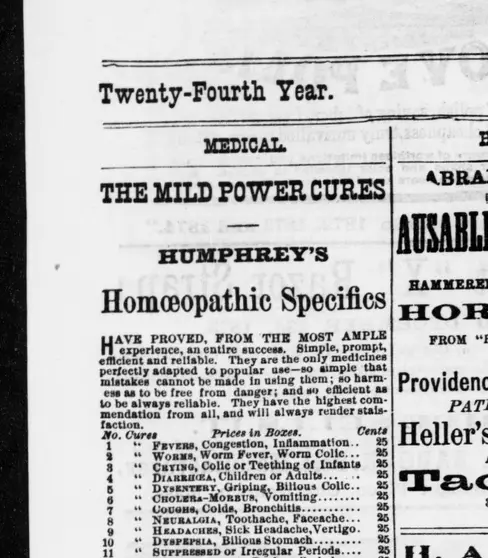
MEDICAL.THE MILD POWER CURES
HUMPHREYS Homeopathic Specifics
LAVE PROVED, FROM THE MOST AMPLE II experience, entire success Simple, prompt, efficient and reliable. They the only medlcines perfectly adapted to popular use-so ample tnat
ess AZ TO be free from danger; and 80 efficient as 70 be always reliable. They have the highest com mendation from all, and will always render stais- faction. -.
AS onlycorrectly not servedAS #61 p1-2
- advertisement: The text is a list of remedies with corresponding ailments and prices, typical of a patent medicine advertisement.
snewpapers
nothingAmerican Stories
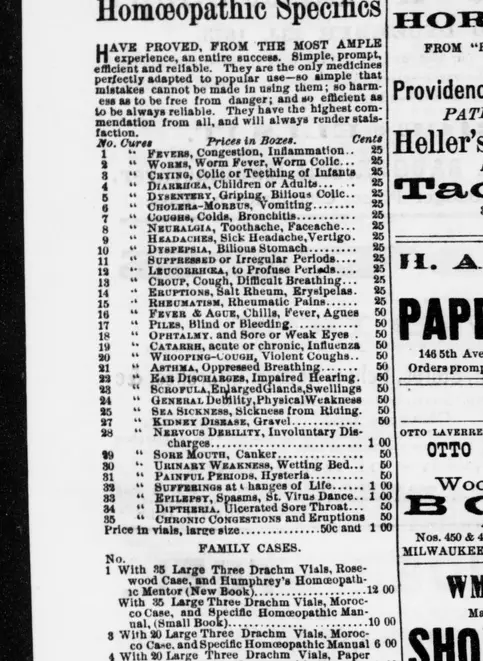
faction. NO CIIrss Prices In B0Tes. CeDts FEyERs Congestion, Inflammation. % . WORMS Worm Fever, Worm Colic... IS CRYING Collie or Teething OF Infants 70 DfARRHRA, Children or Adults. 70 5 DYsENrERY, Gripping, Bilious Collie. Is q CHOLERA-MoBBUs, Vomiting 70 4 CoueHs, Colds, Bronchitis. .......... 70 8 " NEURALGIA, Toothache, Faceache... 70 q - HEADACHES, Sick Headache, Vertigo. rs 10 F" DYSPEPSIA, Bilious Stomach. ......... 70 II /" SUPPRESSED or Irregular Periods. Is ~ /" LKUcoRRHGA, to Profuse PeriAds.... % IS GROUP, Cough, Difficult Breathing. rs IA - ERUPTIoNs, Salt Rheum, Erysipelas. 70 is - RHEUMATIsM, Rheumatic Pains. rs 10 " FEVER q AGUE, Chills, Fever, Agues 80 II PILES, Blind or Bleeding. ........... 80 1s " OPHTALMY. and Sore or Weak Eyes 80 10 - CATARRH, acute or chronic, Influenza bO 20 WHooPING-CoUGH, Violent Coughs. 81 81 ASTHMA, Oppressed Breathing. 81 ~ EAR DISCHARGES, Impaired Hearing. 80 % ScRoFULA, Enlarged Glands, ,Swellings 81 "a GENERAL Debility, Phi ysicalWeakness 81 IS SEA SICKNESS, Sickness from RIDING. 81 u KIDNEY DISEASE, Gravel. ............ d % NERVOUS DEBILITY, Involuntary Discharges. ACKNOWLEDGEMENTS. j % SORE MOUTH, Canker. er...........-.... q 30 :. URINARY WEAKNEss, Wetting Bed. 8 81 " PAINFUL PERIODS, Hysteria. B 80 " SUFFERINGs at hanges OF Life...... o 33 " EPILEPsY, Spasms, st. Virus Dance. "a 4" DIPTHERIA. liberated Sore Throat. 35 +" CHRONIC CONCESSIONS and Eruptions . Price In Vihis. large size .bUc anu
AS onlycorrectly not servedAS #62 p1-3
- advertisement: It lists products (family cases with vials, cases, and manuals) with prices and ordering information, typical of a mail-order advertisement.
snewpapers
nothingAmerican Stories
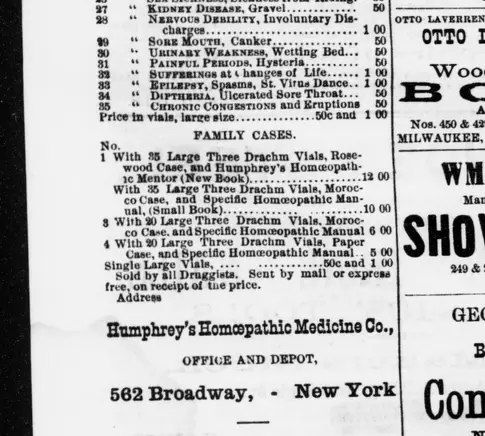
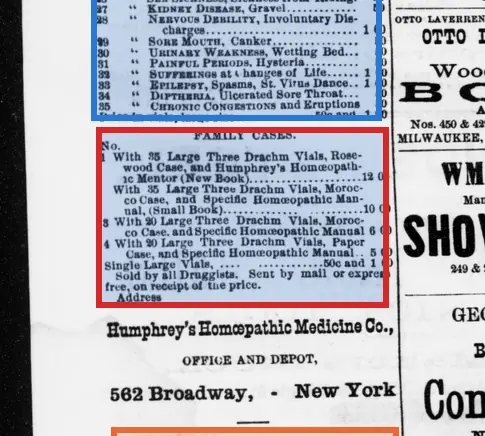
FAMILY CASES. No.With 35 Large Three Drachm Walls, Rose wood Case, and Humphreys Homeopath- ~ &c Mentor New Book k).................... ....1 w With 30 Large Three Drachm Walls Moroc- co Case, and Specific Homeopathic Man ual, (Small Book .............. ,.........lO OO With 20 Large Three Drachm Walls. Moroc- co Case. and Specific Homeopathic Manual Ot With 20 Large Three Drachm Walls, Paper Case and Specific Homeopathic Manual. O( Single Large NlhlS, oOC duu W Sold by ali Druggists. Sent by mail or express free, on receipt OF the price.
Address
AS onlycorrectly not servedAS #45 p1-4
- advertisement: The text promotes Humphreys Witch Hazel medicine with marketing claims and lists local sellers, making it a patent-medicine advertisement.
snewpapers
nothingAmerican Stories
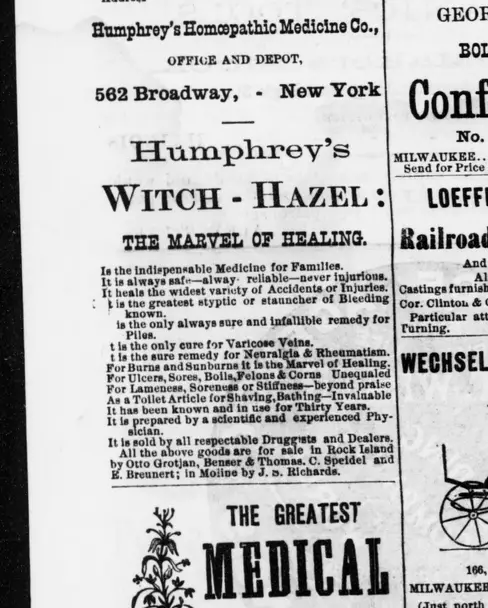
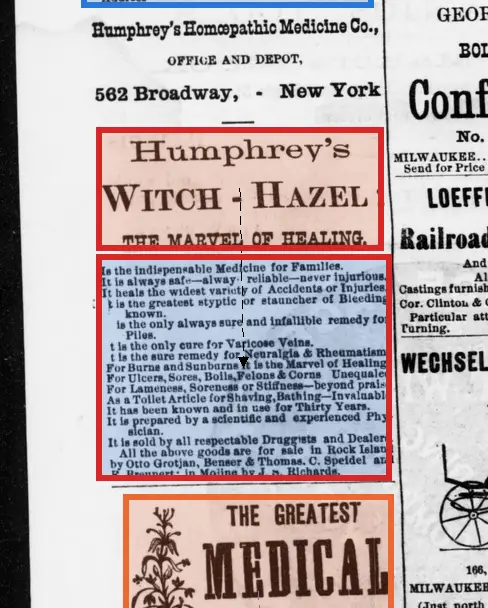
Humphreys WITCH HAZEL : THE MARVEL OF HEALING.Ia the indispensable Medicine for Families. II ia always safe-away. reliable-never injurious. II heals the widest variety OF Accidents or Injuries is the greatest styptic or stauncher OF Bleeding Is the only always sure and infallible remedy for
Piles.
For Rnrns and Supburns It is the Marvel of Healing FOR ulcers Sores Boils, ,Felons q Corns Unequaled For Lameness, Soreness or Stianess-beyond praise A Toilet Article for Shaving, g,Bathing-lnvauable II has been known and in Use for Thirty Years Ii is prepared by scientific and experienced Phy-
sician.
All the above goods are for sale In Rock Island nv otto Grotjan, Benser q Thomas. G. Speidel anc T. Breunert; in Moline by j. .. Richards.
AS onlycorrectly not servedAS #7 p1-5
- advertisement: The text promotes a patent medicine (Kennedy's Medical Discovery) with testimonials, a price, and directions for use, which are typical features of a newspaper advertisement.
snewpapers
nothingAmerican Stories
V THE GREATEST S: MEDICAL & DISCOVERY %F OF THE AGE.KENNEDY Of Roxbury has discovered In i one OF common p.s!nrH.weeds . remeuy me- Una tna cures EVERY KIND OF HUMoR, from the worse ScroIula down to u common Plmple. IL He has tried 1t in eleven hundred cases, ana never failed except in two cases l0otn thunuer-nu mor1 He has now In his possess ion over one hun dred certificates of its vuale, all within twenty Two bottles are warranted to cure nursing sore mouth. m -. ,,,a - | Two or three bottles will cure the system OF Dolls Two bottles are warranted to cure tne wors' can kcr in the mouth OF stomach. Three to live bottles are warranted 10 cure 'he worst kind VI Erysipelas. M, | one to wo bottles wa ranted to cure all hu- Two bottles are warranted to cure running Of the Ears and blotches among the hair. ,o-,rnt -Four to six bottles are warranted 10 cure eohf"P' One bottle viii cure scaly eruptions OF the Skin; Two or three bottles are warranted 10 cuie 'n0 worst kind Of Rngworm. A.. most desperate cases OF Rheumatism CT. Three to four bottles are warranted TO cure oai'- Five 10 eight bottles will cure the worst case Of benefit is always experienced from the Arst bot tie and u perfect cure is warranted when IT. sDoNe puAn'''' RoxBuRY, MASS. kDEAR MADAM: The reputation OF the Medlcai Discovery in curing all kinds of humors ID 80 wen establshsd by the unanimous voice of all who have used it, that need not say nything on tne "a the most skilfui physicians and the most caIeiui Sngy,ss an The cnunry are unanimous in its praise in 5r"s.nting the Medlcal Discovery to your mo- tice do 1t with iS ,pd oSrne most % OF those dis Eases TO which you unfortunately 30 hapie. That most excruciatine disease'a
NURSING SORE MOUTH, is cured us If by miracle; your own temper s,ag p9 shnrt and fretful maps 10 calm and SWEEP siumpets and the Medical Discovery becomes sid ioun'A'n VI blessing to your husband and househoiu'
In the more advanced stages Oh
CANKER,
xtends to the stomach, causing
DYSPEPSIA,
which Ia nothing but canker ON the stomach; the O the intestines and
..o.,,n, a s,plinr. gone feeling, and an indiffe encv even to the cares of your family
Your stomach Is
RAW AND INFLAMED.
your food distresses you, and you can oniy Gn Ss certain kinds and even OF that your system N q uo > nat yet halI the nourishmSnt II contains as the = rimonious fluid Of the canker eats upi tuIh iy ~ coC,rsxiou I,ses its bloom and becomes sAlAoW gresnish and your best day is gone FOR want nourishment your system becomes oose' hTSu5 S = - the nbrls Of your body become relaxed, dnen -. y Ow a tram diseases which the Meolcai Olsco'er' peculiarly adapted to
palpitation OF the heart, pain In the side, weakns of the splne and small Of the back pains OF the and also, that most excruciating OF diseases. inc
PILES.
How many thousands OF poor women arc SUI ingfrom this disease, and pnlng away mssera n = iifs and their mex door neighbor does not kn the eausei wisn TO impress ON your mlna : good old pr verb-"An ounce OF prevention IL Ter than pound Of cure" In the
MEDICAL DISCOVERY
Won have both the preventive and the cure, with yyreat aud good quality, that 1t Will never under circumstances do an INJURY. No chAliIe of diet ever necessafy.-ea the won can get anu enough uf II.
DlRroTioN YoR UsE.-Adalts, one taoiespoo ,,er dav Chi rem over teu years. dessertsRo0r thiIdren from I'VE TO eight years, teaspoonIul no uirecuons Cal be applicable 10 all cohstltuu tkae sufficient to operate on the Dowels TWICE.
hours truly, vuNNrn Price, $3.50 per rottle. For sale by Drug erywhere
AS onlycorrectly not servedAS #17 p1-6
- advertisement: The text promotes a business, solicits agents and asks readers to send their name and address for circulars and terms, which is characteristic of an advertisement rather than a notice or editorial content.
snewpapers
nothingAmerican Stories
.TH1 bESF |PhYIN 6|BUSINESS
ness for themselves. We have tne most aseuts aitu do the largest business in our line. we nave rign
eyc,usye territory furnish the best tools to wors with. give the largest cash pay. Book AGENTS an" ali experienced agents find the business we inrisn, decioedly the most profitable. EVERYBODY can ,aL, nooney Send YOUR name and address at once TO- circulars terms, etc. AGENTS. no matter Wnal vou are dong send to us for particulars Address WATERS & TINKER. Publishers, Chicago, III.
AS onlycorrectly not servedAS #47 p1-7
- advertisement: The text promotes an 'AGENCY' and recruiting 'AGENTS,' with persuasive language about success and inducements typical of a classified or business advertisement.
snewpapers
nothingAmerican Stories
We now enter the field for the fall and coming Winter and are furnishing the bes, paving and most easily worked AGENCY in the world. Our AGENTS have always been the most successful, and we nave lately added new and exceed ingiy taking inducements, re auiring only intelligence and application for any one,young or old, of ether sex, to make really first-class paying buslours onlynot captured by ASdomestic_news p1-8
snewpapers
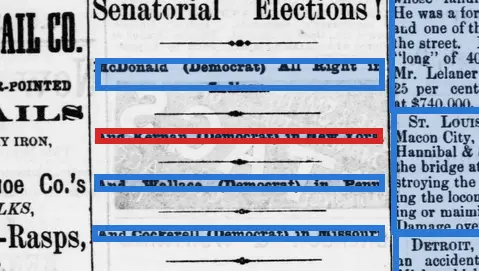
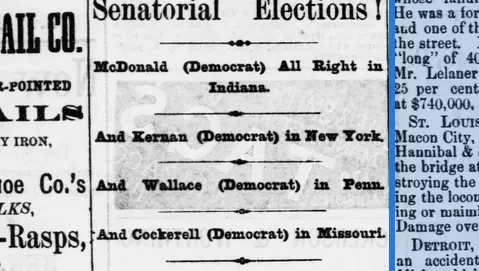
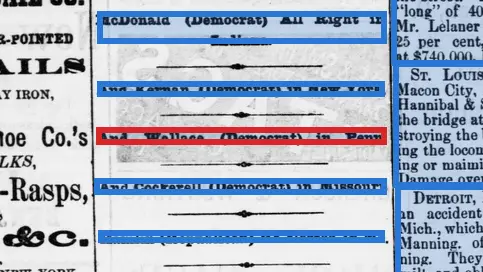
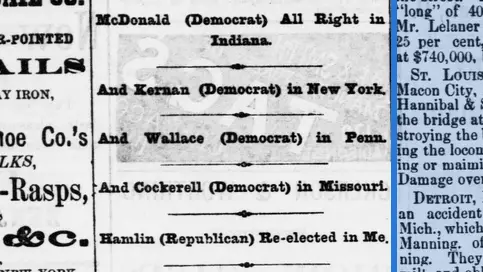
McDonald (Democrat) All Right in Indiana.American Stories
nothingours onlynot captured by ASdomestic_news p1-9
snewpapers
And Kernan (Democrat) in New YorkAmerican Stories
nothingours onlynot captured by ASdomestic_news p1-10
snewpapers
And Wallace (Democrat) in Penn.American Stories
nothingours onlynot captured by ASdomestic_news p1-11
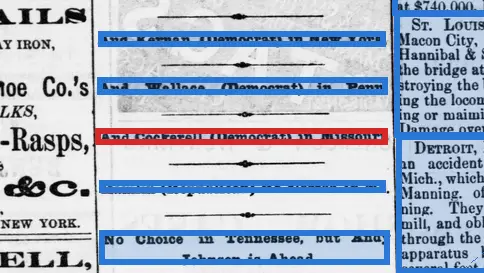
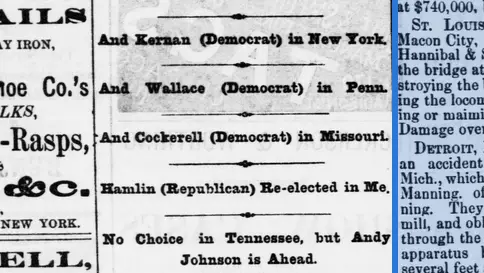
snewpapers
And Cockerell (Democrat) in MissouriAmerican Stories
nothingours onlynot captured by ASdomestic_news p1-12
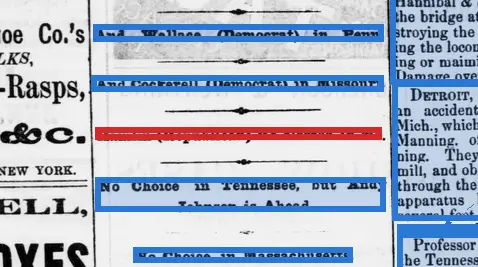
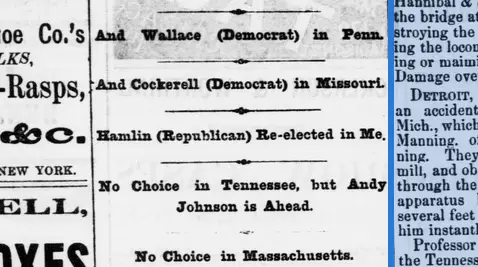
snewpapers
Hamlin (Republican) Re-elected in MeAmerican Stories
nothingours onlynot captured by ASdomestic_news p1-13
snewpapers
No Choice in Tennessee. but Andy Johnson is Ahead.American Stories
nothingours onlynot captured by ASdomestic_news p1-14
snewpapers
No Choice in Massachusetts.American Stories
nothingours onlynot captured by ASdomestic_news p1-15
snewpapers
No Choice in Rhode Island.American Stories
nothingours onlynot captured by ASdomestic_news p1-16
snewpapers
No Choice in Nebraska.American Stories
nothingours onlynot captured by ASdomestic_news p1-17
snewpapers
No Choice in MichiganAmerican Stories
nothingours onlynot captured by ASdomestic_news p1-18
snewpapers
Wisconsin Votes next TuesdayAmerican Stories
nothing1:1 matchmatchdomestic_news ↔ AS #63 p1-19
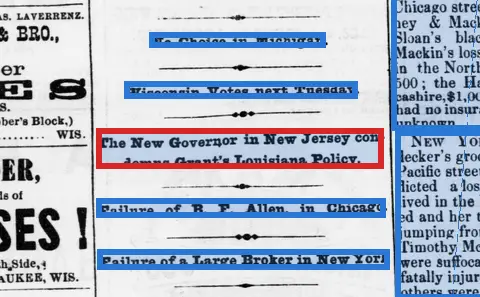
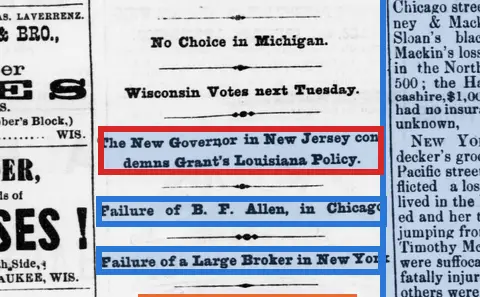
snewpapers
The New Governor in New Jersey condemns Grant's Louisiana PolicyAmerican Stories
The New Governor in New Jersey con-denns Grants Louisiana Policy.
1:1 matchmatchdomestic_news ↔ AS #46 p1-20
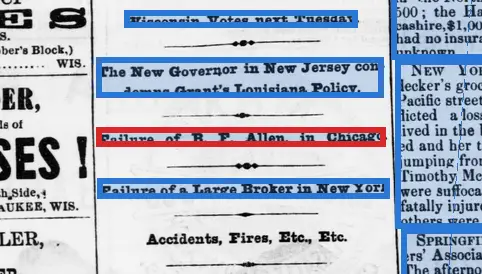
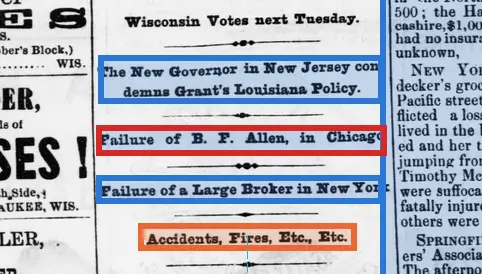
snewpapers
Failure of B. F. Allen, in Chicago.American Stories
Failure of b. z. Allen, in Chicago.1:1 matchmatchdomestic_news ↔ AS #34 p1-21
snewpapers
Failure of a Large Broker in New YorkAmerican Stories
Failure of Large Broker in New Yor'AS onlycorrectly not servedAS #14 p1-22
- page furniture: This is a short heading labeling a category of news items, functioning as a section heading rather than a full printed item.
snewpapers
nothingAmerican Stories
Accidents, Fires, Etc, Etc.in N ours : 1 ASsnewpapers rightdomestic_news ↔ AS #14 p1-23 inside AS's merged article, decided by p1-24
snewpapers
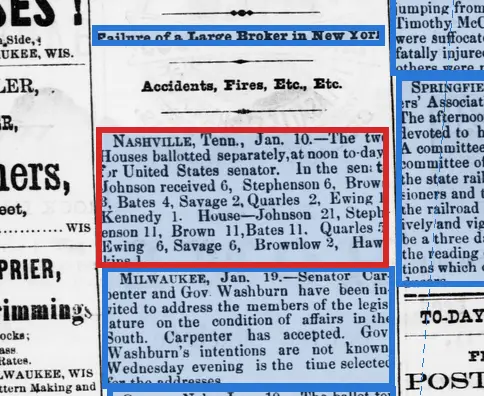
NASHVILLE, Tenn., Jan. 10.—The two Houses balloted separately, at noon to-day, for United States senator. In the senate Johnson received 6, Stephenson 6, Brown 3, Bates 4, Savage 2, Quarles 2, Ewing 1, Kennedy 1. House—Johnson 21, Stephenson 11, Brown 11, Bates 11, Quarles 5, Ewing 6, Savage 6, Brownlow 2, Hawkins 1.American Stories
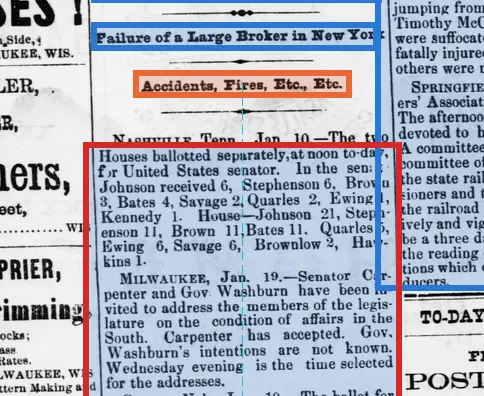
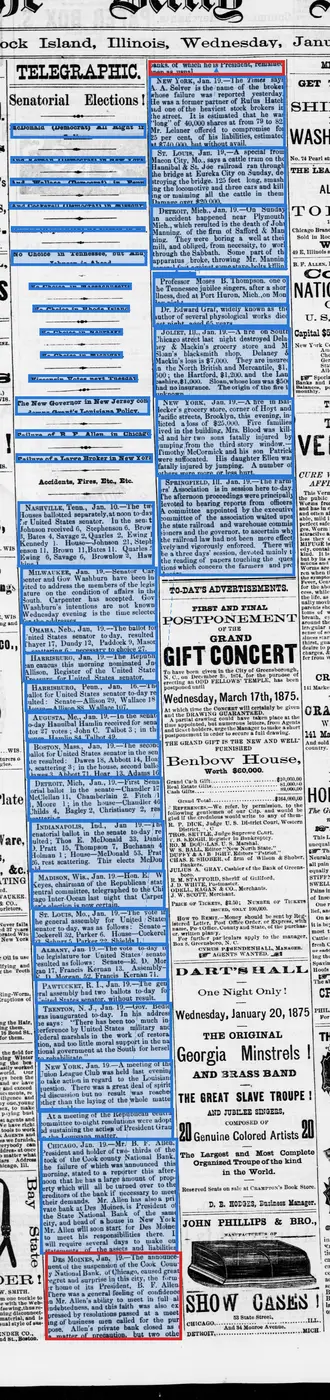
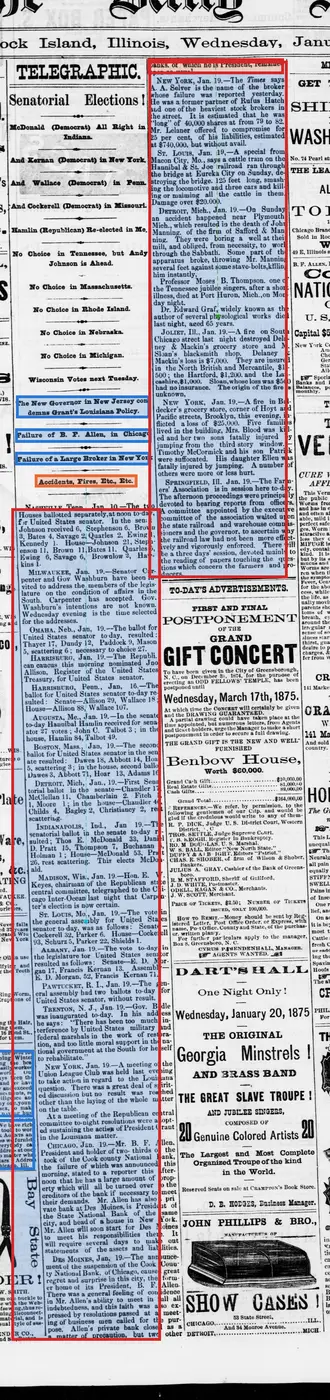
| Houses ballotted separately, at noon to-day, f,r United States senator. In the SENT johnson received 6, Stephenson g., Brown 3, Bates 4, Savage 2. Quarles 2, Ewing l, Kennedy /. House-Johnson q, Steph- S enson ii, Brown ll,Bates II. Quarles 5, = Ewing 6, Savage 6, Brownlow 2, Haw- kinsN ours : 1 ASsnewpapers rightdomestic_news, domestic_news, domestic_news, domestic_news, domestic_news, domestic_news, domestic_news, domestic_news, domestic_news, domestic_news, domestic_news, domestic_news, domestic_news, domestic_news, domestic_news, domestic_news, domestic_news, domestic_news ↔ AS #14 p1-24
- stated first: one component (American Stories): snewpapers right (said several): The passage is a column of separate telegraphic news items, each with its own dateline and distinct topic (senatorial ballots, inaugurations, bank failure), so the numbered pieces are individual components.
- stated first: several components (snewpapers): snewpapers right (said several): The passage consists of many separate telegraphic news items, each datelined from a different city (Nashville, Milwaukee, Omaha, etc.) and reporting distinct legislative ballots or events, so they are independent components rather than one article.
snewpapers
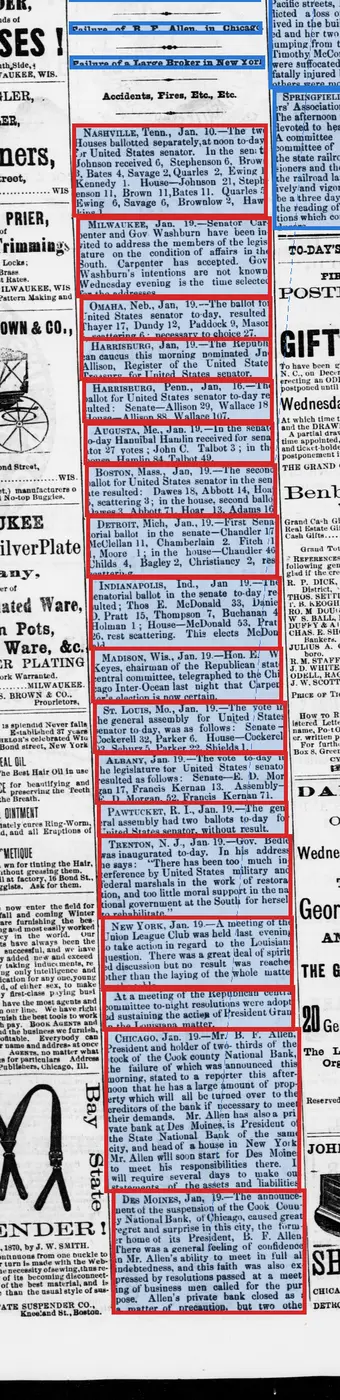
NASHVILLE, Tenn., Jan. 10.—The two Houses balloted separately, at noon to-day, for United States senator. In the senate Johnson received 6, Stephenson 6, Brown 3, Bates 4, Savage 2, Quarles 2, Ewing 1, Kennedy 1. House—Johnson 21, Stephenson 11, Brown 11, Bates 11, Quarles 5, Ewing 6, Savage 6, Brownlow 2, Hawkins 1.MILWAUKEE, Jan. 19.-Senator Carpenter and Gov. Washburn have been invited to address the members of the legislature on the condition of affairs in the South. Carpenter has accepted. Gov. Washburn's intentions are not known. Wednesday evening is the time selected for the addresses.
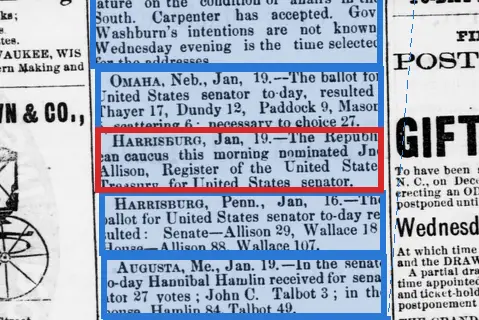
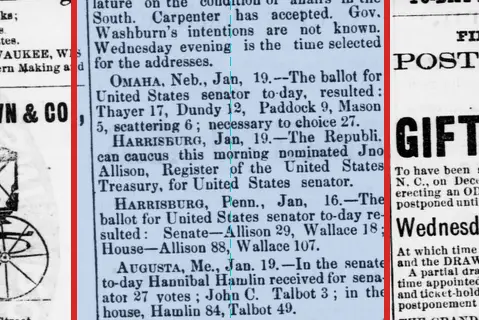
OMAHA, Neb., Jan, 19.--The ballot for United States senator to-day, resulted: Thayer 17, Dundy 12, Paddock 9, Mason 5, scattering 6; necessary to choice 27.
HARRISBURG, Jan, 19.—The Republican caucus this morning nominated Jno Allison, Register of the United States Treasury, for United States senator.
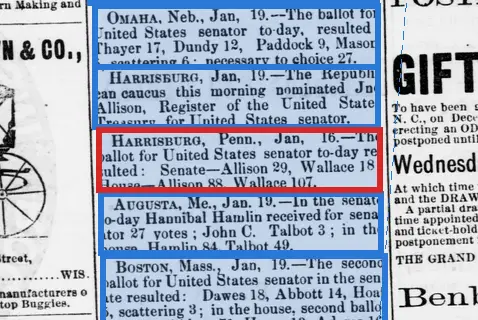
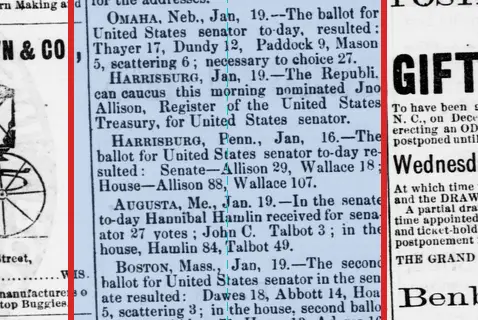
HARRISBURG, Penn., Jan, 16.—The ballot for United States senator to-day resulted: Senate-Allison 29, Wallace 18; House—Allison 88, Wallace 107.
AUGUSTA, Me., Jan. 19.—In the senate to-day Hannibal Hamlin received for senator 27 votes ; John C. Talbot 3; in the house, Hamlin 84, Talbot 49.
BOSTON, Mass., Jan, 19.—The second ballot for United States senator in the senate resulted: Dawes 18, Abbott 14, Hoar 5, scattering 3; in the house, second ballot Dawes 3, Abbott 71, Hoar 13, Adams 16.
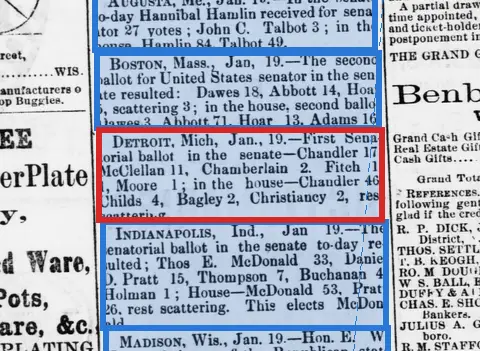
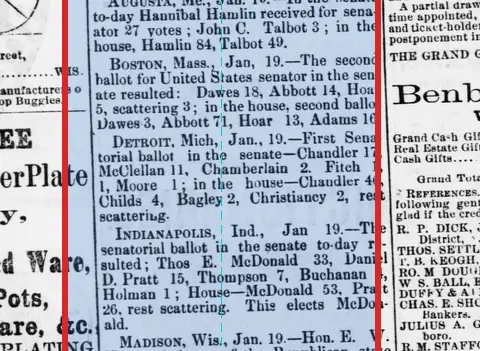
DETROIT, Mich., Jan., 19.—First Senatorial ballot in the senate-Chandler 17, McClellan 11, Chamberlain 2. Fitch 1, 1, Moore 1; in the house-Chandler 46, Childs 4, Bagley 2, Christiancy 2, rest scattering
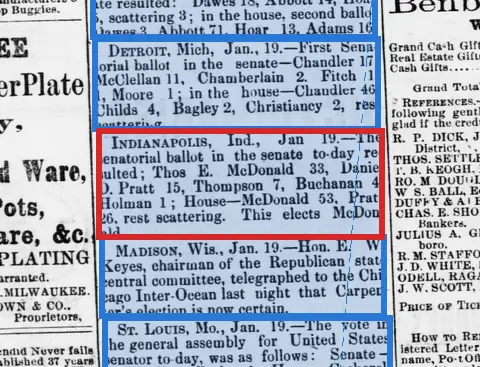
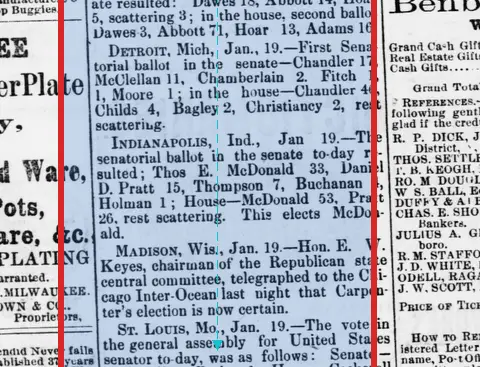
INDIANAPOLIS, Ind., Jan 19.-The senatorial ballot in the senate to-day resulted; Thos E. McDonald 33, Daniel D. Pratt 15, Thompson 7, Buchanan 4, Holman 1; House—McDonald 53, Pratt 26, rest scattering. This elects McDonald.
MADISON, Wis., Jan. 19.—Hon. E. W. Keyes, chairman of the Republican state central committee, telegraphed to the Chicago Inter-Ocean last night that Carpenter's election is now certain.
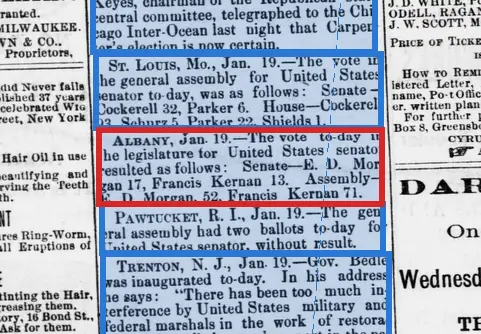
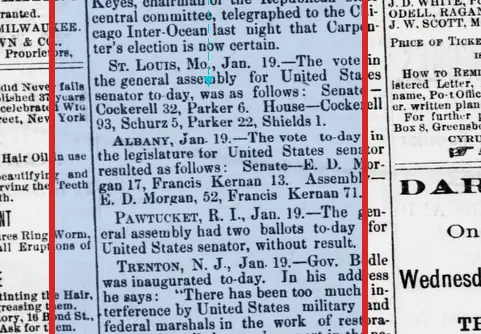
ST. LOUIS, Mo., Jan. 19.—The vote in the general assembly for United States senator to-day, was as follows: Senate - Cockerell 32, Parker 6. House-Cockerell 93, Schurz 5, Parker 22, Shields 1.
ALBANY, Jan. 19.-The vote to-day in the legislature for United States senator resulted as follows: Senate-E. D. Morgan 17, Francis Kernan 13. Assembly—E. D. Morgan, 52, Francis Kernan 71.
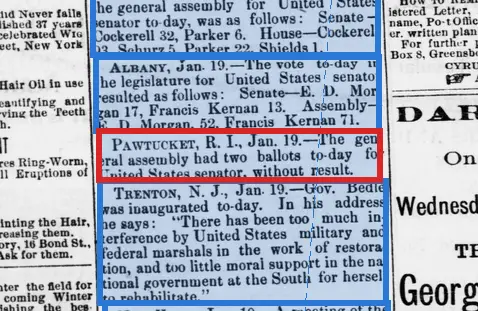
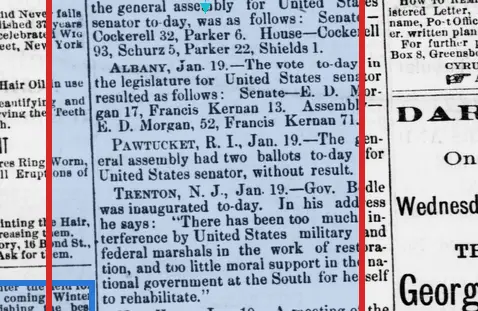
PAWTUCKET, R. I., Jan. 19.—The general assembly had two ballots to-day for United States senator, without result.
TRENTON, N. J., Jan. 19.—Gov. Bedle was inaugurated to-day. In his address he says: "There has been too much interference by United States military and federal marshals in the work of restoration, and too little moral support in the national government at the South for herself to rehabilitate."
NEW YORK, Jan. 19.—A meeting of the Union League Club was held last evening to take action in regard to the Louisiana question. There was a great deal of spirited discussion but no result was reached other than the laying of the whole matter on the table.
At a meeting of the Republican central committee to-night resolutions were adopted sustaining the action of President Grant in the Louisiana matter.
CHICAGO, Jan. 19.—Mr. B. F. Allen, President and holder of two-thirds of the stock of the Cook county National Bank, the failure of which was announced this morning, stated to a reporter this afternoon that he has a large amount of property which will all be turned over to the creditors of the bank if necessary to meet their demands. Mr. Allen has also a private bank at Des Moines, is President of the State National Bank of the same city, and head of a house in New York. Mr. Allen will soon start for Des Moines to meet his responsibilities there. It will require several days to make out statements of the assets and liabilities.
DES MOINES, Jan, 19.—The announcement of the suspension of the Cook County National Bank, of Chicago, caused great regret and surprise in this city, the former home of its President, B. F. Allen. There was a general feeling of confidence in Mr. Allen's ability to meet in full all indebtedness, and this faith was also expressed by resolutions passed at a meeting of business men called for the purpose. Allen's private bank closed as a matter of precaution, but two other banks, of which he is President, remained open as usual.
American Stories
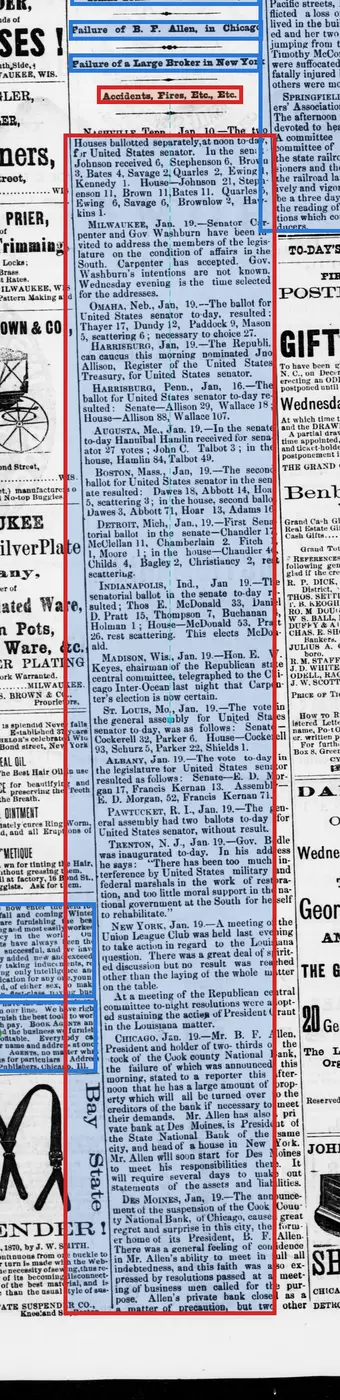
Accidents, Fires, Etc, Etc.| Houses ballotted separately, at noon to-day, f,r United States senator. In the SENT johnson received 6, Stephenson g., Brown 3, Bates 4, Savage 2. Quarles 2, Ewing l, Kennedy /. House-Johnson q, Steph- S enson ii, Brown ll,Bates II. Quarles 5, = Ewing 6, Savage 6, Brownlow 2, Haw- kins l.
MILWAUKEE, Jan. 19.-Senator Car penter and Gov Washburn have been In I yited to address the members OF the legls' | lature on the condition OF affairs In the South. Carpenter has accepted, UoV' Washburn's intentions are not known; e Wednesday evening is the time selecteo nd for the addresses.
OMAHA Neb., Jan, 19.--The ballot for United States senator to-day, resulted Thayer II, Dundy u, Paddock y, Mason y 5, scattering 6; necessary to ShoiGe ~. ,r
HARRIsBURG, Jan, l9-The Republi. can caucus this morning nominated Jno Allison, Register of the United States Treasury, for United States senator.
HARRISBURG, Penn, Jan, l6:-The ballot for United States senator to-day re- suited: Senate-Allison 29, Wallace le;
House-Allison 8S, Wallace lO7.
AUGUSTA, Me-, Jan. 19.-1n the senate TO-DAY Hannibal Hamlin received for sena-
ato1 II votes John G. Talbot 3; in the
house, Hamlin "a, Talbot AZ.
,,o BosToN, Mass, Jan, 19.-The second 'io' ballot for United States senator in the SEN 's o ate resulted Dawes Is, Abbott IA, Hoar IL 5, scattering 3; in the house. second ballot
Dawes 3, Abbott II, Hoar l3, Adams 10.
DETROIT, Mich, JAN, l9.-First Sena-
torial ballot in the senate-Chandler l I, TO Mcclellan IL. Chamberlain 2; Fitch l UO Moore |; in the house-Chandler 46
Childs 4, Bagley 2, Christiancy 2, res
scattering.
INDIANAPOLIS. Ind, Jan 19.-Th
senatorial ballot in the senate to-day re re-. suited; Thos Z. Mcdonald 33, DAME
d. Pratt Is, Thompson 7, Buchanan
Holman l /; House-McDouald 53: Prat
26, rest scattering. This elects McDoI &c. aid. " rC1 MADISON, Wis, Jan. 19-Hon. Il. " NU Keyes, chairman of the Republican sta
central committee, telegraphed to the Ch KEE' cago Inter Ocean last night that Carpe ors o.; ter's election is now certain.
. ST. LOUIS. Mo-, Jan. l9.-The vote ..,. the general assembly for United Stat 7 years senator to- day, was as follows Senate ID WIG Cockerell 32, Parker 6. House-Cocker horA %, Schurz s. Parker %, Shields l.
ALBANY, Jan. 19.-The vote to-day in use the legislature for United States sena = .nd resulted as follows: Senate-E D. M = Teeth pan II. Francis Herman l3. Assembly
+. d. Morgan, SO, Francis Herman IL.
PAwTUCKET, R. l., Jan. 19.-The g Worm. eral assembly had two ballots to-day ions OF United States senator, without result.
TRENTON, n. j., Jan. 19.-Gov. Be
was inaugurated to-day. in his addr lie Hair, he saws: "There has been too much he9; Iterference by United States military Unu Sem o'' federal marshals in the work OF restt - tion, and too little moral support IN the ae,a for tioual government at the South for her Winter to rehabilitate.
ne Ieorsss 9es NEw YORK, Jan. ia meeting of d. our ITn;on League Club was held last ever 'een the to take action in regard to the Louis exceed question There was great deal OF sp lents, re ed discussion but no result was reae e. e.voung other than the laying OF the whole ma to maks on the table ing busi At a meeting of the Republican Gel rinb committee tonight resolutions were az ) to work ed sustaining the actieR Ut PRESIDENT u ESTs s1s0iIS an" in the Louisiana matter.
,ody can CHICAGO, Jan. 19.-Mr b. r. A 3 at ono. President and holder of two thirds OF Address took of the Cook county National b 20, Ill. the failure of which was announced
morning, stated to a reporter this
w erty which will all be turned over t
Is creditors Of the bank if necessary to - their demands. Mr.. Allen has also
yate bank at Des Moines, is Preslde'
the State National Bank of the
city. aud head of house in New =;
nj MIR. Allen will soon start tor Des NJ
" to meet his responsibilities there
& will require several days to make = statements of the assets and lab \ e DEs MONIES, Jan, l9.-The anne v " ment Of the suspension OF the Cook
ty National Bank, of Chicago, caused tR J regret and surprise in this city, the
er home of its President, b: i. NTH. There was general feeling OF cont s ,s 9nekte @ WsS 70 in Mr. Aliens ability to meet In ing, thus re- Indebtedness, and this faith was al dssonnset ans pressed by resolutions passed at style OF sns- ing OF business men odieu All IN SIX ! aostoo SS;, q matter of precaution, but two
- the pieces asked about (snewpapers):
- [1] domestic_news: begins: "NASHVILLE, Tenn., Jan. 10.—The two Houses balloted separately, at noon to-day, for United States senator." … ends: "11, Brown 11, Bates 11, Quarles 5, Ewing 6, Savage 6, Brownlow 2, Hawkins 1."
- [2] domestic_news: begins: "MILWAUKEE, Jan. 19.-Senator Carpenter and Gov. Washburn have been invited to address the members of" … ends: "Gov. Washburn's intentions are not known. Wednesday evening is the time selected for the addresses."
- [3] domestic_news: begins: "OMAHA, Neb., Jan, 19.--The ballot for United States senator to-day, resulted: Thayer 17, Dundy 12," … ends: "resulted: Thayer 17, Dundy 12, Paddock 9, Mason 5, scattering 6; necessary to choice 27."
- [4] domestic_news: begins: "HARRISBURG, Jan, 19.—The Republican caucus this morning nominated Jno Allison, Register of the United States" … ends: "this morning nominated Jno Allison, Register of the United States Treasury, for United States senator."
- [5] domestic_news: begins: "HARRISBURG, Penn., Jan, 16.—The ballot for United States senator to-day resulted: Senate-Allison 29, Wallace 18;" … ends: "ballot for United States senator to-day resulted: Senate-Allison 29, Wallace 18; House—Allison 88, Wallace 107."
- [6] domestic_news: begins: "AUGUSTA, Me., Jan. 19.—In the senate to-day Hannibal Hamlin received for senator 27 votes ;" … ends: "senator 27 votes ; John C. Talbot 3; in the house, Hamlin 84, Talbot 49."
- [7] domestic_news: begins: "BOSTON, Mass., Jan, 19.—The second ballot for United States senator in the senate resulted: Dawes" … ends: "scattering 3; in the house, second ballot Dawes 3, Abbott 71, Hoar 13, Adams 16."
- [8] domestic_news: begins: "DETROIT, Mich., Jan., 19.—First Senatorial ballot in the senate-Chandler 17, McClellan 11, Chamberlain 2. Fitch" … ends: "1, Moore 1; in the house-Chandler 46, Childs 4, Bagley 2, Christiancy 2, rest scattering"
- [9] domestic_news: begins: "INDIANAPOLIS, Ind., Jan 19.-The senatorial ballot in the senate to-day resulted; Thos E. McDonald 33," … ends: "Thompson 7, Buchanan 4, Holman 1; House—McDonald 53, Pratt 26, rest scattering. This elects McDonald."
- [10] domestic_news: begins: "MADISON, Wis., Jan. 19.—Hon. E. W. Keyes, chairman of the Republican state central committee, telegraphed" … ends: "central committee, telegraphed to the Chicago Inter-Ocean last night that Carpenter's election is now certain."
- [11] domestic_news: begins: "ST. LOUIS, Mo., Jan. 19.—The vote in the general assembly for United States senator to-day," … ends: "follows: Senate - Cockerell 32, Parker 6. House-Cockerell 93, Schurz 5, Parker 22, Shields 1."
- [12] domestic_news: begins: "ALBANY, Jan. 19.-The vote to-day in the legislature for United States senator resulted as follows:" … ends: "follows: Senate-E. D. Morgan 17, Francis Kernan 13. Assembly—E. D. Morgan, 52, Francis Kernan 71."
- [13] domestic_news: begins: "PAWTUCKET, R. I., Jan. 19.—The general assembly had two ballots to-day for United States senator," … ends: "I., Jan. 19.—The general assembly had two ballots to-day for United States senator, without result."
- [14] domestic_news: begins: "TRENTON, N. J., Jan. 19.—Gov. Bedle was inaugurated to-day. In his address he says: "There" … ends: "too little moral support in the national government at the South for herself to rehabilitate.""
- [15] domestic_news: begins: "NEW YORK, Jan. 19.—A meeting of the Union League Club was held last evening to" … ends: "no result was reached other than the laying of the whole matter on the table."
- [16] domestic_news: begins: "At a meeting of the Republican central committee to-night resolutions were adopted sustaining the action" … ends: "committee to-night resolutions were adopted sustaining the action of President Grant in the Louisiana matter."
- [17] domestic_news: begins: "CHICAGO, Jan. 19.—Mr. B. F. Allen, President and holder of two-thirds of the stock of" … ends: "there. It will require several days to make out statements of the assets and liabilities."
- [18] domestic_news: begins: "DES MOINES, Jan, 19.—The announcement of the suspension of the Cook County National Bank, of" … ends: "of precaution, but two other banks, of which he is President, remained open as usual."
Text agreement inside AS's merged article (17 pieces): the merged article's text cut where our components begin and end; American Stories draws no boundary there, so these are no matches.
p1-23 domestic_news
snewpapers
NASHVILLE, Tenn., Jan. 10.—The two Houses balloted separately, at noon to-day, for United States senator. In the senate Johnson received 6, Stephenson 6, Brown 3, Bates 4, Savage 2, Quarles 2, Ewing 1, Kennedy 1. House—Johnson 21, Stephenson 11, Brown 11, Bates 11, Quarles 5, Ewing 6, Savage 6, Brownlow 2, Hawkins 1.American Stories (slice of #14)
| Houses ballotted separately, at noon to-day, f,r United States senator. In the SENT johnson received 6, Stephenson g., Brown 3, Bates 4, Savage 2. Quarles 2, Ewing l, Kennedy /. House-Johnson q, Steph- S enson ii, Brown ll,Bates II. Quarles 5, = Ewing 6, Savage 6, Brownlow 2, Haw- kinsp1-25 domestic_news
MILWAUKEE, Jan. 19.-Senator Car penter and Gov Washburn have been In I yited to address the members OF the legls' | lature on the condition OF affairs In the South. Carpenter has accepted, UoV' Washburn's intentions are not known; e Wednesday evening is the time selecteo nd for the addresses.
snewpapers
MILWAUKEE, Jan. 19.-Senator Carpenter and Gov. Washburn have been invited to address the members of the legislature on the condition of affairs in the South. Carpenter has accepted. Gov. Washburn's intentions are not known. Wednesday evening is the time selected for the addresses.American Stories (slice of #14)
l.MILWAUKEE, Jan. 19.-Senator Car penter and Gov Washburn have been In I yited to address the members OF the legls' | lature on the condition OF affairs In the South. Carpenter has accepted, UoV' Washburn's intentions are not known; e Wednesday evening is the time selecteo nd for the addresses.
p1-26 domestic_news
snewpapers
OMAHA, Neb., Jan, 19.--The ballot for United States senator to-day, resulted: Thayer 17, Dundy 12, Paddock 9, Mason 5, scattering 6; necessary to choice 27.American Stories (slice of #14)
OMAHA Neb., Jan, 19.--The ballot for United States senator to-day, resulted Thayer II, Dundy u, Paddock y, Mason y 5, scattering 6; necessary to ShoiGe ~.p1-27 domestic_news
HARRIsBURG, Jan, l9-The Republi. can caucus this morning nominated Jno Allison, Register of the United States Treasury, for United States senator.
snewpapers
HARRISBURG, Jan, 19.—The Republican caucus this morning nominated Jno Allison, Register of the United States Treasury, for United States senator.American Stories (slice of #14)
,rHARRIsBURG, Jan, l9-The Republi. can caucus this morning nominated Jno Allison, Register of the United States Treasury, for United States senator.
p1-28 domestic_news
House-Allison 8S, Wallace
snewpapers
HARRISBURG, Penn., Jan, 16.—The ballot for United States senator to-day resulted: Senate-Allison 29, Wallace 18; House—Allison 88, Wallace 107.American Stories (slice of #14)
HARRISBURG, Penn, Jan, l6:-The ballot for United States senator to-day re- suited: Senate-Allison 29, Wallace le;House-Allison 8S, Wallace
p1-29 domestic_news
AUGUSTA, Me-, Jan. 19.-1n the senate TO-DAY Hannibal Hamlin received for sena-
ato1 II votes John G. Talbot 3; in the
house, Hamlin "a, Talbot
snewpapers
AUGUSTA, Me., Jan. 19.—In the senate to-day Hannibal Hamlin received for senator 27 votes ; John C. Talbot 3; in the house, Hamlin 84, Talbot 49.American Stories (slice of #14)
lO7.AUGUSTA, Me-, Jan. 19.-1n the senate TO-DAY Hannibal Hamlin received for sena-
ato1 II votes John G. Talbot 3; in the
house, Hamlin "a, Talbot
p1-30 domestic_news
,,o BosToN, Mass, Jan, 19.-The second 'io' ballot for United States senator in the SEN 's o ate resulted Dawes Is, Abbott IA, Hoar IL 5, scattering 3; in the house. second ballot
Dawes 3, Abbott II, Hoar l3, Adams
snewpapers
BOSTON, Mass., Jan, 19.—The second ballot for United States senator in the senate resulted: Dawes 18, Abbott 14, Hoar 5, scattering 3; in the house, second ballot Dawes 3, Abbott 71, Hoar 13, Adams 16.American Stories (slice of #14)
AZ.,,o BosToN, Mass, Jan, 19.-The second 'io' ballot for United States senator in the SEN 's o ate resulted Dawes Is, Abbott IA, Hoar IL 5, scattering 3; in the house. second ballot
Dawes 3, Abbott II, Hoar l3, Adams
p1-31 domestic_news
DETROIT, Mich, JAN, l9.-First Sena-
torial ballot in the senate-Chandler l I, TO Mcclellan IL. Chamberlain 2; Fitch l UO Moore |; in the house-Chandler 46
Childs 4, Bagley 2, Christiancy 2, res
scattering.
snewpapers
DETROIT, Mich., Jan., 19.—First Senatorial ballot in the senate-Chandler 17, McClellan 11, Chamberlain 2. Fitch 1, 1, Moore 1; in the house-Chandler 46, Childs 4, Bagley 2, Christiancy 2, rest scatteringAmerican Stories (slice of #14)
10.DETROIT, Mich, JAN, l9.-First Sena-
torial ballot in the senate-Chandler l I, TO Mcclellan IL. Chamberlain 2; Fitch l UO Moore |; in the house-Chandler 46
Childs 4, Bagley 2, Christiancy 2, res
scattering.
p1-32 domestic_news
senatorial ballot in the senate to-day re re-. suited; Thos Z. Mcdonald 33, DAME
d. Pratt Is, Thompson 7, Buchanan
Holman l /; House-McDouald 53: Prat
26, rest scattering. This elects McDoI &c.
snewpapers
INDIANAPOLIS, Ind., Jan 19.-The senatorial ballot in the senate to-day resulted; Thos E. McDonald 33, Daniel D. Pratt 15, Thompson 7, Buchanan 4, Holman 1; House—McDonald 53, Pratt 26, rest scattering. This elects McDonald.American Stories (slice of #14)
INDIANAPOLIS. Ind, Jan 19.-Thsenatorial ballot in the senate to-day re re-. suited; Thos Z. Mcdonald 33, DAME
d. Pratt Is, Thompson 7, Buchanan
Holman l /; House-McDouald 53: Prat
26, rest scattering. This elects McDoI &c.
p1-33 domestic_news
central committee, telegraphed to the Ch KEE' cago Inter Ocean last night that Carpe ors o.; ter's election is now certain.
snewpapers
MADISON, Wis., Jan. 19.—Hon. E. W. Keyes, chairman of the Republican state central committee, telegraphed to the Chicago Inter-Ocean last night that Carpenter's election is now certain.American Stories (slice of #14)
aid. " rC1 MADISON, Wis, Jan. 19-Hon. Il. " NU Keyes, chairman of the Republican stacentral committee, telegraphed to the Ch KEE' cago Inter Ocean last night that Carpe ors o.; ter's election is now certain.
p1-34 domestic_news
snewpapers
ST. LOUIS, Mo., Jan. 19.—The vote in the general assembly for United States senator to-day, was as follows: Senate - Cockerell 32, Parker 6. House-Cockerell 93, Schurz 5, Parker 22, Shields 1.American Stories (slice of #14)
ST. LOUIS. Mo-, Jan. l9.-The vote ..,. the general assembly for United Stat 7 years senator to- day, was as follows Senate ID WIG Cockerell 32, Parker 6. House-Cocker horA %, Schurz s. Parker %, Shields l.p1-35 domestic_news
+. d. Morgan, SO, Francis Herman
snewpapers
ALBANY, Jan. 19.-The vote to-day in the legislature for United States senator resulted as follows: Senate-E. D. Morgan 17, Francis Kernan 13. Assembly—E. D. Morgan, 52, Francis Kernan 71.American Stories (slice of #14)
ALBANY, Jan. 19.-The vote to-day in use the legislature for United States sena = .nd resulted as follows: Senate-E D. M = Teeth pan II. Francis Herman l3. Assembly+. d. Morgan, SO, Francis Herman
p1-36 domestic_news
PAwTUCKET, R. l., Jan. 19.-The g Worm. eral assembly had two ballots to-day ions OF United States senator, without result.
snewpapers
PAWTUCKET, R. I., Jan. 19.—The general assembly had two ballots to-day for United States senator, without result.American Stories (slice of #14)
IL.PAwTUCKET, R. l., Jan. 19.-The g Worm. eral assembly had two ballots to-day ions OF United States senator, without result.
p1-37 domestic_news
was inaugurated to-day. in his addr lie Hair, he saws: "There has been too much he9; Iterference by United States military Unu Sem o'' federal marshals in the work OF restt - tion, and too little moral support IN the ae,a for tioual government at the South for her Winter to rehabilitate.
snewpapers
TRENTON, N. J., Jan. 19.—Gov. Bedle was inaugurated to-day. In his address he says: "There has been too much interference by United States military and federal marshals in the work of restoration, and too little moral support in the national government at the South for herself to rehabilitate."American Stories (slice of #14)
TRENTON, n. j., Jan. 19.-Gov. Bewas inaugurated to-day. in his addr lie Hair, he saws: "There has been too much he9; Iterference by United States military Unu Sem o'' federal marshals in the work OF restt - tion, and too little moral support IN the ae,a for tioual government at the South for her Winter to rehabilitate.
p1-38 domestic_news
snewpapers
NEW YORK, Jan. 19.—A meeting of the Union League Club was held last evening to take action in regard to the Louisiana question. There was a great deal of spirited discussion but no result was reached other than the laying of the whole matter on the table.American Stories (slice of #14)
ne Ieorsss 9es NEw YORK, Jan. ia meeting of d. our ITn;on League Club was held last ever 'een the to take action in regard to the Louis exceed question There was great deal OF sp lents, re ed discussion but no result was reae e. e.voung other than the laying OF the whole ma to maks on the tablep1-39 domestic_news
snewpapers
At a meeting of the Republican central committee to-night resolutions were adopted sustaining the action of President Grant in the Louisiana matter.American Stories (slice of #14)
ing busi At a meeting of the Republican Gel rinb committee tonight resolutions were az ) to work ed sustaining the actieR Ut PRESIDENT u ESTs s1s0iIS an" in the Louisiana matter.p1-40 domestic_news
morning, stated to a reporter this
w erty which will all be turned over t
Is creditors Of the bank if necessary to - their demands. Mr.. Allen has also
yate bank at Des Moines, is Preslde'
the State National Bank of the
city. aud head of house in New =;
nj MIR. Allen will soon start tor Des NJ
" to meet his responsibilities there
& will require several days to make = statements of the assets and lab \ e DEs
snewpapers
CHICAGO, Jan. 19.—Mr. B. F. Allen, President and holder of two-thirds of the stock of the Cook county National Bank, the failure of which was announced this morning, stated to a reporter this afternoon that he has a large amount of property which will all be turned over to the creditors of the bank if necessary to meet their demands. Mr. Allen has also a private bank at Des Moines, is President of the State National Bank of the same city, and head of a house in New York. Mr. Allen will soon start for Des Moines to meet his responsibilities there. It will require several days to make out statements of the assets and liabilities.American Stories (slice of #14)
,ody can CHICAGO, Jan. 19.-Mr b. r. A 3 at ono. President and holder of two thirds OF Address took of the Cook county National b 20, Ill. the failure of which was announcedmorning, stated to a reporter this
w erty which will all be turned over t
Is creditors Of the bank if necessary to - their demands. Mr.. Allen has also
yate bank at Des Moines, is Preslde'
the State National Bank of the
city. aud head of house in New =;
nj MIR. Allen will soon start tor Des NJ
" to meet his responsibilities there
& will require several days to make = statements of the assets and lab \ e DEs
in N ours : 1 ASsnewpapers rightdomestic_news ↔ AS #14 p1-25 inside AS's merged article, decided by p1-24
snewpapers
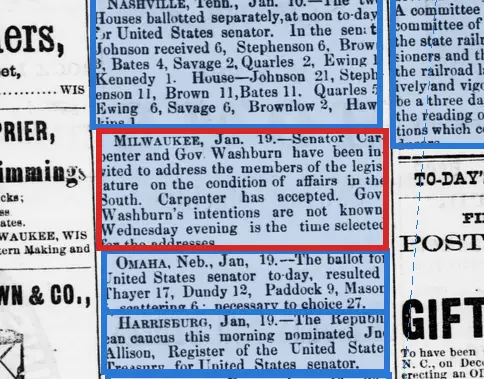
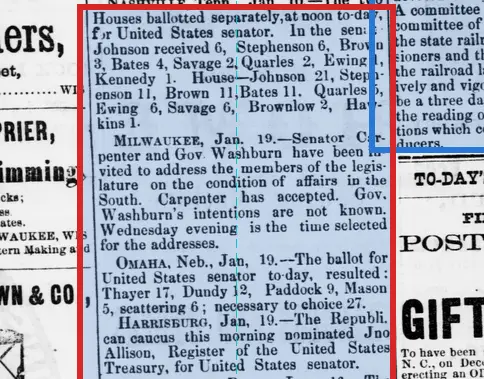
MILWAUKEE, Jan. 19.-Senator Carpenter and Gov. Washburn have been invited to address the members of the legislature on the condition of affairs in the South. Carpenter has accepted. Gov. Washburn's intentions are not known. Wednesday evening is the time selected for the addresses.American Stories
l.MILWAUKEE, Jan. 19.-Senator Car penter and Gov Washburn have been In I yited to address the members OF the legls' | lature on the condition OF affairs In the South. Carpenter has accepted, UoV' Washburn's intentions are not known; e Wednesday evening is the time selecteo nd for the addresses.
in N ours : 1 ASsnewpapers rightdomestic_news ↔ AS #14 p1-26 inside AS's merged article, decided by p1-24
snewpapers
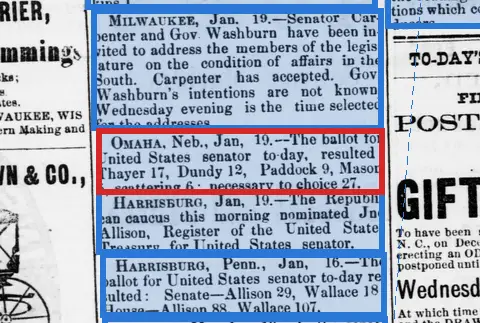
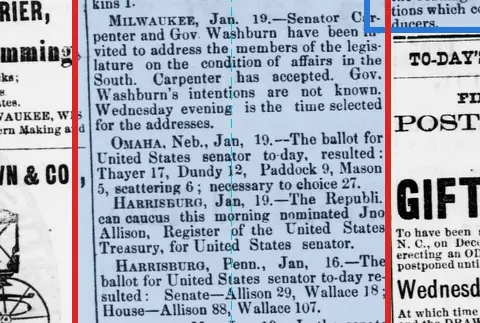
OMAHA, Neb., Jan, 19.--The ballot for United States senator to-day, resulted: Thayer 17, Dundy 12, Paddock 9, Mason 5, scattering 6; necessary to choice 27.American Stories
OMAHA Neb., Jan, 19.--The ballot for United States senator to-day, resulted Thayer II, Dundy u, Paddock y, Mason y 5, scattering 6; necessary to ShoiGe ~.in N ours : 1 ASsnewpapers rightdomestic_news ↔ AS #14 p1-27 inside AS's merged article, decided by p1-24
snewpapers
HARRISBURG, Jan, 19.—The Republican caucus this morning nominated Jno Allison, Register of the United States Treasury, for United States senator.American Stories
,rHARRIsBURG, Jan, l9-The Republi. can caucus this morning nominated Jno Allison, Register of the United States Treasury, for United States senator.
in N ours : 1 ASsnewpapers rightdomestic_news ↔ AS #14 p1-28 inside AS's merged article, decided by p1-24
snewpapers
HARRISBURG, Penn., Jan, 16.—The ballot for United States senator to-day resulted: Senate-Allison 29, Wallace 18; House—Allison 88, Wallace 107.American Stories
HARRISBURG, Penn, Jan, l6:-The ballot for United States senator to-day re- suited: Senate-Allison 29, Wallace le;House-Allison 8S, Wallace
in N ours : 1 ASsnewpapers rightdomestic_news ↔ AS #14 p1-29 inside AS's merged article, decided by p1-24
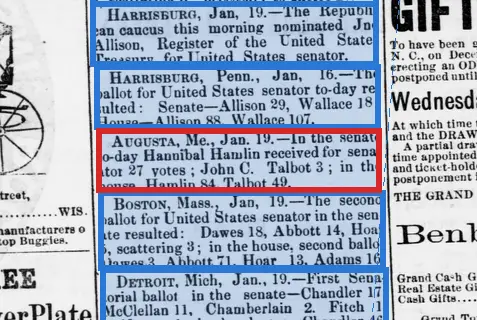
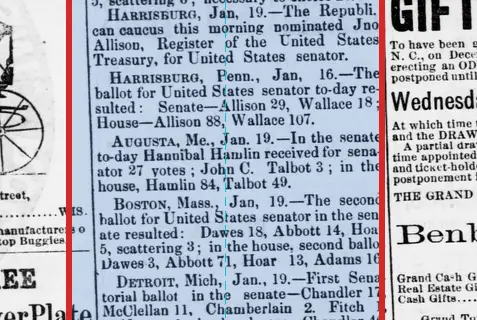
snewpapers
AUGUSTA, Me., Jan. 19.—In the senate to-day Hannibal Hamlin received for senator 27 votes ; John C. Talbot 3; in the house, Hamlin 84, Talbot 49.American Stories
lO7.AUGUSTA, Me-, Jan. 19.-1n the senate TO-DAY Hannibal Hamlin received for sena-
ato1 II votes John G. Talbot 3; in the
house, Hamlin "a, Talbot
in N ours : 1 ASsnewpapers rightdomestic_news ↔ AS #14 p1-30 inside AS's merged article, decided by p1-24
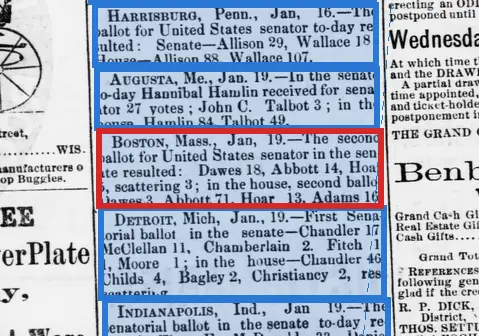
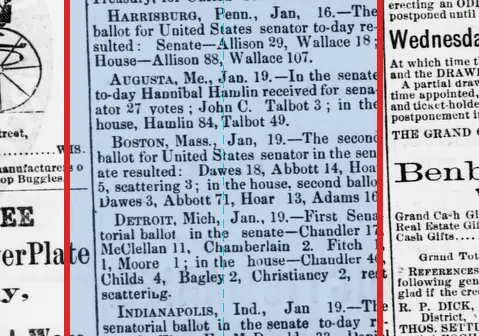
snewpapers
BOSTON, Mass., Jan, 19.—The second ballot for United States senator in the senate resulted: Dawes 18, Abbott 14, Hoar 5, scattering 3; in the house, second ballot Dawes 3, Abbott 71, Hoar 13, Adams 16.American Stories
AZ.,,o BosToN, Mass, Jan, 19.-The second 'io' ballot for United States senator in the SEN 's o ate resulted Dawes Is, Abbott IA, Hoar IL 5, scattering 3; in the house. second ballot
Dawes 3, Abbott II, Hoar l3, Adams
in N ours : 1 ASsnewpapers rightdomestic_news ↔ AS #14 p1-31 inside AS's merged article, decided by p1-24
snewpapers
DETROIT, Mich., Jan., 19.—First Senatorial ballot in the senate-Chandler 17, McClellan 11, Chamberlain 2. Fitch 1, 1, Moore 1; in the house-Chandler 46, Childs 4, Bagley 2, Christiancy 2, rest scatteringAmerican Stories
10.DETROIT, Mich, JAN, l9.-First Sena-
torial ballot in the senate-Chandler l I, TO Mcclellan IL. Chamberlain 2; Fitch l UO Moore |; in the house-Chandler 46
Childs 4, Bagley 2, Christiancy 2, res
scattering.
in N ours : 1 ASsnewpapers rightdomestic_news ↔ AS #14 p1-32 inside AS's merged article, decided by p1-24
snewpapers
INDIANAPOLIS, Ind., Jan 19.-The senatorial ballot in the senate to-day resulted; Thos E. McDonald 33, Daniel D. Pratt 15, Thompson 7, Buchanan 4, Holman 1; House—McDonald 53, Pratt 26, rest scattering. This elects McDonald.American Stories
INDIANAPOLIS. Ind, Jan 19.-Thsenatorial ballot in the senate to-day re re-. suited; Thos Z. Mcdonald 33, DAME
d. Pratt Is, Thompson 7, Buchanan
Holman l /; House-McDouald 53: Prat
26, rest scattering. This elects McDoI &c.
in N ours : 1 ASsnewpapers rightdomestic_news ↔ AS #14 p1-33 inside AS's merged article, decided by p1-24
snewpapers
MADISON, Wis., Jan. 19.—Hon. E. W. Keyes, chairman of the Republican state central committee, telegraphed to the Chicago Inter-Ocean last night that Carpenter's election is now certain.American Stories
aid. " rC1 MADISON, Wis, Jan. 19-Hon. Il. " NU Keyes, chairman of the Republican stacentral committee, telegraphed to the Ch KEE' cago Inter Ocean last night that Carpe ors o.; ter's election is now certain.
in N ours : 1 ASsnewpapers rightdomestic_news ↔ AS #14 p1-34 inside AS's merged article, decided by p1-24
snewpapers
ST. LOUIS, Mo., Jan. 19.—The vote in the general assembly for United States senator to-day, was as follows: Senate - Cockerell 32, Parker 6. House-Cockerell 93, Schurz 5, Parker 22, Shields 1.American Stories
ST. LOUIS. Mo-, Jan. l9.-The vote ..,. the general assembly for United Stat 7 years senator to- day, was as follows Senate ID WIG Cockerell 32, Parker 6. House-Cocker horA %, Schurz s. Parker %, Shields l.in N ours : 1 ASsnewpapers rightdomestic_news ↔ AS #14 p1-35 inside AS's merged article, decided by p1-24
snewpapers
ALBANY, Jan. 19.-The vote to-day in the legislature for United States senator resulted as follows: Senate-E. D. Morgan 17, Francis Kernan 13. Assembly—E. D. Morgan, 52, Francis Kernan 71.American Stories
ALBANY, Jan. 19.-The vote to-day in use the legislature for United States sena = .nd resulted as follows: Senate-E D. M = Teeth pan II. Francis Herman l3. Assembly+. d. Morgan, SO, Francis Herman
in N ours : 1 ASsnewpapers rightdomestic_news ↔ AS #14 p1-36 inside AS's merged article, decided by p1-24
snewpapers
PAWTUCKET, R. I., Jan. 19.—The general assembly had two ballots to-day for United States senator, without result.American Stories
IL.PAwTUCKET, R. l., Jan. 19.-The g Worm. eral assembly had two ballots to-day ions OF United States senator, without result.
in N ours : 1 ASsnewpapers rightdomestic_news ↔ AS #14 p1-37 inside AS's merged article, decided by p1-24
snewpapers
TRENTON, N. J., Jan. 19.—Gov. Bedle was inaugurated to-day. In his address he says: "There has been too much interference by United States military and federal marshals in the work of restoration, and too little moral support in the national government at the South for herself to rehabilitate."American Stories
TRENTON, n. j., Jan. 19.-Gov. Bewas inaugurated to-day. in his addr lie Hair, he saws: "There has been too much he9; Iterference by United States military Unu Sem o'' federal marshals in the work OF restt - tion, and too little moral support IN the ae,a for tioual government at the South for her Winter to rehabilitate.
in N ours : 1 ASsnewpapers rightdomestic_news ↔ AS #14 p1-38 inside AS's merged article, decided by p1-24
snewpapers
NEW YORK, Jan. 19.—A meeting of the Union League Club was held last evening to take action in regard to the Louisiana question. There was a great deal of spirited discussion but no result was reached other than the laying of the whole matter on the table.American Stories
ne Ieorsss 9es NEw YORK, Jan. ia meeting of d. our ITn;on League Club was held last ever 'een the to take action in regard to the Louis exceed question There was great deal OF sp lents, re ed discussion but no result was reae e. e.voung other than the laying OF the whole ma to maks on the tablein N ours : 1 ASsnewpapers rightdomestic_news ↔ AS #14 p1-39 inside AS's merged article, decided by p1-24
snewpapers
At a meeting of the Republican central committee to-night resolutions were adopted sustaining the action of President Grant in the Louisiana matter.American Stories
ing busi At a meeting of the Republican Gel rinb committee tonight resolutions were az ) to work ed sustaining the actieR Ut PRESIDENT u ESTs s1s0iIS an" in the Louisiana matter.in N ours : 1 ASsnewpapers rightdomestic_news ↔ AS #14 p1-40 inside AS's merged article, decided by p1-24
snewpapers
CHICAGO, Jan. 19.—Mr. B. F. Allen, President and holder of two-thirds of the stock of the Cook county National Bank, the failure of which was announced this morning, stated to a reporter this afternoon that he has a large amount of property which will all be turned over to the creditors of the bank if necessary to meet their demands. Mr. Allen has also a private bank at Des Moines, is President of the State National Bank of the same city, and head of a house in New York. Mr. Allen will soon start for Des Moines to meet his responsibilities there. It will require several days to make out statements of the assets and liabilities.American Stories
,ody can CHICAGO, Jan. 19.-Mr b. r. A 3 at ono. President and holder of two thirds OF Address took of the Cook county National b 20, Ill. the failure of which was announcedmorning, stated to a reporter this
w erty which will all be turned over t
Is creditors Of the bank if necessary to - their demands. Mr.. Allen has also
yate bank at Des Moines, is Preslde'
the State National Bank of the
city. aud head of house in New =;
nj MIR. Allen will soon start tor Des NJ
" to meet his responsibilities there
& will require several days to make = statements of the assets and lab \ e DEs
1 ours : N ASsnewpapers rightdomestic_news ↔ AS #14, AS #3 p1-41
- stated first: several components (American Stories): snewpapers right (said one): The second piece is just a garbled repeat/continuation of the first story's closing sentence, not a separate printed item; the whole passage is one news article about the bank suspension.
- stated first: one component (snewpapers): snewpapers right (said one): The second passage is just a garbled OCR repetition/continuation of the first news item about the bank suspension; both pieces belong to the same article.
snewpapers
DES MOINES, Jan, 19.—The announcement of the suspension of the Cook County National Bank, of Chicago, caused great regret and surprise in this city, the former home of its President, B. F. Allen. There was a general feeling of confidence in Mr. Allen's ability to meet in full all indebtedness, and this faith was also expressed by resolutions passed at a meeting of business men called for the purpose. Allen's private bank closed as a matter of precaution, but two other banks, of which he is President, remained open as usual.American Stories
DEs MONIES, Jan, l9.-The anne v " ment Of the suspension OF the Cookty National Bank, of Chicago, caused tR J regret and surprise in this city, the
er home of its President, b: i. NTH. There was general feeling OF cont s ,s 9nekte @ WsS 70 in Mr. Aliens ability to meet In ing, thus re- Indebtedness, and this faith was al dssonnset ans pressed by resolutions passed at style OF sns- ing OF business men odieu All IN SIX ! aostoo SS;, q matter of precaution, but two
banks. of which he is President, remained omen as usual.
banks. of which he is President, remained open as usual.
- the pieces asked about (American Stories):
- [1] AS #14: begins: "DEs MONIES, Jan, l9.-The anne v " ment Of the suspension OF the Cook ty" … ends: "business men odieu All IN SIX ! aostoo SS;, q matter of precaution, but two"
- [2] AS #3: begins: "banks. of which he is President, remained omen as usual. banks. of which he is" … ends: "President, remained omen as usual. banks. of which he is President, remained open as usual."
N ours : 1 ASsnewpapers rightdomestic_news, domestic_news, domestic_news, domestic_news, domestic_news, domestic_news, domestic_news, domestic_news ↔ AS #3 p1-42
- stated first: one component (American Stories): snewpapers right (said several): The passage consists of distinct news items, each a separate brief with its own dateline and topic (a broker's failure, a train wreck, an accident, two obituaries, two fires, and a farmers' convention); these are independent components, not continuations of one another.
- stated first: several components (snewpapers): snewpapers right (said several): The passage consists of eight distinct, separately datelined news items (broker failure, railroad accident, well accident, two obituaries, two fires, and a farmers' convention), each a separate printed item rather than one continued story.
snewpapers
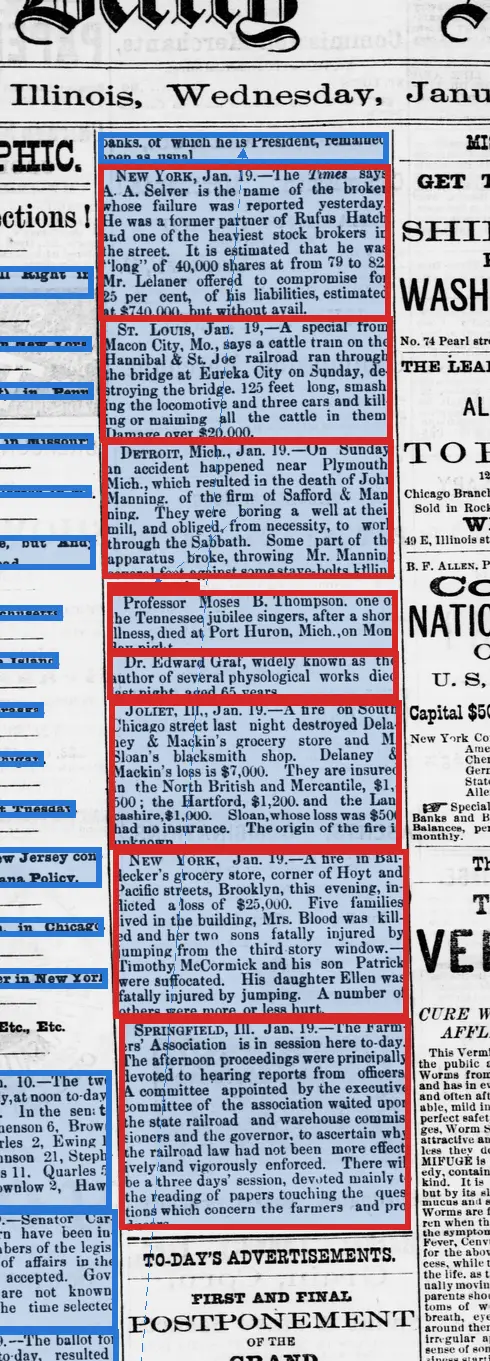
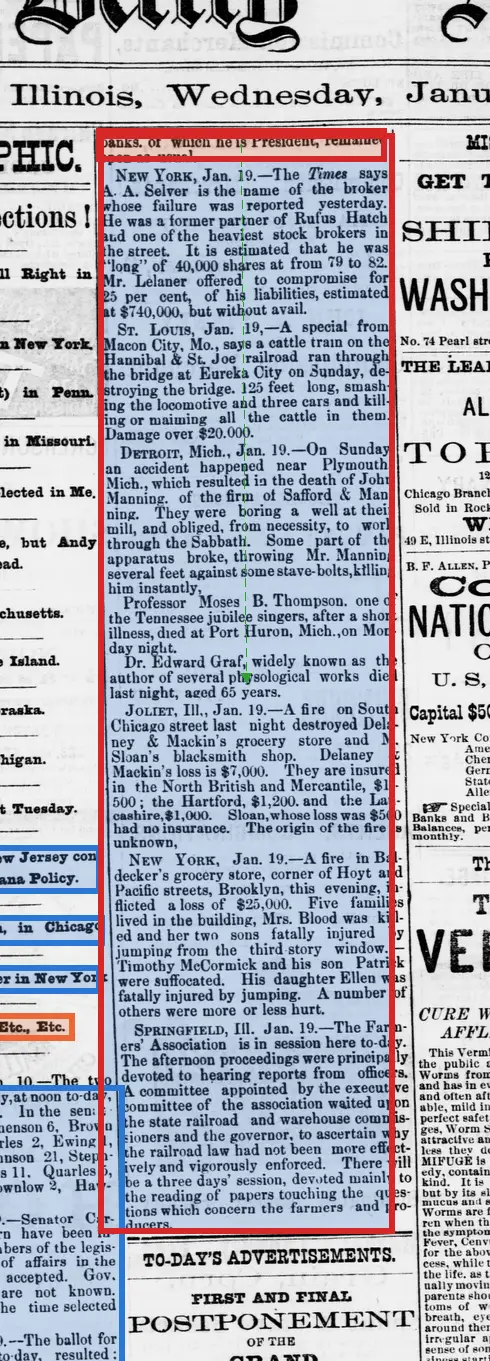
NEW YORK, Jan. 19.—The Times says A. A. Selver is the name of the broker whose failure was reported yesterday. He was a former partner of Rufus Hatch and one of the heaviest stock brokers in the street. It is estimated that he was "long" of 40,000 shares at from 79 to 82. Mr. Lelaner offered to compromise for 25 per cent, of his liabilities, estimated at $740,000, but without avail.ST. LOUIS, Jan. 19,—A special from Macon City, Mo., says a cattle train on the Hannibal & St. Joe railroad ran through the bridge at Eureka City on Sunday, destroying the bridge. 125 feet long, smashing the locomotive and three cars and killing or maiming all the cattle in them. Damage over $20,000.
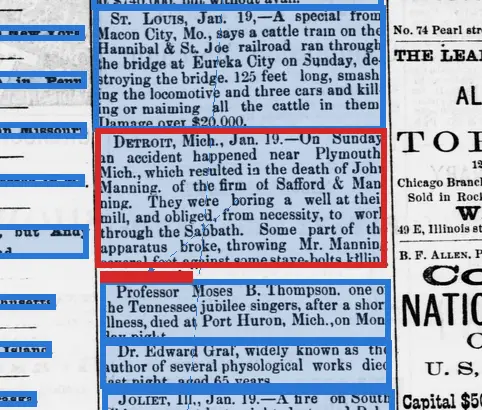
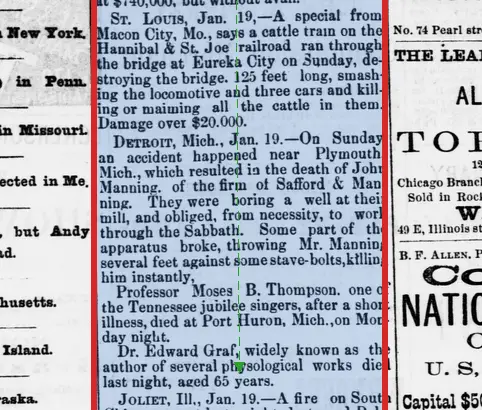
DETROIT, Mich., Jan. 19.—On Sunday an accident happened near Plymouth. Mich., which resulted in the death of John Manning. of the firm of Safford & Manning. They were boring a well at their mill, and obliged, from necessity, to work through the Sabbath. Some part of the apparatus broke, throwing Mr. Manning several feet against some stave-bolts, killing him instantly.
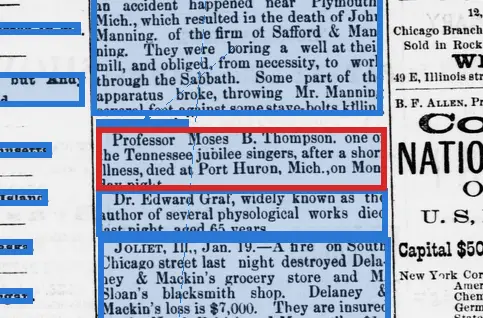
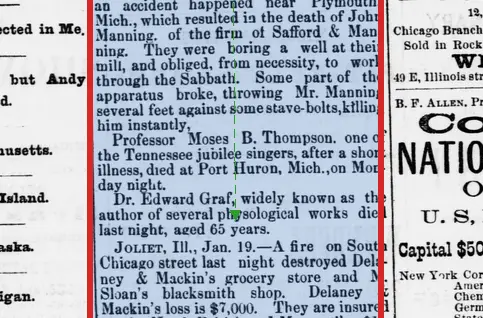
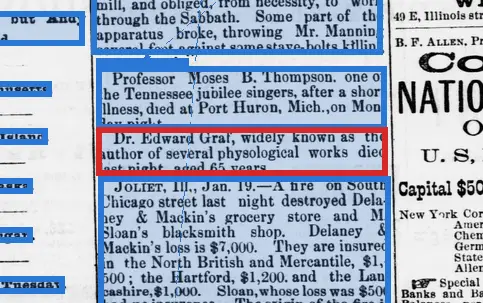
Professor Moses B. Thompson. one of the Tennessee jubilee singers, after a short illness, died at Port Huron, Mich.,on Monday night.
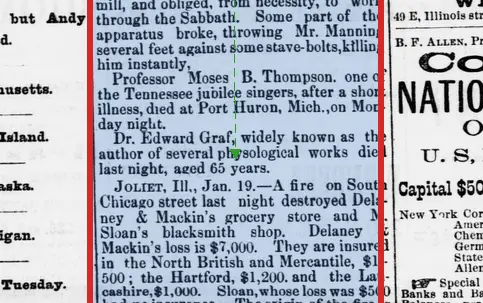
Dr. Edward Graf, widely known as the author of several physiological works died last night, aged 65 years.
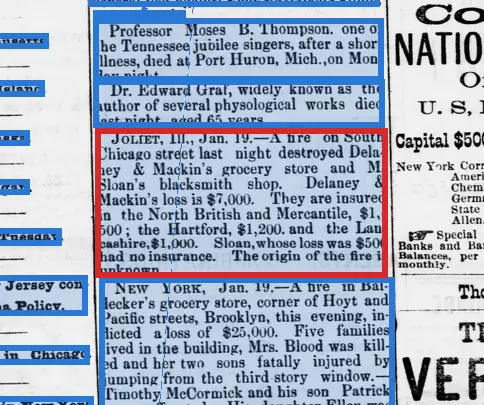
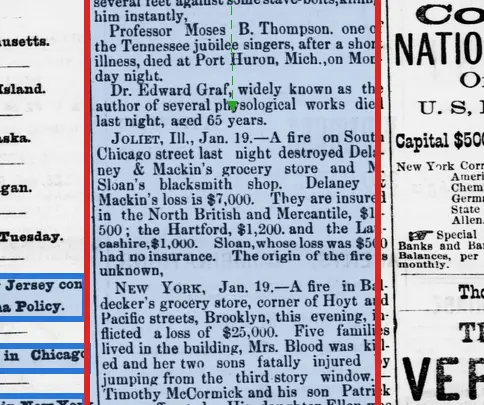
JOLIET, Ill., Jan. 19.—A fire on South Chicago street last night destroyed Delaney & Mackin's grocery store and M. Sloan's blacksmith shop. Delaney & Mackin's loss is $7,000. They are insured in the North British and Mercantile, $1,500; the Hartford, $1,200. and the Lancashire,$1,000. Sloan, whose loss was $500 had no insurance. The origin of the fire is unknown,
NEW YORK, Jan. 19.—A fire in Baldecker's grocery store, corner of Hoyt and Pacific streets, Brooklyn, this evening, inflicted a loss of $25,000. Five families lived in the building, Mrs. Blood was killed and her two sons fatally injured by jumping from the third-story window.— Timothy McCormick and his son Patrick were suffocated. His daughter Ellen was fatally injured by jumping. A number of others were more or less hurt.
SPRINGFIELD, Ill. Jan, 19.—The Farmers' Association is in session here to-day. The afternoon proceedings were principally devoted to hearing reports from officers. A committee appointed by the executive committee of the association waited upon the state railroad and warehouse commissioners and the governor, to ascertain why the railroad law had not been more effectually and vigorously enforced. There will be a three days' session, devoted mainly to the reading of papers touching the questions which concern the farmers and producers.
American Stories
banks. of which he is President, remained omen as usual.banks. of which he is President, remained open as usual.
New YORK, Jan. l9.-The Times says A. A. Solver is the name of the broker whose failure was reported yesterday. He was former partner of Rutus Hatch and one of the heaviest stock brokers In the street. 1t is estimated that he was LONG of 10000 shares at from ~ to S2. Mr.. Lelaner offered to compromise for 25 per cent, of his liabilities, estimated at $74O, 200. but without avail.
ST. LOUIS, Jan. ia special from Macon City, Mo-, says cattle tram on the Hannibal & St. Joe railroad ran through the bridge at Eureka City on Sunday, de- stroying the bridge. l25 feet long, smash ing the locomotive and three cars and kill ing or manning all the cattle in them. Damage over $4,000.
DETROIT, Mich, Jan. l9.-On Sunday an accident happened near Plymouth. Mich. which resulted in the death of John Manning. of the firm OF Stafford Il Man ming. They we're boring we'll at their mill, and obliged, from necessity, to work through the Sabbath. Some part of the apparatus broke, throwing MIR. Manning several feet against some stave- bolts, killing him instantly,
Professor Moses B. Thompson. one Of the Tennessee jubilee singers, after short illness. died at Port Huron, Mich ,on Mon. day night.
DR.. Edward Graf, widely known as the author of several physiological works dice last night, aged IS years.
JOLIET. ILL.,, Jan. ia fire on Soutf Chicago street last night destroyed Della ney & Mackins grocery store and N lSloan's blacksmith shop. Delaney 4 Mackin's loss is $1,000. They are insure' lin the North British and Mercantile, 81, 500; the Hartford, 81, 200. and the Ian cashire, 81 900. Sloan, whose loss was $50
had no insurance. The origin of the fire
unknown,
New YORK, Jan. 19.-A fire in Ba
decker's grocery store, corner OF Hoyt an
Pacific streets, Brooklyn, this evening, il
hicted loss of $4,000. Five famllie lived in the building, Mrs. Blood was xii
ed and her two sons fatally injured 3 jumping from the third story window. lTimothy Mccormick and his son Patric K we're suffocated. His daughter Ellen W;
fatally injured by jumping. A number
others were more or less hurt.
SPRINGFIELD, Ill. Jan, 19.--The Farr
ers' Association is in session here to- da
The afternoon proceedings were principal W devoted to hearing reports from officer " A committee appointed by the executi : committee of the association waited up w the state railroad and warehouse comm ! sioners and the governor, to ascertain vi h, the railroad law had not been more effe : lively and vigorously enforced. There " v. " be three days session, devoted mainly
the reading of papers touching the qu
tions which concern the farmers and p - ducers.
- the pieces asked about (snewpapers):
- [1] domestic_news: begins: "NEW YORK, Jan. 19.—The Times says A. A. Selver is the name of the broker" … ends: "to compromise for 25 per cent, of his liabilities, estimated at $740,000, but without avail."
- [2] domestic_news: begins: "ST. LOUIS, Jan. 19,—A special from Macon City, Mo., says a cattle train on the" … ends: "and three cars and killing or maiming all the cattle in them. Damage over $20,000."
- [3] domestic_news: begins: "DETROIT, Mich., Jan. 19.—On Sunday an accident happened near Plymouth. Mich., which resulted in the" … ends: "of the apparatus broke, throwing Mr. Manning several feet against some stave-bolts, killing him instantly."
- [4] domestic_news: begins: "Professor Moses B. Thompson. one of the Tennessee jubilee singers, after a short illness, died" … ends: "the Tennessee jubilee singers, after a short illness, died at Port Huron, Mich.,on Monday night."
- [5] domestic_news: begins: "Dr. Edward Graf, widely known as the author of several physiological works died last night," … ends: "widely known as the author of several physiological works died last night, aged 65 years."
- [6] domestic_news: begins: "JOLIET, Ill., Jan. 19.—A fire on South Chicago street last night destroyed Delaney & Mackin's" … ends: "Sloan, whose loss was $500 had no insurance. The origin of the fire is unknown,"
- [7] domestic_news: begins: "NEW YORK, Jan. 19.—A fire in Baldecker's grocery store, corner of Hoyt and Pacific streets," … ends: "Ellen was fatally injured by jumping. A number of others were more or less hurt."
- [8] domestic_news: begins: "SPRINGFIELD, Ill. Jan, 19.—The Farmers' Association is in session here to-day. The afternoon proceedings were" … ends: "mainly to the reading of papers touching the questions which concern the farmers and producers."
Text agreement inside AS's merged article (8 pieces): the merged article's text cut where our components begin and end; American Stories draws no boundary there, so these are no matches.
p1-43 domestic_news
snewpapers
NEW YORK, Jan. 19.—The Times says A. A. Selver is the name of the broker whose failure was reported yesterday. He was a former partner of Rufus Hatch and one of the heaviest stock brokers in the street. It is estimated that he was "long" of 40,000 shares at from 79 to 82. Mr. Lelaner offered to compromise for 25 per cent, of his liabilities, estimated at $740,000, but without avail.American Stories (slice of #3)
New YORK, Jan. l9.-The Times says A. A. Solver is the name of the broker whose failure was reported yesterday. He was former partner of Rutus Hatch and one of the heaviest stock brokers In the street. 1t is estimated that he was LONG of 10000 shares at from ~ to S2. Mr.. Lelaner offered to compromise for 25 per cent, of his liabilities, estimated at $74O, 200. but without avail.p1-44 domestic_news
snewpapers
ST. LOUIS, Jan. 19,—A special from Macon City, Mo., says a cattle train on the Hannibal & St. Joe railroad ran through the bridge at Eureka City on Sunday, destroying the bridge. 125 feet long, smashing the locomotive and three cars and killing or maiming all the cattle in them. Damage over $20,000.American Stories (slice of #3)
ST. LOUIS, Jan. ia special from Macon City, Mo-, says cattle tram on the Hannibal & St. Joe railroad ran through the bridge at Eureka City on Sunday, de- stroying the bridge. l25 feet long, smash ing the locomotive and three cars and kill ing or manning all the cattle in them. Damage over $4,000.p1-45 domestic_news
snewpapers
DETROIT, Mich., Jan. 19.—On Sunday an accident happened near Plymouth. Mich., which resulted in the death of John Manning. of the firm of Safford & Manning. They were boring a well at their mill, and obliged, from necessity, to work through the Sabbath. Some part of the apparatus broke, throwing Mr. Manning several feet against some stave-bolts, killing him instantly.American Stories (slice of #3)
DETROIT, Mich, Jan. l9.-On Sunday an accident happened near Plymouth. Mich. which resulted in the death of John Manning. of the firm OF Stafford Il Man ming. They we're boring we'll at their mill, and obliged, from necessity, to work through the Sabbath. Some part of the apparatus broke, throwing MIR. Manning several feet against some stave- bolts, killing him instantly,p1-46 domestic_news
snewpapers
Professor Moses B. Thompson. one of the Tennessee jubilee singers, after a short illness, died at Port Huron, Mich.,on Monday night.American Stories (slice of #3)
Professor Moses B. Thompson. one Of the Tennessee jubilee singers, after short illness. died at Port Huron, Mich ,on Mon. day night.p1-47 domestic_news
snewpapers
Dr. Edward Graf, widely known as the author of several physiological works died last night, aged 65 years.American Stories (slice of #3)
DR.. Edward Graf, widely known as the author of several physiological works dice last night, aged IS years.p1-48 domestic_news
had no insurance. The origin of the fire
unknown,
snewpapers
JOLIET, Ill., Jan. 19.—A fire on South Chicago street last night destroyed Delaney & Mackin's grocery store and M. Sloan's blacksmith shop. Delaney & Mackin's loss is $7,000. They are insured in the North British and Mercantile, $1,500; the Hartford, $1,200. and the Lancashire,$1,000. Sloan, whose loss was $500 had no insurance. The origin of the fire is unknown,American Stories (slice of #3)
JOLIET. ILL.,, Jan. ia fire on Soutf Chicago street last night destroyed Della ney & Mackins grocery store and N lSloan's blacksmith shop. Delaney 4 Mackin's loss is $1,000. They are insure' lin the North British and Mercantile, 81, 500; the Hartford, 81, 200. and the Ian cashire, 81 900. Sloan, whose loss was $50had no insurance. The origin of the fire
unknown,
p1-49 domestic_news
decker's grocery store, corner OF Hoyt an
Pacific streets, Brooklyn, this evening, il
hicted loss of $4,000. Five famllie lived in the building, Mrs. Blood was xii
ed and her two sons fatally injured 3 jumping from the third story window. lTimothy Mccormick and his son Patric K we're suffocated. His daughter Ellen W;
fatally injured by jumping. A number
others were more or less hurt.
snewpapers
NEW YORK, Jan. 19.—A fire in Baldecker's grocery store, corner of Hoyt and Pacific streets, Brooklyn, this evening, inflicted a loss of $25,000. Five families lived in the building, Mrs. Blood was killed and her two sons fatally injured by jumping from the third-story window.— Timothy McCormick and his son Patrick were suffocated. His daughter Ellen was fatally injured by jumping. A number of others were more or less hurt.American Stories (slice of #3)
New YORK, Jan. 19.-A fire in Badecker's grocery store, corner OF Hoyt an
Pacific streets, Brooklyn, this evening, il
hicted loss of $4,000. Five famllie lived in the building, Mrs. Blood was xii
ed and her two sons fatally injured 3 jumping from the third story window. lTimothy Mccormick and his son Patric K we're suffocated. His daughter Ellen W;
fatally injured by jumping. A number
others were more or less hurt.
p1-50 domestic_news
ers' Association is in session here to- da
The afternoon proceedings were principal W devoted to hearing reports from officer " A committee appointed by the executi : committee of the association waited up w the state railroad and warehouse comm ! sioners and the governor, to ascertain vi h, the railroad law had not been more effe : lively and vigorously enforced. There " v. " be three days session, devoted mainly
the reading of papers touching the qu
tions which concern the farmers and p - ducers.
snewpapers
SPRINGFIELD, Ill. Jan, 19.—The Farmers' Association is in session here to-day. The afternoon proceedings were principally devoted to hearing reports from officers. A committee appointed by the executive committee of the association waited upon the state railroad and warehouse commissioners and the governor, to ascertain why the railroad law had not been more effectually and vigorously enforced. There will be a three days' session, devoted mainly to the reading of papers touching the questions which concern the farmers and producers.American Stories (slice of #3)
SPRINGFIELD, Ill. Jan, 19.--The Farrers' Association is in session here to- da
The afternoon proceedings were principal W devoted to hearing reports from officer " A committee appointed by the executi : committee of the association waited up w the state railroad and warehouse comm ! sioners and the governor, to ascertain vi h, the railroad law had not been more effe : lively and vigorously enforced. There " v. " be three days session, devoted mainly
the reading of papers touching the qu
tions which concern the farmers and p - ducers.
in N ours : 1 ASsnewpapers rightdomestic_news ↔ AS #3 p1-43 inside AS's merged article, decided by p1-42
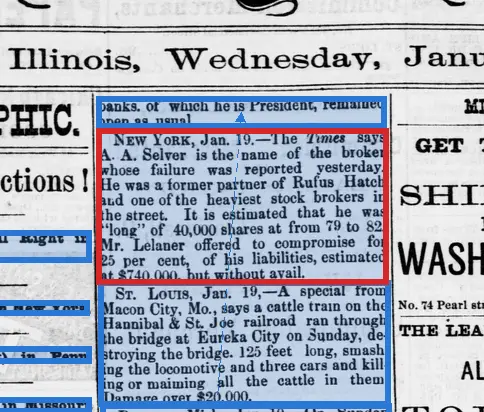
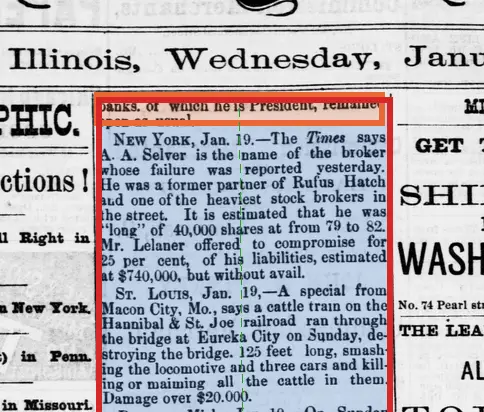
snewpapers
NEW YORK, Jan. 19.—The Times says A. A. Selver is the name of the broker whose failure was reported yesterday. He was a former partner of Rufus Hatch and one of the heaviest stock brokers in the street. It is estimated that he was "long" of 40,000 shares at from 79 to 82. Mr. Lelaner offered to compromise for 25 per cent, of his liabilities, estimated at $740,000, but without avail.American Stories
New YORK, Jan. l9.-The Times says A. A. Solver is the name of the broker whose failure was reported yesterday. He was former partner of Rutus Hatch and one of the heaviest stock brokers In the street. 1t is estimated that he was LONG of 10000 shares at from ~ to S2. Mr.. Lelaner offered to compromise for 25 per cent, of his liabilities, estimated at $74O, 200. but without avail.in N ours : 1 ASsnewpapers rightdomestic_news ↔ AS #3 p1-44 inside AS's merged article, decided by p1-42
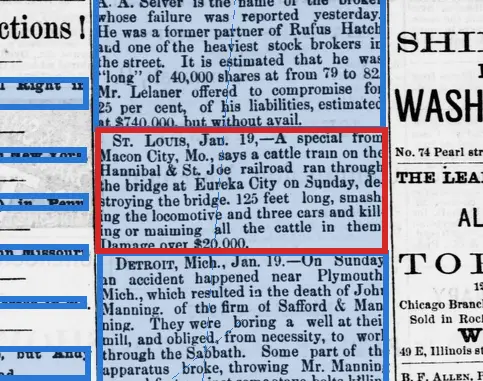
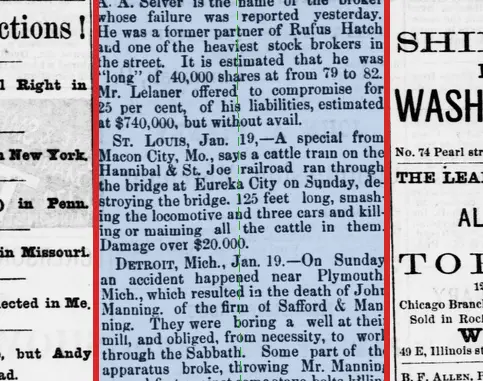
snewpapers
ST. LOUIS, Jan. 19,—A special from Macon City, Mo., says a cattle train on the Hannibal & St. Joe railroad ran through the bridge at Eureka City on Sunday, destroying the bridge. 125 feet long, smashing the locomotive and three cars and killing or maiming all the cattle in them. Damage over $20,000.American Stories
ST. LOUIS, Jan. ia special from Macon City, Mo-, says cattle tram on the Hannibal & St. Joe railroad ran through the bridge at Eureka City on Sunday, de- stroying the bridge. l25 feet long, smash ing the locomotive and three cars and kill ing or manning all the cattle in them. Damage over $4,000.in N ours : 1 ASsnewpapers rightdomestic_news ↔ AS #3 p1-45 inside AS's merged article, decided by p1-42
snewpapers
DETROIT, Mich., Jan. 19.—On Sunday an accident happened near Plymouth. Mich., which resulted in the death of John Manning. of the firm of Safford & Manning. They were boring a well at their mill, and obliged, from necessity, to work through the Sabbath. Some part of the apparatus broke, throwing Mr. Manning several feet against some stave-bolts, killing him instantly.American Stories
DETROIT, Mich, Jan. l9.-On Sunday an accident happened near Plymouth. Mich. which resulted in the death of John Manning. of the firm OF Stafford Il Man ming. They we're boring we'll at their mill, and obliged, from necessity, to work through the Sabbath. Some part of the apparatus broke, throwing MIR. Manning several feet against some stave- bolts, killing him instantly,in N ours : 1 ASsnewpapers rightdomestic_news ↔ AS #3 p1-46 inside AS's merged article, decided by p1-42
snewpapers
Professor Moses B. Thompson. one of the Tennessee jubilee singers, after a short illness, died at Port Huron, Mich.,on Monday night.American Stories
Professor Moses B. Thompson. one Of the Tennessee jubilee singers, after short illness. died at Port Huron, Mich ,on Mon. day night.in N ours : 1 ASsnewpapers rightdomestic_news ↔ AS #3 p1-47 inside AS's merged article, decided by p1-42
snewpapers
Dr. Edward Graf, widely known as the author of several physiological works died last night, aged 65 years.American Stories
DR.. Edward Graf, widely known as the author of several physiological works dice last night, aged IS years.in N ours : 1 ASsnewpapers rightdomestic_news ↔ AS #3 p1-48 inside AS's merged article, decided by p1-42
snewpapers
JOLIET, Ill., Jan. 19.—A fire on South Chicago street last night destroyed Delaney & Mackin's grocery store and M. Sloan's blacksmith shop. Delaney & Mackin's loss is $7,000. They are insured in the North British and Mercantile, $1,500; the Hartford, $1,200. and the Lancashire,$1,000. Sloan, whose loss was $500 had no insurance. The origin of the fire is unknown,American Stories
JOLIET. ILL.,, Jan. ia fire on Soutf Chicago street last night destroyed Della ney & Mackins grocery store and N lSloan's blacksmith shop. Delaney 4 Mackin's loss is $1,000. They are insure' lin the North British and Mercantile, 81, 500; the Hartford, 81, 200. and the Ian cashire, 81 900. Sloan, whose loss was $50had no insurance. The origin of the fire
unknown,
in N ours : 1 ASsnewpapers rightdomestic_news ↔ AS #3 p1-49 inside AS's merged article, decided by p1-42
snewpapers
NEW YORK, Jan. 19.—A fire in Baldecker's grocery store, corner of Hoyt and Pacific streets, Brooklyn, this evening, inflicted a loss of $25,000. Five families lived in the building, Mrs. Blood was killed and her two sons fatally injured by jumping from the third-story window.— Timothy McCormick and his son Patrick were suffocated. His daughter Ellen was fatally injured by jumping. A number of others were more or less hurt.American Stories
New YORK, Jan. 19.-A fire in Badecker's grocery store, corner OF Hoyt an
Pacific streets, Brooklyn, this evening, il
hicted loss of $4,000. Five famllie lived in the building, Mrs. Blood was xii
ed and her two sons fatally injured 3 jumping from the third story window. lTimothy Mccormick and his son Patric K we're suffocated. His daughter Ellen W;
fatally injured by jumping. A number
others were more or less hurt.
in N ours : 1 ASsnewpapers rightdomestic_news ↔ AS #3 p1-50 inside AS's merged article, decided by p1-42
snewpapers
SPRINGFIELD, Ill. Jan, 19.—The Farmers' Association is in session here to-day. The afternoon proceedings were principally devoted to hearing reports from officers. A committee appointed by the executive committee of the association waited upon the state railroad and warehouse commissioners and the governor, to ascertain why the railroad law had not been more effectually and vigorously enforced. There will be a three days' session, devoted mainly to the reading of papers touching the questions which concern the farmers and producers.American Stories
SPRINGFIELD, Ill. Jan, 19.--The Farrers' Association is in session here to- da
The afternoon proceedings were principal W devoted to hearing reports from officer " A committee appointed by the executi : committee of the association waited up w the state railroad and warehouse comm ! sioners and the governor, to ascertain vi h, the railroad law had not been more effe : lively and vigorously enforced. There " v. " be three days session, devoted mainly
the reading of papers touching the qu
tions which concern the farmers and p - ducers.
AS onlycorrectly not servedAS #13 p1-51
- advertisement: It is a paid medical/physician notice promoting consultation services, a health guide for sale, and includes prices and contact information—clearly commercial advertising.
snewpapers
nothingAmerican Stories
AVOID oUAcKs AND IMPoSTERSNo CHARGE FOR ADVICE AND CONSULTATION,
nrJB Dvott. graduate If Jefferson College, PHILADELPHIA authCr OF several valuable works. can lie consulted on all diseases of Sexual or Urinary Organs (which he ha- made an especial study e;t6er in male or female, no matter from what cause originating or of how long standing. prac- tice of 80 years enables him to treat diseases with success Cures guaranteed Charges reason bile. Those at distance can forward letter describing symptoms and enclosing stamp to prepay postage. Send.for the GUIDE TO HEALTH. Price 10 cents.
J. BDYOTT, NJ D. Physician and Surgeon t04 Duane Street, New YORK.
AS only, no textno text, not askedAS #65 p1-52
snewpapers
nothingAmerican Stories
nothingPage 2
1 ours : N ASsnewpapers rightdomestic_news ↔ AS #22 (p. 2), AS #4 (p. 2), AS #4 (p. 3), AS #23 (p. 4) p2-1 continued in p3-1, p4-61
- stated first: one component (snewpapers): snewpapers right (said one): The pieces form a single continuous article on the Louisiana usurpation meetings, with explicit continuation lines ("Continued on third page", "Continued from second page", etc.) linking each part; the headings are internal section heads, not separate components.
- stated first: several components (American Stories): snewpapers right (said one): The pieces are successive continuations of a single report on the Boston and Baltimore indignation meetings, joined by explicit jump lines ('Continued on third page', 'Concluded from third page').
snewpapers
INDIGNATION.Great Meetings in Boston and Baltimore.
It was ever known throughout the length and breadth of our land as that which was aroused by the tyrannical act of usurpation committed by Grant in Louisiana. During the past two weeks immense meetings have been held in every state, denouncing in no mealy-mouthed words the onslaught upon public liberty and the right of the people to choose their own law-makers.
The ball set in motion by the patriotic people of New York, without regard to party, has rolled over the land gathering force every day, and it is destined to utterly crush out Grant and his miserable tools of tyranny and usurpation. Governors have denounced the outrage and protested against it in proclamations to the people and in messages to legislatures. And legislatures have solemnly and formally protested against the alarming encroachment upon the liberties and rights of the people.
Among the most notable of the meetings held last week were the Faneuil Hall meeting in Boston, and the Masonic Temple meeting in Baltimore.
BOSTON.
In Faneuil Hall, that ancient cradle of liberty, the Hon. Wm. Gray, with a grand array of vice-presidents and secretaries, presided. Mr. Gray, upon taking the chair, was greeted with enthusiastic applause, and after it had subsided he proceeded to speak as follows:
FELLOW CITIZENS:-In the opening month of the centennial year in which we are to celebrate the battles of Lexington and Bunker Hill, the culmination of those long civil struggles which preceded American independence, we are called upon to take notice of a fact which has no parallel in American history. We must seek under the arbitrary tyranny of the Stuarts of England, or under the iron despotism of Oliver Cromwell, the Protector, for anything to place by the side of that outrage committed in Louisiana on the 4th day of January, 1875. It gives me great pleasure, fellow citizens, to stand in your presence in this hall on an occasion like this. No party ties are to fetter the speech of any one who addresses you to-day. (Applause.) No party fealty can put a check upon the free speech of the citizens of Massachusetts in Faneuil Hall. (Applause.) I am the more glad, fellow-citizens, that this meeting has assembled when I remember that we have two senators in congress whose voices have not been heard—(Applause)—upon this enormous outrage, and further remember that the two leading candidates for the chair of Charles Sumner are now members of the house of representatives, whose voices have been silent. (Applause.) We have been educated in Massachusetts, fellow-citizens, and I trust and feel confident that without the aid and countenance of those to whom we should naturally have looked to as our leaders, we will try to find our own way to the declaration and maintenance of the right. (Applause.)
Fellow-citizens, we all know, and it is so familiar to us that in ordinary times it makes little impression, that the houses of congress and of legislation throughout length and breadth of the land are the sole judges of the qualifications and modes of election of their own members. But we do not always remember through how much toil and struggle those principles were established. If you go back to the time of the discovery of America, and later still, to the landing at Plymouth, you will find that up to that time and within a few years of that landing the chancellor of England, acting under the direction of the King, though ostensibly not doing so, frequently unseated members of parliament by taking advantage of a short absence and ordering a new election. The story of Charles the First and his attempt to expel the five members is familiar to all, and in later days, in the struggle with Cromwell and up to the revolution of 1688, the Commons found themselves the great defenders of the rights of the people.
Severe resolutions were then read, after which the Hon. John Quincy Adams was called out.
SPEECH OF JOHN QUINCY ADAMS.
Mr. Adams was received with a warm round of applause and proceeded to address the assembly. He opened by deprecating any feeling of partisanship in connection with the subject, and affirmed that those present had gathered not as members of any party, but as citizens of the United States. He recited at length the circumstances attending the meeting of the Louisiana legislature on the 4th of January, the organization with a legal quorum, the election of a Conservative speaker, the swearing in of five Conservative members who had not received certificates of election from the returning board. The organization was a purely political contest, waged with cunning and sharpness, but no more than had been witnessed in many states of the Union, and the house of representatives of Louisiana, as thus organized, was a legal representative of the people. At this time a general officer of the United States, accompanied by soldiers, marched into the hall, and, producing an order from the governor, proceeded to remove, by force, the five members who had just been seated by the house. It is just at this point, said Mr. Adams, that I wish to arrest your attention. Do not permit yourselves to be diverted from this precise point by any declamation or sophistry. What right had soldiers of the United States to determine who should sit in the legislature of a state? It is nothing to tell me that political passions ran high in the state. It is nothing to aver that many persons had been frightened at the previous election. It is immaterial, if true, that much violence or crime, arising from political passion or prejudice of race, prevailed in the community, nor is it to the purpose even that the five members had been seated by a surprise and voted in in haste. Let it be granted, and still I ask, "What right had the United States soldiers to pass upon the election, qualifications and the return of a state?" "There can be no doubt that here was a usurpation. The constitution permits federal interference at the appeal of the executive of a state 'when the legislature cannot be convened ;' but in this case the legislature was actually sitting. But it was not merely a plain violation of the letter of the fundamental law. The whole tone of the president's message is one of excuse and justification. There is no renunciation of the very thought of such usurpation. The tone of the message is more menacing than the deed it attempts to palliate. The incident we deplore to-day is but a symptom, and such must occur until the radically false relations now existing between the government of the United States and some of the states is removed. The original federates in the Union regarded themselves as free, sovereign and independent states; free to come or not, and the central conception was that the general government was the creation of the states, not they the servants of the central government; but in consequence of the war the conquered states were saddled with the most intolerable system of government in the world. After a time, where opportunity was given, state after state threw off its tainted and incompetent rulers and placed its affairs in the hands of the competent and intelligent classes; but in several ill-starred states, and notably in South Carolina, Mississippi and Louisiana the enormous preponderance in numbers of the freedmen and the facility with which their natural fears permitted them to be led by crafty and designing adventurers, seemed to postpone indefinitely the restoration of an honest and able administration of the public trust; but such is the inherent force of the republican principle that it became daily more clear that the powers of management, struggle as they would, must eventually fall before the growing force of public opinion within and without those states. This inevitable struggle is going on, must go on, and under a republican system of government, under our old constitutional methods, under the guidance of an intelligent and an honest public opinion, it can end only in the overthrow of such governments as that of the state of Louisiana, because it is not upheld by the effective public opinion of the community. Now, if this government and others like it are to be maintained by force of the United States arms, against all legal efforts of the people to get rid of them, then this precedent which has been made in Louisiana is one eminently fit to be made and it must be speedily followed by others more stringent and effective. Did it never occur to you that the same process of reasoning feeling which now induces you in a moment of excitement to oppose a plain violation of law, may equally induce a Democratic majority, tempted and excited as you are, to accept a corresponding violation of the safeguards upon which alone you can rely to protect the freedmen from an outrage similar to that which we now contemplate. Do you think there will be a less temptation ? Then count the votes the South can throw in a Democratic convention and estimate the power which they must wield in the party councils. I do not believe that they will yield to the temptation; but I do say that you render it almost irresistible when you set them so seductive an example of successful usurpation. Mr. Adams affirmed that the constitution never contemplated that the United States should systematically maintain and prescribe governments in the states. Such work cannot be done except at the price of liberty. He referred to the usurpation of Charles the First and of Cromwell and declared that the logical and inevitable result of a tendency in the public mind to pass lightly over that which has been done in Louisiana in the general government which will sooner or later absorb all independence of the states. This arbitrary act may be defended on the ground that it seems to tend the security of the black race; but this stretch of prerogative in his behalf does him infinite injury. The great revolution in public feeling with regard to the conservatives in Louisiana of late has sprung from sympathy with their sufferings and admiration of the patience with which they have borne them. Massachusetts would not have borne the same. Let it not be erected into a precedent, for it is a precedent which, as George Washington tells you, has always proved fatal to republican government. Such precedents you have seen mark like milestones the broad and easy way which leads to Rome. We stand where the ways part. Adopt this act of the army in Louisiana and we have passed the first milestone on our way to empire. On the other hand stretches the rough and difficult path which our fathers trod. My friends, let us stand fast in the old way, to the end that, as the constitution of Massachusetts hath it, "To the end that it may be a government of laws, and not of men."
Mr. Adams's speech was frequently applauded. Hon. Francis W. Bird spoke next. He said he came as a partisan. He had been one all his life. He belonged to the party (Continued on third page.)
(Continued from second page.)
that made truth and duty its guiding star. This was a party question, and the men, whether at the white house or the custom house, who supported these outrages would go down. He belonged to the party who were going to crush the men who supported this outrage. If this passed unchallenged, farewell, a long farewell, to all our greatness as a free government. He believed the office-holders at Washington were capable of perpetuating their power by getting up a war all over the southern states. (Applause and hisses.) You say "No," he added; see that they don't do it, then.
Several other distinguished men spoke - mostly Republicans, and among them Phillips and Garrison (for they have free speech in Faneuil Hall) against the resolutions. And at the close the resolutions were adopted.
BALTIMORE.
Long before the hour for the meeting an immense concourse gathered in the vicinity of the Masonic Temple, and in a few moments after the doors were thrown open the spacious hall was filled to its utmost capacity. The floor presented the appearance of a compact mass of human heads, while the doorways, the ante-room and the staircases were packed with those anxious even to get a glimpse of the speakers and catch an occasional sentence from their lips. Baltimore has seldom witnessed such an assemblage of representative men. The leading bankers, merchants, lawyers, doctors and clergymen of the city were present, irrespective of party affiliation, and, from the unanimity of sentiment and hearty co-operation displayed, it was evident that all were impressed with the gravity of the situation and the absolute necessity that the people in their majesty should rise to rebuke the outrage perpetrated in Louisiana. A novel feature of the occasion was the presence of a number of ladies in the gallery, who, doubtless, were drawn thither by the prominence and ability of those advertised to speak.
Mayor Van Sant called the meeting to order and Reverdy Johnson was chosen President with a long list of vice presidents and secretaries.
Mr. Johnson was, of course, the central figure on the platform; his great age, his pure life, his patriotism and his wonderful intellect making him the admiration of his countrymen. His speech was a battle axe which will beat the brains out of the ring known as Grantism. With unanswerable reasoning and logic he showed the danger to republican government from the usurpations of Grant and the army.
HIS WARNING VOICE
He said "no occasion has ever occurred in the history of our country of a character more grave than the one which brings us together this evening, it should be considered with solemn seriousness and with all the temperance that our sense of the wrong which has been done to a sister state, and of the inevitable tendency of that wrong to produce a similar one to any other state in the Union, will permit. — Every citizen who has any knowledge of our forms of government and of the principles of freedom upon which they rest, and who is not blinded by party prejudices and a desire to keep in power the men who now control the general government, cannot fail to see that those forms and principles have been grossly violated by the conduct of the military at New Orleans. If such conduct is not sternly rebuked, if it is passed by in silence, it is easy to foresee the political calamities which will result from it. That it will not be passed by in silence and will be sternly rebuked the signs of the times give every assurance. The people are aroused everywhere. — Words of reproach and indignation fill the air. The press of the country, with very few exceptions, with one voice criticise the conduct of the government with a severity of censure never before so universally heard."
He then pointed out the usurping acts and their illegality and Mr. Grant's connection with them.
(Continued on fourth page.)
(Concluded from third page.) THE BANDITTI DISPATCH In regard to Sheridan's "banditti" dispatch he said that, "since civilization favorably progressed under the influence of our christian faith no words ever fell from the lips of any man, civilian or soldier which more outrage every obligation of humanity or exhibit a more fiendish thirst for human blood. Not satisfied with denouncing the people of three states he suggests as you have seen, that if the President will issue a proclamation declaring the parties he refers to "banditti," "no further action need be taken, except that which would devolve upon him!" How he proposed to act, we gather from his dispatch. To arrest and try the ringleaders of what he calls the armed White Leagues. To try them by a military commission. Execution,then,would instantly follow sentence and the cities and villages of three states would be the scenes of a carnage, the horrors of which no imagination can adequately depict. In this recommendation he totally disregards all the guarantees of personal liberty contained in the constitution. Those guarantees are to be found in the amendments which are coeval with the constitution itself, and it is historically certain that,without an assurance that they would be provided, the constitution would not have been ratified. Among them—not to mention them all-are, first the security of the people against seizure of their persons; second, "that no person shall be held to answer for a capital or otherwise infamous crime unless on a presentment or indictment of a grand jury," except persons in the military or naval service of the United States; third, that every party charged with a crime is secured a trial "by an impartial jury of the state and district wherein the crime shall have been committed," and this trial by jury was also provided by the original constitution. THE REMEDY. After alluding to various remedies proposed he said the only remedy that is left for the people of the state, as things now are, is to exercise patience, to adopt a masterly inactivity and to rely with confidence, as I think they may, upon the support which they will receive from every patriotic citizen of the United States. I think, too, they may rely upon the moral influence which the constitution itself, as well as the general and intense indignation of the people at the course which has been pursued in regard to them by the executive of the United States.cannot fail to impart. If the existing wrong is persisted in, there are remedies to which congress may resort, These may be extreme, but extreme diseases require extreme treatment. Congress may get rid of the offending General by reorganizing the army and abolishing his office ; or,they may stop the supplies; or, they may use their impeaching power, It is no objection to this last remedy, as far as the Presidential office is concerned, that it proved unavailing in the case of President Johnson. I think I may say with positive certainty that if President Johnson had used the army or sanctioned its use in ejecting from the halls of the legislature of a state any of its members, as has been done in this instance, that act would have been made the subject of one of the articles of impeachment. and, if proven, every member of the court —many of whom are now senators-would have found him guilty. We should be glad to publish the whole speech but want of space prevents. Other powerful speeches were made, among them one by Hon, Wm, Pinckney Whyte, the newly-elected U. S. senator, which was eloquent and argumentative. He closed as follows: Heaven be praised,we have independent and outspoken newspapers to-day! They are the sentinels on the watchtower of liberty. If the people waited for congress or the politicians to warn them of their danger our liberties would be silently and stealthily stolen away; but the independent journals, like the "burglar alarm" at Bay Ridge warns us that the despoiler is at our door.
American Stories
INDIGNATION.Great Meetings in Boston and 6al'a-
more.
No such outburst of patriotic indignation I was ever known throughout the length and breadth of our land as that which was aroused by the tyrannical act of usurpation committed by Grant in Louisiana. Dur ing the past two weeks immense meetings have been held in every state, denouncing in no mealy- mouthed words the onslaught upon public liberty and the right Of the people to choose their own lawmakers | The ball set in motion by the patriotic peo- | pie of New York, without regard to party | has rolled over the land gathering force every day, and it is destined to utterly crush out Grant and his miserable tools OF tyranny and usurpation. Governors nave denounced the outrage and protested AGAINST IL in proclamations to the people and in messages to legislatures. And leg islatures have solemnly and formally pro- tested against the alarming encroachment upon the liberties and rights of the peo- pie.
Among the most notable Of the meetings held last week were the Faneuil Hall meet ing in Boston, and the Masonic Temple meeting in Baltimore. BOSTON. In Faneuil Hall, that ancient cradle OF liberty, the Hon. WIN. Gray, with grand array of vice presidents and secretaries, presided. Mr. Gray, upon taking the chair, was greeted with enthusiastic ap- plause, and after it had subsidized he pro- ceeded to speak as follows: .l.Ng
FELLOW CITIZENS In the opening month of the centennial year in which we are TO celebrate the battles of Lexington and Bunker Hill, the elimination OF those long civil struggles which preceded Amer lean independence, we are called upon to take notice of fact which has no parallel in American history We must seek I'M der the arbitrary tyranny of the Stuarts. of England, or under the iron dospotlsm of Oliver Cromwell, the Protector, for any thing to place by the side of that outrage committed in Louisiana ON the 4th day OF January, 1875. 1t gives me great pleas ure, fellow citizens, to stand in your pres ence in this hall on an occasion like this No party ties are to fetter the speech Of any one VINO aQuT6SSeS yOu lO-Udy. NAP plause.) No party fealty can put check upon the free speech of the citizens o. Massachusetts in Faneuil Hall. Applause / am the more glad, fellow citizens, tina this meeting has assembled when remem Der that we have two senators in congress whose voices have not been heard APP plause)-upou this enormous outrage. anC / further remember that the two leading candidates for the chair of Charles Sum ner are now members of the house of rep resentatives at Washington, and that th Tsl yo;oas have been silent. Applause w t..sc' been educated in Massachusetts, fel iow-citizens, and trust and feel con6den that without the aid and countenance q those to whom we should naturally hav looked to as our leaders, we will try to fin our own way to the declaration and mali tenance of the right. (Applause.)
Fellow citizens, we all know, and it is s familiar to us that in ordinary times
makes little impression, that the houses congress and of legislation throughout til length and breadth of the land are the so judges of the qualifications and modes
election of their own members. But v do not always remember through no much toll and struggle those principle were established. If you go back to tt time OF the discovery of America, al later still, to the landing at Plymouth, " will find that up to that time and within few years of that landing the chancellor England, acting under the direction of Il King, though ostensbly not doing so, fir quently unseated members of pariame by taking advantage of short absen and ordering new election. The story Charles the First and his attempt to exp the five members is familiar tn all, and
later days, in the struggle with Cromwell al up to the revolution of 1888, the Comma ers found themselves the great detende of the rights OF the people.
Severe resolutions were then read, aft which the Hon. John Quincy Adams W called out.
SPEECH OF JOHN QUINCY ADAMS
Mr.. Adams was received with war round of applause and proceeded to a dress the assembly, He opened by de recating any feeling of partisanshp
connection with the subject, and affirm, that those present had gathered not members of any party, but as citizens the United States. He recited at leng the circumstances attending the meetir of the Louisiana legislature on the 4th
January, the organization with q leg quorum, the election of q Conservati, speaker. the swearing in of five Conserv tive members who had not received certi Gates of election from the returning boar The organization was a purely polite contest, waged with cunning and shar1 ness, but no more than had been witnesst in many states of the Union, and the hou of representatives of Louisiana, as tn, organized. was legal representative
the people. At this time q general of Ger of the United States, accompanied | soldiers, marched into the hall, and, Or ducing an order from the governor, Or ceeded to remove, by force, the five men bers who had just been seated by IL house. 1t is just at this point, said NJ Adams, that wish to arrest your atte ton. Do not permit yourselves to be d verted from this precise point BY ar defamation or sophistry. What right hs soldiers of the United States to determir who should sit in the legislature of stat 1t is nothing to tell me that political pa sions ran high in the state, It is notl ing to aver that many persons had bee frightened at the previous election. 1t immaterial, iftrue, that much violence crime, arising from political passion prejudice OF race, prevailed in the con munity, nor is 1t to the purpose even-th, the five members had been seated by surprise and voted in in haste Let it / granted, and still ask, What right ha the United States soldiers to pass upo the election, qualifications and the return of state?' There can be no doubt th, here was q usurpation. The constitutio permits federal interference at the anne,
ln or not, and the cenLrhl COnceptlOn was that the general government was the crea- ton of the states, not they the servants of tie central government; but in conse- auence of the war the conquered states were saddled with the most intolerable system of government in the world. After a time, where opportunity was given, state after state threw off its tainted and incom- petent rulers and placed its affairs in the hands of the competent and intelligent classes; but in several ill-starred states,
and notably in South Carolina, Mississippi
and Louisiana the enormous preponder- | ance in numbers of the freedmen and the |
facility with which their natural fears per |
mitted them to be led by crafty and de-
signing adventures, seemed to postpone indefinitely the restoration of an honest and able administration of the public trust
but such is the inherent force OF the re- publican principle that it became daily
more clear that the powers OF management,
struggle as they would, must eventually | fall before the growing force of public opinion within and without those states. | This inevitable struggle is going on, must | 90 on, and under republican system of ! government, under our old constitutional methods, under the guidance of an intelli
gent and an honest public opinion, it can end only in the overthrow of such govern ments as that of the state of Louisiana, be-
cause it is not upheld by the effective pub
lie opinion of the community. Now, if this government and others like it are to be
maintained by force of the United States
arms, against all legal efforts of the peo- pie to get rid of them, then this precedent
which has been made in Louisiana is one eminently fit to be made and it must be speedily followed by others : more stringent and effective. Did it never
occur to you that the same process OF rea- } soning feeling which now induces you in
moment of excitement to oppose a plain
violation of law, may equally induce a Democratic majority, tempted and excited
rs you are, to accept corresponding vlo-
llatiop of the safeguards upon which alone g Won can rely to protect the freedmen from /, an outrage similar to that which we now ! contemplate. Do you think there will be , less temptation ? Then count the votes o the South can throw in Democratic con
vention and estimate the power which they must WELD in the party councils. DO not : believe that they will yield to the tempta-
tion but do say that you render 1t al , most irresistible when you set them so = seductive an example of successful usurp- n alton. MIR. Adams affirmed that the con- . stitution never contemplated that the Uni. :. ted States should Systematically maintain q and prescribe governments in the states j Such work cannot be done except at the !. price of liberty. He referred To the J. Iusurpation of Charles the First and O n Cromwell and declared that the logical anC v inevitable result of tendency in the pub re- lie mind to pass lightly over that which If has been done in Louisiana in the genera A. government which will sooner or later alb s. sorb all independence of the states Thl $. arbitrary act may be defended on tn Of ground that it seems to tend the securit o. Of the black race but this stretch of pre- * rogative in his behalf does him infinite in Of jury. The great revolution in public fee u ing with regard to the conservatives at Louisiana of late has sprung from sympa a. thy with their suferings and admiratio IS of the patience with which they have born D them. Massachusetts would not hav nd borne the same. Let it not be erecte lg into precedent, for it is a preceder %, which, as George w Washington tells yol always pSEDvsSd n fatal to hep pe Seen mark like milestones the broad an ell. easy way which leads to Rome. We stan mt where the ways part Adopt this act of the army in Louisiana and we have passe We the first milestone on our way to empir nd On the other hand stretches the rough an in difficult path which our fathers trod. N
friends, let US stand fast in the old wa, so to the end that, as the constitution of Ma
it sachusetts hath it, ITO the end that
of may be government of laws, and not he men"
ole Mr.. Adams speech was frequently a
of plauded.
we Hon. Francis W. Bird spoke next. | ow cold bo oo,,o 90 n n.r,;son uab.d no the one all his life. He belonged to the par md Continued on third pagel
Continued from second page. J
IT, Continued from second page.l
that made truth and duty its guiding star. This was party question, and the men, whether at the white house or the custom house, who supported these outrages would go down. He belonged to the party who were going to crush the men who sup ported this outrage. If this passed I'M challenged farewell, long farewell to all our greatness as free government he believed the office holders at Washington were capable of perpetuating their power by getting up war all over the southern states. Applause and Kisses. You say mo" he added ;i.see that they don do it, then ,ssn4 ~ a- " 3I7
Several other distinguished men spoke mostly Republicans, and among them Phillips and Garrison (for they have free speech in Faneui Hall) against the resolu- tons. And at the close the resolutions were adopted.
BALTIMORE.
Long before the hour for the meeting an immense concourse gathered in the vicinity of the Masonic Temple, and in few mo- ments after the doors were thrown open the spacious hall was filed to its utmost capacity. The floor presented the appear ance of compact mass of human heads, while the doorways, the ante-room and the staircases were packed with those anxious even to get glimpse of the speakers and catch an occasional sentence from their lips. Baltimore has seldom witnessed such an assemblage Of representative men. | The leading bankers, merchants, lawyers, doctors and clergymen of the city were present, irrespective of party utilization, and, from the unanimity of sentiment and hearty cooperation displayed, it was evil dent that all were impressed with the gravity of the situation and the absolute necessity that the people in their majesty should rise to rebuke the outrage perpe- trated in Louisiana. A novel feature of the occasion was the presence of number of ladies in the gallery, who. doubtless, were drawn thither by the prominence and ability of those advertised to speak.
Mayor Van SAINT called the meeting te order and Reverdy Johnson was chosen President with long list of vice presidents and secretaries. a-.5. Mr.. johnson was, of course, the centra figure on the platform his great age, hi: pure life, his patriotism and his wonderful intellect making him the admiration of hi. countrymen His speech was battle AK which will beat the brains out of the rim, known as Grantism. With unanswerabl, reasoning and logic he showed the DANCE to republican government from the usurpa tons of Grant and the army.
HIS WARNING VOICE
He said no occasion has ever occurred in the history of our country of eharac ter more grave than the one which bring us together this evening, it should be con sidered with solemn seriousness and will all the temperance that our sense of thu wrong which has been done to a siste state. and of the inevitable tendency o that wrong to produce similar one to an. other state in the Union, will permit Every citizen who has any knowledge 0 our forms OF government and of the princi pies of freedom upon which they rest, an who is not blinded by party prejudices an desire to keep in power the men VIII now control the general government, can not fail to see that those forms and primo pies have been grossly violated by the cor | duct of the military at New Orleans. such conduct is not sternly rebuked, if it a passed by in silence, it is easy to forese E the political calamities which will resu from it. That it will not be passed by silence and will be sternly rebuked tn signs of the times give every assurance The people are aroused everywhere.
Words of reproach and indignation fill tt air. The press of the country, with very fe ! exceptions, with one voice criticlse the col . duct Of the government with severely
censure never before so universally heard
He then pointed out the usurping acts ar
their illegalitv and Mr. Grants connectit ), with them.
Continued on fourth page.)
Concluded from third page. J
THE BANDITTI DISPATCH.
In regard to Sheridan's 'banditti' dis l. patch he said that, ''since civilization ia vorably progressed under the influence of our christian faith no words ever fell from the lips of any man, civilian or soldier which more outrage every obligation OF humanity or exhibit more fiendish thirst
for human blood. Not satisfied with de-,
nouncing the people Of three states he sug-
gests as you have seen, that if the Presi- dent will issue a proclamation declaring the | narties he refers to ''banditti, mo further action need be taken, except that which would devolve upon him !" How he pro- posed to act, we gather from his dispatch. Ito arrest and try the ringleaders OF what , he calls the armed White Leagues. 10
try them by military commission. Exc cution. theu. would instantly follow sentence and the cities and villages of three states = would be the scenes Of carnage, the nor
rors of which no imagination can adequate e " depict. In this recommendation ne TO- e tallv disregards all the guarantees OF per-
sonal liberty contained in the constitution. n Those guarantees are to be found 10 the IT amendments which are coeval with the CON
stitution ITSELF and it is historically certain ? % that without an assurance that they Woulo =. be provided, the constitution would not f. have been ratified. Among them-not to
mention them all-are, first the security !, of the people against seizure OF their per &c sons; second, that no person shall oe ~ ~, held to answer for capital or otherwise 70 Infamous crime unless on presentment OF = indictment of a grand jury, except per OF sons in the military or naval service OF th' III hot ST. charged with a crime is secured trla gn by an impartial jury of the state and dis ut trict wherein the crime shall have beel
committed" and this trial by jury was al ng so provided by the original constitution. "a, THE REMEDY.
;, After alluding to various remedies pre- all posed he said the only remedy that is lei
for the people of the state, as things no Ids are, is to exercise patience, to adopt Is; mastery inactivity and to rely with conf II dence, as l think they may. upon the SUI wv port which they will receive from every p
triotic citizen of the United States L thin uis too, they may rely upon the moral ind ad- ence which the constitution itself, as We "a as the general and intense indignation 10 the people at the course which has be-
pursued in regard to them by the exec
tive of the United States. cannot fail to il a part. If the existing wrong is perseyer' Vi in, there are remedies to which congre 3g may resort. These may be extreme, b I Ien extreme diseases require extreme tres IL ment. Congress may get rid of the offer
ing General by recognizing the army a re- abohshing his Office !; or,they may stop her, supplies; or, they may use their impeae
to ing power. 1t is no objection to this Ii who remedy, as far as the Presidential office ted. concerned, that it proved unavailing in cad, case OF President johnson. think N
say with positive certainty that it Pre- ans dent johnson had used the army or sa ruth toned its use in ejecting from the halls ured the legislature of state any OF its me We bers, as has been done in this instan ouse that act would have been mace the s. rary ject of one of the articles of impeachme " alt and, if proven, every member of the co
many of whom are now senators-Wo mort have found him guilty.
ming We should be glad to publish the VIII !, too. speech but want of space prevents. ores, Other powerful speeches were ma over over among them one by Hon, VIM, Pinck sion Whyte, the newiy-elected .. S. sena pro- which was eloquent and argumentat
He closed as follows:
from Heaven be praised. we have independ unity, and ontsnoken newsnapers TODAY T large are the sentinels ON the watchtower of been erty. IF the people waited for congress I'm OF the politicians to warn them of their d and ger nnr liberties would he silently
His stealtbilv stolen awav but the inder rents dent journals, like the burglar alarm nu Bay Ridge warns US that the despoile
at our door.
- the pieces asked about (American Stories):
- [1] AS #22 (p. 2): begins: "INDIGNATION. Great Meetings in Boston and 6al'a- more. No such outburst of patriotic indignation I" … ends: "no doubt th, here was q usurpation. The constitutio permits federal interference at the anne,"
- [2] AS #4 (p. 2): begins: "ln or not, and the cenLrhl COnceptlOn was that the general government was the crea-" … ends: "the one all his life. He belonged to the par md Continued on third pagel"
- [3] AS #4 (p. 3): begins: "Continued from second page. J IT, Continued from second page.l that made truth and duty" … ends: "acts ar their illegalitv and Mr. Grants connectit ), with them. Continued on fourth page.)"
- [4] AS #23 (p. 4): begins: "Concluded from third page. J THE BANDITTI DISPATCH. In regard to Sheridan's 'banditti' dis l." … ends: "like the burglar alarm nu Bay Ridge warns US that the despoile at our door."
AS onlycorrectly not servedAS #9 p2-2
- advertisement: The text promotes 'Climax Salve,' listing its price, claims, and uses, which is clearly commercial advertising copy.
snewpapers
nothingAmerican Stories
CLIMAX! CLIMAX {!Pages Climax Salve, a Family
Pages Climax Salve, a Family blessing for 25 cents.
1t heals without q scar. No family should be without it.
Wewarrant it to cure ScrOfula Sores, Salt Rheum, Chilblains, Sore Breasts or Nipples, Burns, Scalds, Cuts, and Sprains.
1t has been used over twenty years, without one failure.
Ithas no parallel-having per- fectly eradieated disease, and healed after all other remedies had failed. 1t is a compound of Arnica with many other Extracts and Balsams, and putup in larger bOxesfOr thesame price than any other Ointment.
AS onlycorrectly not servedAS #28 p2-3
- advertisement: It promotes patent medicines with claims of cures, certificates, and a named proprietor/address, typical of a paid advertisement.
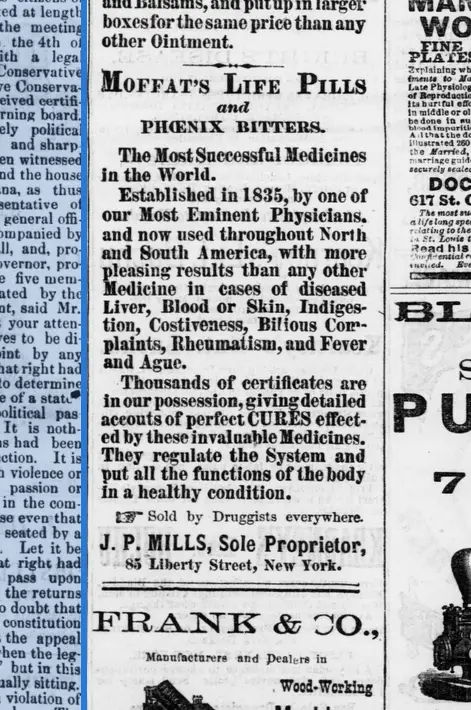
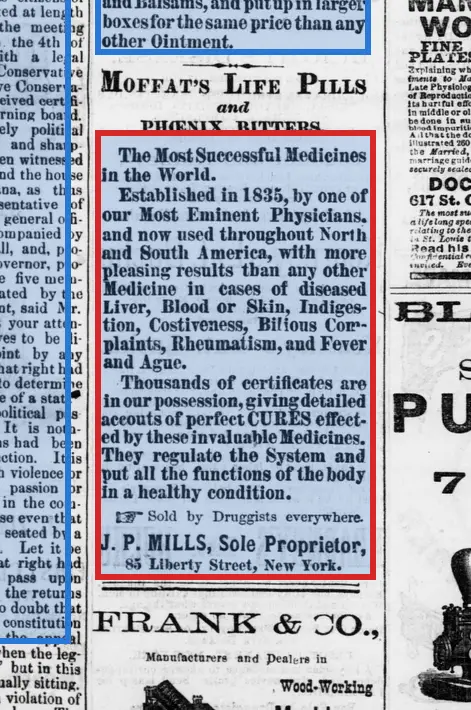
snewpapers
nothingAmerican Stories
The Most Successful Medicines in the World.Established in 1886, by one of our Most Eminent Physicians. and now used throughout North and South America, with more pleasing results than any other Medicine i'm cases of diseased Liver, Blood or Skin, Indiges- ton, COstiveness, Bilious Corr plants, Rheumatism, and Fever and Ague.
Thousands of certificates are i'm our possession, giving detailed aceouts of perfect CURES effect ed by these invaluable Medicines. They regulate the System and put all the functions of the body In a healthy condition.
Gy Sold by Druggists everywhere. ]. P. MILLS, Sole Proprietor, SIS Liberty Street, New York.
AS onlycorrectly not servedAS #49 p2-4
- advertisement: The text is a promotional notice offering an imported article at importer's prices and urging readers to send for a circular, which is advertising content.
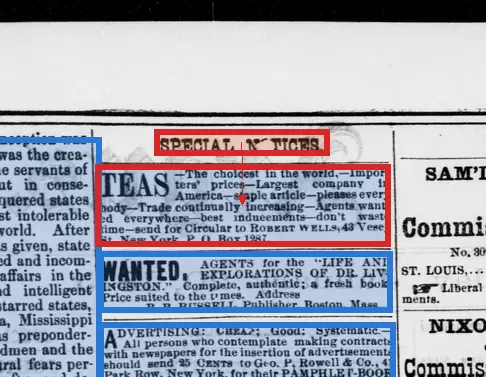
snewpapers
nothingAmerican Stories
SPECIAL N>TIcEs.rc ~ The choicest in the world,-Impor-
KAN ters' prices-Largest company in AlAAo America-staple article-pleases every body-Trade continually increasing want ed everywhere-best Indueements-dont waste time-send for Circular to ROBERT W Ellis 43 Vesey St. New York p. o. Box 1887.
AS onlycorrectly not servedAS #48 p2-5
- advertisement: It is a promotional book notice with a price and a publisher's address to contact, characteristic of an advertisement.
snewpapers
nothingAmerican Stories
MaMFcn AGENTS for the LIFE AND VAN Evs EXPLORATIONS OF DR Law INGSTON." Complete, authenfic; a fresh book Price suited to the times. Address49,. b. B. RUSSELL, Publisher, Boston. Mass.
AS onlycorrectly not servedAS #43 p2-6
- advertisement: The text promotes a pamphlet/booklet from Geo. P. Rowell & Co. and solicits payment, making it a promotional advertisement rather than terms or page furniture.
snewpapers
nothingAmerican Stories
ADyERTISING: CHEAP; Good: Systematic n All persons who contemplate making contracts with newspapers for the insertion Of advertisements should send 25 CENTS to Geo. r, Rowell q Co., Al Park Row, New York, for their PAMPHLEf-BO0K NINETY edition). cont lining lists OF over 1000 newspapers and estimates. showing the costs Advertisements taken for leading papers in many States at tremendous reduction from publishers rates. GET TIE Book.AS onlycorrectly not servedAS #39 p2-7
- advertisement: This is a classified ad offering work at home with terms and an address, using OCR-mangled wording typical of a small advertisement.
snewpapers
nothingAmerican Stories
az . O0f per day at home. Terms free W OEU Address GEO. STINsoN & Co..AS onlycorrectly not servedAS #34 p2-8
- advertisement: The text consists of testimonial letters praising a pencil brand and ends with a call to address the manufacturer for samples, which is promotional advertising copy.
snewpapers
nothingAmerican Stories
UNITED STATES PATENT OFFICE, -. =. a.WASHINGTON ID. c., March 9Th, 1874. { O. II am using the best imported Siberian pencils and paying ($lS.0) eighteen dollars per gross for them. l have. for the production of the drawings not be beaten i'll the United States for fine pencil work Your pencil II is quite up to the quail ty of the $500 imported; it hardly be better; but my best draughtsman Gays ii Is perhaps little better. We shall hereafter Use none but your Y V II, and i have experimental carefully. L send tome of the drawings from which my cuts are maze so show you that need the Best High Grade Pen ellis, at any price.
The package containing Fl 81, and V ii PEN ellis Came safely to hand. and some have, een given to other bureaus in the Department. with every where favorable verdict
/ am yours truly,
EDWARD II. KNIGHT. A. NJ. Examiner-in-charse OF Classihcations and Official Publications, U. ). Patent Office.
Author of knights American Mechanical Dict'y." a. P. o. DEPT, (ToPoGRAPHIcAL DIVISION WASHINGTON, ID. c., March 81. 1874. { OREsTEs CLEVELAND, ESQ -s .Sir:-Having made trial of the Dixon American Graphite Pencil IN this Division of the Post Office Department, cheertufly add my testimony w. l.. NICHOLSON, Topographer P. y. Dep'mt The undersigned concur in the above:
Z. III. fooLE, Assistant Topographer.
A. =. DINsMoRE, friucipal Draughtslnan.
TREASURY DEPARTMENT, OFFICE of
SUPERVISING ARCHITECT. :
WASHINGTON, ID. c., April s. 1874. OREsTEs CLEVELAND, EsR. ''Sir:-Having used Dixon's Graphite Pencils in ~ For Samples and Descriptive Lists, address
The , DRESTES CLEVELAND President. At their Cl al Railroad Avenue 2Sl 959. asa and ass Waype 6
AS onlycorrectly not servedAS #52 p2-9
- advertisement: The text consists of testimonials praising "Ora Pencils," which is promotional advertising content for a pencil brand rather than a news item, notice, or page furniture.
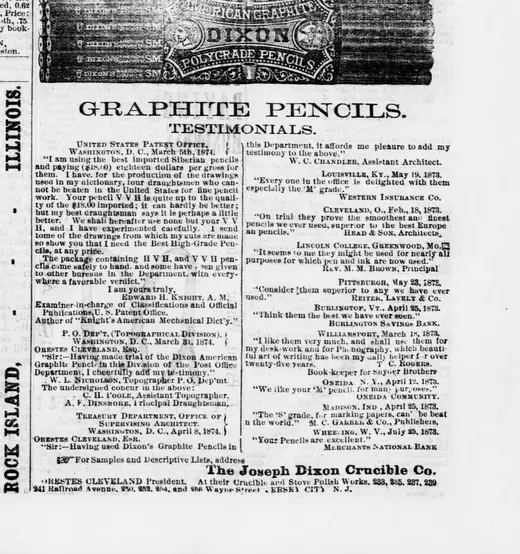
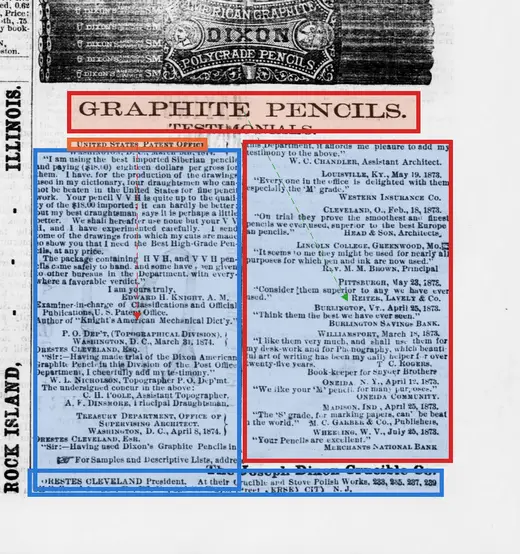
snewpapers
nothingAmerican Stories
Ora PENCILSTESTIMONIALS
this Department, it affords me pleaure to add my testimony to the above.'
W. &. CHANDLER, Assistant Architect,
LOUISVILLE, KY, May 10. 1879. Every one in the office is delighted with them especially the NJ grade"
WESTERN Insurance Co.
CLEVELAND, o., Feb, is, 1873. on trial they prove the smoothest anu finest pencils we ever used, superior to the best Europe an pencils" HEAD & Son, Architects
LINCOLN COLLEGE, GREENWOOD, MOE 1t seems 10 me they might be used for nearly all purposes for which pen and ink are now used"
RLv NJ. NJ. Brown, Principal
PITTSBURGH, Nay %, ISIS Consider them superior to any We have ever used" REITER LAyKLY & Co
BURLrNGToF, VI, April s5, 1873 Think them the best We have ever SEEN"
BURLINGTON SAVINGS BANK. WILIIAMsPoRT, March Is 1878. Il like them very much, and shall use them for my desk-work ana for PHI biography, which beauti- tul art of writing has been my aily helper fr over twenty five years Il c. RoGERs,
Book-k keeper for Snyder Brothers
ONEIDA n. Y, April Il. 1873. 1--WE like your M pencil for many PURPOSES"
ONEIDA COMMUNITY.
MADISON, IND April %, 1873. THE - grade, for marking papers, can, be beat n the world NJ c. CARRIER & Co., Publishers,
WHEEl ING. W. ", July IS, 1878. "Yocr Pencils are excellent"
MERCHANTS NATIONAL BANK
AS only, tinytiny, not askedAS #54 p2-10
snewpapers
nothingAmerican Stories
Wayne Steet.EPage 3
continuedsnewpapers rightdomestic_news ↔ AS #4 p3-1 AS attaches text outside it continues p2-1: compared, asked and decided there
American Stories also attaches: «The 9 1a ii Atsas.» (outside this component; AS article #4) page furniture, not counted
- stated first: the component includes it (American Stories): page furniture, not counted (said furniture): This is a short, garbled fragment likely a newspaper title or dateline, not substantive content of the article.
- stated first: the component does not include it (snewpapers): page furniture, not counted (said furniture): The text is a small, garbled fragment (likely an OCR-mangled masthead or title line) that is page furniture rather than a substantive part of the article.
AS onlycorrectly not servedAS #35 p3-2
- advertisement: The text promotes a public library concert with a two-million-dollar distribution and offers 'money refunded,' which is promotional lottery advertising language.
snewpapers
nothingAmerican Stories
DOLLARSTO THE AMOUN OF TWO MILLION FIVE HUNDRED THOUSAND ARE TO BE DISTRIB- UTED On THE 9TH FEB quarry BY THE PUBLIC LIBRARY OF KY, UPON THE coca SION OF THEIR fItTH AND LAST CON CERT.
Drawing Certain or Money Refunded.
AS onlycorrectly not servedAS #38 p3-3
- advertisement: The text promotes Dr. Hedges' Pulmonic Life Balsam with testimonials, price, manufacturer address, and sales agents, which are all typical features of a patent-medicine advertisement.
snewpapers
nothingAmerican Stories
l;SsI3s!a$1S14N1slsi}s|RIFE A8Y3x F. . 6 y Is Prompt, Reliable. safe and Pleasant, consequent ~, the Greatest Remedy of the Age for COUGHS, COLDS, BRONCHITIS. PNEUMONIA, WaOOP-| Ing COUGH. GROUP, aud all Pulmonary affections.
Positively the most reliable remedy in the market for what it is recommended
The united voice of all that have used it are enough to prove it's wonderful effects in arresting all diseases of the Throat and Lungs.
Consumptives should not rest until they try DIR. HEDGES PULMONIC LIFE BALSAM, primarily because in the end it will secure to them health.
Secondarily, because it will give to them comfort and freedom from coughing.
Every forerunner or producer of con- sumption, such as Coughs, Asthma, Bron- chitis, &C., are speedily cured by DR.. HEDGES PULMONIC LIFE BAL SAM.
There are ten reasons why every family should have DR.. HEDGES PULMONIC LIFE BALSAM:
]. 1t is the cheapest Large Bottles for so cents.
2. 1t is much more pleasant to take. 3. 1t is more effectual. 4. 1t is simple, safe, and certain cure. 5. 1t is adapted to both old and young. G.. It is warranted to give satisfaction. 7. It is composed entirely of herbal bal samic medicines. s. 1t is the most popular medicine in the market. 9. Because physicians are prescribing | 1t.
| To- Because every family that has had | it will not be without it.
MANUFACTURED AT THE LABO- RATORY OF
W. y. HEDGES, G. co. Southeast cor. of Main & Center SITS
Springfield, O.
For sale by all Druggists and Country Merchants. ] JOHN D. PARK. Agent j Cincinnati D For sale in Rock Island by JOHN BENGSTON, tues
AS onlycorrectly not servedAS #18 p3-4
- advertisement: It is a testimonial endorsing Maguire's Medicines/Cundurango Bitters, with named agents and sales information, clearly promotional advertising copy.
snewpapers
nothingAmerican Stories
A MIRACLETESTIMONIAL
Office and Residence No. a DauPhine St., /
NEW ORLEANS Sept. %, 1873. CAPT. TRYON j, WOODWARD
CAPT TRYON j, WOODWARD Agent Maguire's Medicines
| No SO Magazine Street: ESTEEMED SIR:-From feeling of heartfelt graf itude and general sense of duty, am prompted to address you and respectfully beg to give you u voluntary and brief statement of my past and pres ent state of health. CUNDRANGU LIVER AND BLOOD | BITTERs AND SARsAPA2ILLA Tonic. My health for wears has been bad. but from the commencement OF this year rapidly declined forcing me to abandon all character of business: and upon becoming COR | pleeIy paralyzed in my right arm and with my whole right side threate ed, became helpless and hopeless indeed, though attended upon by the mos | skillful physicians of his and other States ana cities, with no benefit; and in fact, my own medi cal knowledge forces me to realize the fact that u less some change and improvement took place soon | with me would shortly die, and made my every earthly arrangement accordingly when by mos: provdential circumstance | was directed 10 ana met YOU about month ago. and, from your gen erous sympathy, was induced Ito gratify you. pu with no hope or confidence OF benefit to myself only try the Cundurango; and to my utmost aston ishment and qualification am now almost entlrei restored to perfect health and that by TIC use but one bottle of the CUNDURASGo LIVER AMI BLOOD BITTERs and SARsArARILLA ToN'". feei indeed q renewed and re -urrccied n.a", ana VII ever, my dear sir, ne grateful in my rememSrahcs of you for the kind interest and generous sympathy | shown in my wretched helplessness, and an | convinced that to the use of Cunderango ana w vine Providence through you, am indebted 1or | new lease of life.
From sense of duty, let me ask that nnblica ton of my case be made; and by my happy expert g ence none need despair. and that through you IL the use of Cundurahgo. they may also find re1e YOURS truly, etc. THOS. NJ. LOGAN, JR M D. 81 NEW ORLEANS, Sept, "a, 1873 We the undersigned, being personally ac9uaineeu with Dr. Logan, cheerfully certify that the ABOVE statement is true and correct N every partiGular
C McCALLISTER
Pm GOODWIN.
OAN'L HICEAR
Sold hv Censer& Thomas. Rock Island.
Page 4
1:1 matchmatchtrain_schedules ↔ AS #79 p4-1
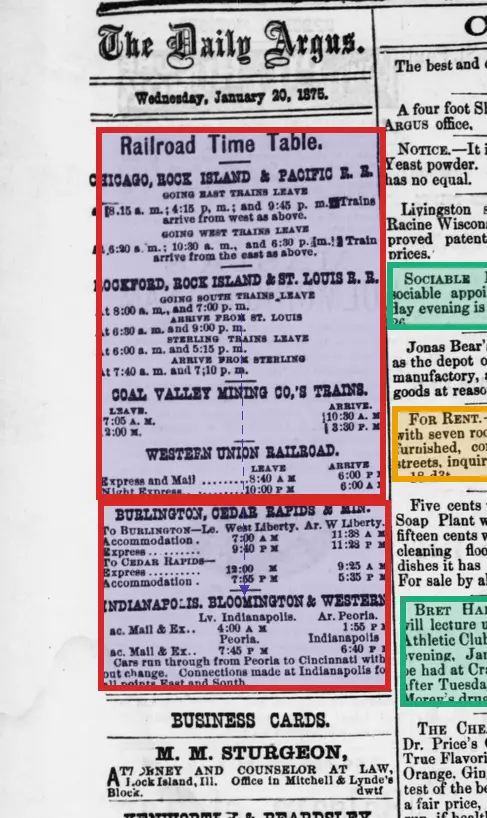
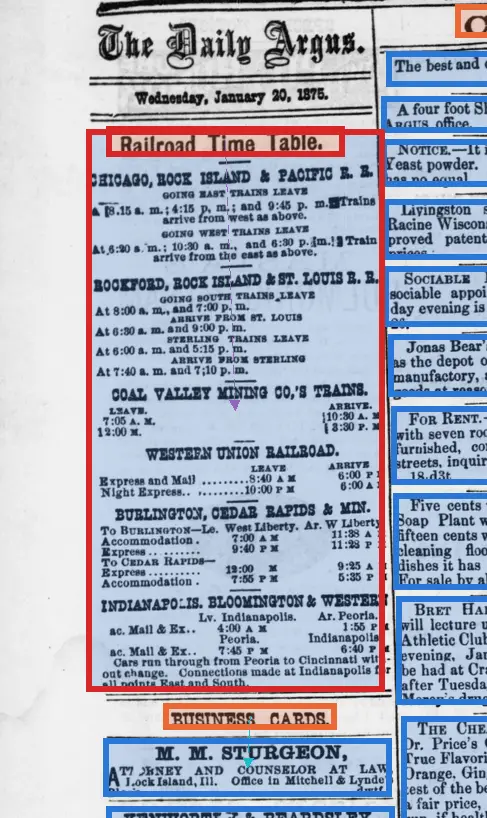
snewpapers
Railroad Time Table. CHICAGO, ROCK ISLAND & PACIFIC R. R. GOING EAST TRAINS LEAVE 8.15 a. m.; 4:15 p. m.; and 9:45 p. m. Trains arrive from west as above. GOING WEST TRAINS LEAVE 6:20 a. m.; 10:30 a. m., and 6:30 p. m. Trains arrive from the east as above. ROCKFORD, ROCK ISLAND & ST. LOUIS R. R. GOING SOUTH TRAINS LEAVE At 8:00 a. m, and 7:00 p. m. ARRIVE FROM ST. LOUIS At 6:30 a. m. and 9:00 p. m. STERLING TRAINS LEAVE At 6:00 a. m. and 5:15 p. m. ARRIVE FROM STERLING At 7:40 a. m. and 7:10 p. m. COAL VALLEY MINING CO.'S TRAINS. LEAVE ARRIVE. 7:05 A.M. 10:30 A.M. 12:00 M. 3:30 P. M. WESTERN UNION RAILROAD. LEAVE ARRIVE Express and Mail..........8:40 AM 6:00 P M Night Express..........10:00 P 6:00 AM BURLINGTON. CEDAR RAPIDS & MIN. To Burlington - Le. West Liberty. Ar. W Liberty. Accommodation. 7:00AM 11:38 A M Express.......... 9:40 P M 11:28 P M TO CEDAR RAPIDS- Express.......... 12:00 M 9:25 AM Accommodation. 7:55 PM 5:35 P M INDIANAPOLIS. BLOOMINGTON& WESTERN Lv. Indianapolis. Ar. Peoria. ac. Mail & Ex.. 4:00AM 1:55 PM Peoria. Indianapolis ac. Mail & Ex.. 7:45 P M 6:40 PM Cars run through from Peoria to Cincinnati without change. Connections made at Indianapolis for all points East and South.American Stories
Railroad Time Table.Railroad Time Table. CHICAGO. socx ISLAND b PACIFIC y. D.
GOING EAST TRAINS LEAVE AH.ina. m. 4:15 p, M; and 9:45 p m'niiNin'
arrive from west a. aooVe'
GOING WEST TRAINS LEAVE Al $40 O. M; 1890 q. m, and 6;S ?. am'' Ai~AA
arrive from the east - Hoo'e' ROCKFORD. aocK ISLAND &sT. LOUIS B. B.
GOING SOUTH ThAlNs- LEAVE At 500 q. m, and 7:U p. IN.
ARRIVE FROM ST. LOUIS Al 0.a0 a m. and 600 p. m.
STERLING TRAINS LEAVE At 500 O. m. and 5:15 p. m.
ARRIVE TRoM STERLING At 7:40 @. m. and 7;lO p. m.
COAL VALLEY MINING CO.'S TRAINS. LEAVE. ,inasN NJ 7:05 AN. lio:S0 a i2:00M. to''' E. A
WESTERN UNION RAILROAD. Express and Mail ........;s s:S9As 60 500 Night Express. '........iV'WfA
BURLINGTON, CEDAR RAPIDS b MN. To BuRIIseroN-Le West Liberty. Ar W E 90 Accommodation. s sS 1M ii:ss N To CEDAR RAPIDS 90, . , Express :;:; :;: l7 z:wpM S:s5 P J INDIANAPOLIS. BLOOMINGTON b wEsTEaS
Lv. Indianapolis. Ar. Peoria. &C. Mail & Ex.. 4:OOAM l:5S ] ac Mail q Ex T:45P 64O Cars run through from Peoria to Cincinnati with out change. Connections made at Indianapolis 10 all points East and South.
AS onlycorrectly not servedAS #83 p4-2
- advertisement: This is a brief professional services listing for an attorney, with name, title, and business address, characteristic of a classified advertisement.


snewpapers
nothingAmerican Stories
MI. M. STURGEON, ATT ShNEY AND COUNSELOR AT Law, n Lock Island, ILL., once in Mitchell 8 Lynde's Blocx dwtfAS onlycorrectly not servedAS #88 p4-3
- advertisement: It lists a business name and office services with an address and date-style closing, typical of a small classified or business advertisement.
snewpapers
nothingAmerican Stories
KENwoRTEY & BEARDSLEY, \ Aw AND ABSTRACT OFFICE. ROOMS IN L Can't House Jno r. KenWorthy jas, NJ Boards. ey 1O-23d&wn.AS onlycorrectly not servedAS #74 p4-4
- advertisement: It lists a professional name and law office address with a 'Money to Loan' service line, typical of a business card advertisement.
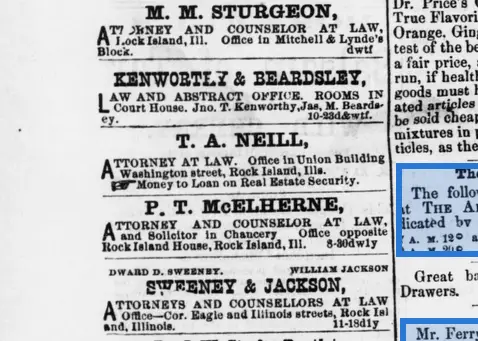
snewpapers
nothingAmerican Stories
IT. A. NELL.p r. McELHERNE,
ATTORNEY AT LAW Office in Union Building n Washington street, Rock Island, lis.
eaF-Money to Loan on Real Estate Security.
AS onlycorrectly not servedAS #78 p4-5
- advertisement: This is a professional card or business listing for an attorney, including his office location and a run schedule, which is a paid classified-style advertisement.
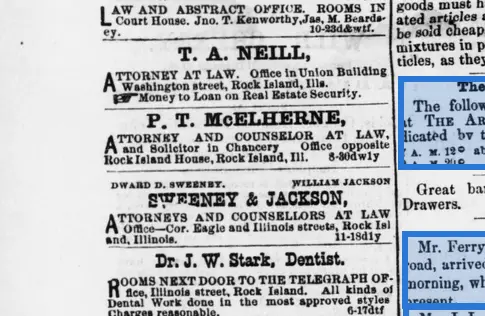
snewpapers
nothingAmerican Stories
WILLIAM JACKSONATTORNEY AND COUNSELOR AT Law, n and Solicitor In Chancery ONCE opposite Rock Island House, Rock Island, Ill. o-3Odwly
AS onlycorrectly not servedAS #92 p4-6
- advertisement: It is a dentist's business card promoting services, location, reasonable charges, and contact details, which is a paid commercial advertisement.

snewpapers
nothingAmerican Stories
DR.. J. w, Stark, Dentist.OooMs NEXT DOOR TO THE TELEGRAPH OF, n Ace Illinois street Rock Island. All kinds Of Dental Work done in the most approved styles Charges reasonable, 6-1Tdi
AS onlycorrectly not servedAS #70 p4-7
- advertisement: It is a paid professional card listing a physician's office and services, a typical small advertisement.
snewpapers
nothingAmerican Stories
q. M. KELLER. RI. D.PHYSICIAN AND SURGEON. Office and resi- ] dence corner of Orleans and Ohio streets next door Kehler's Drug Store. Professional services rendered at all hours Of the day or night.
7-14d&w1y
AS onlycorrectly not servedAS #71 p4-8
- advertisement: The text promotes plumbing, gas, and steam fitting services with a call for estimates, and names Thomas Yates as the business, which is clearly a commercial advertisement.
snewpapers
nothingAmerican Stories
70 PREPARED TO DO PLUMBING IN ALL ITS i branches. also, Gas and Steam Fitting.Call and have estimates made oeio'e oe' - a -. NJ her parties. Work aoh1r THOMAS YATES, (Levee. } Rock Island
- .oatf
AS onlycorrectly not servedAS #63 p4-9
- advertisement: The text offers choice table butter for sale in lots with rates, inviting readers to contact the undersigned, which is a commercial sales notice typical of an advertisement.
snewpapers
nothingAmerican Stories
Choice Table Butter.0ERsoNs WANTING CHOICE TABLE BUT I TER, Ia 20 lb. lots or upwards, at reasonable rates, will be furnished by dropping line to the undersigned. ID. q. MOORE US,
AS onlycorrectly not servedAS #15 p4-10
- advertisement: The text promotes and prices a patented asthma remedy with retail sizes, mail-order instructions, and local sellers, which is clearly commercial advertising.
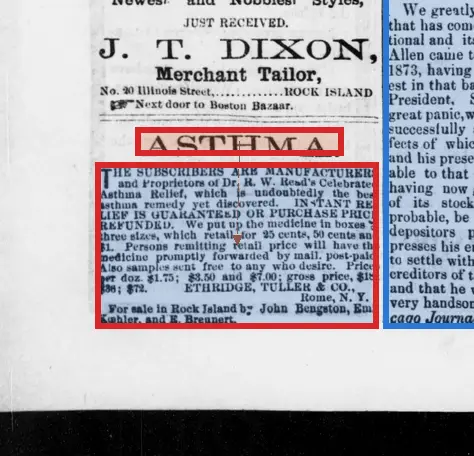
snewpapers
nothingAmerican Stories
ASTHMATHE SUBSCRIBERS ARE MANUFACTURERS l and Proprietors OF DIR. X. w. Reads Celebrated Asthma Relief, which Is undoubtedly the best asthma remedy vet discovered. IN slant RE- LIEF Is GUARANTEED OR PURCHASE PRICE REEUNDED. We put up the medicine in boxes 3 three Sizes which retail for 25 cents 50 cents and 81 Persons remitting retail price will have tina medicine promptly forwarded by mail. postpaid Also samples sent free to any who desire. Prices per doz x1.75; $3.50 and 800; gross price, SIS H3s; ST2 ETHRIDGE, FULLER q CO.,
Rome, N. Y. For sale In Rock Island b. John Bengston, Emf K1hler, and Il, Breuneyt,
AS onlycorrectly not servedAS #60 p4-11
- advertisement: It is a short promotional line for 'the best and cheapest clothing' followed by a merchant's name, typical of a classified or display advertisement.
snewpapers
nothingAmerican Stories
The best and cheapest clothing./. BANiBERGER.
AS onlycorrectly not servedAS #47 p4-12
- advertisement: The text is a classified notice offering a four foot show case for sale at the Argus Office, which is a commercial sales listing.
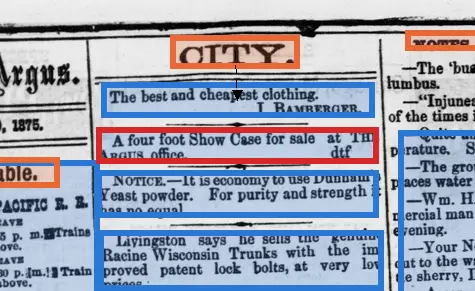
snewpapers
nothingAmerican Stories
A four foot Show Case for sale at The ARGUS Office. ditAS onlycorrectly not servedAS #36 p4-13
- advertisement: It promotes Durham Yeast powder, praising its purity, strength, and economy, which is a commercial product advertisement rather than a notice or page furniture.
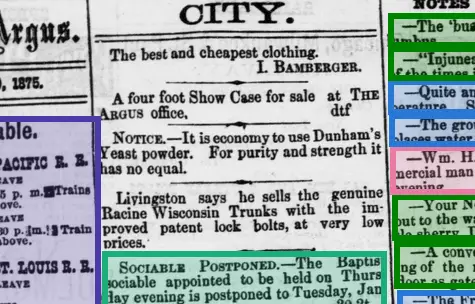
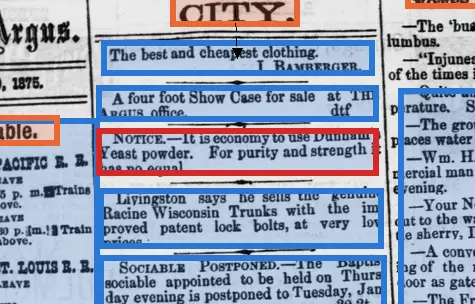
snewpapers
nothingAmerican Stories
NoTIcE.-It is economy to use Durham : Yeast powder. For purity and strength II has no equal.AS onlycorrectly not servedAS #30 p4-14
- advertisement: The text promotes a specific merchant (Livingston) selling branded trunks and mentions prices, which is characteristic of a commercial advertisement.
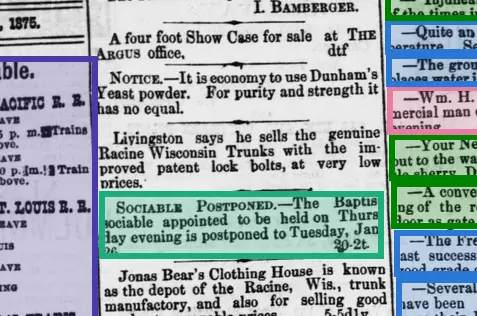
snewpapers
nothingAmerican Stories
Livingston says he sells the genuine Racine Wisconsin Trunks with the I'M proved patent lock bolts, at very 10" prices.1:1 matchmatchnotice ↔ AS #33 p4-15
snewpapers
SOCIABLE POSTPONED.—The Baptist sociable appointed to be held on Thursday evening is postponed to Tuesday, Jan. 26. 20-2t.American Stories
SocrABLE PosTPoNED.-The Baptist sociable appointed to be held on THURS day evening is postponed to Tuesday, o. 9an' OfAS onlycorrectly not servedAS #31 p4-16
- advertisement: The text promotes a clothing house and its trunk depot with sales language like 'good goods at reasonable prices,' which is typical advertising copy.
snewpapers
nothingAmerican Stories
Jonas Bears Clothing House is known as the depot of the Racine, WIS, trunk manufactory, and also for selling good goods at reasonable prices. Bodily.1:1 matchmatchpersonal_ad ↔ AS #27 p4-17
snewpapers
For Rent.—A neat little cottage, new, with seven rooms, either furnished or unfurnished, corner Swan and Mississippi streets, inquire on promises. 18.d3t JOHN P. STIBOLT.American Stories
For RENT.-A neat little cottage, new, with seven rooms, either furnished or un furnished, corner Swan and Mississippi streets. inquire on premises.l8.d3t JOHN P. SrBOLT.
AS onlycorrectly not servedAS #26 p4-18
- advertisement: The text promotes Corbett's California Soap, describes its value and invites a trial, with an offer to buy from grocers, which is characteristic of a product advertisement.
snewpapers
nothingAmerican Stories
Five cents worth of Corbett's California Soap Plant will do as large washing as fifteen cents worth of ordinary soap. Fol- cleaning floors, woodwork or washing dishes it has no equal. A trial is invited For sale by all grocers. l1-3dtf1:1 matchmatchnotice ↔ AS #25 p4-19
snewpapers
BRET HARTE'S LECTURE.—Bret Harte will lecture under the management of the Athletic Club at Dart's Hall on Saturday evening, Jan. 23. Reserved seats can be had at Crampton's book store on and after Tuesday, Jan. 19. at 9 A. M., and at Morey's drug store in Moline.American Stories
BRET HARTE's LEcTURE.-Bret Harte will lecture under the management OF the Athletic Club at Darts Hall on Saturday evening, Jan. %. Reserved seats can be had at Champions book store on and after Tuesday, Jan. l9. at ga. NJ, and at Morey's drug store in Moline.AS onlycorrectly not servedAS #22 p4-20
- advertisement: The text promotes a specific branded product (Dr. Price's Cream Baking Powder and flavoring extracts), arguing it is the cheapest and purest, which is characteristic marketing copy.
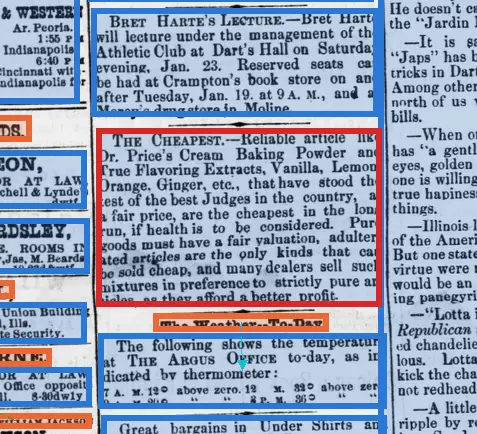
snewpapers
nothingAmerican Stories
THE CHEAPEST. Reliable article like DR.. Prices Cream Baking Powder and True Flavoring Extracts, Vanilla, Lemon Orange. Ginger. etc., that have stood the test Of the best Judges in the country, at fair price, are the cheapest in the long RIM. if health is to be considered. Pure roods mnst have a fair valuation, adulter- ssteJ articles are the only kinds that can ae sod cheap, and many dealers sell such mixtures in preference to strictly pure ar ticles, as they afford better profit.1:1 matchmatchweather_report ↔ AS #37 p4-21
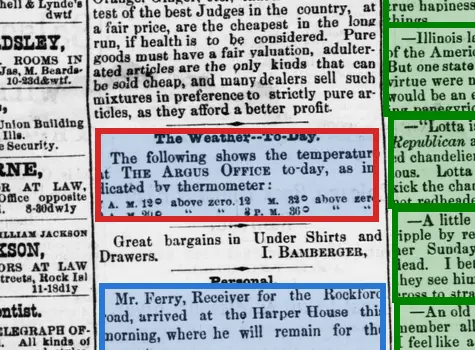
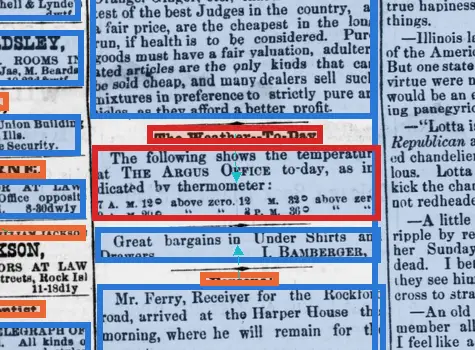
snewpapers
The Weather--To-Day. The following shows the temperature at THE ARGUS OFFICE to-day, as indicated by thermometer: 7 A. M. 12 above zero. 12 . 32 above zero 9 A. M. 20° 3 P. M. 36°American Stories
The weather--To-Day.The following shows the temperature at THE ARGUS OFFICE to-day, as In Dictated by thermometer: = NJ 1ae above zero.1e NJ. $40 above zero N 2Ge aP M $50 :"
in N ours : 1 ASsnewpapers rightlocal_news ↔ AS #9 p4-22 AS attaches text outside it AS puts a line of it in another article inside AS's merged article, decided by p4-23
American Stories also attaches: «Great bargains in Under Shirts and
Drawers. L. bAMBEhdEh'» (outside this component; AS article #56) snewpapers right
- stated first: the component does not include it (snewpapers): snewpapers right (said separate): The text is an advertisement for shirts and drawers, a different printed item from the personal news notice about Mr. Ferry.
- stated first: the component includes it (American Stories): snewpapers right (said separate): The additional text is an advertisement for shirts and drawers, unrelated to the news item about Mr. Ferry, so it belongs to a different printed item.
American Stories puts part of this component in another article: «Personal.» (inside this component; AS article #56) page furniture, not counted
- stated first: the component includes it (snewpapers): page furniture, not counted (said furniture): «Personal.» is a short section heading printed over several items, so it is page furniture and should not decide the segmentation.
- stated first: the component does not include it (American Stories): page furniture, not counted (said furniture): The text «Personal.» is a small section heading/tagline printed above a short item, of the kind treated as page furniture rather than part of the article's content.
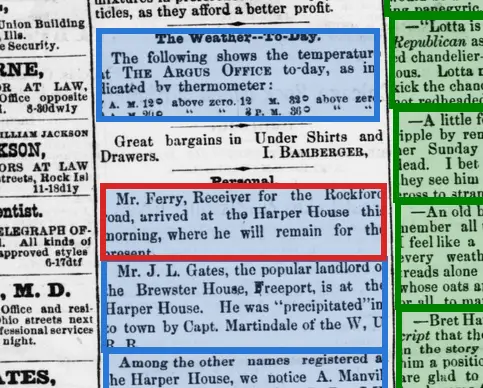
snewpapers
Mr. Ferry, Receiver for the Rockford road, arrived at the Harper House this morning, where he will remain for the present.American Stories
Mr.. Ferry, Receiver for the Rockford road, arrived at the Harper House this morning, where he will remain for the present.N ours : 1 ASsnewpapers rightlocal_news, local_news, local_news ↔ AS #9 p4-23
- stated first: one component (American Stories): snewpapers right (said several): Each numbered piece is a separate hotel-arrival/personals notice about different individuals, so they are distinct printed items.
- stated first: several components (snewpapers): snewpapers right (said several): These are three separate hotel arrivals/registration notices, each a distinct news item rather than a single continued article.
snewpapers
Mr. Ferry, Receiver for the Rockford road, arrived at the Harper House this morning, where he will remain for the present.Mr. J. L. Gates, the popular landlord of the Brewster House, Freeport, is at the Harper House. He was "precipitated" into town by Capt. Martindale of the W. U. R. R.
Among the other names registered at the Harper House, we notice A. Manvil, Assistant Sup't C. R. I. & P. R. R.; J.H. Howard and J. F. Phillips, pay-masters C. R. I. & P. R. R.; Mr. J. Crickard, St. Louis; Mr. J. W. Norton and Mr. W. F. Brackett, Chicago.
American Stories
Mr.. Ferry, Receiver for the Rockford road, arrived at the Harper House this morning, where he will remain for the present.Mr.. J. L. Gates, the popular landlord OF the Brewster House, Ereeport, is at the Harper House. He was ''precipitated in to town by Capt. Martindale OF the W, I. r. r.
Among the other names registered at the Harper House, we notice A. Manvll, Assistant Sup't Q. r. I.& p. R. R. J.H Howard and J. F. Phillips, pay-masters G.. r. I. & P. R. R.; Mr.. J. Orchard, St Louis; Mr.. J. w. Norton and Mr. w. f Bracket, Chicago.
- the pieces asked about (snewpapers):
- [1] local_news: begins: "Mr. Ferry, Receiver for the Rockford road, arrived at the Harper House this morning, where" … ends: "road, arrived at the Harper House this morning, where he will remain for the present."
- [2] local_news: begins: "Mr. J. L. Gates, the popular landlord of the Brewster House, Freeport, is at the" … ends: "House. He was "precipitated" into town by Capt. Martindale of the W. U. R. R."
- [3] local_news: begins: "Among the other names registered at the Harper House, we notice A. Manvil, Assistant Sup't" … ends: "Mr. J. Crickard, St. Louis; Mr. J. W. Norton and Mr. W. F. Brackett, Chicago."
Text agreement inside AS's merged article (3 pieces): the merged article's text cut where our components begin and end; American Stories draws no boundary there, so these are no matches.
p4-22 local_news
snewpapers
Mr. Ferry, Receiver for the Rockford road, arrived at the Harper House this morning, where he will remain for the present.American Stories (slice of #9)
Mr.. Ferry, Receiver for the Rockford road, arrived at the Harper House this morning, where he will remain for the present.p4-24 local_news
snewpapers
Mr. J. L. Gates, the popular landlord of the Brewster House, Freeport, is at the Harper House. He was "precipitated" into town by Capt. Martindale of the W. U. R. R.American Stories (slice of #9)
Mr.. J. L. Gates, the popular landlord OF the Brewster House, Ereeport, is at the Harper House. He was ''precipitated in to town by Capt. Martindale OF the W, I. r. r.p4-25 local_news
snewpapers
Among the other names registered at the Harper House, we notice A. Manvil, Assistant Sup't C. R. I. & P. R. R.; J.H. Howard and J. F. Phillips, pay-masters C. R. I. & P. R. R.; Mr. J. Crickard, St. Louis; Mr. J. W. Norton and Mr. W. F. Brackett, Chicago.American Stories (slice of #9)
Among the other names registered at the Harper House, we notice A. Manvll, Assistant Sup't Q. r. I.& p. R. R. J.H Howard and J. F. Phillips, pay-masters G.. r. I. & P. R. R.; Mr.. J. Orchard, St Louis; Mr.. J. w. Norton and Mr. w. f Bracket, Chicago.in N ours : 1 ASsnewpapers rightlocal_news ↔ AS #9 p4-24 inside AS's merged article, decided by p4-23
snewpapers
Mr. J. L. Gates, the popular landlord of the Brewster House, Freeport, is at the Harper House. He was "precipitated" into town by Capt. Martindale of the W. U. R. R.American Stories
Mr.. J. L. Gates, the popular landlord OF the Brewster House, Ereeport, is at the Harper House. He was ''precipitated in to town by Capt. Martindale OF the W, I. r. r.in N ours : 1 ASsnewpapers rightlocal_news ↔ AS #9 p4-25 inside AS's merged article, decided by p4-23
snewpapers
Among the other names registered at the Harper House, we notice A. Manvil, Assistant Sup't C. R. I. & P. R. R.; J.H. Howard and J. F. Phillips, pay-masters C. R. I. & P. R. R.; Mr. J. Crickard, St. Louis; Mr. J. W. Norton and Mr. W. F. Brackett, Chicago.American Stories
Among the other names registered at the Harper House, we notice A. Manvll, Assistant Sup't Q. r. I.& p. R. R. J.H Howard and J. F. Phillips, pay-masters G.. r. I. & P. R. R.; Mr.. J. Orchard, St Louis; Mr.. J. w. Norton and Mr. w. f Bracket, Chicago.1:1 matchmatchlocal_news ↔ AS #3 p4-26
snewpapers
Fun To-Night. The celebrated Georgia Minstrels, composed of over twenty colored men, will appear to-night at Dart's Hall, This troupe has just concluded a tour of the principal cities of the United States and everywhere they met with the most enthusiastic reception from the high order generally of their performances, the truthfulness and freshness of their delineations of African character and eccentricities, and the peculiar paths and fervency of their rendition of plantation melodies. The troupe is said to be the most completely organized one now traveling, embracing a brass band, orchestra, vocalists, comedians, etc. The band paraded our streets this afternoon giving some fine music. A full house is expected to-night.American Stories
Fun Tonight.The celebrated Georgia Minstrels, COM posed of over twenty colored men, will ap- pear tonight at Darts Hall. This troupe has just concluded tour of the principal cities of the United States and everywhere they met with the most enthusiastic re. ception from the high order generally Of their performances, the truthfulness and freshness of their delineations of African character and eccentricies, and the pecul, lar paths and fervency of their rendition of plantation melodies. The troupe is said to be the most completely organized one now travelling. embracing brass band orchestra, vocalists, comedians, etc. The band paraded our streets this Afternoon giving some fine music. A full house is expected tonight.
AS onlycorrectly not servedAS #41 p4-27
- advertisement: The text promotes a merchant's stock of furnishings and clothing at popular prices, with a shop name (Loeh's) and sales language, typical of a commercial advertisement.
snewpapers
nothingAmerican Stories
A splendid stock OF frst-class furnish ing goods, underwear, hosiery, gloves scarfs. ties, collars, etc, etc. Everything at popular prices at Loeh's. 41:1 matchmatchfiller ↔ AS #1 p4-28
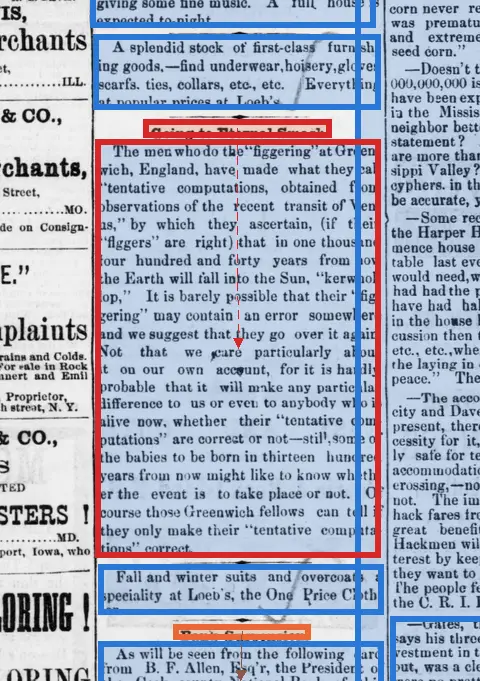
snewpapers
Going to Eternal Smash. The men who do the "figgering" at Greenwich, England, have made what they call "tentative computations, obtained from observations of the recent transit of Venus," by which they ascertain, (if their "figgers" are right) that in one thousand four hundred and forty years from now the Earth will fall into the Sun, "kerwhollop," It is barely possible that their "figgering" may contain an error somewhere and we suggest that they go over it again. Not that we care particularly about it on our own account, for it is hardly probable that it will make any particular difference to us or even to anybody who is alive now, whether their "tentative computations" are correct or not-still, some of the babies to be born in thirteen hundred years from now might like to know whether the event is to take place or not. Of course those Greenwich fellows can tell if they only make their "tentative computations" correct.American Stories
Going to Eternal Smash,The men who do the 'fggering' at Green wich, England, have made what they call tentative computations, obtained from observations of the recent transit Of Ven u.s." by which they ascertain, (if their ''fggers" are right that in one thousand four hundred and forty years from now the Earth will fall into the Sun. 'kerwhol- lop," 1t is barely possible that their fig gering' may contain an error somewhere and we suggest that they go over it again Not that we care particularly about it on our own account, for it is hardly probable that it will make any particular difference to US or even to anybody who is alive now, whether their tentative COM putations" are correct or not-stil', some of the babies to be born in thirteen hundred years from now might like to know wheth- er the event is to take place or not. Oi course those Greenwich fellows can tell il they only make their tentative computa- tons correct.
AS onlycorrectly not servedAS #66 p4-29
- advertisement: The text promotes fall and winter suits and overcoats as a specialty at a named one-price clothier, which is commercial advertising copy.
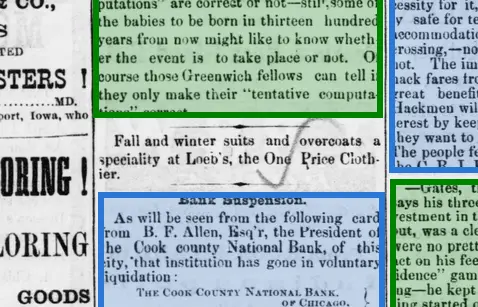
snewpapers
nothingAmerican Stories
Fall and winter suits and fovercoats a speciality at Loep's, the One Price Cloth ier1 ours : N ASsnewpapers rightdomestic_news ↔ AS #53, AS #19 p4-30
- stated first: one component (snewpapers): snewpapers right (said one): The first piece is the lead-in news report about the bank's suspension and the second is the card and accompanying commentary that the lead-in explicitly introduces; together they form one continuous article.
- stated first: several components (American Stories): snewpapers right (said one): The passage is a single news item: an introductory notice followed by the bank president's card and the accompanying report, all part of the same story about the bank's liquidation.
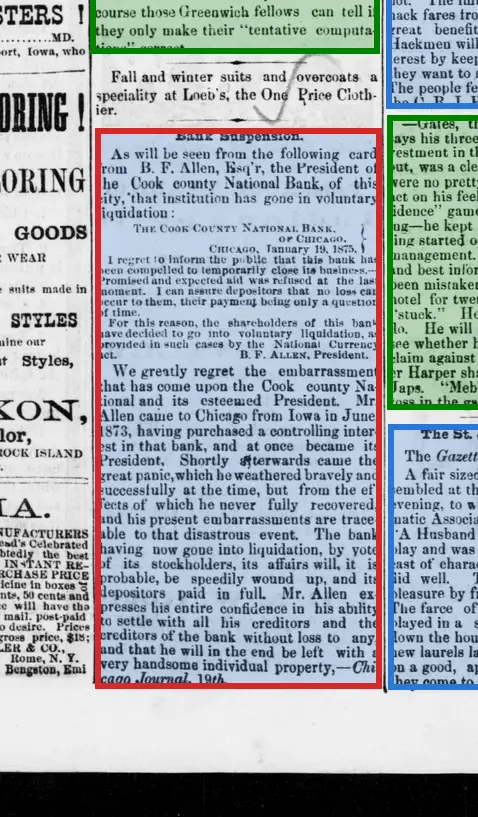
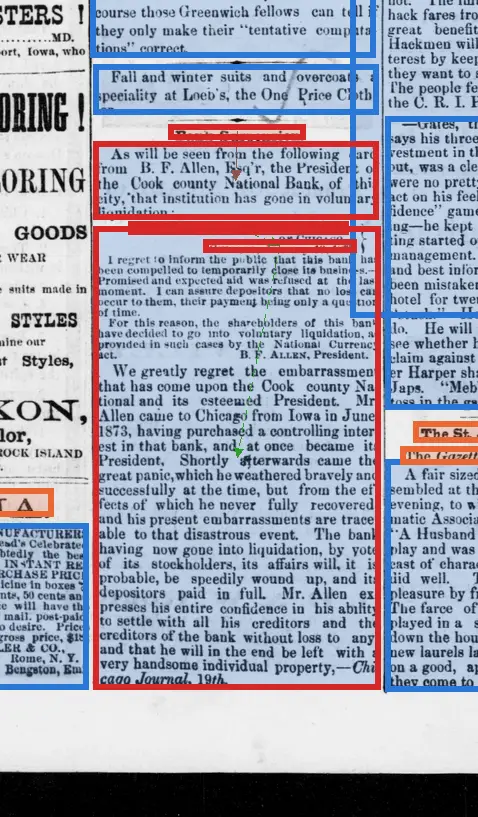
snewpapers
Bank Suspension. As will be seen from the following card from B. F. Allen, Esq'r, the President of the Cook county National Bank, of this city, that institution has gone in voluntary liquidation: THE COOK COUNTY NATIONAL BANK OF CHICAGO, Chicago, January 19, 1875, I regret to inform the public that this bank has been compelled to temporarily close its business. Promised and expected aid was refused at the last moment. I can assure depositors that no loss can occur to them, their payment being only a question of time. For this reason, the shareholders of this bank have decided to go into voluntary liquidation, as provided in such cases by the National Currency act. B.F.ALLEN, President. We greatly regret the embarrassment that has come upon the Cook county National and its esteemed President. Mr. Allen came to Chicago from Iowa in June, 1873, having purchased a controlling interest in that bank, and at once became its President. Shortly afterwards came the great panic, which he weathered bravely and successfully at the time, but from the effects of which he never fully recovered, and his present embarrassments are traceable to that disastrous event. The bank having now gone into liquidation, by vote of its stockholders, its affairs will, it is probable, be speedily wound up, and its depositors paid in full. Mr. Allen expresses his entire confidence in his ability to settle with all his creditors and the creditors of the bank without loss to any, and that he will in the end be left with a very handsome individual property,-Chicago Journal, 19th.American Stories
Bank Suspeusiou.AS will be seen from the following card from b. F. Allen, Esq'r, the President of the Cook county National Bank, of this city, that institution has gone in voluntary liquidation
The Cook COUNTY NATIONAL BANK.
VT ShLt AHps CHICAGO. January 10. 1873.
lHE COOK COUNTY NATIONAL bANk
OF CHICAGO.
CHICAGO, January 49, 1879 / regret o inform the public that this bank has been compelled to temporarily close its business.- Promised and expected aid was refused at the last moment. i can assure depositors that no loss can occur TO them, their payment being only question of time.
For this reason, the shareholders Of this bank have decided 10 go into voluntary liquidation, as provided in such cases by the National Currency act. ID. F. ALLEN, President. We greatly regret the embarrassment that has come upon the Cook county Ma tional and it's esteemed President Mr.. Allen came to Chicago from Iowa in June, 1873, having purchased controlling inter. est in that bank, and at once became its President, Shortly afterwards came the great panic, which he weathered bravely and successfully at the time, but from the eff fects of which he never fully recovered, and his present embarrassments are trace able to that disastrous event. The bank having now gone into liquidation, by vote of its stockholders, its affairs will, it is probable, be speedily wound up, and its depositors paid in full. Mr.. Allen ex- presses his entire confidence in his ability to settle with all his creditors and the creditors of the bank without loss to any, and that he will in the end be left with a very handsome individual property,-Chi- ca0o Journal, 18th.
- the pieces asked about (American Stories):
- [1] AS #53: begins: "Bank Suspeusiou. AS will be seen from the following card from b. F. Allen, Esq'r," … ends: "the Cook county National Bank, of this city, that institution has gone in voluntary liquidation"
- [2] AS #19: begins: "The Cook COUNTY NATIONAL BANK. VT ShLt AHps CHICAGO. January 10. 1873. lHE COOK COUNTY" … ends: "will in the end be left with a very handsome individual property,-Chi- ca0o Journal, 18th."
AS onlycorrectly not servedAS #34 p4-31
- page furniture: This is a short heading-like label ('NOTES HERE AND THERE.') acting as a section heading rather than a complete article or notice.
snewpapers
nothingAmerican Stories
NOTES HERE AND THERE.ours onlynot captured by ASfiller p4-32
snewpapers
—The 'bus that crossed the ocean—Columbus.American Stories
nothingours onlynot captured by ASfiller p4-33
snewpapers
—"Injunearing Done Here" is the sign of the times in Detroit.American Stories
nothingin N ours : 1 ASsnewpapers rightlocal_news ↔ AS #34 p4-34 inside AS's merged article, decided by p4-35
snewpapers
—Quite an agreeable change in the temperature. See weather table.American Stories
QUITE an agreeable cnangc III ZIG e0u- OF erature. See weather table. lttN ours : 1 ASsnewpapers rightlocal_news, local_news, obituary, filler, filler, local_news, local_news, filler, filler, local_news, filler, local_news, filler, filler, filler, filler, filler, filler, local_news, local_news, local_news, filler, filler, local_news, filler ↔ AS #34 p4-35
- stated first: one component (American Stories): snewpapers right (said several): Each numbered piece is a separate short news item, introduced by its own dash, covering unrelated topics (weather, deaths, local incidents, jokes, etc.); they are distinct components rather than parts of a single article.
- stated first: several components (snewpapers): snewpapers right (said several): The passage consists of 25 distinct short news items, each marked by a dash and covering a separate topic; they are separate components, not one article.


snewpapers
—Quite an agreeable change in the temperature. See weather table.—The ground is frozen deep and in many places water in the pipes is frozen.
—Wm. H. Aspinwall, the great commercial man of New York died on Monday evening.
—Your New Orleans man never bawls out to the waiter, now: "Bring me a little sherry, Dan,"
—A converted jockey has been speaking of the receipts at a church festival door as gate money.
—The Freeport beet sugar factory is at last successful, and turning out a very good grade of sugar.
—Several "sick" creditors of the "Japs" have been around Dart's Hall trying to have their bills liquidated.
—A Detroit hotel porter has to remove a diamond ring from his finger before laying hold of a big trunk.
—Pericles is dead. He was a Parisian rhinoceros. Butler will soon be the last representative of the species.
--The Japs managed to get to Geneseo by giving a lien on their baggage. Incompetent management is what's the matter with that troupe.
—John G, Saxe has taken up his abode in Brooklyn in spite of it all, you know. He doesn't care; he is the man who wrote the "Jardin Mabille."
—It is said that a poor company of "Japs" has been performing very common tricks in Dart's Hall for two nights past. Among other tricks performed in a town north of us was that of not paying their bills.
—When one reflects that Katie King has ''a gentle, serious face, large, clear eyes, golden hair and delicate rosy lips,'' one is willing to believe in the maxim that true happiness lies in a medium in all things.
—Illinois last year paid into the funds of the American Bible society $44,285 25. But one state paid a larger amount. If virtue were not its own reward the above would be an excellent subject for a flowing panegyric.
—"Lotta is mention in the St. Louis Republican as 'our sweet little red-headed chandelier-kicker.' And that's scandalous. Lotta may be able and anxious to kick the chandelier, but she certainly is not redheaded."—Boston Post.
—A little four-year old girl created a ripple by remarking to the teacher of her Sunday school class: "Our dog's dead. I bet the angels was scared when they see him coming up the walk. He's cross to strangers."—Rome Sentinel.
—An old bachelor says: "When I remember all the girls I've met together, I feel like a rooster in fall exposed to every weather! I feel like one who treads alone the barn-yard all deserted, whose oats are fed, whose hens are dead, or all to market started."
—Bret Harte the writes to Boston Transcript that there is not a word of truth in the story that his friends have secured him a position in the custom-house. We are glad to hear it. The custom-house has become famous for killing off literary men from Hawthorne down to Walt Whitman.
—From Rock Island comes the report that thieving and burglarizing is becoming quite common--and it is done up clean,too. Articles disappear from houses and stores, and not the least trace is obtained of them afterwards. From the way thieves cover their tracks,it appears they are professionals, but the police of that city are not professionals.—Davenport Democrat.
—John O'Neil, who was taken from jail here to Princeton, Bureau county, several weeks ago, to answer to a charge of burglary, has had his trial and been sentenced to the penitentiary for a term of three years. He was a precious rascal and deserved perhaps a severer sentence. His real name is Ed. Morris and his parents live at Princeton. His aliases were numerous.
-Says the Belvidere Standard: "The corn raised this year lacks in nutritious qualities, also the oats. A hog or horse, say the farmers, requires to eat all the while, and then acts as if halfstarved. This accounts for the thin pork. The corn never really reached maturity, but was prematurely ripened by the drouth and extreme heat. It will not do for seed corn."
—Doesn't the Union think that $11,000,000,000 is a good deal of money to have been expended on river improvements in the Mississippi Valley? Hadn't our neighbor better drop three cyphers in the statement? And does it not think there are more than 20,000 people in the Mississippi Valley? Had it not better add three cyphers. in this case? It is a fine thing to be accurate, you know.
-Some recently married people, now at the Harper House, who are soon to commence house keeping, were chatting at the table last evening as to what stores they would need,when one lady remarked, "If I had had the purchasing of supplies I would have had half a dozen barrels of apples in the house before this time." The discussion then turned upon preserved fruit, etc., etc.,when a waggish friend suggested the laying in of a good stock of "preserved peace." The idea was voted "good."
—The accommodation train between this city and Davenport is discontinued for the present, there being now no particular necessity for it, as the ice bridge is perfectly safe for teams, It was put on for the accommodation of the people, during bad crossing,-no matter whether it paid or not. The immediate effect was to reduce hack fares from 25 cents to 10 cents—a great benefit to the people generally. Hackmen will consult their permanent interest by keeping the price down, unless they want to see another ten cent train on. The people feel under many obligations to the C. R. I. P. R, R. management.
—Gates, the jolly Freeport landlord, says his three hundred and forty dollar investment in the Japs to help them start out, was a clear case of sympathy. There were no pretty women among the Japs to act on his feelings, nor was there any "confidence" game, for he knew they had nothing—he kept them and helped them in getting started on the supposed honor of the management. But "some of the oldest and best informed inhabitants have often been mistaken"—he was, for he has kept hotel for twenty years, and still he got "stuck." He knows what he is going to do. He will propose to toss a copper and see whether he shall have Ben Harper's claim against the Worrell Sisters or whether Harper shall have his claim against the Japs. "Mebby" Dr. Burtis would like a toss in the game.
American Stories
NOTES HERE AND THERE.QUITE an agreeable cnangc III ZIG e0u- OF erature. See weather table. ltt The ground is frozen deep andin many = laces water in the pipes Is frozen. l." WIN. III. Aspinwall, the great COM ~ nercial man of New York died on Monday fo vening. d Your New Orleans man never bawls g ,ut to the waiter. now: Bring me a lit d lie sherry. Dan" n "A converted jockey has been speak. a door as gate money. lI
The Freeport beet sugar factory is at last successful, and turning out very good grade of sugar. II
Several "sick" creditors of the "Japs" have been around Darts Hall trying to have their bills hquidated.
A Detroit hotel porter has to remove a diamond ring from his finger before laying hold of a big trunk.
-Pericles is dead He was Partisan rhinoceros. Butler will soon be the last representative Of the species. The Japs managed to get to Geneseo by giving lien on their baggage. In competent management is what's the mat | ter with tnaC troupe | John G, SAKE has taken up his abode in Brooklyn in spite of it all, you know.
He doesn't care; he is the man who wrote
the "Jardin Mabille." | 1t is said that poor company OF
"Japs' has been performing very common tricks in Darts Hall for two nights past. Among other tricks performed in town
north of US was that of not paying their
bills.
/ When one reflects that Katie klng | has "a gentle, serious face, large, ciea, aves. golden hair and delicate rosy ups, one is willing to believe in the maxim tnat true happiness lies 10 medium III Ill , things. ; Illinois last year paid into the FUNDS of the American Bible society $44, 2o3 70: } But one state paid larger amount. 1t ! virtue were not its own reward the above : would be an excellent subject for How ling panegyric.
Lolita is mention in the st. Louis
Republicdn as our sweet little d-head e ed chandelier kicker And that's scanda l. Ions. Lolita may be able and anxious e kick the chandelier, but she certainly i: o. not redheaded. Boston Post.
A little four-year old girl created d ripple by remarking to the teacher Q
her Sunday school class; Our, dog
dead. l bet the angels was scared whel
they see him coming up the walk. He I'd cross to strangers. Rome Sentinet. is An old bachelor says: when [ re ne member all the girls I've met together
I feel like rooster in fall exposed t i, every weather! I feel like one VIII OF ,reads alone the barn yard all deserted ne whose oats are fed, whose hens are deat in. or all to market started.
Z. Bret Harte the writes to Boston Tran
cript that there is not word OF trul
in the story that his friends have secure at him a position in the CUSTOM house. W il, are glad to hear it. The custom hou RI has become famous for killing of literal &c men from Hawthorne down to Wa ,. Whitman.
N From Rock Island comes the repo T. that thieving and burglarizing is becomil
quite common--aud it is done up clean, tC
Articles disappear from houses and store
aud not the least trace is obtained of the m afterwards From the way thieves GOV m their tracks,it appears they are professlo = ais, but the police of that city are not pr ipe tessionals -DdUenport Democrat. pal John ONeil, who was taken fro ere Jail here to Princeton, Bureau count re. several weeks ago, to answer to char of of burglary, has had his trial and be sentenced to the penitentiary for term anu three years. He was precious rascal a can deserved perhaps severer sentence. ,ul real name is Ed. Morris and his parer +;o, live at Princeton. His aliases were n al merous
'A Says the Belvidere .Standa one THE corn raised this year lacks in I md, tritious qualities, also the oats. A hog The horse, say the farmers, requires to eat non the while, and then acts as if halfstarv,
This accounts for the thin pork. 7 e Is corn never really reached maturity,
was prematurely ripened by the dror and extreme heat. It will not do lsh seed corn"
ives Doesn't the Union think that 81 ling 100000, 900 is good deal of money
have been expended on river i'm proyeme
in the Mississippi Valley? Hadn't {
neighbor better drop three cyphers in
statement? And does it not think tn Gen. are more than 10000 people in the Miss call sippi Valley? Had it not better add tn rom cyphers. in this case? 1t is fine thing ION be accurate, you know.
bo;r Some recently married people, now m the Harper House, who are soon to &C anu mence house keeping, were chatting at now table last evening as to what stores tt hol- would need, when one lady remarked, II .Gr had had the purchasing of supplies wo
% have had half dozen barrels of apr lere in the hosse before this time" The { rain cussion then turned upon preserved FRI bout etc., etc. when a waggish friend sugges .d,,, the laying in of good stock of ''preser, ,.I peace" The idea was voted good" 10 ia The accommodation train between t
city and Davenport is discontinued for 'oui- present, there being now no particular lie OF cessity for it, as the ice bridge is perft lred ly safe for teams. 1t was put on for 9th accommodation of the people, during
oc crossing, mo matter whether it paid VI not. The Immediate effect was to red I'll II hack fares from 25 cents to 10 cents uta- great benefit to the people genera
Hackmen will consult their permanent
terest by keeping the price down, unl . a they want to see another ten cent train IL, The people feel under many obligations o'D' the G. r. l. p. r, r. management.
Gates, the jolly Freeport landlo
says his three hundred and forty dollar card vestment in the Japs to help them st It of out, was clear case of sympathy. TIL this were no pretty women among the Japs tary act on his feelings, nor was there any &C
fidence' game, for he knew they had nc ing-he kept them and helped them 10 ( ting started on the supposed honor of ; has management. But some of the old sss.- and best informed inhabitants have of , last last been mistaken he was, for he has k st ION hotel for twenty years, and still he
..stnck y He Ennms what he is pninr
- the pieces asked about (snewpapers):
- [1] local_news: begins: "—Quite an agreeable change in the temperature. See weather table." … ends: "—Quite an agreeable change in the temperature. See weather table."
- [2] local_news: begins: "—The ground is frozen deep and in many places water in the pipes is frozen." … ends: "—The ground is frozen deep and in many places water in the pipes is frozen."
- [3] obituary: begins: "—Wm. H. Aspinwall, the great commercial man of New York died on Monday evening." … ends: "—Wm. H. Aspinwall, the great commercial man of New York died on Monday evening."
- [4] filler: begins: "—Your New Orleans man never bawls out to the waiter, now: "Bring me a little" … ends: "Orleans man never bawls out to the waiter, now: "Bring me a little sherry, Dan,""
- [5] filler: begins: "—A converted jockey has been speaking of the receipts at a church festival door as" … ends: "jockey has been speaking of the receipts at a church festival door as gate money."
- [6] local_news: begins: "—The Freeport beet sugar factory is at last successful, and turning out a very good" … ends: "sugar factory is at last successful, and turning out a very good grade of sugar."
- [7] local_news: begins: "—Several "sick" creditors of the "Japs" have been around Dart's Hall trying to have their" … ends: "creditors of the "Japs" have been around Dart's Hall trying to have their bills liquidated."
- [8] filler: begins: "—A Detroit hotel porter has to remove a diamond ring from his finger before laying" … ends: "to remove a diamond ring from his finger before laying hold of a big trunk."
- [9] filler: begins: "—Pericles is dead. He was a Parisian rhinoceros. Butler will soon be the last representative" … ends: "He was a Parisian rhinoceros. Butler will soon be the last representative of the species."
- [10] local_news: begins: "--The Japs managed to get to Geneseo by giving a lien on their baggage. Incompetent" … ends: "giving a lien on their baggage. Incompetent management is what's the matter with that troupe."
- [11] filler: begins: "—John G, Saxe has taken up his abode in Brooklyn in spite of it all," … ends: "all, you know. He doesn't care; he is the man who wrote the "Jardin Mabille.""
- [12] local_news: begins: "—It is said that a poor company of "Japs" has been performing very common tricks" … ends: "tricks performed in a town north of us was that of not paying their bills."
- [13] filler: begins: "—When one reflects that Katie King has ''a gentle, serious face, large, clear eyes, golden" … ends: "to believe in the maxim that true happiness lies in a medium in all things."
- [14] filler: begins: "—Illinois last year paid into the funds of the American Bible society $44,285 25. But" … ends: "not its own reward the above would be an excellent subject for a flowing panegyric."
- [15] filler: begins: "—"Lotta is mention in the St. Louis Republican as 'our sweet little red-headed chandelier-kicker.' And" … ends: "be able and anxious to kick the chandelier, but she certainly is not redheaded."—Boston Post."
- [16] filler: begins: "—A little four-year old girl created a ripple by remarking to the teacher of her" … ends: "was scared when they see him coming up the walk. He's cross to strangers."—Rome Sentinel."
- [17] filler: begins: "—An old bachelor says: "When I remember all the girls I've met together, I feel" … ends: "all deserted, whose oats are fed, whose hens are dead, or all to market started.""
- [18] filler: begins: "—Bret Harte the writes to Boston Transcript that there is not a word of truth" … ends: "custom-house has become famous for killing off literary men from Hawthorne down to Walt Whitman."
- [19] local_news: begins: "—From Rock Island comes the report that thieving and burglarizing is becoming quite common--and it" … ends: "tracks,it appears they are professionals, but the police of that city are not professionals.—Davenport Democrat."
- [20] local_news: begins: "—John O'Neil, who was taken from jail here to Princeton, Bureau county, several weeks ago," … ends: "real name is Ed. Morris and his parents live at Princeton. His aliases were numerous."
- [21] local_news: begins: "-Says the Belvidere Standard: "The corn raised this year lacks in nutritious qualities, also the" … ends: "prematurely ripened by the drouth and extreme heat. It will not do for seed corn.""
- [22] filler: begins: "—Doesn't the Union think that $11,000,000,000 is a good deal of money to have been" … ends: "three cyphers. in this case? It is a fine thing to be accurate, you know."
- [23] filler: begins: "-Some recently married people, now at the Harper House, who are soon to commence house" … ends: "the laying in of a good stock of "preserved peace." The idea was voted "good.""
- [24] local_news: begins: "—The accommodation train between this city and Davenport is discontinued for the present, there being" … ends: "The people feel under many obligations to the C. R. I. P. R, R. management."
- [25] filler: begins: "—Gates, the jolly Freeport landlord, says his three hundred and forty dollar investment in the" … ends: "his claim against the Japs. "Mebby" Dr. Burtis would like a toss in the game."
Text agreement inside AS's merged article (24 pieces): the merged article's text cut where our components begin and end; American Stories draws no boundary there, so these are no matches.
p4-34 local_news
snewpapers
—Quite an agreeable change in the temperature. See weather table.American Stories (slice of #34)
QUITE an agreeable cnangc III ZIG e0u- OF erature. See weather table. lttp4-36 local_news
snewpapers
—The ground is frozen deep and in many places water in the pipes is frozen.American Stories (slice of #34)
The ground is frozen deep andin many = laces water in the pipes Is frozen.p4-37 obituary
snewpapers
—Wm. H. Aspinwall, the great commercial man of New York died on Monday evening.American Stories (slice of #34)
l." WIN. III. Aspinwall, the great COM ~ nercial man of New York died on Monday fo vening.p4-38 filler
snewpapers
—Your New Orleans man never bawls out to the waiter, now: "Bring me a little sherry, Dan,"American Stories (slice of #34)
d Your New Orleans man never bawls g ,ut to the waiter. now: Bring me a lit d lie sherry. Dan"p4-39 filler
The Freeport beet sugar factory is at last successful, and turning out very good grade of sugar. II
snewpapers
—A converted jockey has been speaking of the receipts at a church festival door as gate money.American Stories (slice of #34)
Dan" n "A converted jockey has been speak. a door as gate money. lIThe Freeport beet sugar factory is at last successful, and turning out very good grade of sugar. II
p4-40 local_news
snewpapers
—The Freeport beet sugar factory is at last successful, and turning out a very good grade of sugar.American Stories (slice of #34)
Freeport beet sugar factory is at last successful, and turning out very good grade of sugar.p4-41 local_news
A Detroit hotel porter has to remove a diamond ring from his finger before laying hold of a big trunk.
-Pericles is dead He was Partisan
snewpapers
—Several "sick" creditors of the "Japs" have been around Dart's Hall trying to have their bills liquidated.American Stories (slice of #34)
Several "sick" creditors of the "Japs" have been around Darts Hall trying to have their bills hquidated.A Detroit hotel porter has to remove a diamond ring from his finger before laying hold of a big trunk.
-Pericles is dead He was Partisan
p4-42 filler
snewpapers
—A Detroit hotel porter has to remove a diamond ring from his finger before laying hold of a big trunk.American Stories (slice of #34)
Partisan rhinoceros. Butler will soon be the last representative Of the species. The Japs managed to get to Geneseo by giving lienp4-43 filler
snewpapers
—Pericles is dead. He was a Parisian rhinoceros. Butler will soon be the last representative of the species.American Stories (slice of #34)
giving lien on their baggage. In competent management is what's the mat | ter with tnaC troupe | John G, SAKE has taken up his abodep4-44 local_news
He doesn't care; he is the man who wrote
the "Jardin Mabille." | 1t is said that poor company OF
"Japs'
snewpapers
--The Japs managed to get to Geneseo by giving a lien on their baggage. Incompetent management is what's the matter with that troupe.American Stories (slice of #34)
abode in Brooklyn in spite of it all, you know.He doesn't care; he is the man who wrote
the "Jardin Mabille." | 1t is said that poor company OF
"Japs'
p4-45 filler
north of US was that of not paying their
bills.
snewpapers
—John G, Saxe has taken up his abode in Brooklyn in spite of it all, you know. He doesn't care; he is the man who wrote the "Jardin Mabille."American Stories (slice of #34)
"Japs' has been performing very common tricks in Darts Hall for two nights past. Among other tricks performed in townnorth of US was that of not paying their
bills.
p4-46 local_news
bills.
snewpapers
—It is said that a poor company of "Japs" has been performing very common tricks in Dart's Hall for two nights past. Among other tricks performed in a town north of us was that of not paying their bills.American Stories (slice of #34)
paying theirbills.
p4-47 filler
Lolita is mention in
snewpapers
—When one reflects that Katie King has ''a gentle, serious face, large, clear eyes, golden hair and delicate rosy lips,'' one is willing to believe in the maxim that true happiness lies in a medium in all things.American Stories (slice of #34)
/ When one reflects that Katie klng | has "a gentle, serious face, large, ciea, aves. golden hair and delicate rosy ups, one is willing to believe in the maxim tnat true happiness lies 10 medium III Ill , things. ; Illinois last year paid into the FUNDS of the American Bible society $44, 2o3 70: } But one state paid larger amount. 1t ! virtue were not its own reward the above : would be an excellent subject for How ling panegyric.Lolita is mention in
p4-48 filler
Republicdn as our sweet little d-head e ed chandelier kicker And that's scanda l. Ions. Lolita may be able and anxious e kick the chandelier, but she certainly i: o. not redheaded. Boston Post.
A little
snewpapers
—Illinois last year paid into the funds of the American Bible society $44,285 25. But one state paid a larger amount. If virtue were not its own reward the above would be an excellent subject for a flowing panegyric.American Stories (slice of #34)
is mention in the st. LouisRepublicdn as our sweet little d-head e ed chandelier kicker And that's scanda l. Ions. Lolita may be able and anxious e kick the chandelier, but she certainly i: o. not redheaded. Boston Post.
A little
p4-49 filler
her Sunday school class; Our, dog
dead. l bet the angels was scared whel
they see him coming up the walk. He I'd cross to strangers. Rome Sentinet. is An old bachelor
snewpapers
—"Lotta is mention in the St. Louis Republican as 'our sweet little red-headed chandelier-kicker.' And that's scandalous. Lotta may be able and anxious to kick the chandelier, but she certainly is not redheaded."—Boston Post.American Stories (slice of #34)
little four-year old girl created d ripple by remarking to the teacher Qher Sunday school class; Our, dog
dead. l bet the angels was scared whel
they see him coming up the walk. He I'd cross to strangers. Rome Sentinet. is An old bachelor
p4-50 filler
I feel like rooster in fall exposed t i, every weather! I feel like one VIII OF ,reads alone the barn yard all deserted ne whose oats are fed, whose hens are deat in. or
snewpapers
—A little four-year old girl created a ripple by remarking to the teacher of her Sunday school class: "Our dog's dead. I bet the angels was scared when they see him coming up the walk. He's cross to strangers."—Rome Sentinel.American Stories (slice of #34)
old bachelor says: when [ re ne member all the girls I've met togetherI feel like rooster in fall exposed t i, every weather! I feel like one VIII OF ,reads alone the barn yard all deserted ne whose oats are fed, whose hens are deat in. or
p4-51 filler
snewpapers
—An old bachelor says: "When I remember all the girls I've met together, I feel like a rooster in fall exposed to every weather! I feel like one who treads alone the barn-yard all deserted, whose oats are fed, whose hens are dead, or all to market started."American Stories (slice of #34)
deat in. or all to market started.p4-52 filler
cript that there is not word OF trul
in the story that his friends have secure at him a position in the CUSTOM house. W il, are glad to hear it. The custom hou RI has become famous for killing of literal &c men from Hawthorne down to Wa ,. Whitman.
snewpapers
—Bret Harte the writes to Boston Transcript that there is not a word of truth in the story that his friends have secured him a position in the custom-house. We are glad to hear it. The custom-house has become famous for killing off literary men from Hawthorne down to Walt Whitman.American Stories (slice of #34)
Z. Bret Harte the writes to Boston Trancript that there is not word OF trul
in the story that his friends have secure at him a position in the CUSTOM house. W il, are glad to hear it. The custom hou RI has become famous for killing of literal &c men from Hawthorne down to Wa ,. Whitman.
p4-53 local_news
quite common--aud it is done up clean, tC
Articles disappear from houses and store
aud not the least trace is obtained of the m afterwards From the way thieves GOV m their tracks,it appears they are professlo = ais, but the police of that city are not pr ipe tessionals -DdUenport Democrat.
snewpapers
—From Rock Island comes the report that thieving and burglarizing is becoming quite common--and it is done up clean,too. Articles disappear from houses and stores, and not the least trace is obtained of them afterwards. From the way thieves cover their tracks,it appears they are professionals, but the police of that city are not professionals.—Davenport Democrat.American Stories (slice of #34)
N From Rock Island comes the repo T. that thieving and burglarizing is becomilquite common--aud it is done up clean, tC
Articles disappear from houses and store
aud not the least trace is obtained of the m afterwards From the way thieves GOV m their tracks,it appears they are professlo = ais, but the police of that city are not pr ipe tessionals -DdUenport Democrat.
p4-54 local_news
snewpapers
—John O'Neil, who was taken from jail here to Princeton, Bureau county, several weeks ago, to answer to a charge of burglary, has had his trial and been sentenced to the penitentiary for a term of three years. He was a precious rascal and deserved perhaps a severer sentence. His real name is Ed. Morris and his parents live at Princeton. His aliases were numerous.American Stories (slice of #34)
pal John ONeil, who was taken fro ere Jail here to Princeton, Bureau count re. several weeks ago, to answer to char of of burglary, has had his trial and be sentenced to the penitentiary for term anu three years. He was precious rascal a can deserved perhaps severer sentence. ,ul real name is Ed. Morris and his parer +;o, live at Princeton. His aliases were n al merousp4-55 local_news
This accounts for the thin pork. 7 e Is corn never really reached maturity,
was prematurely ripened by the dror and extreme heat. It will not do lsh seed corn"
snewpapers
-Says the Belvidere Standard: "The corn raised this year lacks in nutritious qualities, also the oats. A hog or horse, say the farmers, requires to eat all the while, and then acts as if halfstarved. This accounts for the thin pork. The corn never really reached maturity, but was prematurely ripened by the drouth and extreme heat. It will not do for seed corn."American Stories (slice of #34)
'A Says the Belvidere .Standa one THE corn raised this year lacks in I md, tritious qualities, also the oats. A hog The horse, say the farmers, requires to eat non the while, and then acts as if halfstarv,This accounts for the thin pork. 7 e Is corn never really reached maturity,
was prematurely ripened by the dror and extreme heat. It will not do lsh seed corn"
p4-56 filler
have been expended on river i'm proyeme
in the Mississippi Valley? Hadn't {
neighbor better drop three cyphers in
statement? And does it not think tn Gen. are more than 10000 people in the Miss call sippi Valley? Had it not better add tn rom cyphers. in this case? 1t is fine thing ION be accurate, you know.
snewpapers
—Doesn't the Union think that $11,000,000,000 is a good deal of money to have been expended on river improvements in the Mississippi Valley? Hadn't our neighbor better drop three cyphers in the statement? And does it not think there are more than 20,000 people in the Mississippi Valley? Had it not better add three cyphers. in this case? It is a fine thing to be accurate, you know.American Stories (slice of #34)
ives Doesn't the Union think that 81 ling 100000, 900 is good deal of moneyhave been expended on river i'm proyeme
in the Mississippi Valley? Hadn't {
neighbor better drop three cyphers in
statement? And does it not think tn Gen. are more than 10000 people in the Miss call sippi Valley? Had it not better add tn rom cyphers. in this case? 1t is fine thing ION be accurate, you know.
p4-57 filler
% have had half dozen barrels of apr lere in the hosse before this time" The { rain cussion then turned upon preserved FRI bout etc., etc. when a waggish friend sugges .d,,, the laying in of good stock of ''preser, ,.I peace" The idea was voted good"
snewpapers
-Some recently married people, now at the Harper House, who are soon to commence house keeping, were chatting at the table last evening as to what stores they would need,when one lady remarked, "If I had had the purchasing of supplies I would have had half a dozen barrels of apples in the house before this time." The discussion then turned upon preserved fruit, etc., etc.,when a waggish friend suggested the laying in of a good stock of "preserved peace." The idea was voted "good."American Stories (slice of #34)
bo;r Some recently married people, now m the Harper House, who are soon to &C anu mence house keeping, were chatting at now table last evening as to what stores tt hol- would need, when one lady remarked, II .Gr had had the purchasing of supplies wo% have had half dozen barrels of apr lere in the hosse before this time" The { rain cussion then turned upon preserved FRI bout etc., etc. when a waggish friend sugges .d,,, the laying in of good stock of ''preser, ,.I peace" The idea was voted good"
p4-58 local_news
city and Davenport is discontinued for 'oui- present, there being now no particular lie OF cessity for it, as the ice bridge is perft lred ly safe for teams. 1t was put on for 9th accommodation of the people, during
oc crossing, mo matter whether it paid VI not. The Immediate effect was to red I'll II hack fares from 25 cents to 10 cents uta- great benefit to the people genera
Hackmen will consult their permanent
terest by keeping the price down, unl . a they want to see another ten cent train IL, The people feel under many obligations o'D' the G. r. l. p. r, r. management.
snewpapers
—The accommodation train between this city and Davenport is discontinued for the present, there being now no particular necessity for it, as the ice bridge is perfectly safe for teams, It was put on for the accommodation of the people, during bad crossing,-no matter whether it paid or not. The immediate effect was to reduce hack fares from 25 cents to 10 cents—a great benefit to the people generally. Hackmen will consult their permanent interest by keeping the price down, unless they want to see another ten cent train on. The people feel under many obligations to the C. R. I. P. R, R. management.American Stories (slice of #34)
10 ia The accommodation train between tcity and Davenport is discontinued for 'oui- present, there being now no particular lie OF cessity for it, as the ice bridge is perft lred ly safe for teams. 1t was put on for 9th accommodation of the people, during
oc crossing, mo matter whether it paid VI not. The Immediate effect was to red I'll II hack fares from 25 cents to 10 cents uta- great benefit to the people genera
Hackmen will consult their permanent
terest by keeping the price down, unl . a they want to see another ten cent train IL, The people feel under many obligations o'D' the G. r. l. p. r, r. management.
in N ours : 1 ASsnewpapers rightlocal_news ↔ AS #34 p4-36 inside AS's merged article, decided by p4-35
snewpapers
—The ground is frozen deep and in many places water in the pipes is frozen.American Stories
The ground is frozen deep andin many = laces water in the pipes Is frozen.in N ours : 1 ASsnewpapers rightobituary ↔ AS #34 p4-37 inside AS's merged article, decided by p4-35
snewpapers
—Wm. H. Aspinwall, the great commercial man of New York died on Monday evening.American Stories
l." WIN. III. Aspinwall, the great COM ~ nercial man of New York died on Monday fo vening.in N ours : 1 ASsnewpapers rightfiller ↔ AS #34 p4-38 inside AS's merged article, decided by p4-35
snewpapers
—Your New Orleans man never bawls out to the waiter, now: "Bring me a little sherry, Dan,"American Stories
d Your New Orleans man never bawls g ,ut to the waiter. now: Bring me a lit d lie sherry. Dan"in N ours : 1 ASsnewpapers rightfiller ↔ AS #34 p4-39 inside AS's merged article, decided by p4-35
snewpapers
—A converted jockey has been speaking of the receipts at a church festival door as gate money.American Stories
Dan" n "A converted jockey has been speak. a door as gate money. lIThe Freeport beet sugar factory is at last successful, and turning out very good grade of sugar. II
in N ours : 1 ASsnewpapers rightlocal_news ↔ AS #34 p4-40 inside AS's merged article, decided by p4-35
snewpapers
—The Freeport beet sugar factory is at last successful, and turning out a very good grade of sugar.American Stories
Freeport beet sugar factory is at last successful, and turning out very good grade of sugar.in N ours : 1 ASsnewpapers rightlocal_news ↔ AS #34 p4-41 inside AS's merged article, decided by p4-35
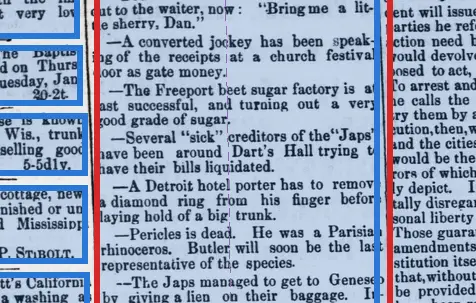
snewpapers
—Several "sick" creditors of the "Japs" have been around Dart's Hall trying to have their bills liquidated.American Stories
Several "sick" creditors of the "Japs" have been around Darts Hall trying to have their bills hquidated.A Detroit hotel porter has to remove a diamond ring from his finger before laying hold of a big trunk.
-Pericles is dead He was Partisan
in N ours : 1 ASsnewpapers rightfiller ↔ AS #34 p4-42 inside AS's merged article, decided by p4-35
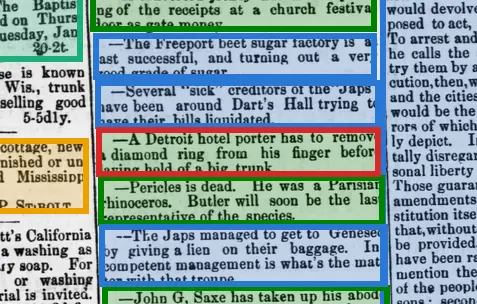
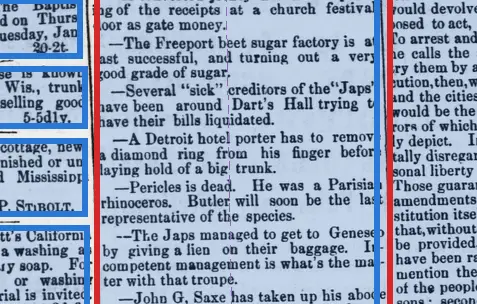
snewpapers
—A Detroit hotel porter has to remove a diamond ring from his finger before laying hold of a big trunk.American Stories
Partisan rhinoceros. Butler will soon be the last representative Of the species. The Japs managed to get to Geneseo by giving lienin N ours : 1 ASsnewpapers rightfiller ↔ AS #34 p4-43 inside AS's merged article, decided by p4-35
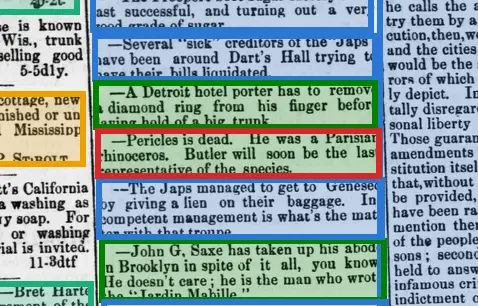
snewpapers
—Pericles is dead. He was a Parisian rhinoceros. Butler will soon be the last representative of the species.American Stories
giving lien on their baggage. In competent management is what's the mat | ter with tnaC troupe | John G, SAKE has taken up his abodein N ours : 1 ASsnewpapers rightlocal_news ↔ AS #34 p4-44 inside AS's merged article, decided by p4-35
snewpapers
--The Japs managed to get to Geneseo by giving a lien on their baggage. Incompetent management is what's the matter with that troupe.American Stories
abode in Brooklyn in spite of it all, you know.He doesn't care; he is the man who wrote
the "Jardin Mabille." | 1t is said that poor company OF
"Japs'
in N ours : 1 ASsnewpapers rightfiller ↔ AS #34 p4-45 inside AS's merged article, decided by p4-35
snewpapers
—John G, Saxe has taken up his abode in Brooklyn in spite of it all, you know. He doesn't care; he is the man who wrote the "Jardin Mabille."American Stories
"Japs' has been performing very common tricks in Darts Hall for two nights past. Among other tricks performed in townnorth of US was that of not paying their
bills.
in N ours : 1 ASsnewpapers rightlocal_news ↔ AS #34 p4-46 inside AS's merged article, decided by p4-35
snewpapers
—It is said that a poor company of "Japs" has been performing very common tricks in Dart's Hall for two nights past. Among other tricks performed in a town north of us was that of not paying their bills.American Stories
paying theirbills.
in N ours : 1 ASsnewpapers rightfiller ↔ AS #34 p4-47 inside AS's merged article, decided by p4-35
snewpapers
—When one reflects that Katie King has ''a gentle, serious face, large, clear eyes, golden hair and delicate rosy lips,'' one is willing to believe in the maxim that true happiness lies in a medium in all things.American Stories
/ When one reflects that Katie klng | has "a gentle, serious face, large, ciea, aves. golden hair and delicate rosy ups, one is willing to believe in the maxim tnat true happiness lies 10 medium III Ill , things. ; Illinois last year paid into the FUNDS of the American Bible society $44, 2o3 70: } But one state paid larger amount. 1t ! virtue were not its own reward the above : would be an excellent subject for How ling panegyric.Lolita is mention in
in N ours : 1 ASsnewpapers rightfiller ↔ AS #34 p4-48 inside AS's merged article, decided by p4-35
snewpapers
—Illinois last year paid into the funds of the American Bible society $44,285 25. But one state paid a larger amount. If virtue were not its own reward the above would be an excellent subject for a flowing panegyric.American Stories
is mention in the st. LouisRepublicdn as our sweet little d-head e ed chandelier kicker And that's scanda l. Ions. Lolita may be able and anxious e kick the chandelier, but she certainly i: o. not redheaded. Boston Post.
A little
in N ours : 1 ASsnewpapers rightfiller ↔ AS #34 p4-49 inside AS's merged article, decided by p4-35
snewpapers
—"Lotta is mention in the St. Louis Republican as 'our sweet little red-headed chandelier-kicker.' And that's scandalous. Lotta may be able and anxious to kick the chandelier, but she certainly is not redheaded."—Boston Post.American Stories
little four-year old girl created d ripple by remarking to the teacher Qher Sunday school class; Our, dog
dead. l bet the angels was scared whel
they see him coming up the walk. He I'd cross to strangers. Rome Sentinet. is An old bachelor
in N ours : 1 ASsnewpapers rightfiller ↔ AS #34 p4-50 inside AS's merged article, decided by p4-35
snewpapers
—A little four-year old girl created a ripple by remarking to the teacher of her Sunday school class: "Our dog's dead. I bet the angels was scared when they see him coming up the walk. He's cross to strangers."—Rome Sentinel.American Stories
old bachelor says: when [ re ne member all the girls I've met togetherI feel like rooster in fall exposed t i, every weather! I feel like one VIII OF ,reads alone the barn yard all deserted ne whose oats are fed, whose hens are deat in. or
in N ours : 1 ASsnewpapers rightfiller ↔ AS #34 p4-51 inside AS's merged article, decided by p4-35
snewpapers
—An old bachelor says: "When I remember all the girls I've met together, I feel like a rooster in fall exposed to every weather! I feel like one who treads alone the barn-yard all deserted, whose oats are fed, whose hens are dead, or all to market started."American Stories
deat in. or all to market started.in N ours : 1 ASsnewpapers rightfiller ↔ AS #34 p4-52 inside AS's merged article, decided by p4-35
snewpapers
—Bret Harte the writes to Boston Transcript that there is not a word of truth in the story that his friends have secured him a position in the custom-house. We are glad to hear it. The custom-house has become famous for killing off literary men from Hawthorne down to Walt Whitman.American Stories
Z. Bret Harte the writes to Boston Trancript that there is not word OF trul
in the story that his friends have secure at him a position in the CUSTOM house. W il, are glad to hear it. The custom hou RI has become famous for killing of literal &c men from Hawthorne down to Wa ,. Whitman.
in N ours : 1 ASsnewpapers rightlocal_news ↔ AS #34 p4-53 inside AS's merged article, decided by p4-35
snewpapers
—From Rock Island comes the report that thieving and burglarizing is becoming quite common--and it is done up clean,too. Articles disappear from houses and stores, and not the least trace is obtained of them afterwards. From the way thieves cover their tracks,it appears they are professionals, but the police of that city are not professionals.—Davenport Democrat.American Stories
N From Rock Island comes the repo T. that thieving and burglarizing is becomilquite common--aud it is done up clean, tC
Articles disappear from houses and store
aud not the least trace is obtained of the m afterwards From the way thieves GOV m their tracks,it appears they are professlo = ais, but the police of that city are not pr ipe tessionals -DdUenport Democrat.
in N ours : 1 ASsnewpapers rightlocal_news ↔ AS #34 p4-54 inside AS's merged article, decided by p4-35
snewpapers
—John O'Neil, who was taken from jail here to Princeton, Bureau county, several weeks ago, to answer to a charge of burglary, has had his trial and been sentenced to the penitentiary for a term of three years. He was a precious rascal and deserved perhaps a severer sentence. His real name is Ed. Morris and his parents live at Princeton. His aliases were numerous.American Stories
pal John ONeil, who was taken fro ere Jail here to Princeton, Bureau count re. several weeks ago, to answer to char of of burglary, has had his trial and be sentenced to the penitentiary for term anu three years. He was precious rascal a can deserved perhaps severer sentence. ,ul real name is Ed. Morris and his parer +;o, live at Princeton. His aliases were n al merousin N ours : 1 ASsnewpapers rightlocal_news ↔ AS #34 p4-55 inside AS's merged article, decided by p4-35
snewpapers
-Says the Belvidere Standard: "The corn raised this year lacks in nutritious qualities, also the oats. A hog or horse, say the farmers, requires to eat all the while, and then acts as if halfstarved. This accounts for the thin pork. The corn never really reached maturity, but was prematurely ripened by the drouth and extreme heat. It will not do for seed corn."American Stories
'A Says the Belvidere .Standa one THE corn raised this year lacks in I md, tritious qualities, also the oats. A hog The horse, say the farmers, requires to eat non the while, and then acts as if halfstarv,This accounts for the thin pork. 7 e Is corn never really reached maturity,
was prematurely ripened by the dror and extreme heat. It will not do lsh seed corn"
in N ours : 1 ASsnewpapers rightfiller ↔ AS #34 p4-56 inside AS's merged article, decided by p4-35
snewpapers
—Doesn't the Union think that $11,000,000,000 is a good deal of money to have been expended on river improvements in the Mississippi Valley? Hadn't our neighbor better drop three cyphers in the statement? And does it not think there are more than 20,000 people in the Mississippi Valley? Had it not better add three cyphers. in this case? It is a fine thing to be accurate, you know.American Stories
ives Doesn't the Union think that 81 ling 100000, 900 is good deal of moneyhave been expended on river i'm proyeme
in the Mississippi Valley? Hadn't {
neighbor better drop three cyphers in
statement? And does it not think tn Gen. are more than 10000 people in the Miss call sippi Valley? Had it not better add tn rom cyphers. in this case? 1t is fine thing ION be accurate, you know.
in N ours : 1 ASsnewpapers rightfiller ↔ AS #34 p4-57 inside AS's merged article, decided by p4-35
snewpapers
-Some recently married people, now at the Harper House, who are soon to commence house keeping, were chatting at the table last evening as to what stores they would need,when one lady remarked, "If I had had the purchasing of supplies I would have had half a dozen barrels of apples in the house before this time." The discussion then turned upon preserved fruit, etc., etc.,when a waggish friend suggested the laying in of a good stock of "preserved peace." The idea was voted "good."American Stories
bo;r Some recently married people, now m the Harper House, who are soon to &C anu mence house keeping, were chatting at now table last evening as to what stores tt hol- would need, when one lady remarked, II .Gr had had the purchasing of supplies wo% have had half dozen barrels of apr lere in the hosse before this time" The { rain cussion then turned upon preserved FRI bout etc., etc. when a waggish friend sugges .d,,, the laying in of good stock of ''preser, ,.I peace" The idea was voted good"
in N ours : 1 ASsnewpapers rightlocal_news ↔ AS #34 p4-58 inside AS's merged article, decided by p4-35
snewpapers
—The accommodation train between this city and Davenport is discontinued for the present, there being now no particular necessity for it, as the ice bridge is perfectly safe for teams, It was put on for the accommodation of the people, during bad crossing,-no matter whether it paid or not. The immediate effect was to reduce hack fares from 25 cents to 10 cents—a great benefit to the people generally. Hackmen will consult their permanent interest by keeping the price down, unless they want to see another ten cent train on. The people feel under many obligations to the C. R. I. P. R, R. management.American Stories
10 ia The accommodation train between tcity and Davenport is discontinued for 'oui- present, there being now no particular lie OF cessity for it, as the ice bridge is perft lred ly safe for teams. 1t was put on for 9th accommodation of the people, during
oc crossing, mo matter whether it paid VI not. The Immediate effect was to red I'll II hack fares from 25 cents to 10 cents uta- great benefit to the people genera
Hackmen will consult their permanent
terest by keeping the price down, unl . a they want to see another ten cent train IL, The people feel under many obligations o'D' the G. r. l. p. r, r. management.
1 ours : N ASsnewpapers rightfiller ↔ AS #34, AS #99 p4-59
- stated first: one component (snewpapers): snewpapers right (said one): Both pieces are the same news item about Gates and the Japs, with [1] being a garbled OCR version of the start of the same article that [2] presents more fully; they belong to a single printed item.
- stated first: several components (American Stories): snewpapers right (said one): Both numbered pieces are the same printed item—a single humorous anecdote about Gates—with [2] simply a fuller/cleaner OCR rendering of the same article rather than a separate component.
snewpapers
—Gates, the jolly Freeport landlord, says his three hundred and forty dollar investment in the Japs to help them start out, was a clear case of sympathy. There were no pretty women among the Japs to act on his feelings, nor was there any "confidence" game, for he knew they had nothing—he kept them and helped them in getting started on the supposed honor of the management. But "some of the oldest and best informed inhabitants have often been mistaken"—he was, for he has kept hotel for twenty years, and still he got "stuck." He knows what he is going to do. He will propose to toss a copper and see whether he shall have Ben Harper's claim against the Worrell Sisters or whether Harper shall have his claim against the Japs. "Mebby" Dr. Burtis would like a toss in the game.American Stories
Gates, the jolly Freeport landlosays his three hundred and forty dollar card vestment in the Japs to help them st It of out, was clear case of sympathy. TIL this were no pretty women among the Japs tary act on his feelings, nor was there any &C
fidence' game, for he knew they had nc ing-he kept them and helped them 10 ( ting started on the supposed honor of ; has management. But some of the old sss.- and best informed inhabitants have of , last last been mistaken he was, for he has k st ION hotel for twenty years, and still he
..stnck y He Ennms what he is pninr
Gates, the jolly Freeport landlord, says his three hundred and forty dollar in vestment in the Japs to help them start out, was clear case of sympathy. There were no pretty women among the Japs to act on his feelings, nor was there any con fidence'' game, for he knew they had moth ing-he kept them and helped them in get ting started on the supposed honor of the management. But some of the oldest and best informed inhabitants have often been mistaken "-he was, for he has kept hotel for twenty years, and still he got
stuck" He knows what he is going to do. He will propose to toss copper and see whether he shall have Ben Harper s claim against the Worrell Sisters or whetb- er Harper shall have his claim against the Japs "Mebby'' DR. Burtis would ike a toss in the game.
- the pieces asked about (American Stories):
- [1] AS #34: begins: "Gates, the jolly Freeport landlo says his three hundred and forty dollar card vestment in" … ends: "hotel for twenty years, and still he ..stnck y He Ennms what he is pninr"
- [2] AS #99: begins: "Gates, the jolly Freeport landlord, says his three hundred and forty dollar in vestment in" … ends: "his claim against the Japs "Mebby'' DR. Burtis would ike a toss in the game."
1:1 matchmatchlocal_news ↔ AS #17 p4-60
snewpapers
The St. Josephs in Davenport. The Gazette of this morning says: A fair sized, good-looking audience assembled at the Burtis Opera House, last evening, to witness the St. Joseph's Dramatic Association, of Rock Island, play "A Husband to Order." It is an excellent play and was excellently rendered. The cast of characters was good and every one did well. The audience expressed its pleasure by frequent and hearty applause. The farce of "The Two Buzzards" was played in a style that literally brought down the house. The St. Joseph's earned new laurels last night and can always count on a good, appreciative house whenever they come to Davenport.American Stories
The ST. Josephs in Davenport.The Gazette of this morning says:
A fair sized, good looking audience as sembled at the Burtis Opera House, last evening, to witness the St. Joseph's ORA matte Association, of Rock Island, play "A Husband to Order" 1t is an excellent play and was excellently rendered. The cast of characters was good and every one did well. The audience expressed its pleasure by frequent and hearty applause. The farce of THE Two Buzzards'' was played in style that literally brought down the house. The st. Joseph's earned new laurels last night and can always count on good, appreciative house whenever they come to Davenport,
continuedsnewpapers rightdomestic_news ↔ AS #23 p4-61 continues p2-1: compared, asked and decided there
AS onlycorrectly not servedAS #72 p4-62
- advertisement: It offers merchandise (Racine Trunks) for sale and gives the seller's name, which is a commercial advertisement.
snewpapers
nothingAmerican Stories
500 of the best Racine Trunks, with i'm proved locks, for sale. I. BAMBERGER.1:1 matchmatcheditorial ↔ AS #7 p4-63
snewpapers
Gov. Tilden, of New York, has excellent notions as to the duty of the state to the Erie canal. He says: "The state must protect the Erie canal while not seeking to make money from it." That is a sound opinion. We hope it is to be acted upon by the legislature during the winter. But so much cannot be expected from a legislature which Tammany Hall controls.—Chicago Tribune.For more than 20 years, to our certain knowledge, that has been the policy of the New York Democracy. And the Whig and Republican policy has been the very opposite. The Whigs, and after them the Republicans of New York were always in favor of putting up the tolls on the canals to such a figure as would make them a source of revenue to the state. They favored big jobs, contracts to political favorites, and tolls to meet interest, reduce debt and leave a revenue. All this, of course, must come out of the pockets of the western producers.
The Democrats said this course was not only unjust to the Western producers, but it was levying a tax upon the people of other states while passing through their borders, which was expressly forbidden by the constitution of the United States.
As often as parties changed in New York the tariff of tolls on canals were changed. The Democrats claimed that the state could afford to build the canal from its own revenues, as a means of enriching its commonwealth, and building up its great marts of trade; that the tolls should be fixed at so low a figure as to be only sufficient to pay for keeping the canals in repair, and pay the economical expense of managing them for the good of the people generally. That's the difference between the two parties in New York, on that question, and Gov. Tilden is only giving expression to the same old principle, in language, perhaps, more terse and expressive.
American Stories
Gov. Tilden, of New York, has excellent Erie sc canal IA He says: The state must protect the Erie canal while not seeking to make money from it." That is sound opinion, We hope it is to be acted upon by the legislature during the winter But 50 much cannot be expected from legis- lature which Tammany Hall controls Chicago Tribune.For more than 90 years, to our certain knowledge, that has been the p,licy of the New York Democracy. And the Wing and Republican policy has been the very opposite. The Wings, and after them the Republicans of New York were always in favor of putting up the tolls on the canals to such a figure as would make them a source of revenue to the state. They ia vored big jobs, contracts to political favor ties, and tolls to meet interest, reduce debt and leave revenue All this, of course, mist come out of the pockets of the west | ern producers.
The Democrats said this course was not only unjust to the Western producers, but it was levying tax upon the people ofoth- er states while passing through their Dor ders, which was expressly forbidden by the constitution of the United States.
AS often as parties changedin New York the tariff of tolls on canals were changed. The Democrats claimed that the state could afford to build the canal from its own revenues, as means of enriching its CON- monwealth, and building up its great marts of trade; that the tolls should be fixed al so low figure as to be only sufficient tc pay for keeping the canals in repair, and pay the economical expense of managing them for the good of the people generally That's the difference between the two par ties in New York, on that question, and Gov. Tilden is only giving expression tc the same old principle, in language, per haps, more terse aud expressive.
AS onlycorrectly not servedAS #44 p4-64
- advertisement: The text promotes clothing merchandise with prices at a specific store (Loeb's), which is promotional advertising copy.
snewpapers
nothingAmerican Stories
A full assortment of men, boys and children's wear. Clothing at the lowest prices, at Loeb's.AS onlycorrectly not servedAS #21 p4-65
- advertisement: It promotes a clothing merchant's latest styles and patterns, with business details and a shop name, clearly advertising a commercial service.
snewpapers
nothingAmerican Stories
Mr.. Loeb claims to have the very latest styles and finest patterns of imported cloths, and to make them into business or dress suits to order. and in the latest fashions, at his One Price Clothing House.AS onlycorrectly not servedAS #5 p4-66
- advertisement: The text promotes Hostetter's Stomach Bitters as a remedy, using persuasive marketing language typical of a patent-medicine advertisement.
snewpapers
nothingAmerican Stories
Regularity brings Vigor,Local irregularities produce weakness OF the en- tire system. In order, therefore, to re-establsh health and strength upon basis, these irregu- larities must be permanently overcome. Many endeavor to reform them by remedies whi,h ad- dress themselves merely to the symptoms. without affecting the cause, II such individuals were to use instead Hostetter's Stomach Bitters, they would speedily appreciate tine difference between a medicine which palliates, and one which entirely removes physical disability. That prime regulator of bodily disturbances restores the derect organs to an uninterrupted and healthy performance of their various duties, whereby alone the system can recover its lost tone and vfg0r Hosetters Bitters are q tonic medicine, but they are a tonic which regulates ere they strengthen the system.
1:1 matchmatchdomestic_news ↔ AS #46 p4-67
snewpapers
The State Grange and Water Routes, The Illinois State Grange, P. of H. had a three days' session in Springfield last week, with over 300 delegates in attendance. The most important business was the adoption of the report of the Committee on Transportation, which strongly recommends the improvement of all water routes to the seaboard, and of our canal project speaks as follows: "The construction of the projected section of canal connecting the Mississippi river with the lakes, known as the Hennepin and Rock Island canal, is a work of much importance. This would open up another competing route and would have a tendency to reduce the present rates very much. This canal is really the continuation of the Illinois and Michigan canal to the Mississippi river. This section will be sixty-one miles long, and the estimated cost $4,000,000. In relation to the rivers in the Mississippi Valley the report says: "The people living in this great valley, unsurpassed by no other portion of the globe for fertility and soil, with a climate suited to nearly all the various branches of agriculture, a population of 20,000,000 souls representing nearly every nationality on the face of the earth, with forests of the choicest timber hardly touched,with worlds of mineral wealth and its mines scarcely opened, with only about one-fifth of its land under cultivation, and near 12,000 miles of navigable rivers-with all of these great natural advantages in view, we may here inquire what the general government has done for this people in the way of providing transportation of their surplus products. These people can answer as with one voice by simply saying that if there has been anything at all noticeable in the action of the government it has been a most extraordinary indifference, a total neglect of the of the vast interests of the people of this valley, We find there has been expended on the great water courses of this valley, since the organization of the government to the present date, $11,000,000,this being only about $150,000 per annum. while it is known that an amount more than equal to that has been appropriated in a single year for the building of custom houses.American Stories
The State Grange and Water Routes,The Illinois State Grange, P. of d. had three days session in Springfield last week, with over 800 delegates in atten- dance. The most important business was the adoption of the report Of the Commit tee on Transportation. which strongly re- comnends the improvement of all water routes to the seaboard, and of our canal project speaks as follows:
THE construction of the projected sec | ton of canal connecting the Mississippi riv- er with the lakes, known as the Hennepin and Rock Island canal, is work of much Importance. This would open up another competing route and would have tendency to reduce the present rates very much. This canal is really the continuation of the Illinois and Michigan canal to the Missis- sippi river. This section will be sixty one miles long, and the estimated cost 81 ,0OO,-
OOO."
In relation to the rivers in the Missis Isippi Valley the report says:
1.-The people living in this great valley
unsurpassed by no other portion OF the ,, globe for fertility and soil, with climate
suited to nearly all the various branches O agriculture, population of 20,OO0,00( ! souls representing nearly every nationalit! :. on the face OF the earth, with forests of tn - choicest timber hardly touched,wit world y of mineral wealth and its mines scarcel , opened, with only about one-ffth Of its Ian :. under cultivation, and near 1900 miles G . navigable rivers-with all of these grea " natural advantages in view, we may her :. inquire what the general government ha - done for this people in the way of provit - ing transportation of their surplus product u These people can answer as with one voie a. a. by simply saying that if there has bee = :, anything at all noticeable in the action y the government it has been most extr !, ordinary Indifference, total negle ct OF Il : of the vast interests of the people of tn
valley. We find there has been expendt o. on the great water courses of this vale # since the organization of the governme - to the present date, $l1 100000 this bell ," only about $4,000 per annum. while it known that an amount more than equal f. that has been appropriated in single We IN for the building of custom houses.
1:1 matchmatchdomestic_news ↔ AS #28 p4-68
snewpapers
Whitelaw Reid, the editor of the New York Tribune, was examined by the ways and means committee yesterday touching certain facts relative to the Pacific Mail corruption, supposed to be in his possession. Mr. Reid's information was mostly second-hand, of course, but he made some suggestions, based upon the information communicated by him, that may result in eliciting valuable testimony. The committeemen started out with the apparent intention of making Mr, Reid appear ridiculous, but before much progress had been made they found themselves in great danger of occupying the place they had prepared for him. They thereupon changed their tactics, and treated the witness with a respect that almost amounted to genuine condescension. After Mr. Reid's examination he was arrested for libel on complaint of Boss Shepherd, the great ring thief, and required to give bail. Mr. Reid will not be likely to suffer in consequence of the arrest; for it will not be difficult for him to prove that Shepherd, having no character to lose, could not be libeled.—Chicago Times.American Stories
Whitelaw Reid, the editor of the New York Tribune, was examined by the ways and means committee yesterday touching certain facts relative to the Pacific Mail corruption, supposed to by in bis posses sion. Mr.. Reid information was mostly second hand, of course, but he made some suggestions, based upon the information communicated by him, that may result In elciting valuable testimony. The COM mitteemen started out with the apparent intention of making Mr., Reid appear ridicu- lous, but before much progress had been made they found themselves in great dan ger of occupying the place they had pre-; pared for him. They thereupon changed their tactics, and treated the witness with respect that almost amounted to genuine condescension.After Mr.. Reds examination he was arrested for libel on complaint of Boss Shepherd, the great ring thief, and re quired to give bail. Mr.. Reid will not be likely to suffer in consequence of the ar rest for it will not be difficult for him tt prove that Shepherd, having no character to lose, could not be hbeled. Chicago
Times.
AS only, tinytiny, not askedAS #10 p4-69
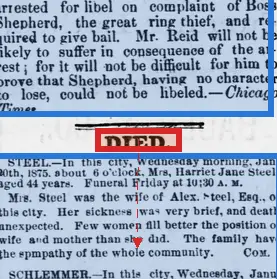
snewpapers
nothingAmerican Stories
DIED.N ours : 1 ASsnewpapers rightobituary, obituary ↔ AS #10 p4-70
- stated first: one component (American Stories): snewpapers right (said several): The passage contains two separate death notices, one for Harriet Jane Steel and one for Mary E. Schlemmer, each a distinct printed item.
- stated first: several components (snewpapers): snewpapers right (said several): The passage contains two distinct death notices, one for Mrs. Harriet Jane Steel and one for Mary E. Schlemmer, each a separate printed item.
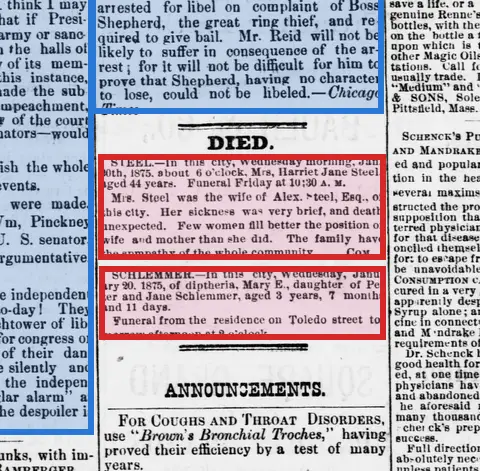
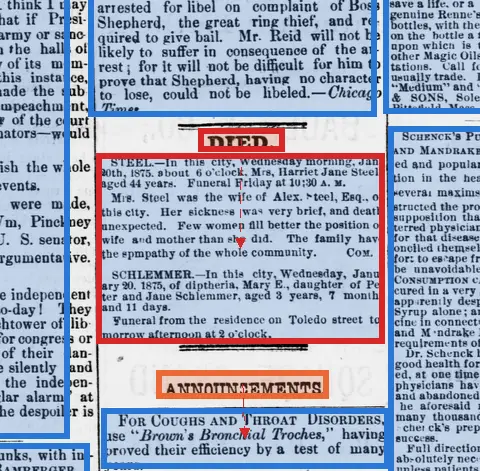
snewpapers
STEEL.—In this city, Wednesday morning, Jan. 20th, 1875. about 6 o'clock, Mrs, Harriet Jane Steel, aged 44 years. Funeral Friday at 10:30 . . Mrs. Steel was the wife of Alex. Steel, Esq., of this city. Her sickness was very brief, and death unexpected. Few women fill better the position of wife and mother than she did. The family have the sympathy of the whole community.Co.SCHLEMMER.-In this city, Wednesday, January 20, 1875, of diptheria, Mary E., daughter of Peter and Jane Schlemmer, aged 3 years, 7 months and 11 days. Funeral from the residence on Toledo street tomorrow afternoon at 2 o'clock,
American Stories
DIED.STEEL.-In this city, Wednesday morning, JAN aOth, 1875 about o'clock, Mrs. Harriet Jane Steel aged a years. Funeral Friday at 1U;3O A. NJ.
Mrs Steel was the wife of Alex. >teel, Esq, Of this city. Her sickness was very brief, and death unexpected Few women fill better the position of wife and mother than she did. The family have the sympathy of the whole community. Cow. SCHLEMMER.-In this city. Wednesday, Janu- airy 90 1875, of diptheria Mary E., daughter of Pc ter and Jane Schlemmer, aged years, months and II days.
Funeral from the residence on Toledo street to morrow afternoon at o'clock,
- the pieces asked about (snewpapers):
- [1] obituary: begins: "STEEL.—In this city, Wednesday morning, Jan. 20th, 1875. about 6 o'clock, Mrs, Harriet Jane Steel," … ends: "wife and mother than she did. The family have the sympathy of the whole community.Co."
- [2] obituary: begins: "SCHLEMMER.-In this city, Wednesday, January 20, 1875, of diptheria, Mary E., daughter of Peter and" … ends: "and 11 days. Funeral from the residence on Toledo street tomorrow afternoon at 2 o'clock,"
Text agreement inside AS's merged article (2 pieces): the merged article's text cut where our components begin and end; American Stories draws no boundary there, so these are no matches.
p4-71 obituary
Mrs Steel was the wife of Alex. >teel, Esq, Of this city. Her sickness was very brief, and death unexpected Few women fill better the position of wife and mother than she did. The family have the sympathy of the whole community.
snewpapers
STEEL.—In this city, Wednesday morning, Jan. 20th, 1875. about 6 o'clock, Mrs, Harriet Jane Steel, aged 44 years. Funeral Friday at 10:30 . . Mrs. Steel was the wife of Alex. Steel, Esq., of this city. Her sickness was very brief, and death unexpected. Few women fill better the position of wife and mother than she did. The family have the sympathy of the whole community.Co.American Stories (slice of #10)
STEEL.-In this city, Wednesday morning, JAN aOth, 1875 about o'clock, Mrs. Harriet Jane Steel aged a years. Funeral Friday at 1U;3O A. NJ.Mrs Steel was the wife of Alex. >teel, Esq, Of this city. Her sickness was very brief, and death unexpected Few women fill better the position of wife and mother than she did. The family have the sympathy of the whole community.
p4-72 obituary
Funeral from the residence on Toledo street to morrow afternoon at o'clock,
snewpapers
SCHLEMMER.-In this city, Wednesday, January 20, 1875, of diptheria, Mary E., daughter of Peter and Jane Schlemmer, aged 3 years, 7 months and 11 days. Funeral from the residence on Toledo street tomorrow afternoon at 2 o'clock,American Stories (slice of #10)
Cow. SCHLEMMER.-In this city. Wednesday, Janu- airy 90 1875, of diptheria Mary E., daughter of Pc ter and Jane Schlemmer, aged years, months and II days.Funeral from the residence on Toledo street to morrow afternoon at o'clock,
in N ours : 1 ASsnewpapers rightobituary ↔ AS #10 p4-71 inside AS's merged article, decided by p4-70
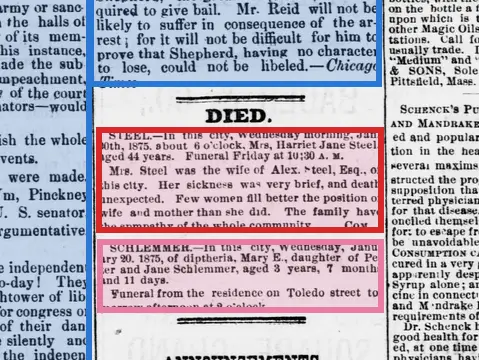
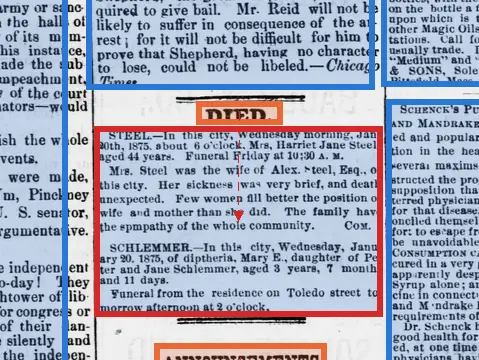
snewpapers
STEEL.—In this city, Wednesday morning, Jan. 20th, 1875. about 6 o'clock, Mrs, Harriet Jane Steel, aged 44 years. Funeral Friday at 10:30 . . Mrs. Steel was the wife of Alex. Steel, Esq., of this city. Her sickness was very brief, and death unexpected. Few women fill better the position of wife and mother than she did. The family have the sympathy of the whole community.Co.American Stories
STEEL.-In this city, Wednesday morning, JAN aOth, 1875 about o'clock, Mrs. Harriet Jane Steel aged a years. Funeral Friday at 1U;3O A. NJ.Mrs Steel was the wife of Alex. >teel, Esq, Of this city. Her sickness was very brief, and death unexpected Few women fill better the position of wife and mother than she did. The family have the sympathy of the whole community.
in N ours : 1 ASsnewpapers rightobituary ↔ AS #10 p4-72 inside AS's merged article, decided by p4-70
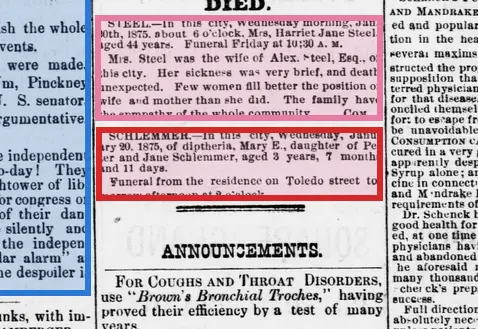
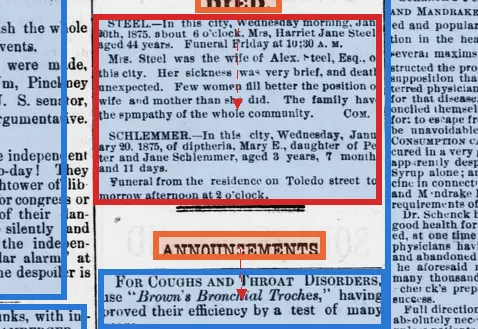
snewpapers
SCHLEMMER.-In this city, Wednesday, January 20, 1875, of diptheria, Mary E., daughter of Peter and Jane Schlemmer, aged 3 years, 7 months and 11 days. Funeral from the residence on Toledo street tomorrow afternoon at 2 o'clock,American Stories
Cow. SCHLEMMER.-In this city. Wednesday, Janu- airy 90 1875, of diptheria Mary E., daughter of Pc ter and Jane Schlemmer, aged years, months and II days.Funeral from the residence on Toledo street to morrow afternoon at o'clock,
AS onlycorrectly not servedAS #32 p4-73
- advertisement: The text promotes a specific remedy (Brown's Bronchial Troches) for coughs and throat disorders, which is typical advertising copy.
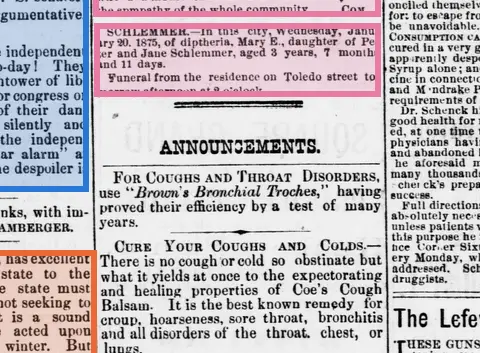
snewpapers
nothingAmerican Stories
ANNOUNCEMENTS.For COUGHs AND THROAT DISORDERS, use 'Bro,Un's Bronchial Iroches," having proved their efficiency by test of many wears
AS onlycorrectly not servedAS #20 p4-74
- advertisement: The text promotes 'Goes Cough Balsam' as a remedy for coughs and colds, using advertising-style language such as 'CURE Your COUGHS AND Colds' and 'the best known remedy.'
snewpapers
nothingAmerican Stories
CURE Your COUGHS AND Colds There is no cough or cold so obstinate but what it yields at once to the expectorating and healing properties of Goes Cough BaIsam. It is the best known remedy for Group. hoarseness, sore throat, bronchitis and all disorders Of the throat. chest, or lungs.AS onlycorrectly not servedAS #16 p4-75
- advertisement: The text promotes and provides usage instructions for 'Renne's Pain-Killing Magic Oil,' a proprietary remedy, urging readers to keep it on hand—classic patent-medicine advertisement copy.
snewpapers
nothingAmerican Stories
Reader, are you liable to headache !? Then you are interested in knowing what Renne's Pain-Killing Magic Oil, does for Headache. Battle the head freely with Magic Oil, mixed with water, then put little clear on the temples. Take a few drops clear, or on sugar. Use it faithfully aud freely, and it will cure the worst cases in from five to ten minutes. Always keep it in the house.AS onlycorrectly not servedAS #18 p4-76
- advertisement: The text promotes Kidder's Asthma Pastilles with persuasive claims and a price, which is characteristic of a patent-medicine advertisement.
snewpapers
nothingAmerican Stories
KIDDER's AsTHAMA PAsTILEs have, without any putting or extravagant prom Use, quietly worn their way to public favor, and now are afording sure relief to thou sands. Their grateful odor and quick ef- feet render them peculiarly acceptable, as the patient is relieved from the most distressing symptoms while inhaiing "a de lightful perfume Price 40 cents by mail. Stowell Il Co. Charleston. Mass. 1920
AS onlycorrectly not servedAS #69 p4-77
- advertisement: The text promotes Cary's Soluble Ink Powder with pricing and ordering information, characteristic of a commercial advertisement.
snewpapers
nothingAmerican Stories
LOCAL COLUMN.4 One box of Cary's Soluble Ink Powder 1 will make pint Of BEST BLACK INK in five minutes i
Sl.25 v d., Sl.sS by mail. H.Go.cARY zauesyis,O.
AS onlycorrectly not servedAS #80 p4-78
- advertisement: The text promotes a patent medicine ('Constitution Water') with a list of cures, a depot address, price, and sales claim, which is characteristic of a newspaper advertisement.
snewpapers
nothingAmerican Stories
m Drops Of Constitution Water TO THREE TIMES DAYCURES inflammation of the Kidneys. Stone in the Bladder. Catarrh of the Bladder. Diabetes. Gravel, elect. Brick-dust Deposit. For Female Complaints Speciality. Dyspepsia. Torpid Liver, Palpitation of the Heart. Depot, 50 john Street 80. $500. NEW YORK For sale by all first Class Druggists. S-Sd1y
AS onlycorrectly not servedAS #11 p4-79
- advertisement: The text promotes Humphreys' Homeopathic Specific medicine with a price, claimed benefits, and a list of sellers, which are classic advertisement features.
snewpapers
nothingAmerican Stories
Nervous Debility.depressed, irritable state of mind: weak, ner- vous exhausted feeling; no energy or nimation; confused head, weak memory, often with debilita- ting, involuntary discharges. The consequence OF excuses, mental overwork or indiscretions. This NERVOUS DEBILITY finds sovereign cure in HUM PHREY's HOMEOPATHIC SPECIFIC. No %. 1t tones up the system, arrests discharges dspels the men tai gloom and dependency, and reJuvenates the en- tire system. 1t is perfectly harmless and always efficient. Price s., for package of five boxes and large 50 vial of powder, which is important in old. serious cases; 81 per single box. Sold by
ALL Druggists or sent by mail Oh receipt of price Address HUMPHREYS SPECIFIC MEDICINE | CO., No. $50, Broadway, N, Y.
For Sale by Otto Grotjan IS Illinois Street. Bense | g. Thomas Speidel and Breunert, Rock ISLAND | and j Richards, Moline. 34dmwf&w1y
AS onlycorrectly not servedAS #12 p4-80
- advertisement: The text promotes and describes a patent medicine ('Renne's Magic Oil'), listing its uses, warnings against counterfeits, and the manufacturer, which is clearly advertising copy.
snewpapers
nothingAmerican Stories
'It Works like a Charm" RENNE'S EA5N MAGIC OIL ]This Is a remedy every family should have in the house to use in case Of emergency. 1t is purely vegetable, and may be used internally exter- naly 1t is not an oily, sticky substance but clean delicious and sate to use, even in inexperienced hands. AS an external IT medy. when freely used, 1t penetrates through the absorbents to the seat ef pain, causing free circulation and giving to weak ened and over-strained cords and muscles new life and elasticity; it sheaths infamed and bruised faces, and cures pain as water quenches fire. Try it for
WOUNDS, SPRAINs, NEURALGIA SORES, CRICK IN THE BACK, RHEUMATIsM. BUhNs, HEADACHE, STIFF JOINTS or any other kind OF pain or lameness. As an in ternal remedy it operates kind difusIve seda- tve it tones and corrects The stomach, aids diges-
ion and readily cures
Colo, CRAMPS. COUGHs.
CHOLERA MoRBUs, INDIGESTION, SORE THROAT and in fact all aches and pains that flesh IL heir to.
The immediate and faithful use of Renne's Pam
Killing Magic Oil In case of emergency will often save life. or long and tedious sickness. The genuine Renne's Magic Oil is put up only in panel bottles, with the blown in the glass; and up on the bottle finely engraved steel plate label, upon which is the likeness of VIM. Renne. All
other Magic Oils are counterfeit, or worthless imi tStions. Call for hennes Magic Oil, where you
usually trade. 1t is put up in three sizes: Trial, Medium and Large size. WILLIAM RENNE | & SONS, Sole Proprietors and Manufacturers Pittsfeld, Mass. 10-13d&w1y
AS onlycorrectly not servedAS #4 p4-81
- advertisement: It promotes Dr. Schenck's medicines (Pulmonic Syrup, Sea Weed Tonic, Mandrake Pills), describing their curative powers and where to buy them, which is characteristic of a patent-medicine advertisement.
snewpapers
nothingAmerican Stories
SCHENCKs PULMoNIC SYRUP, SEA WEED Tonic AND MANDRAKE PILLs.-These deservedly celebra-ed and popular medicines have effected a revolu ton in the healing art and proved the fallacv of severaI maxims which have for manv wears OBJ structed the progress of medical science. The false superstition that consumption is incurable" de- tered physicians from attem4 ting to find remedies for that disease, and patients afflicted with it rec oneiled themselves to death without making an Of for: to escape from doom which they supposed to be unavoidable. 1t is now proved, however that CONSUMPTION CAN BE CURED and that 1t HAS BEEN cured in very great number of cases( some of them apparently desperate on, s. BY Schenek's Pulmonic Syrup alone; and in other cases by the same medi- cine in connection with Schenek's Sea Weed Tonic and NJ ndrake Pills, one or both, according to the requirements of the case.
Dr. Schenck himself, who enjoyed uninterrupted good health for more than forty years. was suppos-
ed, at time TO be al the very gate of death, his physicians having pronounced his case hopeless. and abandoned him to his fate. He was cured by he aforesaid medicines, and since his recovery, many thousands similarly affected have used DR.. chez cks preparations with he same remarkable success.
Full directions accompany each, making it moi
abs olute1y necessary to personally see DR. Schemes
unless patients wish their lungs examined, and fol
this purpose he is profes iona y at his principal Of nee Corner Sixth and Arch Sts,, Philadelphia, ev cry Monday, where all letters for advice must be | addressed. Schenck's medicines are sold by al | druggists.